Guy Thomas

306 posts

Guy Thomas banner
Guy Thomas

Guy Thomas

@guy_thomas

Actuary and investor.

UK شامل ہوئے Mart 2011
27 فالونگ729 فالوورز
Guy Thomas
Guy Thomas@guy_thomas·
Cash offer today for Just Group, 75% above yesterday’s closing price 😍 My Annals of Actuarial Science papers on NNEG are now market consistent 🤣 Long-term option pricing with a lower reflecting barrier doi.org/10.1017/S17484…
English
0
0
2
149
Lyall Taylor
Lyall Taylor@LT3000Lyall·
I've gone through a bit of an evolution in my belief (or lack thereof) in the "power of reason" (logical argumentation/persuasion). *Earlier in life I naively believed that if you presented a powerful, airtight argument, people would be compelled to instantly agree with you. After all, if your facts and reasoning are impeccable, on what basis could someone reasonably disagree? *Later in life, after many bouts/encounters of head-banging stupidity (reinforced by the inane woke era we just lived through), I had a "crisis of confidence" in the power of reason. I came to believe that most people are emotional, parochial, and simply believe what they want to believe. I came to believe there is no point trying to convince most people of anything, particularly if you have an unintuitive perspective because you will inevitably simply be misunderstood and attacked. This is one of several reasons I stopped blogging/tweeting for a while. But I swung too far in the opposite direction. *Where I've come to now is that the truth is somewhere in the middle. One should still have faith in the power of reason, but have *modest expectations* about how much you can reasonably expect to change someone's opinion and how quickly. The best that you can reasonably hope for is to *nudge* someone in a particular direction. The resultant change might be imperceptible to you. However, repeated *nudges* over a long period of time do add up, and eventually people do change their minds. It just takes them a long time. In short, I went from expecting I could flip someone's view from 0 to 100 overnight, to thinking they would stay at 0 no matter how many facts and compelling arguments I impaled them with. Now I think hard-hitting reason can get people from perhaps 0 to 1. Maybe a few months latter, something takes them from 1 to 2. And then something else from 2 to 3. It might take them a decade but people can and do eventually change their views. It is often as slow as aging in the mirror that they barely even realize they changed their view, until they look back at old photos ("beliefs") and say, huh, guess I've changed a lot. And when you think about it, that makes sense. When you have a debate/disagreement with someone, you are talking to someone that has spent perhaps 40 years assembling a vast complexity of neural connections in their brain that leads them to their current conclusion/way of seeing things, and the idea you can instantly rewire it through 10 minutes of rational genius is absurd. But our brains never stop rewiring themselves and are receptive to new stimuli. A separate question is, is it worth trying to do? Sometimes yes, sometimes no. Given the return on effort it so low, you might say why bother. But most things of value/importance in life are built incrementally, not overnight. Reasoning sometimes seems fruitless, and yet whole societies can and have changed their politics - look at the dramatic political swings that can happen decade to decade. Reason (plus people's reflections on and responses to lived experience, which is a form of reason) works, it just works slowly. You need to plant seeds of doubt and wait for real world confirmatory events to fertilize those seeds in their lives. I have concluded that it is worth doing when it matters. Why? We live (mostly) in democracies, and so what other people think (and vote for) matters and can impact your future quality of life, freedoms and economic and other security. And even in non-democratic states, what other people believe often matters a great deal to you. But if it is fringe idiocy that has no power or impact on you - for eg the flat earth society - it should just be ignored. When it comes to woke idiocy and left-wing extremism for instance, that at scale threatens to undermine Western liberal democratic values, freedom of speech, etc, it wouldn't matter if those views are only held by a radical minority that has no power. Twain's admonition about arguing with idiots should be observed. However, if a dangerous ideology goes mainstream and/or starts inflicting policies, mainstream media & education/institutions etc, that is a different matter. It is worth fighting, at least if the personal costs of doing so are not too high, because it matters *and* reason is not totally futile. If the personal costs become high/risks elevated, however, its a different matter. Societies sometimes do reach that level of oppression, and woke repression also cost a lot of people their jobs, as well as no doubt resulted in many false convictions/public prosecutions for fabricated sexual offenses. In this situation you have two choices (besides biting your tongue and quietly suffering your fate): fight or leave. Leaving is the easier (and perhaps wiser from a selfish perspective) option if you have somewhere better to go. Fight from a safe distance, if you still care, but otherwise leave them to burn their own house down. One of the reasons I moved to Singapore instead of back home was I couldn't be fucked with the woke nonsense (also tax lbh, but not just the rates - also how it was being spent). Leaving is less noble but more pragmatic. But the progress of human civilization has depended on people more noble and courageous than that, and the fact that reason ultimately works - sort of.
English
12
13
102
10.2K
Guy Thomas
Guy Thomas@guy_thomas·
@AAGresearch 3. Even less obvious, but again, Wikipedia!) Miss Russia did win in 2002, but she was dethroned for bad behaviour.
English
0
0
1
14
Guy Thomas
Guy Thomas@guy_thomas·
@AAGresearch 1. (Obvious) For more than half the history of the title, these countries did not exist (the land they cover was the USSR). 2. (Less obvious, but see Wikipedia) To gain entry to the title, someone in the country has to pay a franchise fee. Nobody in the USSR could do that.
English
1
0
2
32
Alberto Alvarez
Alberto Alvarez@AAGresearch·
List of countries by Miss Universe titleholders. Genuine question: Why isn´t Russia or Ukraine on the list?
Alberto Alvarez tweet media
English
3
0
1
1.2K
Guy Thomas
Guy Thomas@guy_thomas·
Paul Scott’s Smallcap Value Report moves to Substack @paulypilot" target="_blank" rel="nofollow noopener">substack.com/@paulypilot I read this every day. If you invest in UK small caps, so should you.
English
0
0
2
162
Guy Thomas ری ٹویٹ کیا
TheGladiator
TheGladiator@TheGladiatorHC·
I’ve read the book 'Free Capital: How 12 private investors made millions in the stock market' by @guy_thomas There are a few similarities that most of these investors seem to share which I wanted to briefly explore. - They all had different investing strategies, but they all not only focused on how much money they could make, they focused on how much they could lose. Even though there are many ways to make money, there are a few main ways you can lose money. - Most of the investors made a conscious call early in their lives to live within or below their means. Other than home loans they had very little debt. This allowed them to become full time investors quicker as they didn't have to make large sums of money to fund their lifestyle. - Most of the investors started full time investing later in life. They worked through their 20s and 30s while learning how to invest on the side. This allowed them to continue to learn from their mistakes and improve while their jobs paid the bills. - They majority of the investors didn't grow up always wanting to be investors. Their negative experiences in the corporate world drove them to focus more and more of their time on tightening their investing skills, rather than trying to climb the corporate ladder. - Most of the investors understood that luck had a role to play in their success. This allowed them, in my view, to keep their profits in the long term. Humility was definitely a factor for pretty much all of the 12 investors. - By keeping their losses small, it was really a few big winners that made the majority of their money. This just goes to show that a few stocks can really make your year or even decade. By focusing on limiting losses, they were able to let their winners run. A great book all investors should read.
English
11
9
91
12K
Guy Thomas
Guy Thomas@guy_thomas·
@voltaireisalad Don’t want to write the same book twice. Hope someone else does it. Maybe I will eventually if nobody does...
English
1
0
0
15
Guy Thomas
Guy Thomas@guy_thomas·
REQUEST: Title of a book of reflections / memoir written by a former CEO or non-executive director of small UK quoted companies, published a year or two ago? (I may be hallucinating this. Can’t find on Amazon or ChatGPT.)
English
2
0
0
940
Guy Thomas
Guy Thomas@guy_thomas·
@vodkaquickstep That’s kind of the point. They probably aren’t “my best five”, but there was no point in listing books everyone has read.
English
0
0
2
83
Simon Hedger 🇺🇦
Simon Hedger 🇺🇦@vodkaquickstep·
@guy_thomas I’ve been looking for some book suggestions for my upcoming summer hols so thanks very much as some of these I wasn’t familiar with.
English
1
0
1
193
Guy Thomas
Guy Thomas@guy_thomas·
Statistical fairness trilemma: Any binary predictor applied across two groups with different base rates can satisfy at most two out of the three criteria: – well-calibrated – equal false positive rates – equal false negative rates Full blog: tinyurl.com/2pbjnrzy
English
0
0
0
190
Guy Thomas
Guy Thomas@guy_thomas·
This short review of Free Capital gets it. The book is about life choices and chances. NOT about specific stock-picking methods. (There are lots of other books for that.)
TheGladiator@TheGladiatorHC

I’ve read the book 'Free Capital: How 12 private investors made millions in the stock market' by @guy_thomas. There are a few similarities that most of these investors seem to share which I wanted to briefly explore. They all had different investing strategies, but they all not only focused on how much money they could make, they focused on how much they could lose. Even though there are many ways to make money, there are a few main ways you can lose money. - Most of the investors made a conscious call early in their lives to live within or below their means. Other than home loans they had very little debt. This allowed them to become full time investors quicker as they didn't have to make large sums of money to fund their lifestyle. - Most of the investors started full time investing later in life. They worked through their 20s and 30s while learning how to invest on the side. This allowed them to continue to learn from their mistakes and improve while their jobs paid the bills. - They majority of the investors didn't grow up always wanting to be investors. Their negative experiences in the corporate world drove them to focus more and more of their time on tightening their investing skills, rather than trying to climb the corporate ladder. - Most of the investors understood that luck had a role to play in their success. This allowed them, in my view, to keep their profits in the long term. Humility was definitely a factor for pretty much all of the 12 investors. - By keeping their losses small, it was really a few big winners that made the majority of their money. This just goes to show that a few stocks can really make your year or even decade. By focusing on limiting losses, they were able to let their winners run. A great book all investors should read.

English
0
1
8
3K
Guy Thomas
Guy Thomas@guy_thomas·
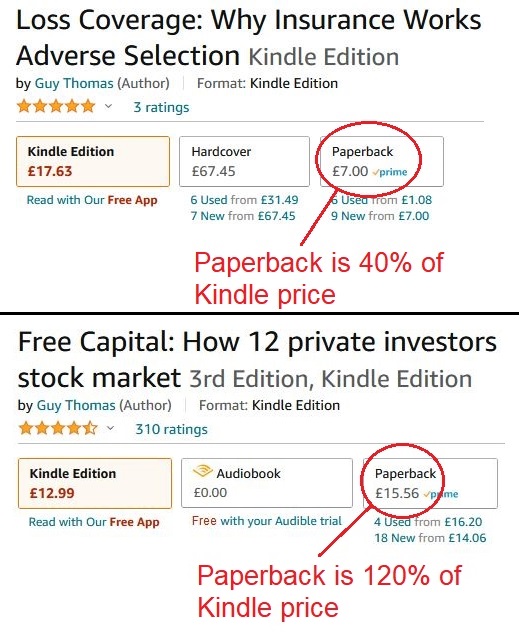
“Loss Coverage” now £7 on Amazon (40% of its Kindle price). Meanwhile “Free Capital” is £15.56 (120% of its Kindle price) The mysteries of price discrimination. The irony is that “Free Capital” is readable on Kindle, but “Loss Coverage” is not (diagrams, maths, footnotes).
Guy Thomas tweet media
English
0
0
1
331