Humanocracy

5.8K posts

Humanocracy banner
Humanocracy

Humanocracy

@hackmanagement

In a world of unrelenting change and unprecedented challenges, we need organizations that are resilient and daring. Available Now!

شامل ہوئے Mart 2010
2.2K فالونگ8.2K فالوورز
Humanocracy ری ٹویٹ کیا
Michele Zanini
Michele Zanini@MicheleZanini·
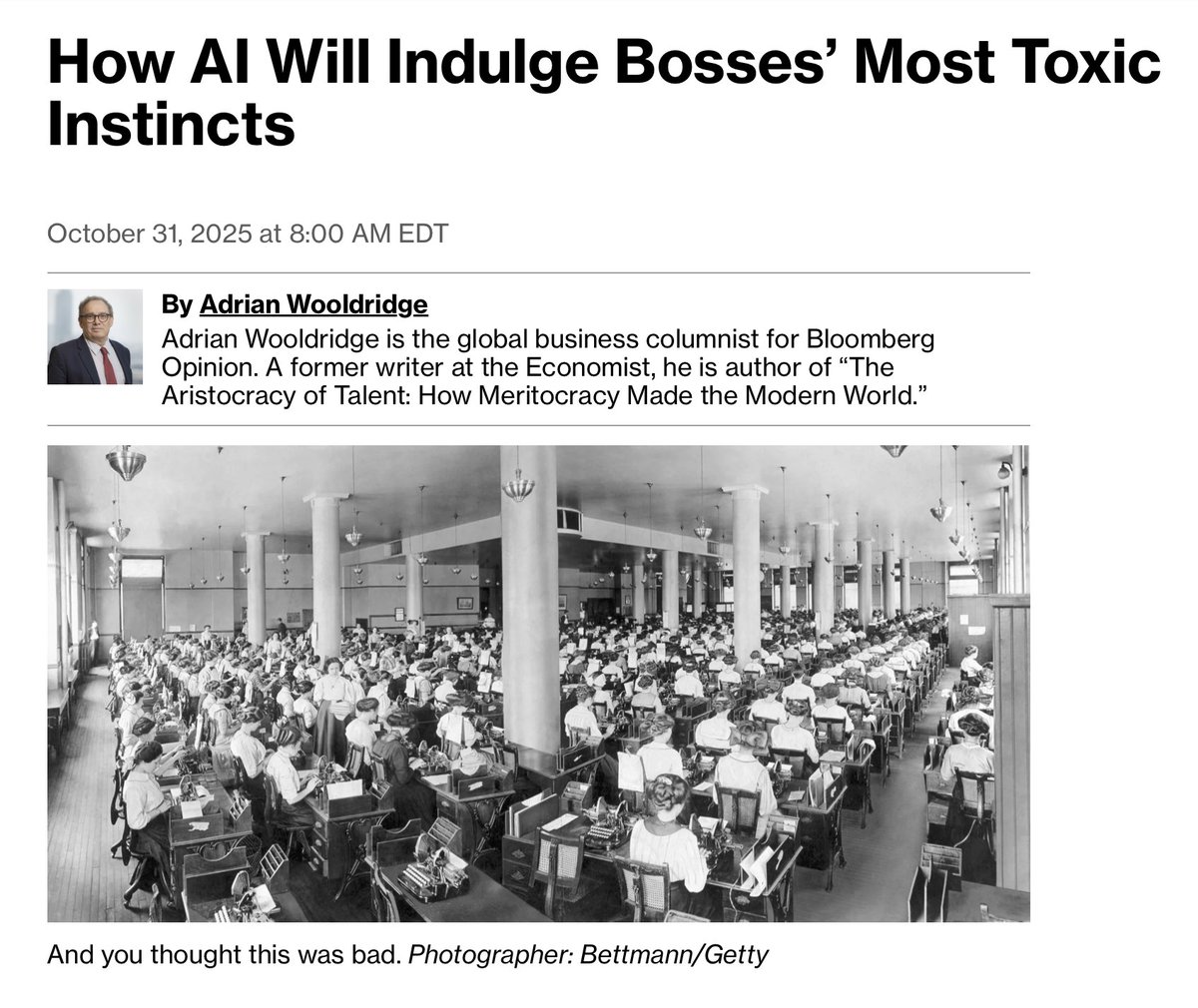
@adwooldridge has a sharp column in @opinion on how companies are deploying AI. His core question: Will we use AI to increase the power of managers or liberate front-line workers? Adrian suspects most companies will go for the former -- and that's a bad thing. Based on some early evidence, he's right to worry. Amazon tracks warehouse workers' bathroom breaks. Algorithms determine fast-food schedules. JPMorgan uses AI to write performance reviews. Companies measure keystrokes per minute and analyze how "collegial" you are in Zoom calls. Workers find it galling: algorithms know everything about them, but they know nothing about the algorithms. This is digital Taylorism—using AI to divide work into identical units, monitor every movement, and eliminate surplus workers. Companies are choosing this path because it offers a quick short-term boost: cut headcount, monitor slackers, measure precise contributions. But if we deploy AI using industrial-era management assumptions, we won't get the sustained performance improvement that comes from unleashing the initiative and ingenuity of people at work. We've seen this movie before. In the early 2000s, everyone predicted the web would democratize information and flatten hierarchies. Prediction markets, crowdsourcing, and open innovation were going to transform decision-making by tapping collective intelligence. Very little of it happened. By some metrics, the opposite happened in fact: the number of managers and administrators more than doubled between 1983 and 2024, while employment in all other occupations grew by just 40 percent. And despite trillions in investment—global IT spending jumped from $2.6 trillion to $3.8 trillion between 2003 and 2023—productivity growth averaged just 1.7 percent annually over the past decade, substantially lower than the long-term average. Technology alone doesn't make organizations better. Unless we rethink how we lead, manage, and organize, AI will be more money poured into the same broken system. Thanks Adrian for the shout-out!
Michele Zanini tweet media
English
2
1
2
125
Humanocracy ری ٹویٹ کیا
Michele Zanini
Michele Zanini@MicheleZanini·
Great piece on @CNBC on what's happening at @Bayer . Most companies in the "Great Flattening" are just cutting middle managers and calling it done. (most likely these layers will grow back within a few years--so it's a bit like mowing the lawn.) Bayer is instead reimagining how 90,000 people actually work. They've organized around thousands of mission teams that operate like mini-startups working in 90-day sprints. When one team set out to turn prostate cancer drug Nubeqa into a blockbuster, they assembled a campaign in 90 days without a gauntlet of sign-offs, helping to push the drug past $1 billion in U.S. sales five months ahead of schedule. I appreciate @AimeeGroth for letting me share some thoughts on what this means for companies that actually want to build vitality by busting bureaucracy--for real!
CNBC Make It@CNBCMakeIt

This CEO’s radical experiment has 90,000 people working without bosses: ‘I don’t have to consult with anybody’ cnbc.com/2025/10/23/gre…

English
0
1
2
295
Humanocracy ری ٹویٹ کیا
Michele Zanini
Michele Zanini@MicheleZanini·
So great to talk with @ericries how to build companies that are more entrepreneurial and innovative at their core. The key is a radical reimagining of how they're led, managed, and organized. In the age of upheaval, tweaks to the industrial-era template just won't cut it. Thanks for the insightful conversation, Eric!
Eric Ries@ericries

Bureaucracy was once a breakthrough. Today, it’s become a costly drag on innovation, human potential, and business impact. In this episode of The Eric Ries Show, I sit down with @profhamel and @MicheleZanini, authors of Humanocracy, to explore how organizations can move beyond outdated management models and unlock true human thriving. Hamel and Zanini have spent years researching and advising some of the world’s most forward-thinking companies. Together, we make the case for replacing top-down control with systems that maximize contribution, creativity, and ownership at every level. We dive into how to rethink management from first principles, why employee engagement is at historic lows, and what leaders can do to build organizations that unlock the full potential of their people.

English
0
2
1
231
Humanocracy ری ٹویٹ کیا
Gary Hamel
Gary Hamel@profhamel·
Come join the conversation! On Monday, September 29, at 12 pm ET, Harvard Business Review will be hosting a live webinar with the authors of "HUMANOCRACY: Expanded and Updated"--that's Michele Zanini and me! We'll be sharing our latest data-based insights on what can be done to build organizations that are as daring and dynamic as the times demand. You can register here:  s.hbr.org/3VkL5me. Hope to see you there!
English
0
4
15
1.4K
Humanocracy ری ٹویٹ کیا
Michele Zanini
Michele Zanini@MicheleZanini·
With humanity facing an unprecedented array of challenges, we can no longer afford to pour vast quantities of initiative and ingenuity down the bureaucratic drain hole. In this excerpt from the new edition of Humanocracy, we lay out the social case for radically reimagining how organizations work. hbr.org/2025/09/the-so…
English
0
3
7
218
Humanocracy ری ٹویٹ کیا
Harvard Business Review
Harvard Business Review@HarvardBiz·
Now more than ever, we need organizations that are daring, resilient, and creative. In “Humanocracy,” @profhamel and @MicheleZanini make a passionate, data-driven argument for uninstalling bureaucracy and reinventing management as we know it. In this extensively updated and expanded edition, readers will find new and compelling case studies, the latest research findings, and a wealth of fresh and provocative insights. Order your copy today: mybook.to/humanocracy
Harvard Business Review tweet media
English
4
9
25
24.1K
Humanocracy ری ٹویٹ کیا
Michele Zanini
Michele Zanini@MicheleZanini·
Five years ago, @profhamel and I wrote Humanocracy for everyone--from interns to board members--who dream of a world in which organizations serve human beings rather than the other way around. Today, we’re excited to announce that Humanocracy’s updated and expanded edition is officially available! In it you’ll will compelling new case studies, the latest research findings, and a wealth of fresh and provocative insights. To tackle the challenges that lie in front of us we need organizations that unleash the initiative and ingenuity of everyone at work. If that’s the sort of organization you want to work for, we invite you to start right here, right now, with the brand new edition of Humanocracy. Get a copy at any major bookseller (links below) Amazon: amazon.com/Humanocracy-Re… Barnes & Noble: barnesandnoble.com/w/humanocracy-… Indiebound: bookshop.org/p/books/humano… Booksamillion: booksamillion.com/p/Humanocracy-…
Michele Zanini tweet media
English
1
4
19
14.5K
Humanocracy ری ٹویٹ کیا
Michele Zanini
Michele Zanini@MicheleZanini·
Looking forward to reading Dan's book, but I tend to agree with you. In many prominent US and European organizations, power has shifted to the "suits"—the taskmasters, controllers, accountants, and analysts charged with maximizing control, alignment, and efficiency. Layer by layer, policy by policy, bureaucrats seize the high ground. See what happened at Intel, Boeing, and many others. I've done a fair amount of research at Haier, the world's largest appliance maker based in Qingdao (they own GE appliances in the US). The biggest difference between them and their Western competitors lies in their management philosophy--one that prizes distributed entrepreneurship (they deliberately try to operate as a collection of startups) and keeps management layers and staff functions to a bare minimum. No doubt legalism and regulation plays a role in institutional sclerosis, but organizations have a choice (see Tesla vs. every other automaker). And most incumbents opted for stasis.
Michele Zanini tweet media
English
0
1
1
114
Humanocracy ری ٹویٹ کیا
Michele Zanini
Michele Zanini@MicheleZanini·
The REAL reason why the Death Star blew up. Check out the first episode of what I hope will be a long-running series! #management #humanocracy #starwars
English
0
3
6
241
Humanocracy ری ٹویٹ کیا
Michele Zanini
Michele Zanini@MicheleZanini·
The burden is getting worse. For instance, federal rules affecting research have multiplied 9x over the last two decades. At agencies like @NIH, administrative and managerial ranks have grown far faster than scientific roles or research funding. 3/10
Michele Zanini tweet media
English
1
1
1
64
Humanocracy ری ٹویٹ کیا
Michele Zanini
Michele Zanini@MicheleZanini·
American science is drowning in red tape. My new @scientistsorg Day One memo has a plan to fix it. A 🧵on cutting the bureaucratic tax on the $100+ billion in scientific research conducted by U.S. universities each year. fas.org/publication/me… 1/10
English
1
3
3
364
Humanocracy ری ٹویٹ کیا
Michele Zanini
Michele Zanini@MicheleZanini·
Flattening organizations is everywhere in the news, but it's usually just cost-cutting dressed up as transformation. As Bill Anderson, CEO of @Bayer, said in an interview published by @dealbook, that approach misses the point entirely. "Most corporate change programs take out heads but not the work," Anderson explained. "They eliminate a layer — usually just one — and leave everything else the same. People are back two years later because the work still has to get done." Bayer's taking a different approach. They eliminated five layers of management and pushed average span of control from 5 direct reports to nearly 15. When you're responsible for that many people, you can't micromanage anymore. You have to become more of a mentor and coach instead of a controller. Anderson and colleagues are also reimagining core processes like resource allocation. Bayer's annual budget process has been scrapped. Instead of spending months on bureaucratic planning, teams now spend one day every 90 days asking: How did we do? What's next? Who do we need? Then they work for 89 days. When Bayer's contraception team needed to win back a major client, they made all the resource decisions themselves—brought in specialists, added medical liaisons—without going up through management layers. The company's also overhauling HR systems, moving to peer-based performance reviews and scrapping hierarchy-based job grading. 👉 The lesson: to bust bureaucracy, you need to be bold enough to imagine radical alternatives and systematic enough to change all aspects of work—hierarchy, processes, and decision rights together. Link to the piece below. Great reporting by @AimeeGroth!
English
5
6
17
2.6K
Humanocracy ری ٹویٹ کیا
Gary Hamel
Gary Hamel@profhamel·
It was a pleasure to chat with @Gallup's Global Practice Leader for Leadership Development, Vibhas Ratanjee. Here's what we talked about: forbes.com/sites/vibhasra…
English
1
3
17
1.2K
Humanocracy ری ٹویٹ کیا
Michele Zanini
Michele Zanini@MicheleZanini·
A highly under-rated point when it comes to debates around "state capacity," IMO
Michele Zanini tweet media
English
1
1
2
204
Humanocracy ری ٹویٹ کیا
Michele Zanini
Michele Zanini@MicheleZanini·
America needs a federal government that's better, not just smaller. DOGE mostly failed at both tasks. In this @ProSyn essay, Gary Hamel and I describe how to create a federal government that's bold, entrepreneurial and fast. Here's our roadmap: 1️⃣ Cut administrative bloat - Eliminate the endless box-ticking and redundant reviews that waste time and money. 2️⃣ Shrink managerial ranks - Reduce management positions by more than half to match the Clinton-Gore reform proposals from 30 years ago 3️⃣ Pursue moonshot goals - Set ambitious targets across all agencies, and give teams freedom to innovate. 4️⃣ Turn agencies into laboratories - Allow unprecedented experimentation across all departments. 5️⃣ Measure real-world impact - Link funding directly to measurable performance outcomes. 6️⃣ Listen to front line employees - Make every federal appointee spend 100 days asking "What slows you down?" and "What stifles your creativity?" The CDC once eliminated smallpox with 1,000 people. NASA reached space 30 months after being created. We've done it before. We can do it again. project-syndicate.org/commentary/gut…
English
0
3
8
2.1K