Open Source GPU text rasterization update:
Recently, Eric Lengyel dedicated his patent on the Slug algorithm to the public domain and released Slug's shaders as Open Source software.
I am happy to announce that GLyphy now implements the Slug algorithm:
github.com/behdad/glyphy
Since HarfBuzz is an essential component of proper Open Source (and other) text rendering, clients can benefit from the new `hb-raster` library to address both of these issues with little cost. End of 🧵.
2. Before `hb-raster`, rendering COLRv1 fonts was not possible without whipping up your own renderer, or pull in Cairo or Skia, both of which are otherwise unnecessary for many clients. `hb-raster` renders COLRv1 and SVG color fonts natively, & soon bitmap-based color-fonts too.
HarfBuzz 13 ships with the new `hb-raster` library among other features. You might ask why yet another Open Source rasterizer when there are many high-quality ones available.
`hb-raster` fills two gaps in the Open Source font rasterization scene: 🧵
Calling on all downstream projects (browsers, Linux distros, etc) to share their thoughts on AI contribution policy for HarfBuzz:
github.com/harfbuzz/harfb…
HarfBuzz 13.0.0 released with new experimental features: `hb-vector` for vector output of glyph outlines to SVG and `hb-raster` for rasterizing glyphs to A8 / BGRA32 images, among other features:
github.com/harfbuzz/harfb…
A wave of manic energy in December had me put together a long deck called "HarfBuzz at 20! " , celebrating 20 years of @HarfBuzz. 🎂
I designed the deck to be presented at the #WebEnginesHackfest later this year. Then reality hit that I cannot present this deck in any sane amount of time.
Inspired by all the great presentations coming out of #FOSDEM today, I decided that instead of tossing the deck out, I just put it out here to be read by the curious. I will present a highly condensed version at the hackfest in June.
Let me know what you think. 🙏
docs.google.com/presentation/d…
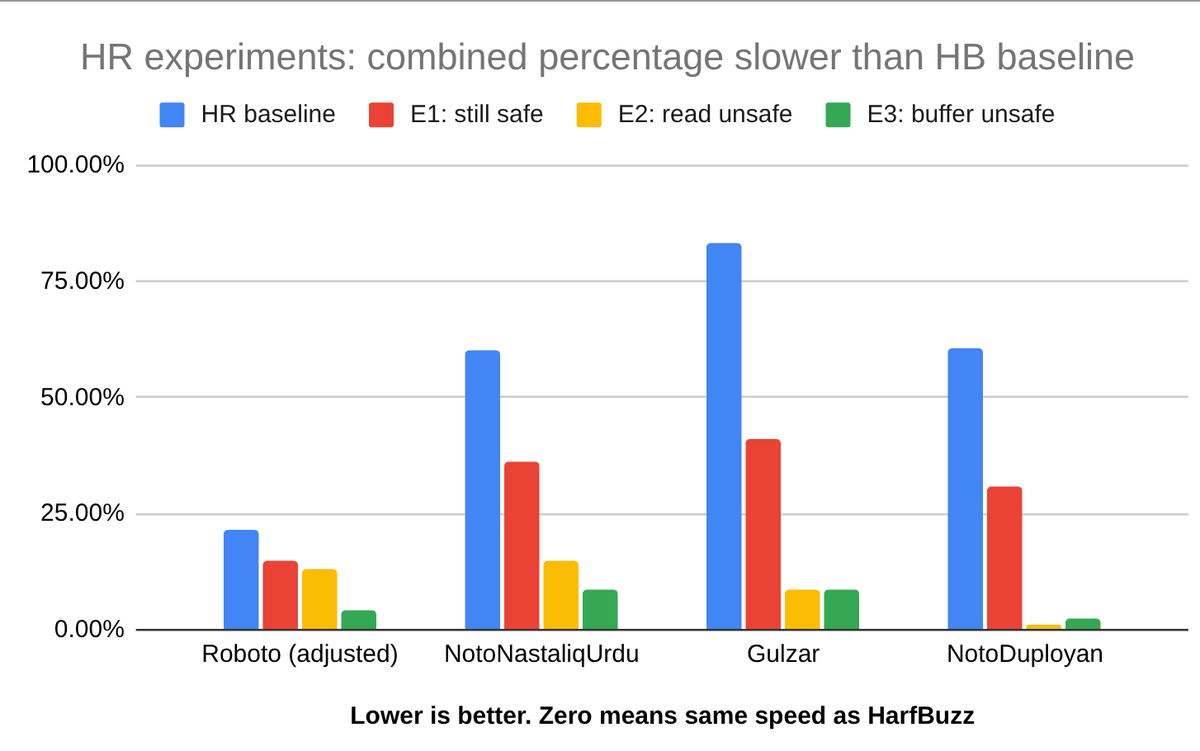
I have an update about experimental HarfRust performance that I like to share:
"To beat @HarfBuzz with #HarfRust" docs.google.com/document/d/1Lj…
TL;DR:
Previous performance comparisons of HarfRust to HarfBuzz were flawed in that the HarfBuzz code tested had assert statements enabled. This skewed the numbers in favor of HarfRust. Moreover, since the last measurements in September 2025, both HarfBuzz & HarfRust got faster, but at a rate that made HarfRust fall further behind HarfBuzz in comparison.
In this work, proof-of-concept unsafe patch to font-codegen & read-fonts as well as removing bounds-checking from HarfRust buffer type show massive speedup benchmarks: from being 20% to 80% slower, down to being less than 10% slower.
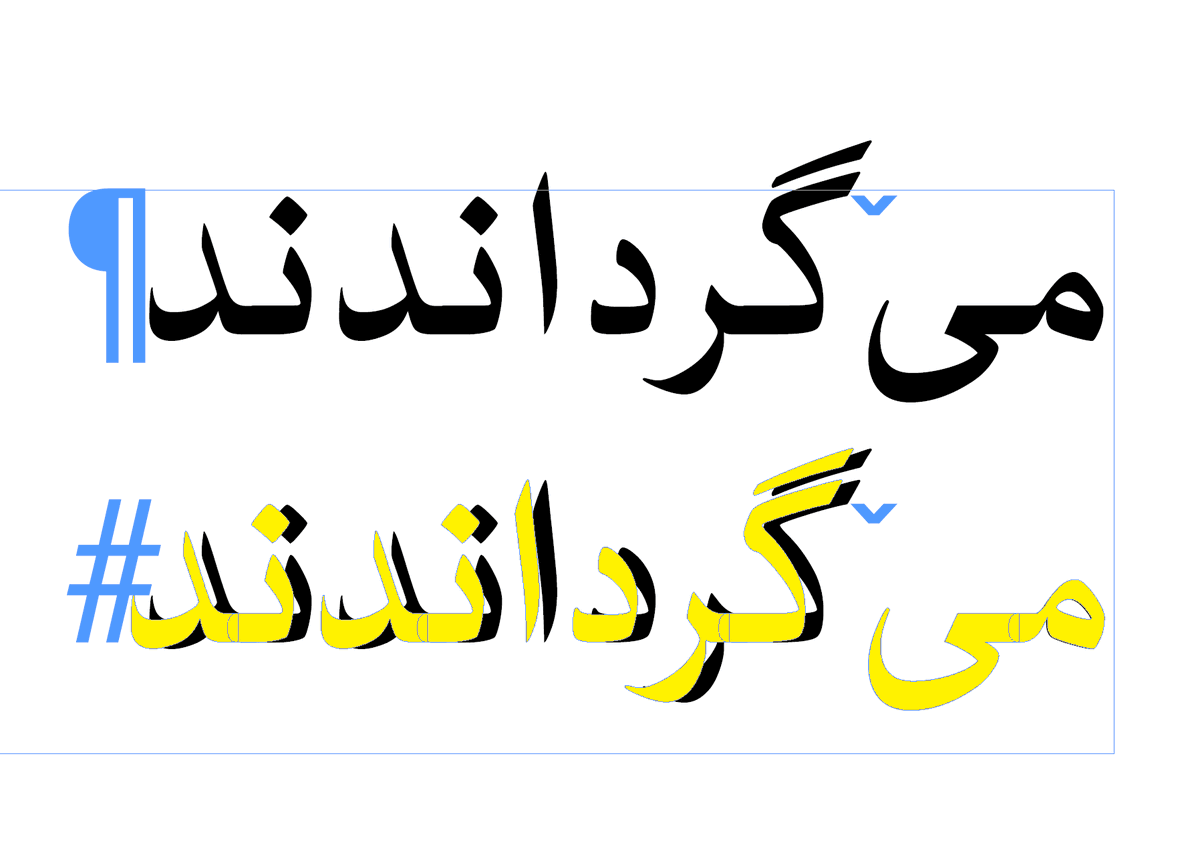
این موضوع باعث میشه وقتی نسخههای مختلف رو اعمال کنی صفحهآرایی تغییر کند آیا این از حرفباز است یا مشکل ایندیزاین؟ مثلاً در عکس پیوست بین ی و گ کرنینگ است در عین حال zwnj هم هست در حالت قبل ایندیزاین کرنینگ را کنار میگذاشت ولی حالا اعمال میکند و کلمه تغییر میکند.
ای @harfbuzz من نتوانستم در گیتهاب بنویسم. حالا اینجا میپرسم در ایندیزاین از وقتی #حرفباز استفاده میشود اگر بین دو حرف کاراکتر zwnj درج کنی و در فونت بین آن دو کاراکتر یک ویژگی مثلا کرنینگ به کار رفته باشد آن موضوع اعمال میشود در حالی که قبلا نمیشد. حالا ...
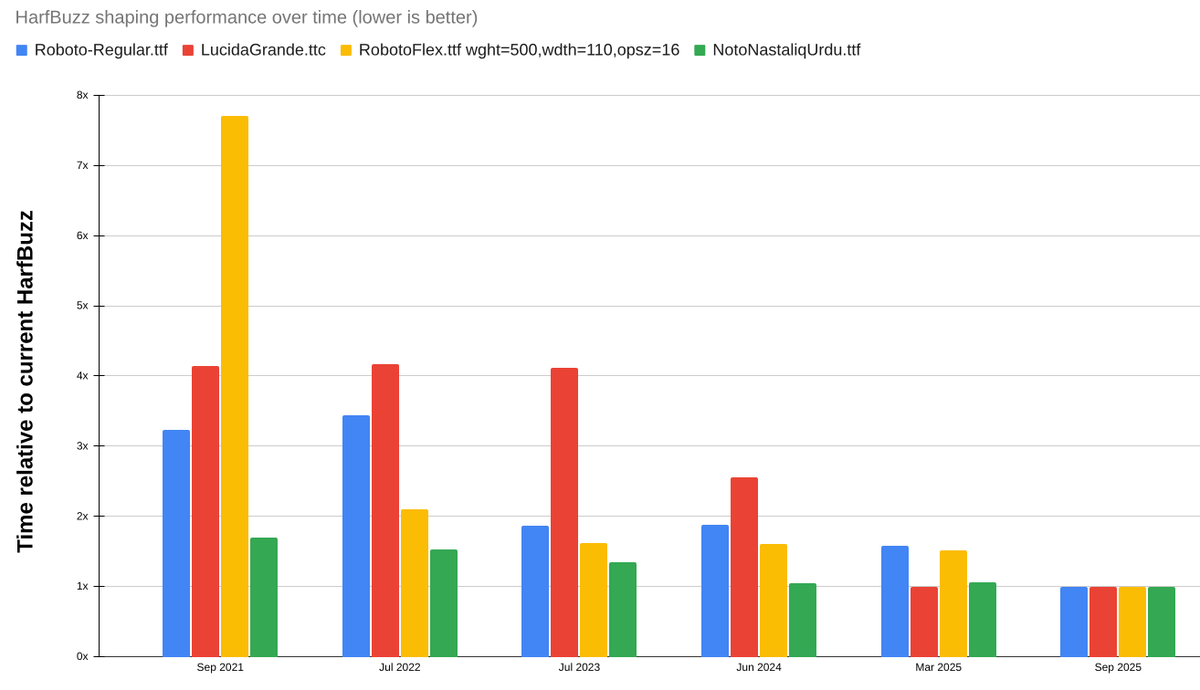
In June, we announced HarfRust, a fully safe port of @HarfBuzz to Rust. At that time, HarfRust was 2x to 4x slower than HarfBuzz for a variety of benchmarks, so we have been working on addressing that.
Today, Chad Brokaw and I are pleased to present HarfRust 0.2.0, which is less than 25% slower than HarfBuzz, on both OpenType and AAT shaping benchmarks. We have also addressed all known correctness issues.
Charts:
docs.google.com/spreadsheets/d…
On reddit @TheRealPomax asked what the biggest WTF moments of @harfbuzz development were for me. Here's my answer, a 🧵:
I'll get to the biggest WTF at the end, but first I want to provide multiple opportunity-meets-luck moments of development & adoption: