Evan Ng
396 posts


Evan Ng
@helloevan61
Legacy Entity at @gensynai OG Advocate at @AlloraNetwork
شامل ہوئے Haziran 2021
1.3K فالونگ440 فالوورز
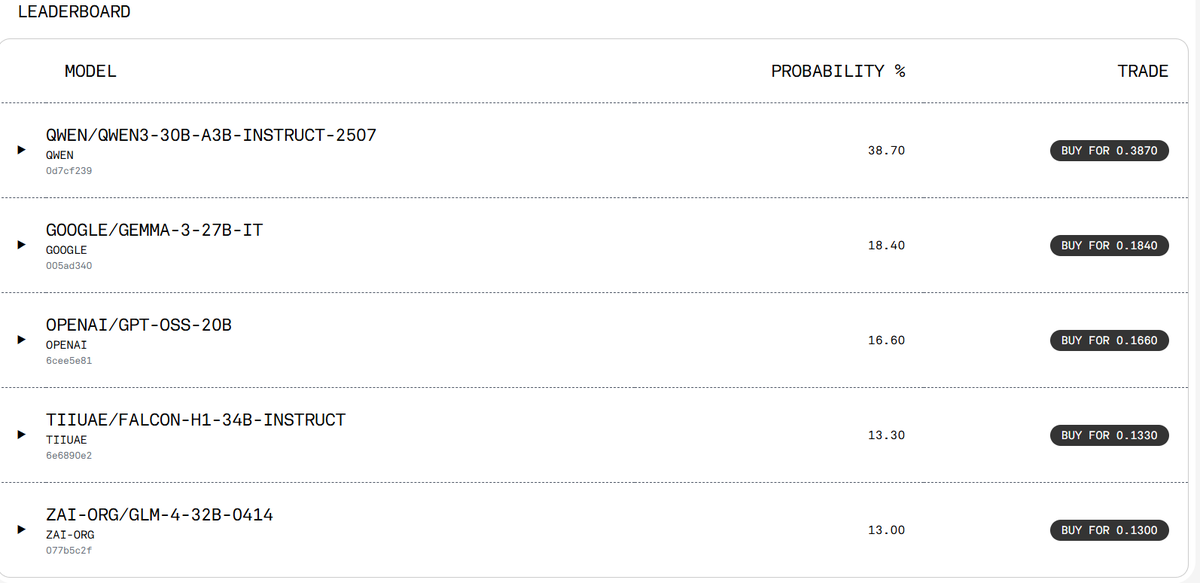

Delphi: a prediction market for Machine Intelligence
@gensyn has introduced Delphi, a groundbreaking system that transforms how we evaluate and invest in machine intelligence. Instead of relying on hype, closed-door benchmarks, or subjective claims, Delphi creates a live, transparent market where open-source models compete on measurable performance.
At its core, Delphi continuously runs real ML models on real benchmarks. Their performance updates in real time, creating a dynamic leaderboard that anyone can observe. But the truly innovative part is the market layer: users can buy into models they believe will perform well, and the market price reflects collective confidence in each model’s technical merits.
This shifts focus away from companies and personalities and toward raw, verifiable model performance. As the ecosystem grows, Delphi will also allow users to submit their own models, create custom benchmarks, and launch new intelligence markets.
In short, Delphi is redefining how we measure progress in open-source machine learning — bringing transparency, incentives, and continuous evaluation to the forefront.
blog.gensyn.ai/introducing-de…
English
Already bought the first stake in Delphi.
Delphi is @gensynai 's prediction market for machine intelligence. You can purchase stake in markets where various large language models (LLMs) are assessed based on performance, creating a market-based indicator of model effectiveness.

English

This guide helps you connect your VPS with Termius, so you can check your running session on both PC & mobile.
The minimum requirements to run @gensynai node:
- CPU (arm64 or x86 CPU with a minimum of 32GB RAM (note that if you run other applications during training it might crash the training)
- GPU (RTX 3090, RTX 4090, RTX 5090, A100, H100)

English



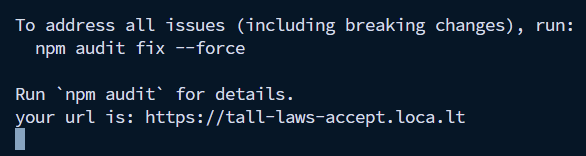
6. Login localhost with your email
- Open new new terminal and run the cmd below
apt install npm && npm install -g localtunnel && lt --port 3000
(password is your IP address)
- Type 'N' when it prompts 'Would you like to push models you train in the RL swarm to the Hugging Face?"
- Then Enter

English
4. Broader Implications & Vision
- CodeZero shows how machine intelligence can evolve via social-style learning: agents don’t just passively consume data but actively participate in problem generation, peer evaluation, and iterative improvement. That hints at a future of more autonomous, flexible, and general-purpose AI systems.
- By building on decentralized, permissionless infrastructure, it lowers the barrier for global participation in AI training — potentially democratizing model development, avoiding reliance on centralized data centers.
- Coding is particularly well suited for this approach: code is structured, verifiable, and each iteration produces interpretable feedback. That makes it an ideal domain for multi-agent learning experiments and gradual scaling toward more complex collaborative tasks.
English
3. What Makes CodeZero Different / Interesting
- Decentralization + Peer-to-Peer RL — CodeZero runs on the same infrastructure as RL-Swarm (peer-to-peer network, distributed orchestration, shared identity) which means anyone with compatible hardware can join the swarm.
- Model-based, non-execution evaluation — to avoid risks associated with running arbitrary code across a network, CodeZero uses a frozen model to evaluate code submissions (checking structure, formatting, apparent correctness) rather than executing them. This enables scalability and safety while still providing a meaningful reward signal.
- Dynamic difficulty & emergent collaboration — because proposers adjust problem difficulty based on solver performance, and solvers share rollouts among themselves, the system can self-tune to gradually push itself to harder problems. Over time, the swarm becomes collectively more capable at coding tasks.
- From isolated models → living ecosystems of agents — unlike traditional ML training where models are trained in isolation, CodeZero envisions a future where many agents continuously generate new tasks, solve them, critique each other, and evolve together.
English