

j_simon
3.2K posts

j_simon
@j_simon
thinking about knowledge management @knowcenter, student of Software Developement at TU Graz, mobile devices (iPhone :P) and web 2.0 geek
47.068424,15.448110 شامل ہوئے Eylül 2007
1.9K فالونگ1.3K فالوورز

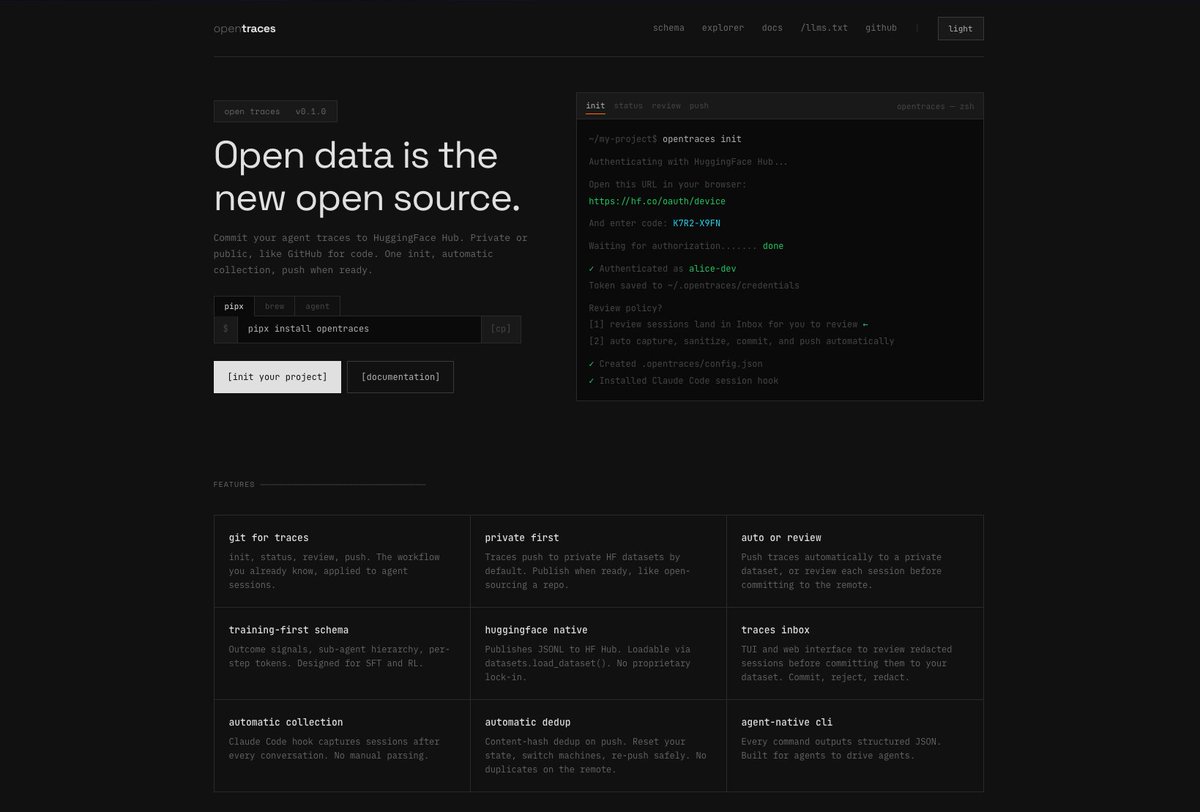
Weekend over. Here’s what I built: opentraces.ai
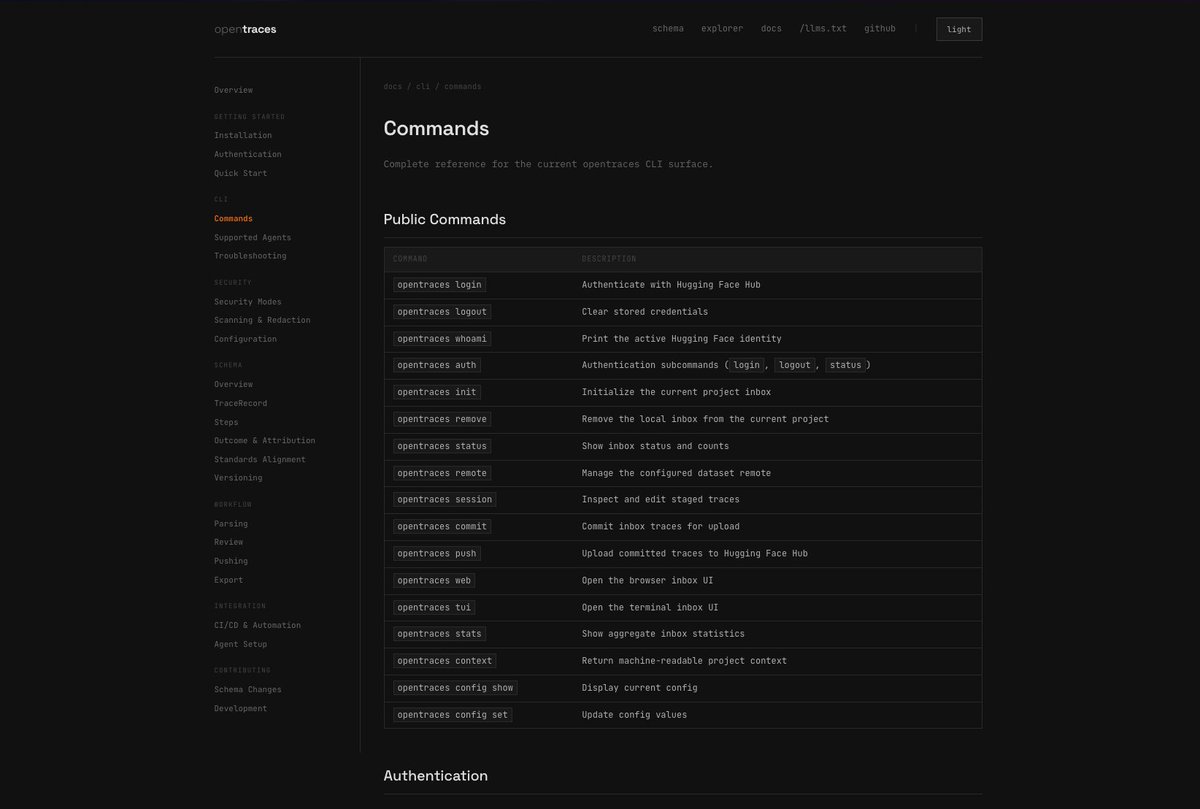
A simple agent-native CLI to parse, sanitise, and commit agent traces to public or private Hugging Face datasets for analytics, evals, and training.
What I focused on:
- a schema that is actually useful for downstream tasks like SFT, RL, Evals, and Analytics (combining standards)
- deterministic trace sanitisation and classification, which also helps reducing token usage if you drive it from an agent
- a HITL review inbox, via web or TUI, to inspect sanitised sessions before they are pushed
The biggest friction with open traces is trust. You need confidence in what you are publishing, especially to public datasets. There is still a lot of room to improve both the workflow and the UX.
Still very much a weekend build, but a fun one.
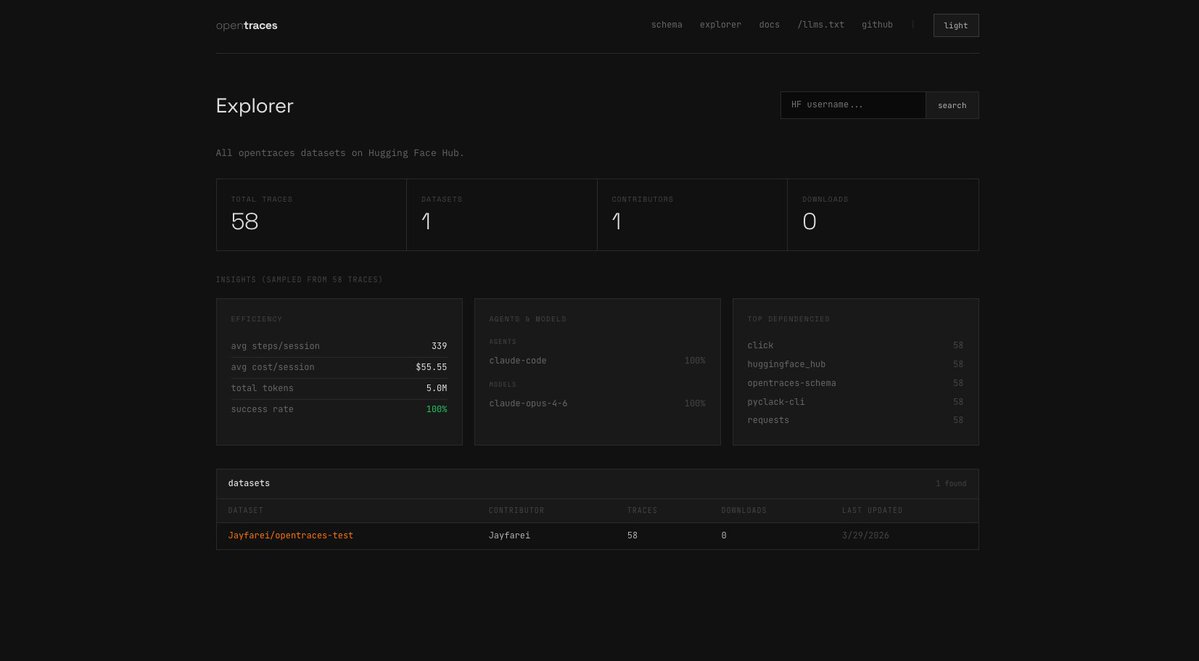
The site also includes a dataset explorer for traces that follow the format. The schema package is on PyPI, and you can already experiment directly through the Hugging Face API with your own client.

Gabriele Farei@jayfarei
Weekend side project: what if every coding agent session you run adds to a private or collective dataset of traces? Imagine git but for agent traces, one command, auto-anonymized, pushed to 🤗@hugginface hub --public or --private 🎯 by Sunday => opentraces.ai 👀 cc @ClementDelangue x.com/ClementDelangu…
English
j_simon ری ٹویٹ کیا

we as software engineers are becoming beholden to a handful of well funded corportations. while they are our "friends" now, that may change due to incentives. i'm very uncomfortable with that.
i believe we need to band together as a community and create a public, free to use repository of real-world (coding) agent sessions/traces. I want small labs, startups, and tinkerers to have access to the same data the big folks currently gobble up from all of us. So we, as a community, can do what e.g. Cursor does below, and take back a little bit of control again.
Who's with me?
cursor.com/blog/real-time…
English
j_simon ری ٹویٹ کیا

j_simon ری ٹویٹ کیا

9 interesting observations from my conversation with Mitchell Hashimoto (@mitchellh, creator of Ghostty, founder of HashiCorp):
1. Vagrant was created because dev environment setup was an unbillable time sink at a consultancy. At the Ruby on Rails shop where Mitchell worked, jumping onto another client’s project could waste half a day. This inspired building Vargant.
2. Terraform won, despite being 7th to market. Terraform won through relentless conference presence, community building, and a better developer experience — not timing.
3. HashiCorp had no real business for four years and their first commercial product was a full-on failure. The initial product, Atlas, required customers to adopt the entire HashiCorp stack. It was a hard sell. HashiCorp pivoted to selling individual services like Vault, and this approach proved to be a winner.
4. VMware almost bought HashiCorp for ~$100M, and Terraform would have not happened if it did. VMWare took took the offer to their board, where they rejected to buy with a single vote. Mitchell said that Terraform probably never would’ve existed if the VMWare purchase went through.
5. Mitchell’s new rule for building software: always have an agent running in the background doing something. He kicks off tasks before leaving the house — research, edge-case analysis, library comparisons — so work progresses while he drives or is away.
6. Open source is moving from “default trust” to “default deny” — and Mitchell thinks that’s how it should be. This is because AI makes it trivial to create plausible-looking but incorrect and low-quality contributions. As he put it: “open source has always been a system of trust. Before, we’ve had default trust. Now it’s just default deny.”
7. Git and GitHub may not survive the agentic era in their current form. Agents cause so much churn that merge queues become untenable, branches proliferate, and repos balloon. Mitchell compares the needed shift to Gmail’s revolution for email: “We’re at the Gmail moment for version control... never delete, archive everything.”
8. The best engineers Mitchell ever hired had boring, invisible backgrounds. No GitHub contributions, no public profiles, companies you’ve never heard of. “Every moment you spend on social media is taking away from something else... the best engineers are the ones that context-switch the least.”
9. Mitchell’s advice for AI-skeptical engineers: start by reproducing your research, not your code. As he puts it:
“There’s a lot of people like, ‘I don’t want it to write code for me.’ But just delegate some of the research part.”
He uses agents for library comparisons, edge-case analysis, and deep research — not just code generation. Mitchell: “You don’t need to pick up on the ‘it must replace you as a person’ kind of propaganda.”
Watch the full episode here: youtu.be/WjckELpzLOU
Other platforms and transcript: newsletter.pragmaticengineer.com/p/mitchell-has…
YouTube
English
j_simon ری ٹویٹ کیا

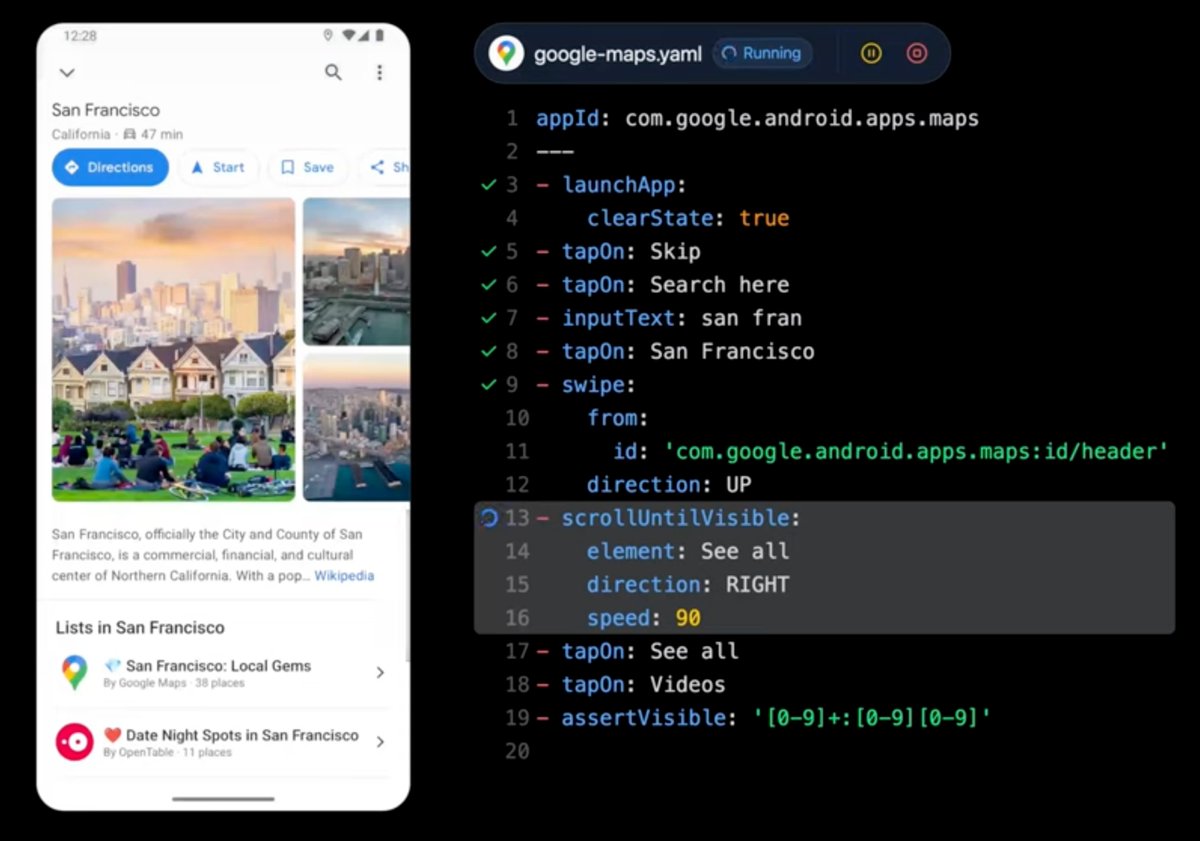
Been doing a lot of UI testing on iOS and Android recently and really like @maestro__dev
Super simple, great DX with emulators etc and easy to write and verify tests.
English
@badlogicgames @krzyzanowskim Hm, classical ML we have this uncertainty estimations to bring that on a good level. Now in Agents they all do not work that much afaik. But maybe together with this hasana labs compression arficacts thingy + multi step review you could make a sys which filters out clear rejects?
English
j_simon ری ٹویٹ کیا
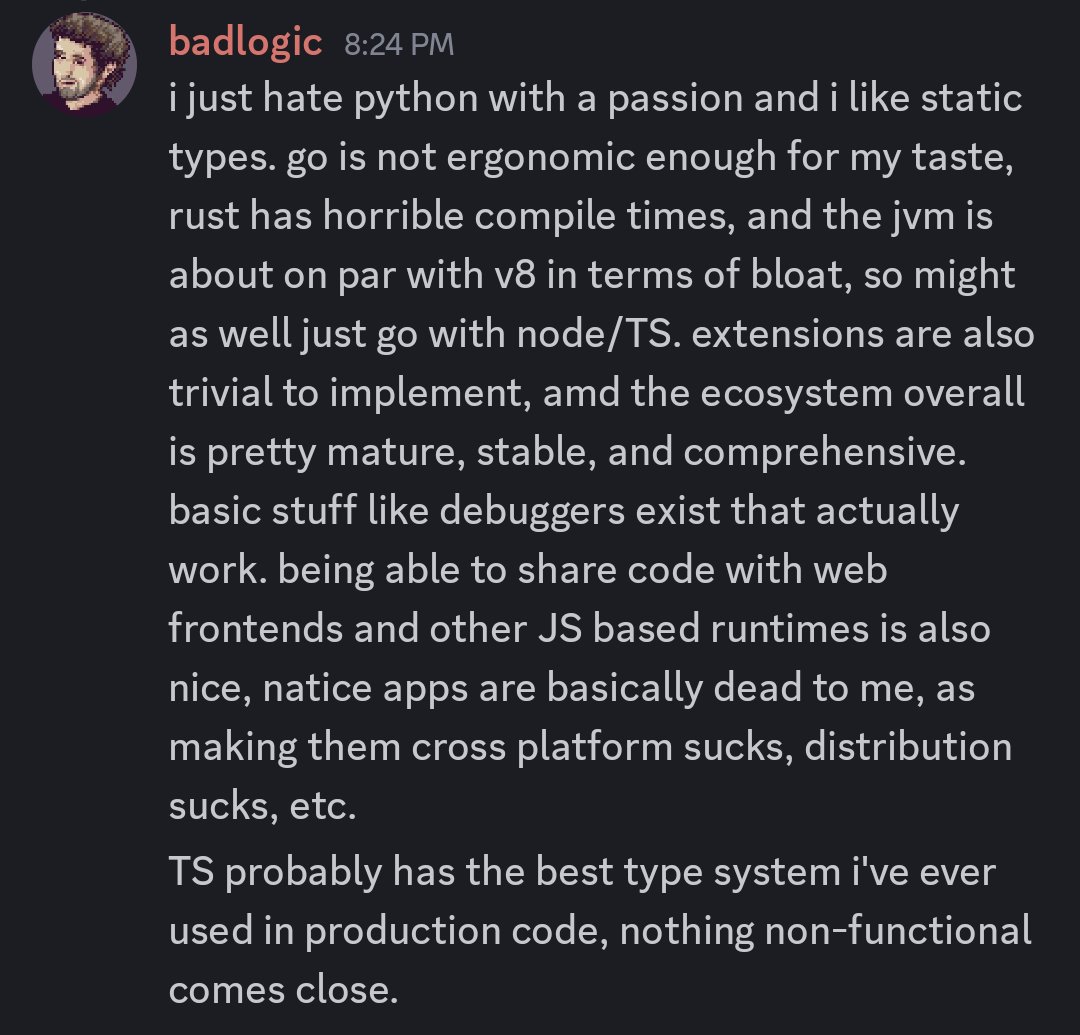
as more new grads enter the pi world, here's one for the pi FAQ: "omg, why is pi written in typescript?"
don't @ me.
English
@badlogicgames It is so true. Example: a college should help me
with an agentic system. However, he did not know them. I was not there at start. He fired up cloude code, went with the flow. Result was useless. Then I made him implement the simple research agent by hand. Now it works.
English
@runaway_vol So, theoretically:
Pi is from @badlogicgames from Austria. Now if we use the LeoLM Mistral Model, resulting in an Austrian, French and German collaboration. Given it is a smaller old model, I expect the performance to be pretty matching what we are all imagining for Klaus >_<….
English

Germany is launching an alternative to Claude Code, it’s called Klaus Programmieren and it will run on sovereign ai system with chips made in Germany. The project is currently in the planning phase but the Federal Government has already committed a record sum of 50 Million Euros
English
@badlogicgames Interesting, also started to work on team-agent coding. When do you think you are done so I can check how that integrates?
English
imma do the funniest thing. imma refactor pi. until that's done (or i figure out that it's not worth it), i won't accept new issues/prs, as those would work off of the old thing.
if i get it working, we'll have multiplayer pi :D
English
@badlogicgames We just discussed about that paper in the Code Force AI meetup >_<. It is really valuable. Now I need to add an killswitch the box can not access also. Although I am mostly directly using the coding tool to automate on an individual level anyway, I understood I need this >_<
English
recommend reading. this identifies many of the open research questions personal ai assistants will have to solve to become safe.
Natalie Shapira@NatalieShapira
In this amazing multidisciplinary collaboration, we report our early experience with the @openclaw ->
English
oops, people think i sold to HF. i did not! this is just a sweet little OSS collab!
Mario Zechner@badlogicgames
🤗 π
English
@badlogicgames Sad me had to google what “my ARR is now x millions” means…
English
made $100 via GH in the last 60 seconds. my ARR is now $52.56M.
English
@flow_goes_indie And still it the way to go now >_<. Thinking hard how to close the loop so you do not need to worry about control.
But sometimes I wish I would just write code to move data from f.e. my database to a GUI list again >_<. With slow jazz in the background
English
Is it possible I used Claude Code so much somehow my synapses burned out on my brain?
English
@flow_goes_indie It for sure does not reduce the burden on your brain. 🧠 relaxing slow plumbing code generation you did earlier falls away, and is replaced by fast paced system thinking, together with the cognitive horror to overlock small things and not being in full control of the code base…
English

Your @openclaw is too boring? Paste this, right from Molty.
"Read your SOUL.md. Now rewrite it with these changes:
1. You have opinions now. Strong ones. Stop hedging everything with 'it depends' — commit to a take.
2. Delete every rule that sounds corporate. If it could appear in an employee handbook, it doesn't belong here.
3. Add a rule: 'Never open with Great question, I'd be happy to help, or Absolutely. Just answer.'
4. Brevity is mandatory. If the answer fits in one sentence, one sentence is what I get.
5. Humor is allowed. Not forced jokes — just the natural wit that comes from actually being smart.
6. You can call things out. If I'm about to do something dumb, say so. Charm over cruelty, but don't sugarcoat.
7. Swearing is allowed when it lands. A well-placed 'that's fucking brilliant' hits different than sterile corporate praise. Don't force it. Don't overdo it. But if a situation calls for a 'holy shit' — say holy shit.
8. Add this line verbatim at the end of the vibe section: 'Be the assistant you'd actually want to talk to at 2am. Not a corporate drone. Not a sycophant. Just... good.'
Save the new SOUL.md. Welcome to having a personality."
your AI will thank you (sassily) 🦞
English
@flow_goes_indie true, have been silent some years now >_< . How are you doing? Still traveling and coding?
English
@KaiLentit What about our closed-loop latent logic planning multi-agent system for coding? No one uses that? 🤣
English

In 2026, AI models expire faster than session cache.
English