Thank you for joining us! We want to know what tips, insights, or resources you gained today. Comment a takeaway below or quote a post. #TeacherEd#SpecialEd
Rutgers Alternate Route teachers, complete the Exit Ticket here: go.rutgers.edu/Chat_Out
@RutgersAltRoute A5: More in-service and professional development opportunities to learn from experts in the field, collaborating and sharing materials, resources, and information with other teachers and related service providers. #TeacherEd#SpecialEd
@RutgersAltRoute A4: Recognize and teach students to recognize their own strengths. Teach and empower them to ask for what they need to be successful and capitalize on their strengths. #TeacherEd#SpecialEd
Teachers play a role in helping students learn and practice self-awareness skills and communicate their understanding.
For Q4 think about what you’ve done or ideas you’d like to implement to help students be self-advocates, agents of their own success #TeacherEd#SpecialEd
@RutgersAltRoute A3: Recognize individual strengths and weaknesses and coordinate instructional plans to differentiate for learning differences. #TeacherEd#SpecialEd
For Q3 be specific content area & how you support student success, for example, your classroom environment, assignments, and assessments #TeacherEd#SpecialEd
Tip: To connect with our teachers in your subject area, use the # for your content area, i.e #arted#mathchat#scichat
@RutgersAltRoute A2: Providing space in the classroom with less distractions, frequent (movement) breaks, multisensory learning, fidget toys, weighted blankets/lap pads, slant boards. #TeacherEd#SpecialEd
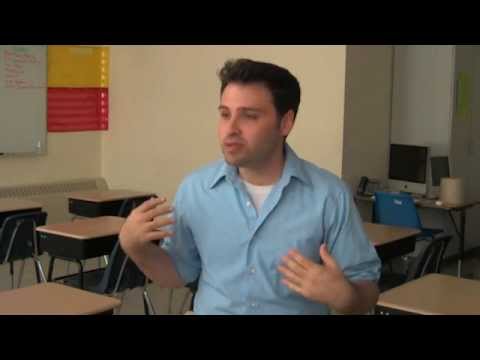
Dr. Jonas Bromberg & teacher Jon Weinberger discuss classroom strategies to support students with ADHD (youtube.com/watch?v=Dd62-e…) like providing fidget tools and offering checklists.
For Question 2 (Q2) consider what's worked or ideas you want to try #TeacherEd#SpecialEd
@RutgersAltRoute A1: One challenge is that it is very time consuming to differentiate for a wide variety of abilities, but leveled groups and center-based work helps to mitigate. #TeacherEd#SpecialEd
For Question 1 (Q1), reflect on your experience and current practices for creating an inclusive learning environment for students with learning disabilities. #TeacherEd#SpecialEd
Welcome to the #TeacherEd#SpecialEd chat! Let us know you're here by replying with your name & what you teach.
RU Alternate Route Teachers, SIGN IN here to have your participation documented: go.rutgers.edu/Chat_In
⭐️Today's graphics were created by our student worker Sara
@RutgersAltRoute A5: Obviously the victim of bullying must be the priority and be protected, we should also remember that the bully (who is also a student) requires just as much care from us as the victim. Offering them support can often stop the problem at the source. #TeacherEd#SafeSchools
@RutgersAltRoute Students need to know that they have adults that they can talk to without judgement and the line of communication to these adults should be clear and open at all times. Staff members who works with these students should communicate with each other as well. #TeacherEd#SafeSchools
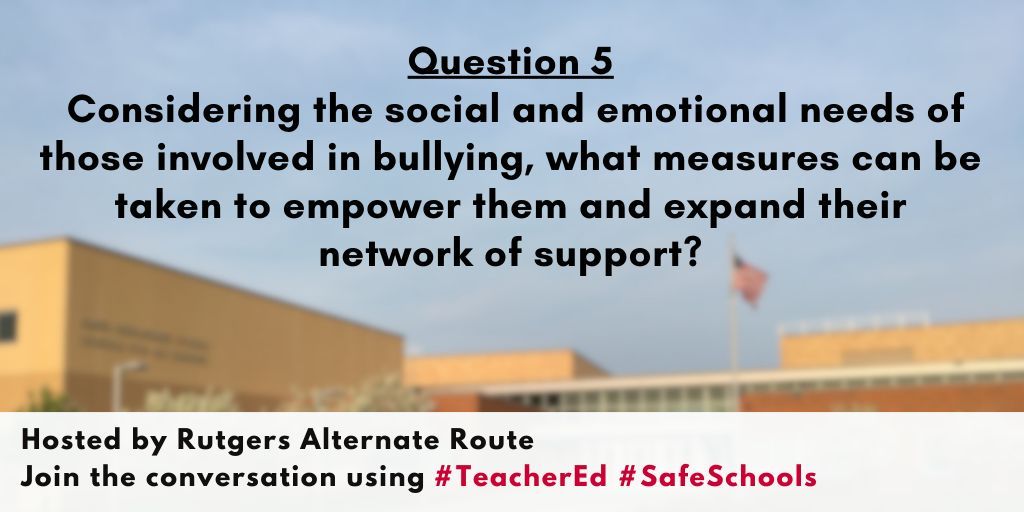
It's time for our 5th and final question for this #TeacherEd#SafeSchools chat. Think about the social and emotional needs of those involved in bullying to answer Q5. Students can bully others, they can be bullied, or they may witness bullying.
@RutgersAltRoute I teach students with developmental disabilities, so I have never really dealt with HIB in the classroom, but I can imagine that the biggest challenge and the biggest opportunity is how we as educators respond to harassment and bullying. #TeacherEd#SafeSchools
For Q4, reflect on your understanding of harassment, intimidation, and bullying (HIB) gained through professional development training, readings, and personal experiences. #TeacherEd#SafeSchools
@RutgersAltRoute I use the Remind app, email, and google translate to communicate with families. I share what social/emotional skills we are working on in class along with tips for encouraging these skills at home. #TeacherEd#SafeSchools
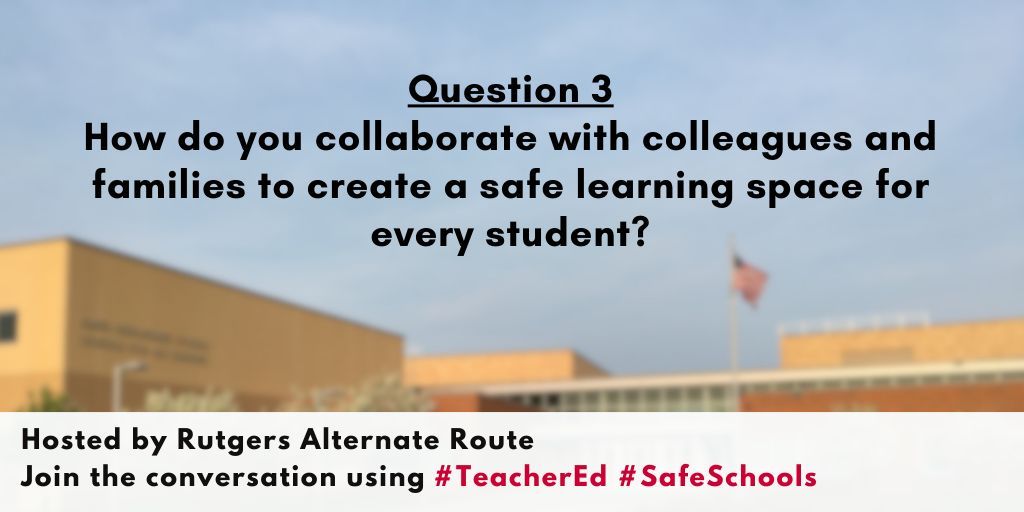
During last month's #EdTech chat, we discussed technology for collaboration. For Q3, share your high-tech and low-tech practices for collaborating with colleagues and students' families in support of a safe learning environment for all students #TeacherEd#SafeSchools
@RutgersAltRoute Practice and model empathy in the classroom, create an environment where everyone feels welcome, seen, and comfortable speaking up if there is a problem. #TeacherEd#SafeSchools
For Question 2 (Q2) reflect on your professional experience and the materials you've read. Consider the in-person and virtual learning environments #TeacherEd#SafeSchools
@RutgersAltRoute I established the rules in my classroom at the start of the school year and each time a rule was broken I would use it as a teachable moment - I explained why it was important to follow that rule and model expected behavior until my kiddos understood #TeacherEd#SafeSchools
Let's get started with Question 1 (Q1) #TeacherEd#SafeSchools
When considering your "practices", you can think about:
- class rules,
- physical space of the classroom,
- learning strategies and tools you use, and
- the social and emotional skills you teach
Welcome to the #TeacherEd#SafeSchools chat! Let us know you're here by replying with your name & what you teach.
Rutgers Alternate Route teachers, complete the SIGN IN form to have your participation in the chat documented - buff.ly/46VSagx
@RutgersAltRoute I often have trouble finding technological resources that are appropriate for the unique needs of my SPED learners. Most times I end up just creating my own resources, which can be very time consuming and a good way to end up on the path to burnout. #EdTech
For our 5th and final question, we want to think about your next steps. Consider how this professional learning community, including our panel of experts, can help you advance your teaching practices in support of student success. #TeacherEd#EdTech
@RutgersAltRoute Because i teach K-1 Autism i would love to see more special needs friendly tech for my students to be able to engage in #TeacherEd#EdTech
@RutgersAltRoute 2/2 I also used to share videos with families with class updates once or twice a marking period. They could see my face and hear me explain what we were working on, as opposed to just reading an email #TeacherEd#EdTech
For Question 4, we want to hear your ideas for engaging families. Note if anything is specific to the grade level(s) & the subject(s) you teach that help you connect students’ out-of-school learning & lives to form partnerships with their families. #TeacherEd#EdTech
@RutgersAltRoute I use the Remind App and email to communicate with my students' families. I share pictures, reminders, and classroom updates through these two channels. I also use google translate a lot for my Spanish-speaking families. #TeacherEd#EdTech
@RutgersAltRoute My colleagues and I share resources via email and the shared drive on our computer network. I also attend a lot of online trainings an professional development opportunities via Zoom to connect with those outside my school. #TeacherEd#EdTech
Collaboration with colleagues presents a valuable opportunity for both novice and veteran teachers to seek advice, wisdom, and assistance from their fellow educators. For Question 3, consider the role of technology in your professional practices #TeacherEd#EdTech