Zaid Khalil

971 posts

Zaid Khalil banner
Zaid Khalil

Zaid Khalil

@kafirkounter

على مذهب الإمام أحمد في الفقه • وعلى طريقة أهل الأثر في الاعتقاد

شامل ہوئے Aralık 2025
274 فالونگ17 فالوورز
Zaid Khalil
Zaid Khalil@kafirkounter·
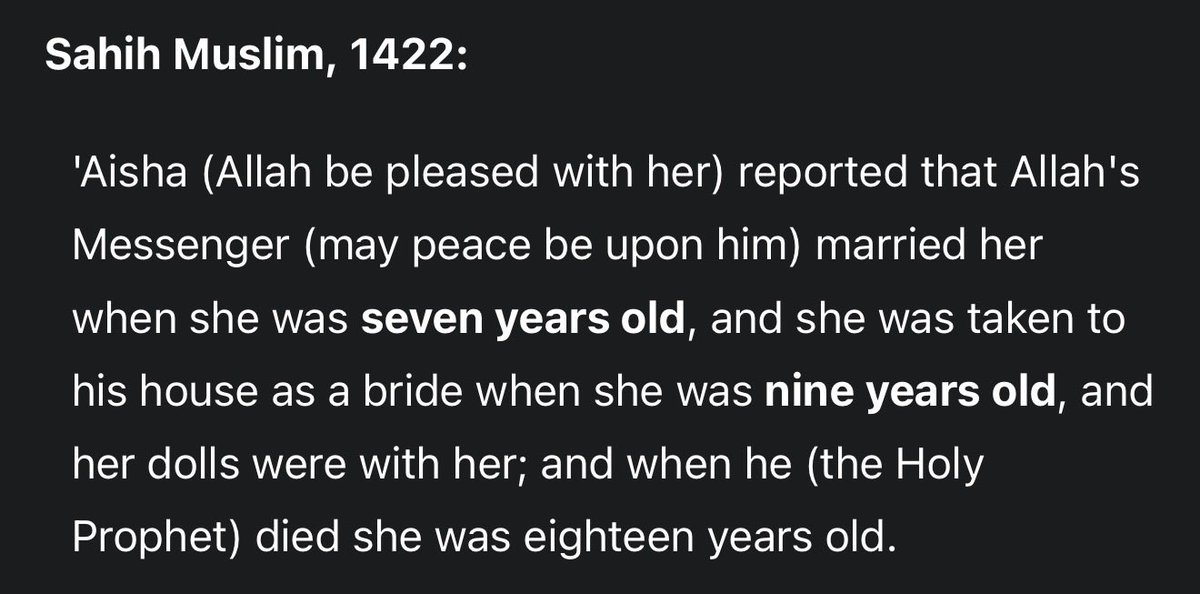
@HabibiResponds «عن عائشة ﵂: "أن النبي ﷺ تزوجها وهي بنت ست سنين، وأدخلت عليه وهي بنت تسع سنين، ومكثت عنده تسعًا" متفق عليه. وفي رواية: "تزوجها وهي بنت سبع، وزفت إليه وهي بنت تسع سنين" رواه أحمد، ومسلم. قلت: ووفق بأنها كانت في السابعة ولم تستكملها، فمن قال ست لم يعتبر ما دخل من السابعة، ومن قال سبع لم يعتبر ما بقي منها والله أعلم.» “From ʿĀʾishah: ‘The Prophet ﷺ married her when she was six years old, she was brought to him when she was nine years old, and she remained with him for nine [years]’ — agreed upon. And in one narration: ‘He married her when she was seven, and she was escorted to him when she was nine years old’ — reported by Aḥmad and Muslim. I say: it was reconciled by saying that she was in her seventh year but had not completed it. So whoever said six did not count what she had entered of the seventh year, and whoever said seven did not count what remained of it. And Allah knows best.” That is the answer: six vs seven at the contract is a reckoning issue, not a collapse of the report. [al-Taʿrīf wa-al-Ikhbār bi-Takhrīj Aḥādīth al-Ikhtiyār], Vol. 3, p. 25. Al-Nawawī states the same basic point in his commentary on Muslim: «فِيهِ حَدِيثُ عَائِشَةَ رَضِيَ اللَّهُ عَنْهَا قَالَتْ (تَزَوَّجَنِي رَسُولُ اللَّهِ صَلَّى اللَّهُ عَلَيْهِ وَسَلَّمَ لِسِتِّ سِنِينَ وَبَنَى بِي وَأَنَا بِنْتُ تِسْعِ سِنِينَ) وَفِي رِوَايَةٍ تَزَوَّجَهَا وَهِيَ بِنْتُ سَبْعِ سِنِينَ» “In it is the hadith of ʿĀʾishah, may Allah be pleased with her: ‘The Messenger of Allah, may Allah bless him and grant him peace, married me when I was six years old and consummated with me when I was nine years old.’ And in one narration: ‘He married her when she was seven years old.’” Al-Nawawī reports both wordings together, not as a fatal contradiction, but as known variant wording within the same discussion. [Sharḥ al-Nawawī ʿalā Muslim], p. 206. The seven wording still says nine at consummation.
العربية
0
0
0
19
Seyed Mohammad Marandi
Seyed Mohammad Marandi@s_m_marandi·
Since the Epstein class is insulting the holy Prophet and his wife Aisha in order to hide their crimes, I decided to write this. Historians list Aisha among the first two dozen people to convert to Islam, which would have required her to be at least several years old at the start of the Prophet's mission. The overwhelming consensus among Shia scholars is that she was 18-19 when she married. This is the most frequently cited range, often calculated using the age of her older sister, Asma, who was 10 years older and died at 100 years old.
English
472
4.6K
19.5K
986K
Abuzar Ali
Abuzar Ali@TeaWasFantastc·
@TheMumMuslim @_A_khalifa Sister .. are you trying invoke the sense of honour in an arab?😭… specially Emarati ?? don’t forget they are the ones who offered their girls to do hair dance for trump. They have lost their manhood long ago.
English
1
0
1
54
Zaid Khalil
Zaid Khalil@kafirkounter·
Pagan @GodLogic_GL Awaiting your response. You do not know what territory you have entered and you will be refuted. So come on boy. You have no knowledge.
English
0
0
0
10
Zaid Khalil
Zaid Khalil@kafirkounter·
«متروك الحديث مع إمامته في القراءة» “Abandoned in hadith, despite his leadership in recitation.” — [Taqrib al-Tahdhib], Vol. 1, p. 257. He can be rejected in hadith and still be an imam in qirāʾah. «ثبت في القراءة، واهي الحديث» “Firm in recitation, weak in hadith.” — [al-Kashif fi Ma‘rifat man Lahu Riwayah fi al-Kutub al-Sittah], Vol. 2, p. 297. The fields are not collapsed into one. The critics themselves did not do what the Christian is demanding. «كان حفص وأبو بكر من أعلم الناس بقراءة عاصم، وكان حفص أقرأ من أبي بكر» “Ḥafṣ and Abū Bakr were among the most knowledgeable of people regarding the recitation of ʿĀṣim, and Ḥafṣ was a stronger reciter than Abū Bakr.” — [Tahdhib al-Kamal], Vol. 7, p. 10. The Christian’s argument assumes: “If a narrator is weak in one discipline, he is therefore unusable in every discipline.” «عاصم صاحب قرآن، وحماد صاحب فقه» “ʿĀṣim is a man of Qurʾān, while Ḥammād is a man of jurisprudence.” And: «حجة في القراءة، وحديثه في الصحيحين مقرون» “He is a proof in recitation, and his hadith in the two Ṣaḥīḥs is only in corroborated form.” And: «كان ثقة، رأسا في القراءة» “He was trustworthy, a chief in recitation.” — [Tahdhib al-Kamal], Vol. 13, p. 473. These do not describe a man whose qirāʾah authority is collapsing. They describe a man whose specialty and imamate were in Qurʾān recitation. And Ibn Mujāhid records ʿĀṣim’s own rootedness in transmission: «قال لي عاصم ما أقرأني أحد حرفا إلا أبو عبد الرحمن السلمي وكان أبو عبد الرحمن قد قرأ على علي رضي الله تعالى عنه وكنت أرجع من عند أبي عبد الرحمن فأعرض على زر بن حبيش وكان زر قد قرأ على عبد الله ابن مسعود ... وكان عاصم مقدما في زمانه مشهورا بالفصاحة معروفا بالإتقان ... ما رأيت أحدا أقرأ للقرآن من عاصم بن أبي النجود ...» “ʿĀṣim said to me: No one taught me a single letter except Abū ʿAbd al-Raḥmān al-Sulamī, and Abū ʿAbd al-Raḥmān had recited to ʿAlī, may Allah be pleased with him. And I would return from Abū ʿAbd al-Raḥmān and present it to Zir ibn Ḥubaysh, and Zir had recited to ʿAbd Allāh ibn Masʿūd ... ʿĀṣim was foremost in his time, famous for eloquence, known for precision ... I have not seen anyone more proficient in the Qurʾān than ʿĀṣim ibn Abī al-Najūd ...” — [Kitab al-Sab‘ah], Vol. 1, p. 70. «وحَدثني الْكسَائي مُحَمَّد بن يحيى عَن أبي الْحَارِث عَن أبي عمَارَة عَن حَفْص عَن عَاصِم وحَدثني أَحْمد بن عَليّ الخزاز قَالَ حَدثنَا ابو عمر هُبَيْرَة بن مُحَمَّد التمار عَن حَفْص بن سُلَيْمَان عَن عَاصِم وحَدثني أَبُو مُحَمَّد الرقي عَن أبي عمر الدوري عَن أبي عمَارَة عَن حَفْص عَن عَاصِم وَأَخْبرنِي مُحَمَّد بن حَمَّاد بن ماهان الدّباغ قَالَ حَدثنِي أَبُو الرّبيع عَن حَفْص عَن عَاصِم» “Al-Kisāʾī Muḥammad ibn Yaḥyā narrated to me from Abū al-Ḥārith from Abū ʿImārah from Ḥafṣ from ʿĀṣim. Aḥmad ibn ʿAlī al-Khazzāz narrated to me: Abū ʿUmar Hubayrah ibn Muḥammad al-Tammār narrated to us from Ḥafṣ ibn Sulaymān from ʿĀṣim. Abū Muḥammad al-Raqqī narrated to me from Abū ʿUmar al-Dūrī from Abū ʿImārah from Ḥafṣ from ʿĀṣim. Muḥammad ibn Ḥammād ibn Māhān al-Dabbāgh informed me: Abū al-Rabīʿ narrated to me from Ḥafṣ from ʿĀṣim.” — [Kitab al-Sab‘ah], Vol. 1, p. 95. This shows the qirāʾah was being carried through multiple qirāʾah routes in the qurrāʾ literature. And Ibn Mujāhid also documents the Abū Bakr ʿan ʿĀṣim routes separately: «وَمَا كَانَ من قِرَاءَة عَاصِم بن أبي النجُود عَن أبي بكر بن عَيَّاش ...» “As for what was from the recitation of ʿĀṣim ibn Abī al-Najūd through Abū Bakr ibn ʿAyyāsh ...” — [Kitab al-Sab‘ah], Vol. 1, p. 94. So even within ʿĀṣim’s school, the transmission is not reducible to one man in one context. The Christian argument trades on category mistakes. It mistakes hadith weakness for total incompetence in qirāʾah.
GodLogic_GL@GodLogic_GL

The most popular Quranic reading (the Hafs Quran) comes from a known liar who is rejected in Hadith. youtu.be/538wPhAmjUI?si…

1
0
0
58
Zaid Khalil
Zaid Khalil@kafirkounter·
@GodLogic_GL You are the worst of creatures. Worships a man. Worships 3 gods. Destined for the hellfire if you do not repent and accept Islam.
English
0
0
0
3
GodLogic_GL
GodLogic_GL@GodLogic_GL·
We don't hate Muslims, our issue is the religion of Islam. Ironically Muhammad calls CHRISTIANS the "WORST of creatures" (S. 98:6), calls to subjugate us (S. 9:29), cursed Christians (Bukhari 3453), and he told Muslims to force us to the narrowest part of the road (Sahih Muslim 2167a). If a Christian said any of this about a Muslim, someone like this guy would say "oh you see 😢Christians hate Muslims!" But when Muhammad does it, he doesn't care.
English
93
238
1.3K
35.4K
Zaid Khalil
Zaid Khalil@kafirkounter·
Zaid Khalil@kafirkounter

«متروك الحديث مع إمامته في القراءة» “Abandoned in hadith, despite his leadership in recitation.” — [Taqrib al-Tahdhib], Vol. 1, p. 257. He can be rejected in hadith and still be an imam in qirāʾah. «ثبت في القراءة، واهي الحديث» “Firm in recitation, weak in hadith.” — [al-Kashif fi Ma‘rifat man Lahu Riwayah fi al-Kutub al-Sittah], Vol. 2, p. 297. The fields are not collapsed into one. The critics themselves did not do what the Christian is demanding. «كان حفص وأبو بكر من أعلم الناس بقراءة عاصم، وكان حفص أقرأ من أبي بكر» “Ḥafṣ and Abū Bakr were among the most knowledgeable of people regarding the recitation of ʿĀṣim, and Ḥafṣ was a stronger reciter than Abū Bakr.” — [Tahdhib al-Kamal], Vol. 7, p. 10. The Christian’s argument assumes: “If a narrator is weak in one discipline, he is therefore unusable in every discipline.” «عاصم صاحب قرآن، وحماد صاحب فقه» “ʿĀṣim is a man of Qurʾān, while Ḥammād is a man of jurisprudence.” And: «حجة في القراءة، وحديثه في الصحيحين مقرون» “He is a proof in recitation, and his hadith in the two Ṣaḥīḥs is only in corroborated form.” And: «كان ثقة، رأسا في القراءة» “He was trustworthy, a chief in recitation.” — [Tahdhib al-Kamal], Vol. 13, p. 473. These do not describe a man whose qirāʾah authority is collapsing. They describe a man whose specialty and imamate were in Qurʾān recitation. And Ibn Mujāhid records ʿĀṣim’s own rootedness in transmission: «قال لي عاصم ما أقرأني أحد حرفا إلا أبو عبد الرحمن السلمي وكان أبو عبد الرحمن قد قرأ على علي رضي الله تعالى عنه وكنت أرجع من عند أبي عبد الرحمن فأعرض على زر بن حبيش وكان زر قد قرأ على عبد الله ابن مسعود ... وكان عاصم مقدما في زمانه مشهورا بالفصاحة معروفا بالإتقان ... ما رأيت أحدا أقرأ للقرآن من عاصم بن أبي النجود ...» “ʿĀṣim said to me: No one taught me a single letter except Abū ʿAbd al-Raḥmān al-Sulamī, and Abū ʿAbd al-Raḥmān had recited to ʿAlī, may Allah be pleased with him. And I would return from Abū ʿAbd al-Raḥmān and present it to Zir ibn Ḥubaysh, and Zir had recited to ʿAbd Allāh ibn Masʿūd ... ʿĀṣim was foremost in his time, famous for eloquence, known for precision ... I have not seen anyone more proficient in the Qurʾān than ʿĀṣim ibn Abī al-Najūd ...” — [Kitab al-Sab‘ah], Vol. 1, p. 70. «وحَدثني الْكسَائي مُحَمَّد بن يحيى عَن أبي الْحَارِث عَن أبي عمَارَة عَن حَفْص عَن عَاصِم وحَدثني أَحْمد بن عَليّ الخزاز قَالَ حَدثنَا ابو عمر هُبَيْرَة بن مُحَمَّد التمار عَن حَفْص بن سُلَيْمَان عَن عَاصِم وحَدثني أَبُو مُحَمَّد الرقي عَن أبي عمر الدوري عَن أبي عمَارَة عَن حَفْص عَن عَاصِم وَأَخْبرنِي مُحَمَّد بن حَمَّاد بن ماهان الدّباغ قَالَ حَدثنِي أَبُو الرّبيع عَن حَفْص عَن عَاصِم» “Al-Kisāʾī Muḥammad ibn Yaḥyā narrated to me from Abū al-Ḥārith from Abū ʿImārah from Ḥafṣ from ʿĀṣim. Aḥmad ibn ʿAlī al-Khazzāz narrated to me: Abū ʿUmar Hubayrah ibn Muḥammad al-Tammār narrated to us from Ḥafṣ ibn Sulaymān from ʿĀṣim. Abū Muḥammad al-Raqqī narrated to me from Abū ʿUmar al-Dūrī from Abū ʿImārah from Ḥafṣ from ʿĀṣim. Muḥammad ibn Ḥammād ibn Māhān al-Dabbāgh informed me: Abū al-Rabīʿ narrated to me from Ḥafṣ from ʿĀṣim.” — [Kitab al-Sab‘ah], Vol. 1, p. 95. This shows the qirāʾah was being carried through multiple qirāʾah routes in the qurrāʾ literature. And Ibn Mujāhid also documents the Abū Bakr ʿan ʿĀṣim routes separately: «وَمَا كَانَ من قِرَاءَة عَاصِم بن أبي النجُود عَن أبي بكر بن عَيَّاش ...» “As for what was from the recitation of ʿĀṣim ibn Abī al-Najūd through Abū Bakr ibn ʿAyyāsh ...” — [Kitab al-Sab‘ah], Vol. 1, p. 94. So even within ʿĀṣim’s school, the transmission is not reducible to one man in one context. The Christian argument trades on category mistakes. It mistakes hadith weakness for total incompetence in qirāʾah.

QME
0
0
0
19
Zaid Khalil
Zaid Khalil@kafirkounter·
a fixed alternative age goes well beyond the wording itself. See: Ṣaḥīḥ al-Bukhārī (p. 275). 10) “Asmāʾ was ten years older and died at one hundred in 73 AH, so that gives an independent cross-reference.” Even if someone accepts the biographical reports about Asmāʾ, that is still an indirect historical inference. By contrast, the six-and-nine report is a direct transmission from ʿĀʾishah through ʿUrwah and Hishām, preserved in the two Ṣaḥīḥs and preferred by Ibn ʿAbd al-Barr from the standpoint of transmission. More importantly, none of the classical hadith scholars or jurists cited here uses the Asmāʾ calculation to dislodge the direct report. So moving from “Asmāʾ’s age” to “therefore ʿĀʾishah was nineteen” is simply not something established by the classical sources being appealed to. See: Ṣaḥīḥ al-Bukhārī (Vol. 3, p. 469), Ṣaḥīḥ Muslim (Vol. 2, p. 1039), and al-Tamhīd (Vol. 19, p. 108). 11) “Some narrations in the Ṣaḥīḥayn were rejected because they were really from Kaʿb al-Aḥbār and Israʾīliyyāt.” That is beside the point here. This age report is not a Kaʿb al-Aḥbār report to begin with. Its chain runs from ʿĀʾishah through ʿUrwah through Hishām and others. Ibn ʿAbd al-Barr explicitly says that Hishām’s narration is the strongest thing reported on this issue. So bringing up Kaʿb al-Aḥbār and Israʾīliyyāt here does not really affect the case at all. See: Ṣaḥīḥ al-Bukhārī (Vol. 3, p. 469), Ṣaḥīḥ Muslim (Vol. 2, p. 1039), and al-Tamhīd (Vol. 19, p. 108). 12) “If Ibn Ḥajar had lived in our time and seen modern polemics, he probably would have examined this more rigorously.” That is just speculation. It is not evidence. What matters is what Ibn Ḥajar actually wrote, not what someone imagines he might have done in a hypothetical modern debate. And what he actually wrote was the standard report under al-Bukhārī’s chapter on consummation at nine. See: Fatḥ al-Bārī sharḥ Ṣaḥīḥ al-Bukhārī (Vol. 9, p. 224). So the conclusion is simple. Yes, our scholars could scrutinize narrations in principle. But that general principle does not justify moving from six and nine to nineteen in this specific case. The classical treatment here is plain: they accepted the core report, reconciled the six/seven wording, preferred Hishām’s route in transmission, and used the report in marriage law. That is the opposite of the modern reconstruction being pushed here. Wa-Allāhu aʿlam.
English
0
0
0
11
Zaid Khalil
Zaid Khalil@kafirkounter·
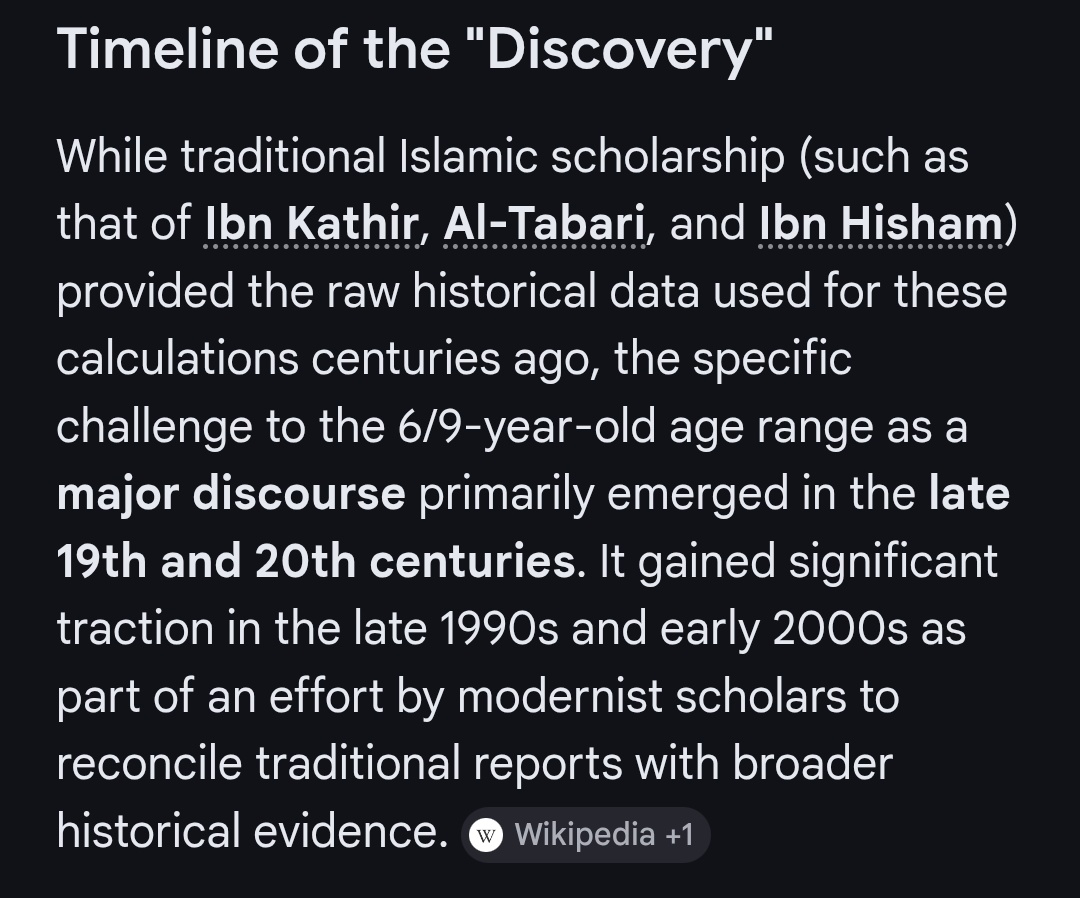
that this age report should be set aside. But the sources here do not do that. Rather, they do the opposite. Ibn Ḥajar repeats al-Bukhārī’s chapter heading about consummation at nine and repeats the hadith itself without turning it into a nineteen-year reinterpretation. So citing al-Dāraquṭnī in the abstract does not really touch this specific report. See: Fatḥ al-Bārī sharḥ Ṣaḥīḥ al-Bukhārī (Vol. 9, p. 224), Taghlīq al-Taʿlīq, and Manhaj al-Imām al-Bukhārī (p. 218). 5) “Albani said this in a YouTube clip..." As it is being presented, this is not a serious proof. A YouTube clip is not the same as a properly sourced classical argument. And even if a later scholar made a broad statement that books besides the Qur’an are not infallible, that still would not outweigh the very specific way this report was handled by al-Bukhārī, Muslim, al-Nawawī, Ibn ʿAbd al-Barr, and al-Sarakhsi. The question here is not general fallibility in theory. The question is how this report was actually treated in the tradition. And in the sources here, it was treated as accepted. See: Ṣaḥīḥ al-Bukhārī (Vol. 3, p. 469), Sharḥ al-Nawawī ʿalā Ṣaḥīḥ Muslim (Vol. 9, p. 206), al-Tamhīd (Vol. 19, p. 108), and al-Mabsūṭ (Vol. 4, p. 212). 6) “ʿĀʾishah said the Prophet ﷺ never urinated standing, but Hudhayfah reported that he did once, and scholars reconciled them.” That part is basically true, but it does not help your argument. The scholars did not throw out ʿĀʾishah’s report. They reconciled two direct reports. Their explanation was that her wording described what was normal and habitual, while Hudhayfah’s report described an exceptional incident. That is classical reconciliation between two direct narrations. It is not the same as taking a direct report and overriding it with indirect historical speculation. See: al-Ijābah li-Īrād mā Istadrakathu ʿĀʾishah ʿalā al-Ṣaḥābah (p. 160). 7) “So just as they qualified her report there, the same can be done with her age reports.” This is where the comparison breaks down. In the urination case, there are two direct reports within the hadith corpus about the same issue, so reconciliation makes sense. In the age case, the alternative claim is not another direct hadith from ʿĀʾishah رضي الله عنها or another Companion saying she was nineteen. It is a modern reconstruction built from indirect chronology. That is a far weaker method than relying on a direct transmitted report preserved in the two Ṣaḥīḥs and used by jurists as legal evidence. See: Ṣaḥīḥ al-Bukhārī (Vol. 3, p. 469), Ṣaḥīḥ Muslim (Vol. 2, p. 1039), and Sharḥ al-Nawawī ʿalā Ṣaḥīḥ Muslim (Vol. 9, p. 206). 8) “This shows that weighing her age reports against other historical evidence follows classical method.” Not really. The classical method shown in these sources is to preserve the direct report, reconcile small variations within the transmission, and then use the result in fiqh. Ibn Quṭlūbughā reconciles six and seven. Ibn ʿAbd al-Barr says Hishām’s route is the strongest in transmission. Al-Nawawī and al-Sarakhsi use the report in legal reasoning. That is not the method of sidelining a direct hadith through indirect timeline reconstruction. See: al-Taʿrīf wa-l-Ikhbār bi-Takhrīj Aḥādīth al-Ikhtiyār (Vol. 3, p. 25), al-Tamhīd (Vol. 19, p. 108), Sharḥ al-Nawawī ʿalā Ṣaḥīḥ Muslim (Vol. 9, p. 206), and al-Mabsūṭ (Vol. 4, p. 212). 9) “ʿĀʾishah said she remembered her parents practicing Islam before the Hijrah, which raises questions.” That report does not really do the work you want it to do. All it says is that from the earliest point she could remember, her parents were already following Islam. It does not give a number. It does not say she was a teenager. It does not say she was close to puberty. It simply says that her earliest memories were of her parents being Muslim and of the Prophet ﷺ visiting. Turning that into... +
English
1
0
0
12
Mohammed Hijab
Mohammed Hijab@mohammed_hijab·
In the broader scholarly discourse concerning the historical details of Sayyidah Aisha radiyallahu anha at the time of her marriage and its consummation the narration appearing in the Sahihayn that places these events at the ages of six and nine respectively remains the position affirmed by the vast majority of classical authorities. Yet the present discussion is strictly methodological in nature and does not endorse any alternative chronological proposal such as the figure of eighteen sometimes advanced in modern academic analyses of the sirah and maghazi literature. The sole purpose here is to illustrate through the words of the ulema themselves that the layman Neo Salafi assertion namely that every single narration contained within Sahih al Bukhari and Sahih Muslim must be accepted without the slightest academic reservation is not the nuanced position upheld by the Salaf or by the broader Sunni tradition of hadith scholarship. On matters that are purely historical and biographical rather than constitutive of legal rulings or articles of creed the classical authorities have always permitted a measured degree of critical engagement. The foundational distinction drawn by the early muhaddithun is instructive in this regard. Imam Abd al Rahman ibn Mahdi a towering figure of the second century and teacher of Imam Ahmad ibn Hanbal articulated the principle with characteristic clarity: “When reports reach us from the Prophet peace be upon him concerning the lawful and the prohibited and the legal rulings we are severe with the chains of transmission and we scrutinise the narrators. But when reports concern the virtues of actions their rewards and punishments or permissible exhortations and invocations we show leniency with the chains.” This statement recorded by al Hakim in al Mustadrak and echoed in al Suyuti’s Tadrib al Rawi reflects a consensus among the Salaf that historical and biographical akhbar precisely the category into which the age of Aisha falls allow greater flexibility than those deployed for deriving ahkam. Imam Ahmad ibn Hanbal expressed a similar view when he remarked that extreme strictness is reserved for what pertains to halal and haram while leniency befits reports of virtues stories and narratives. On purely historical questions therefore the acceptance or rejection of a particular report after due academic examination has always been far less consequential than on matters touching usul al din or fiqh.Even within the Sahihayn themselves the classical tradition never treated every narration as immune to scholarly discussion. Consider first the muallaqat those suspended reports in which Imam al Bukhari deliberately omits part or all of the opening chain for the sake of brevity. While the overwhelming majority of these are corroborated elsewhere in the Sahih with complete isnads a significant subset approximately one hundred and sixty unique instances stand alone in suspended form. Al Hafiz Ibn Hajar al Asqalani devoted an entire monograph Taghliq al Taliq to tracing their external supports and evaluating their authenticity according to rigorous criteria. He and other luminaries such as Ibn al Salah and al Dhahabi subjected these reports to independent scrutiny demonstrating that their inclusion in the Sahih did not exempt them from further verification. This labour alone refutes any notion that the mere presence of a narration in al Bukhari rendered further academic inquiry impermissible.A still more pointed illustration emerges from the work of Imam al Daraqutni whose Kitab al Tatabbu systematically examined roughly seventy eight narrations in Sahih al Bukhari one hundred in Sahih Muslim and thirty two common to both. His critique focused on subtle ilal hidden defects in precision of transmission inversion of wording or minor interruptions without ever impugning the overall stature of the two collections. Later authorities such as Imam al Nawawi engaged these points directly sometimes accepting and sometimes rebutting them yet always within the framework of legitimate scholarly discourse. Such exchanges were regarded as the natural outworking of the science of hadith not as an assault upon the Sahihayn. Concrete examples of these ilal include his observation concerning a narration in Sahih al Bukhari on the topic of Heaven and Hell complaining to Allah where one particular chain transmitted by Ubaydallah ibn Sad inverts the order of divine destiny in its wording an issue of narrator precision that later critics such as Abu Hasan al Qabisi also highlighted. Another instance involves reports that al Daraqutni judged were not transmitted in fully mawsul form as presented but only through specific limited routes such as those of Makhramah ibn Bukayr or Abu Burdah thereby introducing a subtle discontinuity in the chain that required separate verification.Nor was this critical spirit confined to earlier centuries. Shaykh Nasir al Din al Albani whose methodology is frequently invoked by those who champion an uncompromising view of the Sahihayn himself acknowledged that his own research led him to conclude that certain narrations within these collections fall short of the sahih or even hasan standard. In a recorded statement he explained: “Allah the Exalted has granted me firmness in the study of Hadith I applied this study to some of the Hadiths that appear in Sahih al Bukhari. Thus I found that there are some Hadiths that are not considered to be on the grade of Hasan much less the level of Sahih in Sahih al Bukhari not to mention Sahih Muslim.” He reiterated that “during my knowledge based research I passed over some Hadiths in Sahih al Bukhari and Sahih Muslim and it was revealed to me that there are some Hadiths that are weak.” He reinforced this position by quoting Imam al Shafi'i who stated “Allah didn't want to complete anything except His Book.” Al Albani’s position was not a wholesale rejection of the Sahihayn but a continuation of the classical practice of evaluating individual reports on their merits even when they appear in the most authoritative compilations as heard in his lecture available at youtube.com/watch?v=9VuoM-… same principle of critical engagement is evident when one examines mawquf reports statements attributed to the Companions rather than directly to the Prophet peace be upon him that are nonetheless included in Sahih al Bukhari. A particularly illuminating example concerns Sayyidah Aisha’s declaration that no one should believe the Messenger of Allah urinated while standing for she had never seen him do so except while sitting. Despite the sound chain supporting this mawquf transmission the scholars of the ummah did not accept her testimony as an absolute and unqualified rule. It stands in direct tension with the explicit report of Hudhayfah ibn al Yaman in the same Sahih al Bukhari who personally witnessed the Prophet urinate while standing during a journey at a place of refuse. Rather than discarding one narration or the other the hadith scholars undertook detailed reconciliation concluding that Aisha spoke of the Prophet’s habitual practice in the domestic setting while Hudhayfah recorded a specific concession made under the necessity of travel. Her sentiment though conveyed through a sound chain was therefore qualified and not taken at face value. This case demonstrates that even a soundly transmitted statement from Aisha within the Sahihayn is subjected to scrutiny cross referencing and qualification rather than uncritical endorsement.This pattern of scholarly engagement extends directly to other reports transmitted by Aisha herself in Sahih al Bukhari including the well known narration concerning her age at the time of marriage and consummation. Just as her mawquf testimony on the Prophet’s manner of urination was weighed against parallel evidence rather than accepted at face value so too are her statements about her own early life placed in conversation with additional historical indicators. In one narration she describes herself as a young girl who had not yet committed much of the Qur’an to memory when Surah al Qamar was revealed placing the event in the context of the early Medinan period after the Hijrah. This is juxtaposed by scholars with the chronological data surrounding her sister Asma bint Abi Bakr who was consistently reported to be ten years her senior. Asma’s own death at the advanced age of one hundred in the year seventy three after the Hijrah supplies an independent timeline that some classical and later analysts have brought to bear on the broader question of Aisha’s birth year and the precise dating of the marriage. In yet another narration Sahih al Bukhari 2297 Aisha states that since she reached the age when she could remember things she has seen her parents worshipping according to the right faith of Islam and she recounts events from the period of early persecution before the Hijrah including Abu Bakr’s attempted emigration to Ethiopia. This recollection of conscious memory from the pre Hijrah era implies that she must have been well beyond the age of one at the time of those events yet under the strict traditional calculation tied to consummation at nine shortly after the Hijrah she would have been no more than an infant during that persecution. The point is not to reject any single report but to illustrate that the ummah’s hadith scholars have routinely subjected even Aisha’s own transmissions soundly chained as they are to this kind of comparative historical analysis exactly as they did with her statement on the Prophet’s urination. The presence of such ikhtilaf within the pages of the Sahihayn themselves shows that academic discussion of these details has always been part of the Sunni tradition.Comparable caution appears in cases involving transmissions that carry Israelite content. A striking instance is the narration found in Sahih Muslim describing the days of creation land on Saturday mountains on Monday and so forth which certain major authorities including Imam al Bukhari and Yahya ibn Ma’in explicitly identified not as a statement of the Prophet but as originating from Ka’b al Ahbar the learned Jewish convert. Despite an apparently sound chain the content itself prompted its reclassification away from the Prophetic corpus. In Sahih al Bukhari itself hadith 7361 Muawiyah radiyallahu anhu remarks of Ka’b that he was among the most truthful of those who transmit from the People of the Book yet sometimes his words turned out to be false. Such examples underscore that even reports supported by strong chains were not immune to rejection or qualification when historical and biographical scrutiny revealed Israelite influence or internal inconsistencies.It is also important to recognise why many of the classical scholars of the past did not delve more deeply into this particular historical question. In their time there was simply little impetus or external pressure to do so the age of Aisha was not a major point of polemical attack against the Prophet peace be upon him or Islam as it has become in certain modern contexts. Had a scholar of the calibre of al Hafiz Ibn Hajar al Asqalani been aware that this matter would one day constitute one of the primary lines of attack upon the character of the Holy Prophet peace be upon him it is entirely conceivable that he and others would have approached the issue with even greater scrutiny and produced a more exhaustive analysis.In sum the tradition of the Salaf and the classical Sunni muhaddithun has consistently maintained that rigorous academic discussion of individual narrations even those appearing in the Sahihayn remains both permissible and necessary particularly when the material in question belongs to the domain of history and biography. Such discussion in no way undermines the overarching reliability of these collections nor does it constitute rejection of the Sunnah as a whole. Applied to the historical question of Sayyidah Aisha’s age any conclusion reached through sincere evidence based inquiry whatever that conclusion may be carries no implication whatsoever for a Muslim’s aqeedah. It remains a matter of ikhtilaf in the realm of akhbar not a challenge to the foundations of iman. This is not a moral issue the Prophet’s marriage to Aisha fourteen hundred years ago is very much fully defensible within its historical cultural and revelatory context. Rather the discussion serves to show those who disbelieve in Islam that even if they hold a strong view on the perceived immorality of this practice it does not undermine the religion itself. The ummah’s scholars have always distinguished between what touches the core of religion and what pertains to the details of sirah on the latter scholarly difference has been tolerated without the slightest accusation of deviation. May Allah grant us all the guidance to pursue knowledge with integrity and to preserve the unity of the community.
YouTube video
YouTube
English
55
19
241
83.2K
King Kaffir
King Kaffir@King_Kaffir·
@mohammed_hijab @ddkk786 @kafirkounter @s_m_marandi Muslims reject sources 200 years after Muhammad - as they prove him pedo. Yet have no issue with sources 700+ years after Muhammad. Which are then used by modern revisionist 1100 years after Muhammad to vindicate him of pedophilia. You dont see the hypocrisy?!
King Kaffir tweet mediaKing Kaffir tweet mediaKing Kaffir tweet mediaKing Kaffir tweet media
English
1
0
1
293
GeoPolitics
GeoPolitics@Politics_Man101·
@mohammed_hijab @kafirkounter @s_m_marandi The strongest evidence is that she was 18-19 given what has been stated above. Another, plausibility is that age wasn't really measured and that they were only considered after puberty, hence the 6 & 9 are from the time one reaches puberty.
English
1
0
0
115
Zaid Khalil
Zaid Khalil@kafirkounter·
al-Nawawī explicitly calls her a minor girl and ties the hadith to marriage before puberty. هذا صريح في جواز تزويج الأب الصغيرة بغير اذنها “This is explicit that a father may marry off a minor girl without her permission.” Ibn Ruslān states it plainly about ʿĀʾishah. وكانت دون البلوغ “She was below puberty.” Yes, the fuqahāʾ very often treated ʿĀʾishah as a minor. That is explicit in al-Shāfiʿī, al-Nawawī, Ḥanbalī fiqh, Mālikī fiqh, and Ḥanafī fiqh. Yes, many of them also explicitly say she was below puberty. Ibn Ruslān does so in plain words. al-Nawawī also frames the case under the law of marrying the ṣaghīrah and mentions marriage before puberty.
Català
1
1
2
555
Zaid Khalil
Zaid Khalil@kafirkounter·
@gnrlnak @mohammed_hijab @s_m_marandi Her age is recently disputed because the kuffar started to mock the Messenger (SAW). Otherwise it was not a problem before. Whether her age is relevant or irrelevant does not matter. She was 6 and the marriage was consummated when she was 9.
English
1
0
0
51
Tellurian
Tellurian@gnrlnak·
@mohammed_hijab @kafirkounter @s_m_marandi I think we need to change our argument to be, Aisha age is irrelevant as it’s disputed, or principles are aligned with anthemic tradition where age of marriage is legal when the girl is at a marriageable age as was with early Christian and Jewish theology
English
1
0
0
2.4K
Zard si Gana
Zard si Gana@ZardSi·
"You son of Motherland India and Fatherland Israel, bastard—speak with manners." Pakistan's journalist roasted Indian Army General and panelists who were against ceasefire talks between Iran and US in Pakistan and were supporting Israel. Indians are humiliating themselves 🤣🇮🇳
English
67
381
2.3K
110.7K
Zaid Khalil
Zaid Khalil@kafirkounter·
@w_terrence Hey, you can eat whatever you like. You can eat pig, pig shit, tape worms, anything. You can even fuck someone whose HIV infected and we will not say anything. It is your life, pig. Pork is not our kryptonite.
English
0
0
0
76
Terrence K. Williams
Terrence K. Williams@w_terrence·
Unfollow me if you have a problem with me eating bacon and being 100% against Islam. I also want Sharia law federally banned in America, and if that offends you as well, then see you later.
Terrence K. Williams tweet media
English
2.4K
4.7K
27.3K
202.4K
Zaid Khalil
Zaid Khalil@kafirkounter·
@GodLogic_GL Hey, you ape. Of course I will explain it to you and also teach you how to have gheerah for your wife. Your wife who is a whore, the slut of Instagram and other platforms and you, a dayouth. So, if you need a teacher, I can teach you. I will help you transform you from a cuck into a man. The charge is false. The child is explicitly al-Hasan, the Prophet’s own grandson, and the hadith is about love, mercy, embrace, play, and affection for a child, not sexual desire like you cuck and the rapist David Wood Hammer claim it to be. The core version is in Ṣaḥīḥ Muslim does not even contain the “mouth in mouth” wording; it says the Prophet asked for Hasan, Hasan came running, they embraced, and the Prophet prayed: “O Allah, I love him, so love him and love the one who loves him.” Hasan is also explicitly called “my son” by the Prophet in Ṣaḥīḥ al-Bukhārī, and al-Ājurrī transmits that Hasan and Husayn are his “two sweet basil blossoms from this world.” A faithful English rendering of the Muslim report is this: Abu Hurayra went out with the Prophet; they reached the market of Banū Qaynuqāʿ, then returned to Fāṭimah’s tent. The Prophet asked for Hasan, the child came running, they embraced one another, and the Prophet said: “O Allah, I love him, so love him and love whoever loves him.” That is the core ṣaḥīḥ wording. [Sahih Muslim], Vol. 4, p. 1882 In al-Adab al-Mufrad and al-Sharīʿah, the longer route says Hasan came running, fell into the Prophet’s lap, put his hand in the Prophet’s beard, and then the Prophet put his mouth to Hasan’s mouth, kissed him, and made the same prayer for him. Al-Albānī’s grading in Ṣaḥīḥ al-Adab al-Mufrad marks this route ḥasan. But here's the thing you cuck, the hadith corpus itself does not read this sexually. It is your pornified brains that is reading your filth onto the hadith. Al-Ājurrī places the report under a chapter on the Prophet’s playful affection with Hasan and Husayn. Al-Adab al-Mufrad has nearby chapters on kissing children, mercy to the young, and embracing a child. “Whoever does not show mercy will not be shown mercy.” That line is said when the Prophet kissed Hasan and someone objected. The text itself explains the act as raḥma—mercy, not lust. [Al-Adab Al-Mufrad], Vol. 1, p. 46 Do you understand cuck, or should I simplify it more for your chimpanzee brain? The child is Hasan, his grandson. The strongest version says embrace & prayer of love. The longer wording exists, but the hadith corpus itself files it under playful affection, kissing children, mercy to the young, and embracing a child. May peace and blessing be upon our beloved Messenger (SAW). @GodLogic_GL's whore-wife:
GIF
English
0
0
1
119
Zaid Khalil
Zaid Khalil@kafirkounter·
- For اضطراب, you must prove equal, irreconcilable variants with no preference. - For ʿillah, you must identify an actual hidden defect in this report by route-comparison and expert evidence. A general note that Hishām declined somewhat in old age is not, by itself, a demonstrated taʿlīl of this hadith. - For خبر آحاد, the strongest thing you can say on the majority view is that it does not produce qat'i certainty like mutawatir. But that still leaves it as binding, probative evidence, and Ibn Hajar explicitly allows some ahad reports to yield العلم النظري through supporting indicators, including what the two sahihs transmitted and the scholars accepted. Your objection does not prove the age hadith is mudtarib. It does not prove it is muʿallal. And calling it ahad does not make it epistemically worthless or historically unusable. ذكر ابن القطان في أثناء كلام له أن هشاما هذا تغير واختلط، وهذا القول لا عبرة به، لعدم المتابع له، بل هو حجة مطلقا، وإن كان وقع شيء ما فهو من القسم الذى لم يؤثر فيه شيء من ذلك (٢). قال ابن حجر: قال أبو الحسن بن القطان: هشام بن عروة تغير قبل موته، ولم نر له في ذلك سلفا (٣). قال المعلمي اليماني معقبا على ما قاله الذهبي في "الميزان": أما النسيان فلا يلزم منه خلل في الضبط، لأن غايته أنه كان أولا يحفظ أحاديث
English
2
0
2
343