longitude 0 🇫🇷 🇩🇪 🇮🇪 🇪🇺 🇺🇦

369.9K posts

longitude 0 🇫🇷 🇩🇪 🇮🇪 🇪🇺 🇺🇦 banner
longitude 0 🇫🇷 🇩🇪 🇮🇪 🇪🇺 🇺🇦

longitude 0 🇫🇷 🇩🇪 🇮🇪 🇪🇺 🇺🇦

@longitude0

Time waits for no man. 🐘 Mastodon: @[email protected]
At the Prime Meridian شامل ہوئے Şubat 2012
6.2K فالونگ3.3K فالوورز
longitude 0 🇫🇷 🇩🇪 🇮🇪 🇪🇺 🇺🇦 ری ٹویٹ کیا
Liz Webster
Liz Webster@LizWebsterSBF·
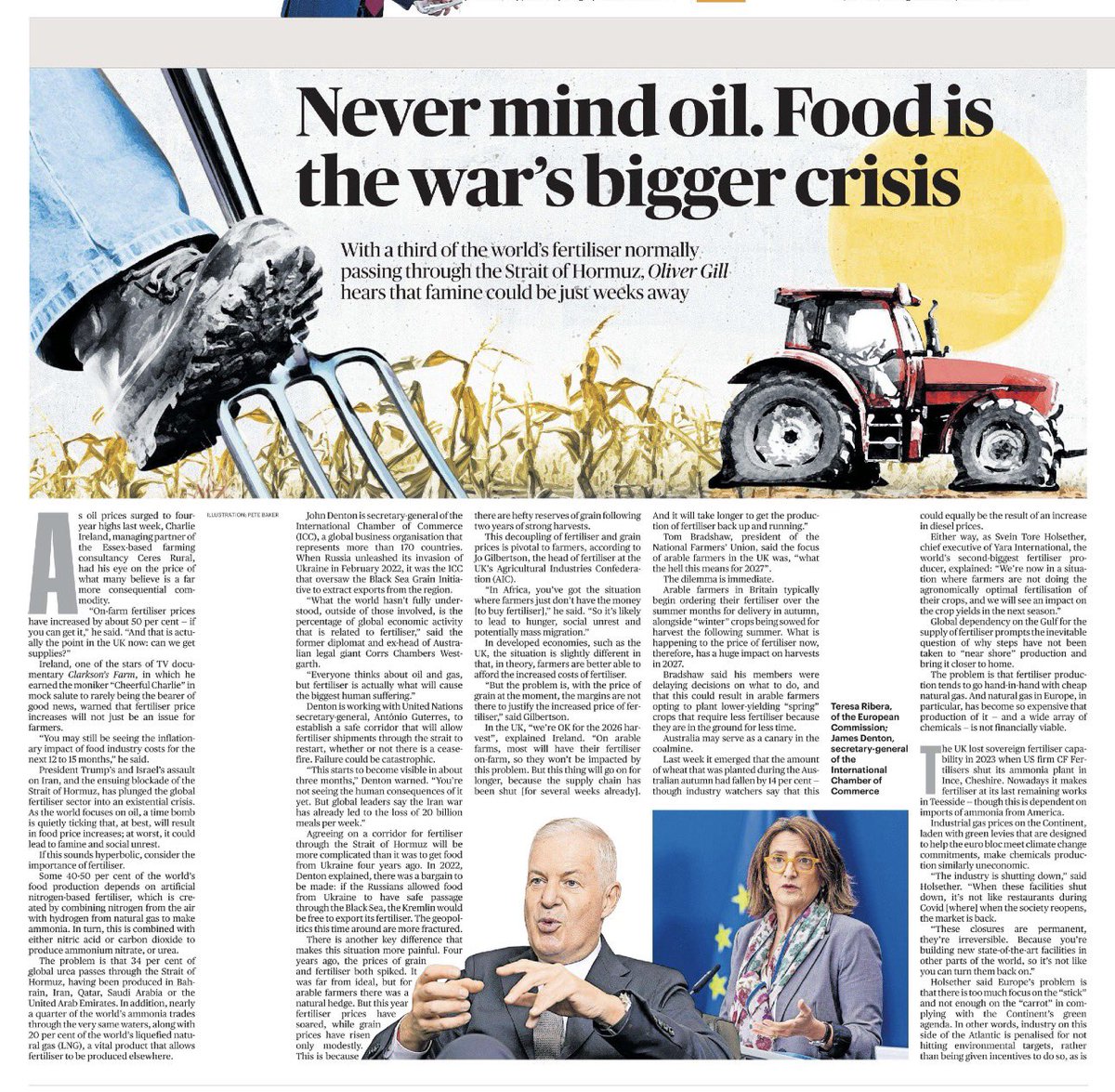
🆘🚨 As I told @HenryRiley1 on @LBC last Sunday, the fertiliser shock from Hormuz isn’t just an energy story. It’s a food story. This week, Sunday Times Business section confirms it: food is the war’s bigger crisis. And the UK is especially exposed. Brexit took us out of CAP and while we’ve replicated EU trade deals, we’ve not replaced the core principle that food production is a public good. That has consequences: ➡️ Rising prices ➡️ Tightening supply ➡️ Real risk to food security After WWII, Attlee’s government passed the 1947 Agriculture Act, recognising that feeding the nation is a strategic priority. That thinking later shaped Article 39 in the EU. 🔥 Today, Brexit Britain has no equivalent duty. No food production plan, no clear strategy. We’re reacting to a crisis instead of preventing one. ☝️ This has to be fixed.
Liz Webster tweet media
Liz Webster@LizWebsterSBF

🚨 “Food doesn’t grow in supermarkets – it grows on farms.” I spoke to LBC about the looming UK food crisis. With fertiliser, diesel & energy shocks from the Middle East war hitting hard, years of relying on world markets and Brexit barriers have left Britain dangerously exposed. No proper food production plan. Farmers ignored in Cobra meetings. We’re not ready. Watch the full interview 👇 #FoodSecurity #UKFarming #BrexitBritain #CostOfLivingCrisis
English
5
18
23
1.2K
longitude 0 🇫🇷 🇩🇪 🇮🇪 🇪🇺 🇺🇦 ری ٹویٹ کیا
Janice Hough
Janice Hough@leftcoastbabe·
Trump gleefully told the story of how Queen Camilla saw his Oval Office redecorating and said "wow." For non-Anglophiles... "Wow" in British slang is similar to "bloody hell"
English
394
3.1K
26.1K
354.2K
longitude 0 🇫🇷 🇩🇪 🇮🇪 🇪🇺 🇺🇦 ری ٹویٹ کیا
ArchaeoHistories
ArchaeoHistories@histories_arch·
Elizabeth Marsh was an Englishwoman born in 1735 who endured one of the most harrowing ordeals of the 18th century. In the summer of 1756, she boarded a ship at Gibraltar intending to return to England and reunite with her fiancé. Her vessel was intercepted by a Moroccan corsair and taken to Salé, where she and her fellow captives were escorted to Marrakech. There, she was brought before Prince Sidi Mohammed and pressured to become his concubine, tricked into renouncing her Christian faith, and nearly broken into submission. To protect herself, Marsh disguised herself as the wife of a London merchant named James Crisp, a calculated deception designed to shield her from further harm. After four months in captivity, and amid renewed peace talks between Britain and Morocco, she was finally released and returned home. Back in England, Marsh faced a different kind of ordeal as society questioned whether she had maintained her virtue during her time with the sultan. More than a decade later, she published The Female Captive, the first Barbary captivity narrative written in English by a woman. She later married James Crisp, the very man she had pretended to be wed to, and the couple had two children together. Scholars have since noted that Marsh displayed symptoms consistent with post-traumatic stress disorder throughout her life following her captivity. Elizabeth Marsh's story left a lasting mark on both literature and the understanding of women's resilience in extreme circumstances. Her published narrative became one of the most widely read female captivity accounts of the era, helping to establish a broader genre of women's captivity literature that challenged the dominant male perspective on slavery and survival. Her account forced readers to confront the gendered double standard applied to captive women, who were judged for their perceived moral failings rather than celebrated for their endurance. Marsh's use of manipulation as a survival strategy, while criticized in her time, is now studied as evidence of female agency within deeply oppressive systems. Her story also contributed to growing historical conversations about the Barbary slave trade, the treatment of European captives in North Africa, and the intersection of gender, power, and cultural identity in the 18th century. #archaeohistories
ArchaeoHistories tweet media
English
2
77
304
14.6K
longitude 0 🇫🇷 🇩🇪 🇮🇪 🇪🇺 🇺🇦 ری ٹویٹ کیا
Sama Hoole
Sama Hoole@SamaHoole·
The cheapest beef in a British supermarket is on a different planet to anything sitting on an American shelf. Here's why. American beef: - 6 growth hormones. Standard. No labelling. - Ractopamine: a muscle-bulking drug. Banned in 168 countries. Legal in the US. - 95% finished in feedlots. Concrete pens, no grass, no movement. - Final months on corn and soya. Stomachs not built for it. - Routine antibiotics on healthy cows. Standard. - Force-fattened to 1,300+ lbs as fast as possible. - Bred for size. The fat is white. It comes from grain. British beef: - Growth hormones banned since 1989. - Ractopamine banned. Imports tested and rejected if traces show up. - Cows live the bulk of their lives on grass. The default, not the premium. - Native breeds. Hereford. Aberdeen Angus. Shorthorn. Galloway. - Routine antibiotics on healthy cows: banned in 2022. - Slower-grown. Slaughtered around 22 months. - The fat is yellow. That's what grass-fed looks like. Omega-3s, vitamin E, the nutrients your body actually wants. Both versions are still elite foods. But there are levels to this.
English
43
275
1.2K
37.2K
longitude 0 🇫🇷 🇩🇪 🇮🇪 🇪🇺 🇺🇦 ری ٹویٹ کیا
Jonathan Cook
Jonathan Cook@Jonathan_K_Cook·
Christians lived safely in south Lebanon alongside Hizbullah for decades. The Israeli army arrives and Christian homes are blown up, monasteries torn down, statues of Jesus smashed with sledgehammers.
Megatron@Megatron_ron

BREAKING: 🇮🇱🇱🇧 A video has been released showing an Israeli excavator DEMOLISHING The Historic Nuns Monastery & Christian School In Lebanon This is a deliberate attempt to eliminate Christian sites in Yaroun, south Lebanon.


English
59
1K
1.7K
42.2K
longitude 0 🇫🇷 🇩🇪 🇮🇪 🇪🇺 🇺🇦 ری ٹویٹ کیا
Daniel Foubert 🇵🇱🇫🇷
Our civilization is going to die from an ADHD epidemic. The attention span required to maintain a complex society — to read contracts, to follow arguments, to sit with difficulty, to defer gratification long enough to build anything that lasts — is being systematically destroyed. ADHD as a clinical category is real. But what is happening now exceeds any clinical definition. What is happening is the mass production of attentional incapacity in people who were never neurologically predisposed to it. The smartphone did in fifteen years what lead paint took generations to do — it rewired the cognitive architecture of an entire population. The difference is that lead was an accident. The feed was engineered. Every pull-to-refresh, every notification badge, every autoplay was optimized by teams of engineers using casino psychology to make the interruption irresistible. They succeeded. The product works exactly as intended. The product is you, stripped of the ability to concentrate. The consequences are not abstract. Democracy requires citizens who can read a long argument and evaluate it. Juries require people who can hold complexity in mind across days of testimony. Science requires researchers who can sit alone with a problem for years without external validation. Literature requires readers. Architecture requires clients who can hold a vision across the time it takes to build. All of these institutions were designed for a cognitive profile that is becoming statistically rare. The human attention span did not evolve for depth — but culture trained it there over millennia, through apprenticeship, through scripture, through the novel, through the slow disciplines of craft. That training is being undone in real time. What makes this terminal rather than merely troubling is the feedback loop. A distracted population elects distracted leaders who make policy in the format of a tweet. A distracted workforce produces goods and services of diminishing complexity and ambition. A distracted electorate cannot sustain the long attention required to hold power accountable across the years it takes for consequences to arrive. And a distracted culture cannot produce the art, the philosophy, or the science that would allow it to understand what is happening to itself. The diagnosis requires exactly the cognitive capacity that the disease destroys. Arrighi described capitalism consuming itself through financialization. This is the human correlate: a civilization consuming its own cognitive substrate. The attention economy is not a metaphor. It is an extraction industry. What is being extracted is the capacity for sustained thought, and like any extractive industry it does not stop until the resource is gone. The ore here is THE ABILITY TO BE BORED, to wait, to follow a thread to its end — the unglamorous mental furniture of every functional society that has ever existed. Rome did not fall in a day. But there was a moment when the complexity required to maintain the empire exceeded the institutional capacity to manage it. We are approaching an equivalent threshold — not military, not economic, but cognitive. The infrastructure of modernity is too complex to be operated by minds that have been optimized for the scroll. Nuclear plants, financial systems, legal codes, diplomatic negotiations, climate modeling — none of these run on dopamine hits and six-second videos. And the people being trained right now, on devices handed to them at age three, are the people who will be asked to run them. The epidemic will not be declared. There will be no moment of recognition, no wartime mobilization of attention. There will only be a slow, well-documented, heavily monetized degradation — and a civilization too distracted to read the report.
English
20
61
170
6.1K
longitude 0 🇫🇷 🇩🇪 🇮🇪 🇪🇺 🇺🇦 ری ٹویٹ کیا
Bobbie
Bobbie@bo66ie29·
This is a place unique in Southern England where a river flows into the sea unaccompanied by a port complex, roads and cars, caravan sites and other trappings of the human race; a place still comparatively remote and peaceful where the silence is only broken by the call of a seagull or the shrill piping of a flock of oystercatchers. Patrick Coulcher, 2001
Bobbie tweet media
English
54
101
958
28.6K
longitude 0 🇫🇷 🇩🇪 🇮🇪 🇪🇺 🇺🇦
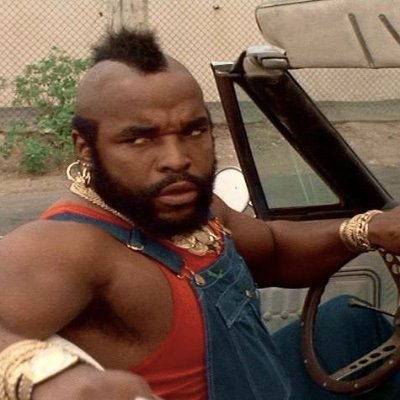
"The Oval Office offends on at least three levels: the ersatz nature of the decor, the way it grates against Hoban’s Neoclassical vision, and the way it misunderstands the classical-republican symbolism ... the kind of decor you'd expect from dictators who rob their own country."
derek guy@dieworkwear

The replies to this person's tweet lack a nuanced understanding of aesthetics. Let me tell you why I don't think this room works. First, the gold decorations make the room look like an ersatz Versailles. Go to Getty Images and type in "Oval Office." Then zoom in on the gold decor. You'll notice that the lines are very blunted and muddied; they lack the sharp lines and fine detailing that you'd expect on something made by an artisan. Hence why some people have suggested these decorations are from Home Depot (true or not, that's the impression). You can see the difference between the first and second photos. The first, of course, is of the Oval Office; the second is the reception room from the Hotel de Cabris in France, which was made during the 18th century under the direction of Louis XVI. Even at this distance, the second image looks much better because it was designed and executed by artisans working within a coherent visual language. You can really see the crisp lines and detailing. Second, the White House was designed by James Hoban, an Irish architect who migrated to the US for economic opportunities (what a great American story!). He originally designed it in the Neoclassical style, drawing on Palladian and Georgian influences. Neoclassicalism was a reaction against the Rococo movement, which reactionaries saw as overly ornate and frivolous. A bit of gold used sparingly and strategically can look fine in a Neoclassical building, but the amount Trump used has so radically encrusted the room that it's now in Rococo territory, making it look like a mismatch of aesthetics. You can see an example of gilded Rococo architecture in the third slide. Although it's not my thing, the effect is totally different because it's coherent. IMO, architecture sets the terms for you can decorate a space. Modernist furniture looks best in modernist buildings, just as Craftsman furniture looks best in Craftsman homes (see fourth slide). You don't have to do period recreations — sometimes mixing two aesthetics, or old and new, can make a space feel more natural — but having a sense of aesthetic history (art, architecture, furniture, fashion) can help you create better aesthetics. The Oval Office offends on at least three levels: the ersatz nature of the decor, the way it grates against Hoban’s Neoclassical vision, and the way it misunderstands the classical-republican symbolism that the White House was meant to project in the first place. As others have noted, this is the kind of decor you'd expect from dictators who rob their own country.

English
0
0
0
23
longitude 0 🇫🇷 🇩🇪 🇮🇪 🇪🇺 🇺🇦 ری ٹویٹ کیا
Tory Fibs
Tory Fibs@ToryFibs·
Outstanding answer.
English
169
756
4.8K
252.9K
longitude 0 🇫🇷 🇩🇪 🇮🇪 🇪🇺 🇺🇦 ری ٹویٹ کیا
James Lucas
James Lucas@JamesLucasIT·
Many scholars believe Rivendell was inspired by a real place. Tolkien hiked there in the summer of 1911. He was 19 years old, and the valley left a mark on him so deep that more than 50 years later he was still describing it from memory... The valley is called Lauterbrunnen. It sits in the Bernese Oberland, in the heart of the Swiss Alps. Tolkien went on foot, "carrying a great pack, in a party of twelve." They walked from Interlaken to Lauterbrunnen, then up to Mürren, and finally to the head of the valley in what he later called a wilderness of moraines. They slept in haylofts and cowsheds. They ate in the open. They walked by map, mostly avoiding the roads. Goethe had stood at the foot of those same falls more than a century before Tolkien did. The poem he wrote about them, Song of the Spirits Over the Waters, was published in 1779. There is something about this valley that has always pulled writers toward it — as if its sheer scale and beauty demand a response, and ordinary language keeps falling short… In 1967, at the age of 75, Tolkien wrote to his son Michael describing the 1911 trip in detail. He called it the "very part of the world that had the deepest effect on me." That is what this valley does. You walk into it once, and it follows you for the rest of your life... If you enjoyed this, I write a weekly newsletter for over 50,000 readers who love rediscovering the beauty of the past: James-lucas.com/welcome Join us!
English
30
250
2.1K
128.2K
longitude 0 🇫🇷 🇩🇪 🇮🇪 🇪🇺 🇺🇦 ری ٹویٹ کیا
Iran (I.R.of) Embassy in UK
The beauty of Persian carpets
English
45
247
1.6K
15.8K
longitude 0 🇫🇷 🇩🇪 🇮🇪 🇪🇺 🇺🇦 ری ٹویٹ کیا
Warfare Analysis
Warfare Analysis@warfareanalysis·
Finally, the identity of the Palestinian fighter who changed the oil on a moving Merkava tank in Gaza has been revealed. His name is Karim Abu Arja.
English
356
2.2K
16.1K
1.5M
longitude 0 🇫🇷 🇩🇪 🇮🇪 🇪🇺 🇺🇦 ری ٹویٹ کیا
courtneybonneauimages
courtneybonneauimages@cbonneauimages·
The level of complicity of the @BBC in the ethnic cleansing of southern Lebanon is shocking. I am listening to their Jerusalem correspondent report that the ‘IDF are striking Hezbollah targets’ while I’m on the ground in the middle of it watching men, women and children being killed on a daily basis. My colleagues are being executed. Paramedics are being systematically murdered. All of this is happening in plain sight and the BBC correspondent here in Lebanon knows it. May you all be put on trial for your deadly propaganda when the time comes. Shame on all of you, especially those on the ground who are too cowardly to speak out.
courtneybonneauimages tweet media
English
120
6.8K
11.8K
212.2K