Levai N.

8K posts

Levai N. banner
Levai N.

Levai N.

@mashlevi

You should become who you are 🇿🇼®

Harare,Zimbabwe شامل ہوئے Haziran 2015
288 فالونگ254 فالوورز
Noah Gwiba
Noah Gwiba@NoGwajaa·
@DougColtart This is a classic case of exaggeration. Parliament remains predominantly elected by the people. Chiefs are part of Zimbabwe’s constitutional structure and represent traditional leadership not presidential “proxies.” Their role is defined and limited by law. As for appointments, they exist to ensure balance, inclusion and expertise not to override democracy. The core of Parliament remains elected by citizens, and that’s what defines its democratic legitimacy. Let’s debate honestly kwete kungoita noise....
English
1
0
1
48
Doug Coltart ✊🏼🇿🇼
Under #CAB3, Parliament WON’T be democratically elected: - 10 will be appointed by the President - 18 will be indirectly appointed by the President & under his control (chiefs) - The remainder will be elected using an undemocratic delimitation process controlled by the President:
Doug Coltart ✊🏼🇿🇼 tweet media
English
18
89
160
3.8K
Levai N.
Levai N.@mashlevi·
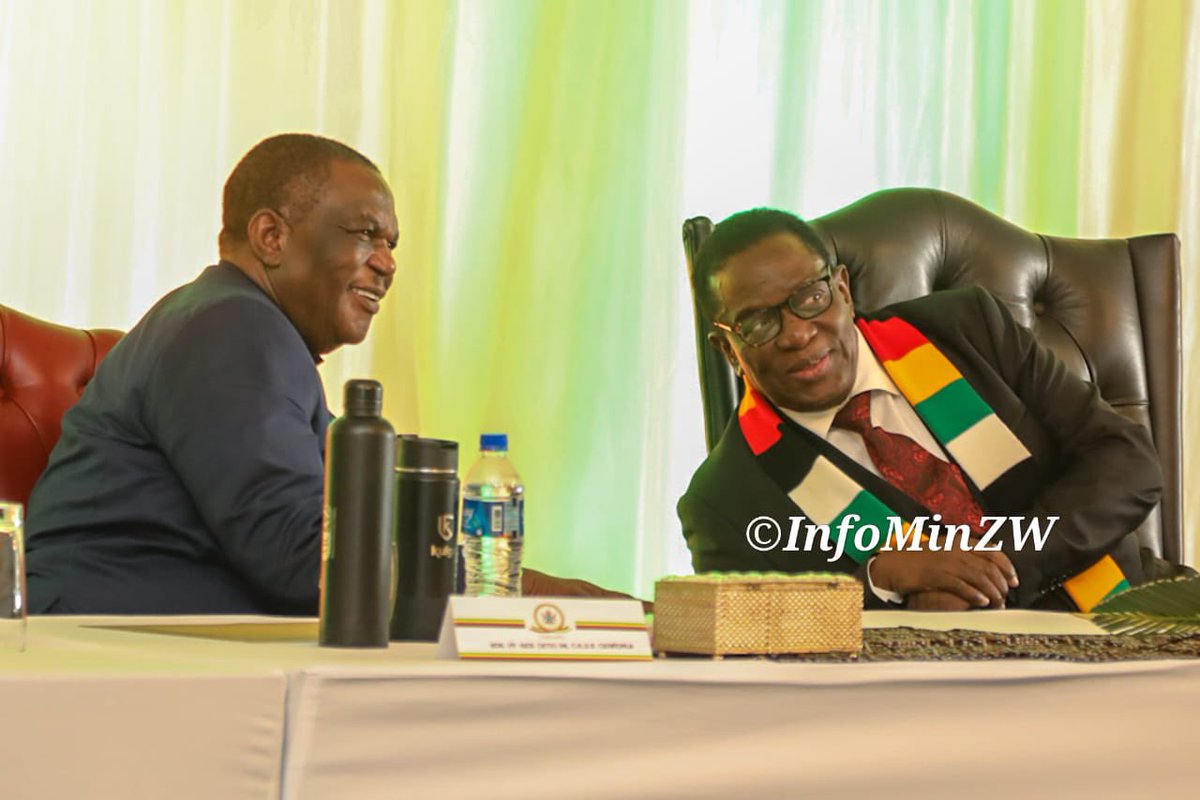
@nickmangwana Kkk ka look ka Mundenda at the VP.Its like he has seen an alien or something 😃😃
English
0
0
0
55
Nick Mangwana
Nick Mangwana@nickmangwana·
Vice President Gen. Rtd C.G.D.N Chiwenga and Vice President Col.Rtd K.C.D Mohadi have arrived at the #ZITF2026 grounds for the official opening ceremony. Botswana's President Duma Boko is the guest of honor for this year's edition of the trade expo.
Nick Mangwana tweet mediaNick Mangwana tweet mediaNick Mangwana tweet mediaNick Mangwana tweet media
English
5
2
15
2.8K
Levai N.
Levai N.@mashlevi·
@CMukungunugwa These are not the ones we deal with everyday tho.Ava ndeveku ZITF chete😃
English
0
0
0
49
C. H. MUKUNGUNUGWA
C. H. MUKUNGUNUGWA@CMukungunugwa·
ZIMBABWE REPUBLIC POLICE ZITF STAND 2026 Smartly dressed officers 🇿🇼
English
15
12
43
12.3K
mutonhodza
mutonhodza@chari639408·
Ukaona munhu anovenga Cab3,iyo iri ndiyo mudiriro yenyika how can a normal person hates ,kubudirira kwenyika yake ,a true Zimbabwean unomuona nekusapota Cab uyo asingadi mmm hatizivi unobvepi cause kubudirira kwenyika kunounza mufaro kwandri uye nemwana wese wemuZimbabwe
mutonhodza tweet media
Indonesia
22
6
10
696
Nyasha
Nyasha@NNyashaYessur·
Is ZITF an all government departments show why is there very little private sector participation. ZBC takes a stand next you have Zanupf one, FAZ, Ministry of Information, City of Harare, National Parks. Is this WHAT WE CALL businesses. Where is the PRIVATE SECTOR?.
Nyasha tweet media
English
7
4
11
529
hazel
hazel@hazelwekwagondo·
Fighting the Constitutional Amendment Bill No 3 is Fighting The Will of of the People The Constitutional Amendment Bill Number 3, a people-driven governance framework hinged on: ✅ Extending President @edmnangagwa's term to 2030 ✅Changing the electoral cycle from 5 to 7 years ✅Revamping the Zimbabwe Electoral Commission, etc. was a PLEA by the masses who sought to provide long-lasting solutions to Zimbabwe's governance. Any attempt to discredit, fight, and smear this bill is tantamount to fighting the will of the people, thereby fighting democracy as well. After all has been said and done, the Constitutional Amendment Bill No. 3 was a CALL by MASSES to prioritize policy continuity, development, and minimize the toxicity brought about by elections. 2030 Baba Va Mnangagwa Vanenge Vachitonga. #CAB3BHOO #ED2030BHOO
hazel tweet media
English
18
10
17
535
Levai N.
Levai N.@mashlevi·
@ProfJNMoyo Stop the mutilation of our constitution.Sctn 91 safeguard is that three or MORE counts as full term.But the constitution DID NOT leave MORE to be defined anyhow, stop this LIE pliz.According to this constitution MORE isn't forever but is capped at 5 yrs.Vakapasa maths can help
English
0
0
0
328
Prof Jonathan Moyo
Prof Jonathan Moyo@ProfJNMoyo·
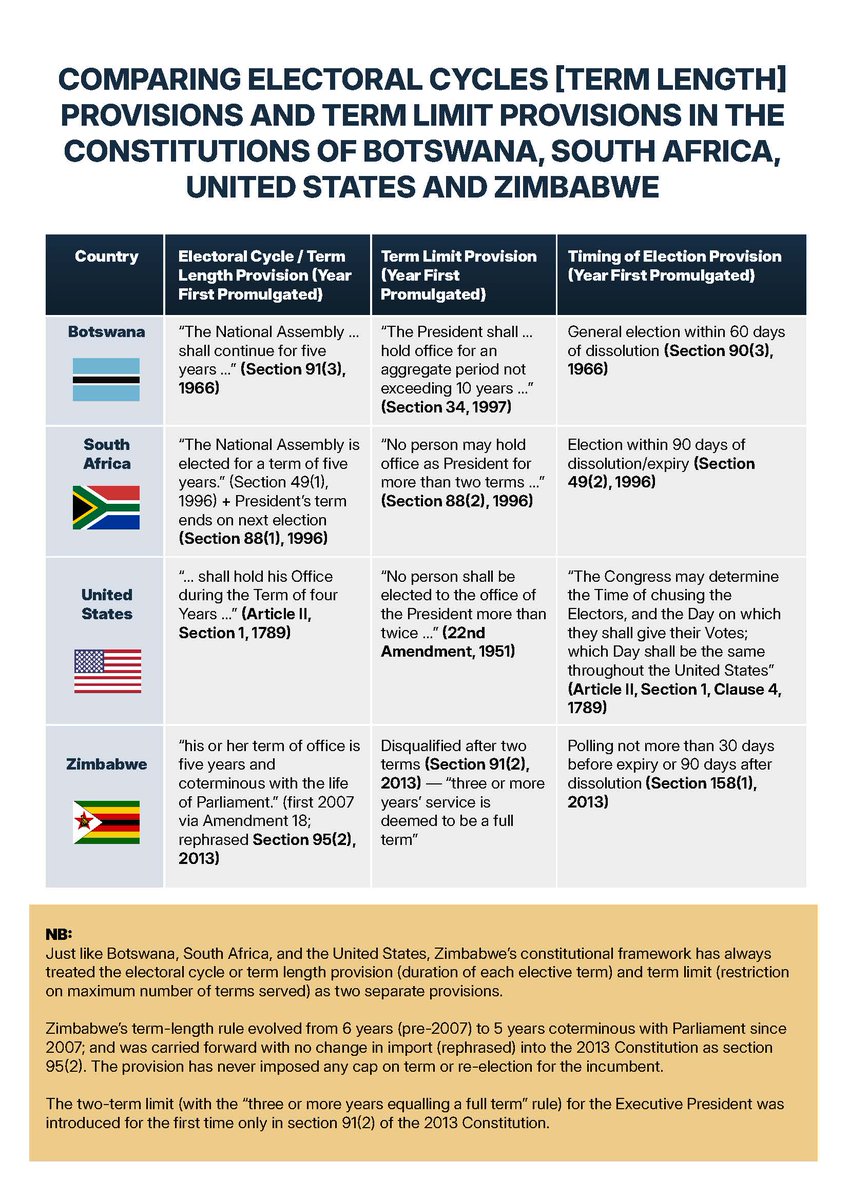
Debunking a Persistent and Dangerous Myth: Zimbabwe’s Constitution Contains Only One Presidential Term Limit Provision: In the intense public debate over the Constitution of Zimbabwe (Amendment No. 3) Bill, an utterly false claim is being repeated relentlessly and without a single shred of evidence: that the Constitution contains two separate presidential term limit provisions—sections 91(2) and 95(2)(b). This assertion is not merely incorrect; it is constitutionally impossible. No constitution anywhere in the world has ever created two distinct term limit provisions for the presidency. Section 95(2)(b) is not—and, according to the Constitution’s own crystal-clear definition in section 328(1), read with section 328(7), cannot possibly be—a term limit provision. A genuine presidential term limit provision restricts the total or maximum length of time any individual may hold or occupy the Office of President. Section 95(2)(b) does nothing of the sort. It simply defines the length of each presidential term as five years, running coterminous with the life of Parliament. In straightforward language, section 95(2)(b) regulates the office itself, not the person who holds it, and says absolutely nothing about how many terms or the length of time any one individual may serve. The Constitution of Zimbabwe (2013) contains only one term limit provision: Section 91(2). This clause is unequivocal and ironclad. It prohibits any person from serving more than two terms as President, with the vital safeguard that three or more years in office counts as a full term. It is only this single provision—and this provision alone—that actually limits the total time any individual can occupy the highest office in the land. Nothing illuminates this fundamental distinction more powerfully than comparative constitutional analysis—the gold standard for both public education and responsible policymaking. As the ancient wisdom has it, there is truly nothing new under the sun. A careful examination of proven global practice, vividly illustrated in the attached infographics, reveals three clear and time-tested approaches that nations around the world have taken when designing presidential term rules: Case 1 – Term length only (unlimited re-election permitted) Constitutions in this category have a single provision that simply defines the length of each presidential term, leaving the number of terms entirely open. This constitutional model operated successfully for decades—for example—in Botswana (31 years, 1966–1997), the United States (163 years, 1789–1951), and Zimbabwe itself (23 years, 1987–2013). Case 2 – Two separate provisions Here constitutions have two separate provisions: one that sets the length of each presidential term; and a second, entirely distinct clause that limits the total time any person may serve as President. This is precisely the framework that has—for example—operated in Botswana since 1997, South Africa since 1996, the United States since 1951, and Zimbabwe since 2013. The first infographic displays this clear separation of the two provisions across all the four countries. Case 3 – Combined in one elegant clause Constitutions in this category have a single constitutional provision that seamlessly merges both term limit concepts—defining term length while simultaneously imposing the limit. This approach has—for example— stood the test of time in Argentina (since 1994), Chile (since 1980), France (since 1958), Mexico (since 1917), the Philippines (since 1987), and South Korea (since 1987), as shown in the second infographic. The historical record is especially telling. Botswana introduced its separate term limit provision only after 31 years of independence, the United States after 163 years, and Zimbabwe after more than two decades of operating under a pure term-length provision. South Africa, by contrast, enshrined both provisions, separately, from the very first day of its democratic Constitution in 1996. These facts drive home an irrefutable truth: a provision that merely defines the length of a term has never been—and can never be—a term limit provision. The distinction is not a technicality; it is the bedrock of constitutional integrity. Recognising it clearly ensures that public discourse and debate on constitutional amendments is anchored in facts, logic, and proven international best practice, rather than convenient fiction to advance nefarious political agendas. Zimbabwe and Zimbabweans deserve nothing less!
Prof Jonathan Moyo tweet mediaProf Jonathan Moyo tweet media
English
153
147
139
43.1K
Levai N.
Levai N.@mashlevi·
@daddyhope Toxicity is everywhere in Africa politics.But for the sake of ubuntu shouldn't the government have yielded to family demands here?
English
0
0
0
339
Levai N.
Levai N.@mashlevi·
@BaShonaBaShona Tenders can't be written off ,how is that even possible-wrong analysis.His massage is all about teaching these youth good business ethics, being responsible citizens & to shun being corrupted by current abuse of govt tenders by the connected few.
English
0
0
0
246
BaShona.
BaShona.@BaShonaBaShona·
I am trying to understand the Minister's statement here, but I am failing. Perhaps it's because it's a short video. However, the reality about tenders cannot be written off; it would be daydreaming. During the 70s 80s, 90s, and early 2000s, companies owned by white people were getting tenders from local government and central government. Today, because it's us black people with our small companies applying for tenders and supplying the government, it becomes an issue. The President is on record saying "nyika inovakwa neve vayo," meaning to say we should participate in doing business with the government and its agencies, and there's nothing wrong with that. Tenders are a proper business.
𝑲𝒖𝒅𝒛𝒂𝒊 𝑴𝒖𝒕𝒊𝒔𝒊@KMutisi

Is it a crime to get a government tender though?? Those youths should aspire to get government tenders too… The Minister shouldn’t be teaching young people that getting tenders is a bad thing!
English
10
2
5
5.1K
Levai N.
Levai N.@mashlevi·
@KMutisi He didn't say don't explore tender.He said money is not made thru govt tenders alone an area being abused especially in the second republic. Infact the day this second republic falls a huge broom would be required there.
English
0
0
4
587
𝑲𝒖𝒅𝒛𝒂𝒊 𝑴𝒖𝒕𝒊𝒔𝒊
Is it a crime to get a government tender though?? Those youths should aspire to get government tenders too… The Minister shouldn’t be teaching young people that getting tenders is a bad thing!
263Chat.com 🇿🇼@263Chat

I have never been awarded a government tender, and I have no intention of pursuing one. There are so many opportunities to get without relying on tenders says Minister of Youth, Tino Machakaire at the Youth Business Forum today.

English
79
9
19
23.5K
Stanley Gama
Stanley Gama@gama_stanley·
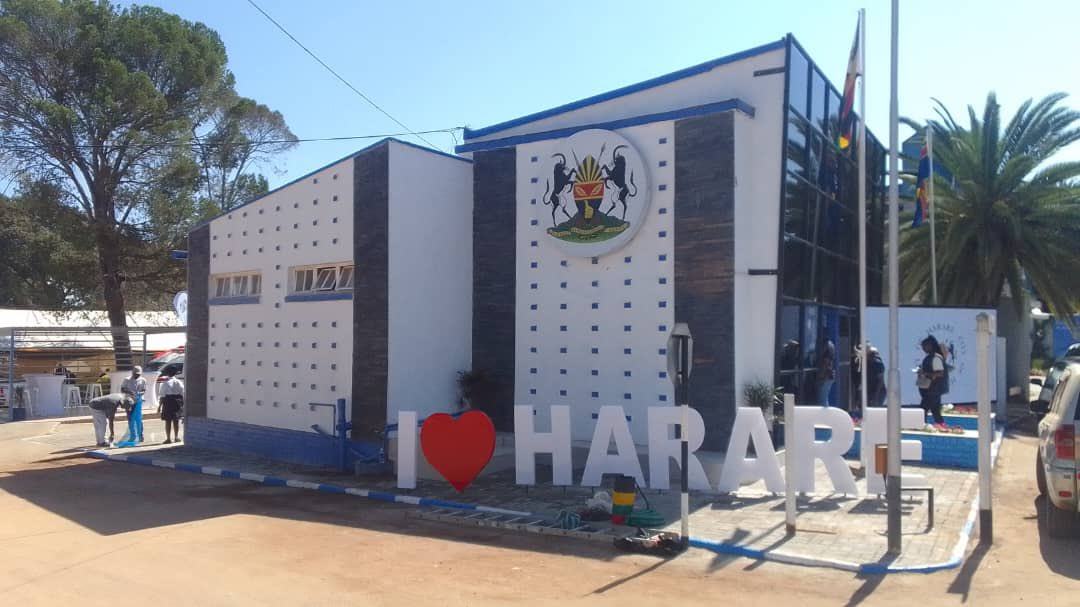
Our City of Harare stand at the ongoing ZITF looks fabulous.
Stanley Gama tweet mediaStanley Gama tweet media
English
91
1
37
38.4K
Dr Rugare EN Gumbo
Dr Rugare EN Gumbo@RugareENGumbo1·
The Youth League should always stand to defend Zanu-PF interests especially the President as the appointing authority. However, in this case, it chose to advance the interests of a specific faction. Parliament has its own mechanisms to speak on its behalf as a legislative body.
Dr Rugare EN Gumbo tweet media
English
21
3
13
3K
Paddy Pardon
Paddy Pardon@CdeNgomaNeHosho·
No force, internal or external, can drive a wedge between President Emmerson Mnangagwa and his deputy Constantino Chiwenga—their unity is resolute and unshakable.
Paddy Pardon tweet media
English
7
1
5
700
Levai N.
Levai N.@mashlevi·
@TembaMliswa Source of Chivayo's wealth yahara itoriwo highly controversial.Ofcoz there isn't nothing honorable about our parly anymore to defend but apa zvezvanynyawo apa
English
0
0
0
172
Sabhuku Temba P. Mliswa
Sabhuku Temba P. Mliswa@TembaMliswa·
𝐒𝐀𝐁𝐇𝐔𝐊𝐔'𝐒 𝐄𝐘𝐄: 𝐑𝐞𝐬𝐢𝐬𝐭𝐢𝐧𝐠 𝐋𝐨𝐜𝐚𝐥 𝐁𝐞𝐧𝐞𝐯𝐨𝐥𝐞𝐧𝐜𝐞 𝐀𝐧𝐝 𝐓𝐡𝐞 𝐁𝐮𝐫𝐝𝐞𝐧 𝐎𝐟 𝐀 𝐂𝐨𝐥𝐨𝐧𝐢𝐚𝐥 𝐌𝐢𝐧𝐝𝐬𝐞𝐭 The assertion that financial assistance received by Parliament from a private individual compromises its integrity is fundamentally misguided and reflects a narrow understanding of the complexities of political funding. The argument reveals an inclination towards political conspiracy, predicated not on observable facts but on speculative presuppositions. It is well documented that Parliament and MPs have historically benefited from a wide spectrum of financial support, both domestically and internationally. For instance, the recent construction of the new Parliament building in Mt Hampden is a $140m-$200 million donation from the Chinese. In addition, Parliament has actively engaged in a "Multi-donor Programme approach" facilitated by organisations such as the United Nations Development Programme (UNDP). This approach incorporates funding from various Western and seemingly opposition-aligned entities, including USAID, the Swedish International Development Cooperation Agency (SIDA), the Konrad Adenauer Foundation (KAF), the Friedrich Ebert Stiftung (FES), and the African Capacity Building Foundation (ACBF). Curiously, there has been no public outcry regarding the potential compromises posed by these Western entities to the integrity of Parliament. However, the moment a local citizen, such as Chivayo, proffers similar support, it becomes a cause for concern. Such a perspective betrays an unsettling inferiority complex and suggests a mindset that has yet to fully undergo decolonisation. The reluctance to accept that a local individual, particularly one who is Black, can leverage personal financial resources to bolster democratic institutions like Parliament, contrasts starkly with the unquestioning acceptance of foreign contributions from individuals like George Soros, whose intentions remain unknown. When MPs have advocated for enhanced financial support to align with regional, continental, and global standards, public discontent has often ensued. This criticism has fostered a precarious situation whereby MPs find themselves financially vulnerable, thereby exposing them to potential compromise by other governmental branches that are, by contrast, amply provisioned. It is noteworthy that Ministers and legislative bodies receive far more substantial remuneration than MPs, yet there remains an expectation that MPs will effectively exercise oversight over these better-resourced entities. This creates an untenable dynamic in which a financially constrained individual is tasked with monitoring someone who is well-nourished, a decidedly precarious arrangement. I have long raised concerns regarding the financial conditions of MPs and the inherent dangers therein. They are allocated a single vehicle over a five-year term, fuel allowances intended for travel to Parliament, and nominal seating allowances, which, when juxtaposed against standard benchmarks, constitute a starkly insufficient provision. Furthermore, there is no support allocated for their extensive constituency work and travel. In essence, is it not a pitfall we have already engineered, fostering conditions that render our legislators compromise-prone and less effective? MPs play a pivotal role in approving budgets for the Executive, thereby enhancing their operational capacities, yet their own remains poor. In this context, the MPs themselves bear a portion of the responsibility for endorsing such arrangements. Figures fighting Chivayos' donation,n such as John Paradza and Tino Machakaire, are doing so not out of principled conviction, but rather because personally they don’t have a need for such support. They already have mines and businesses. Again, they are politically compromised and are defending their faction. Their financial standing liberates them from the dependency on the $10,000 support, which many of their fellow MPs find critically necessary. This dynamic reveals a broader reality within local politics: candidates endowed with substantial resources often emerge victorious in electoral contests. They wield financial capital as a means to secure positions of power, afterwards opting for silence on pressing issues in Parliament. The presence of financial benefactors, such as Chivayo, serves to balance the political landscape by empowering individuals with limited resources, thereby enabling them to wield greater efficacy in their roles. Moreover, the current situation, marked by various party factions contributing to a state of confusion on a relatively straightforward issue, underscores the argument made by some of us that the factional discord emerging from the Vice President’s PB and CC antics is leading the party into disrepute. Entities within the party, including the Youth League and Women’s League, have lost their potency in advancing the party’s agenda, as they increasingly focus on their own factional ambitions.
Sabhuku Temba P. Mliswa tweet media
English
57
4
18
21.7K
Levai N.
Levai N.@mashlevi·
@MaronjeseVital Spot on,our parliament is already compromised so is the judiciary.CAB3 legitimacy is thru a national referendum not parliament.
English
0
0
1
10