Maxime Petazzoni

1.5K posts

Maxime Petazzoni banner
Maxime Petazzoni

Maxime Petazzoni

@mpetazzoni

Engineering leader building great teams and products @traversal_ai. Previously @wherobots, and @splunk/@signalfx. Tweets and opinions are my own. 🇫🇷🇺🇸

San Francisco, CA شامل ہوئے Kasım 2013
749 فالونگ449 فالوورز
Maxime Petazzoni
Maxime Petazzoni@mpetazzoni·
mfw my weekly average hit 5h55 this week juggling a high intensity job and a toddler: 😱😵
Aakash Gupta@aakashgupta

The scariest finding in this paper: the subjects couldn't tell it was happening. UPenn ran this study on 48 healthy adults. One group slept 8 hours. Another slept 6. Another slept 4. For 14 straight days. They tested cognitive performance every 2 hours from 7:30am to 11:30pm. The 6-hour group's reaction times, working memory, and sustained attention deteriorated on a near-linear curve. By day 14 they were performing at the same level as someone who hadn't slept at all in 48 hours. The 4-hour group hit that threshold by day 6. Here's the part that should unsettle everyone who thinks they "do fine" on 6 hours: the subjects' self-reported sleepiness flatlined after the first few days. Their brains kept getting worse. Their perception of how impaired they were stopped updating. The cognitive decline was invisible to the person experiencing it. The researchers found a hard threshold. Any wakefulness beyond 15.84 hours in a day produces cumulative neurobiological cost. That cost compounds every single day you exceed it and does not reset with a weekend of sleeping in. About 35% of American adults sleep less than 7 hours a night. 40% of those get 6 hours or less. In 1942 that number was 11%. We built an entire professional culture around a sleep schedule that this paper says is functionally equivalent to pulling consecutive all-nighters. "I'm fine on 6 hours" is the most common response to sleep research. The first thing chronic sleep debt destroys is your ability to notice chronic sleep debt.

English
0
0
1
48
Maxime Petazzoni
Maxime Petazzoni@mpetazzoni·
Parenting is like a never ending Easter egg hunt, but with cheerios. I think my MTBC (mean time between cheerios) has averaged under 15min today. They just keep popping up everywhere 😆
English
0
0
0
20
Maxime Petazzoni
Maxime Petazzoni@mpetazzoni·
As OpenAI and Anthropic continue to eat up the software development ecosystem, the next step will be for them to acquire and own where+how those applications are hosted.
English
0
0
0
29
Maxime Petazzoni
Maxime Petazzoni@mpetazzoni·
It's 10pm. Do you know what your agents are doing?
English
0
0
0
51
Maxime Petazzoni ری ٹویٹ کیا
Dr. Catharine Young
Dr. Catharine Young@DrCatharineY·
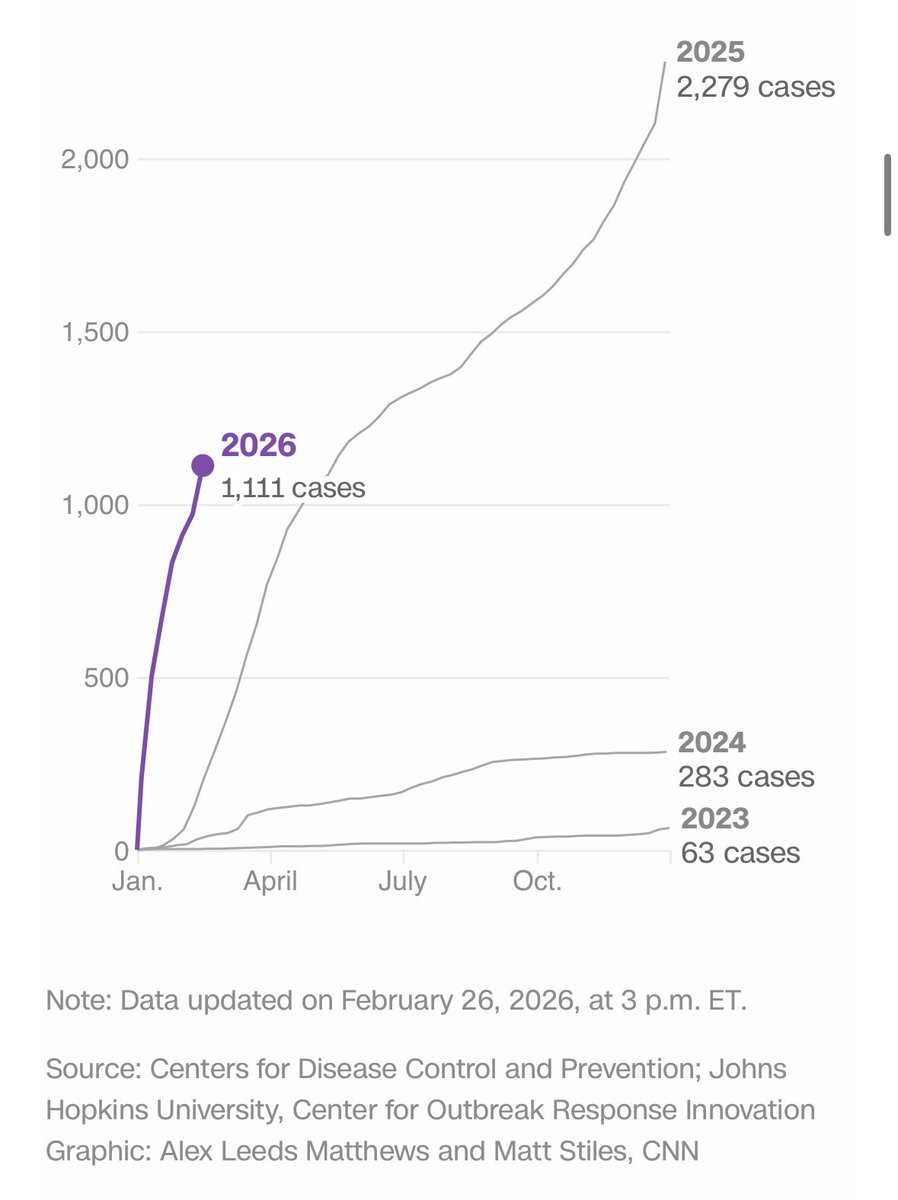
We are now at 1136 new measles cases - in just the first 8 weeks of this year alone. A preventable disease resurging. This is an abject policy failure.
Dr. Catharine Young tweet media
English
2.3K
4.3K
11.6K
1M
Maxime Petazzoni
Maxime Petazzoni@mpetazzoni·
👇🏼 The speed and scale at which this happened - it wasn't working before December, and now it's basically the default way to work - is part of what makes it the most exciting times in our careers. And if AI is expected to accelerate many things even further, ... 🤯
Andrej Karpathy@karpathy

It is hard to communicate how much programming has changed due to AI in the last 2 months: not gradually and over time in the "progress as usual" way, but specifically this last December. There are a number of asterisks but imo coding agents basically didn’t work before December and basically work since - the models have significantly higher quality, long-term coherence and tenacity and they can power through large and long tasks, well past enough that it is extremely disruptive to the default programming workflow. Just to give an example, over the weekend I was building a local video analysis dashboard for the cameras of my home so I wrote: “Here is the local IP and username/password of my DGX Spark. Log in, set up ssh keys, set up vLLM, download and bench Qwen3-VL, set up a server endpoint to inference videos, a basic web ui dashboard, test everything, set it up with systemd, record memory notes for yourself and write up a markdown report for me”. The agent went off for ~30 minutes, ran into multiple issues, researched solutions online, resolved them one by one, wrote the code, tested it, debugged it, set up the services, and came back with the report and it was just done. I didn’t touch anything. All of this could easily have been a weekend project just 3 months ago but today it’s something you kick off and forget about for 30 minutes. As a result, programming is becoming unrecognizable. You’re not typing computer code into an editor like the way things were since computers were invented, that era is over. You're spinning up AI agents, giving them tasks *in English* and managing and reviewing their work in parallel. The biggest prize is in figuring out how you can keep ascending the layers of abstraction to set up long-running orchestrator Claws with all of the right tools, memory and instructions that productively manage multiple parallel Code instances for you. The leverage achievable via top tier "agentic engineering" feels very high right now. It’s not perfect, it needs high-level direction, judgement, taste, oversight, iteration and hints and ideas. It works a lot better in some scenarios than others (e.g. especially for tasks that are well-specified and where you can verify/test functionality). The key is to build intuition to decompose the task just right to hand off the parts that work and help out around the edges. But imo, this is nowhere near "business as usual" time in software.


English
0
0
0
45
Maxime Petazzoni ری ٹویٹ کیا
Dane Knecht 🦭
Dane Knecht 🦭@dok2001·
Everything we're doing to make codebases "agent-ready" (better docs, less dead code, smaller surfaces) engineers always needed too. Agents just have zero tolerance for the entropy humans learned to work around. They can't "just know" a file is outdated or a code path is dead. They take your codebase at face value, which means it finally has to be worth taking at face value.
English
42
87
841
117K
Maxime Petazzoni ری ٹویٹ کیا
Abhishek Singh
Abhishek Singh@0xlelouch_·
The best senior software engineers I’ve worked with all share this exact trait: extreme ownership. When something breaks in production, they don’t start with “the requirements were unclear” or “another team caused it.” They start with: “What did I miss?” or “What assumption did I make that turned out to be wrong?” They treat every outage, bad deploy, or missed deadline as data. If a system failed, they ask: Should I have added better observability? Could I have asked sharper questions earlier? Did I simplify too much? What guardrail would prevent this next time? Even when they technically did the right thing, they still look for ways to increase future signal: better metrics, smaller rollouts, clearer contracts, earlier feedback loops. This mindset is what separates seniors from mids. Senior roles are all about reducing repeat mistakes and compounding good decisions. No blame. No ego. Just learn → adjust → apply. That is what turns experience into wisdom and gets you promoted.
Justin Skycak@justinskycak

The most effective people I've met all maintain a gigantic locus of control and bias towards internalizing blame. Whenever something doesn't go their way, they deeply analyze the circumstances to identify what they should have done differently, or, even if they acted appropriately based on all the information available, how could they have gotten more information or taken intermediate actions to extract more signal to inform later bigger actions. They don't dwell or make excuses. They just learn and apply that learning to the future so they don't make the same mistake twice.

English
10
76
794
80.4K
Maxime Petazzoni ری ٹویٹ کیا
Vic 🌮
Vic 🌮@VicVijayakumar·
Here are the 4 topics we should continue to talk about this week. We are canceling all other topics at this time. 1. AI has resulted in lots of developers outshipping themselves and improving their product, and caused a cambrian explosion of personal software, personal insights, and a billion new note taking apps that scratch your own itch. No more "I wish there was a way to". 2. AI has not resulted in any revolutionary new platform tooling like Docker or Kubernetes. 3. AI has not resulted in any existing tools becoming orders of magnitude better. 4. People are talking way more about using AI than about what they are building with it.
English
28
8
148
13.2K
Maxime Petazzoni
Maxime Petazzoni@mpetazzoni·
Curious what you all think, or if you know people thinking about those transformations that are worth a follow!
English
0
0
0
13
Maxime Petazzoni
Maxime Petazzoni@mpetazzoni·
What does it mean for the authoring of this content, which itself can/is becoming AI-assisted?
English
1
0
0
15
Maxime Petazzoni
Maxime Petazzoni@mpetazzoni·
What's the future of information? As AI and LLMs become the primary interface for most (re)search, what becomes of the UIs of their sources, originally designed for humans? What does it mean for how information is written/captured, stored, and rendered from those sources?
English
1
0
0
16