Salil Tripathi (સલિલ ત્રિપાઠી)

6.7K posts

Salil Tripathi (સલિલ ત્રિપાઠી) banner
Salil Tripathi (સલિલ ત્રિપાઠી)

Salil Tripathi (સલિલ ત્રિપાઠી)

@saliltripathi

Bks @AlephBookCo @yalepress @seagullbooks @contextIndia SrAdv @ihrb Sr associate @cisl_cambridge @indexcensorship @SGUnbound1 Board @pen_int @CHRI_UK Views mine

New York شامل ہوئے Nisan 2008
8.3K فالونگ113.8K فالوورز
Salil Tripathi (સલિલ ત્રિપાઠી) ری ٹویٹ کیا
Ted Merz
Ted Merz@TedMerz·
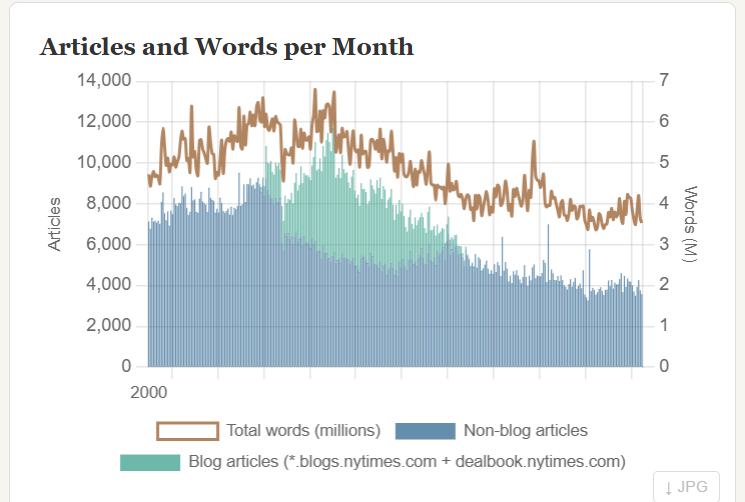
The best story about The New York Times this week didn’t appear in the paper. In fact it wasn’t an article at all, but a web site created by a freelance journalist named Ted Alcorn. Alcorn tapped into the paper’s public API to create a dashboard that provides some extraordinary insights. The first was that over the past 25 years, the Times employed – at various times – a total of 26,000 reporters who wrote 1.5 billion words to produce 2.2 million articles. You can use the dashboard to drill down to see which beats, topics and people have been covered the most and how that coverage has fluctuated. A few examples of the kinds of things Alcorn cited that he noticed: ➡️Trump dominates headlines vs everyone ➡️Maggie Haberman has the most bylines recently ➡️India has been undercovered per-capita ➡️China coverage peaked around 2014 ➡️Iowa stories surge every four years Political partisans will mine the site for ammunition to argue the paper of record is pro THIS or anti THAT. But that debate misses larger truths unearthed counting the number of stories in so many ways over such a long time period. The volume provides a measure of attention largely independent of ideology. Whether a news story about Trump is positive or negative doesn’t change the fact it is about Trump. And the fact that a story was published about Trump reflects interest in hm. It’s not a perfect system, but at this scale, breath and consistency, there is probably no better public dataset to measure what is on everyone's mind. What Alcorn built – whether he realized it or not – was effectively a better version of Google Trends. Google Trends provides comparisons based on search but they don't give you the actual data. It's normalized so you get relative percentages and that limits the comparisons you can make. The Times archive comes from a single institution with a mostly consistent editorial policy over 25 years. That makes apples to apples comparisons possible. It’s a clean cohort in a world where good data is hard to find. It provides a useful signal for understanding how attention has shifted among countries, companies, or individuals. Times reporters jumped on the site when it appeared, mostly to see where they ranked on the leader board. Times editors will likely use the tool to better understand how coverage has shifted. Given its utility, it’s sort of insane that it took an outsider to build it. But in an open API world, the best analytics often are built by people outside the wall. Alcorn explained the difficulty of reconciling data: Categories shift and reporters change names. The same subject gets coded differently over time. Some Times reporters flagged bugs and suggested features. But so far the paper hasn’t commented on the project, which he cheekily called Below the Fold. Here is the link to the @tedalcorn site tedalcorn.github.io/nyt/
Ted Merz tweet media
English
6
52
196
48.5K
Salil Tripathi (સલિલ ત્રિપાઠી) ری ٹویٹ کیا
Acyn
Acyn@Acyn·
Mamdani: When I ran for mayor, I said I was going to tax the rich 
Well, today we're taxing the rich...
English
1.2K
10.8K
132.8K
11.8M
Salil Tripathi (સલિલ ત્રિપાઠી) ری ٹویٹ کیا
Nagrik 🇮🇳
Nagrik 🇮🇳@indian_nagrik·
This is the full submission of @ArvindKejriwal for his recusal application. He lists 10 brilliant point. This is masterclass in how to argue your own case in court and even the judge got impressed. This is peak Cinema and Peak Legal detailing!
English
30
547
1.3K
43.3K
Darshana
Darshana@ravishingrani·
@saliltripathi It is not about the charges at all,I think most people will prefer paying for it happily if they have mobility issues.I am just speaking about sweeping generalisation Bruce's post makes.
English
1
0
0
118
Bruce
Bruce@bruce_barrett·
Air India says 30% of passengers on India-US flights ask for wheelchairs. Most are able bodied travelers scamming the priority boarding system. Real disabled passengers get left short.
English
5.2K
9.7K
74.9K
14.6M
Salil Tripathi (સલિલ ત્રિપાઠી)
@gypsy_nilima What a horrible way to distort what I said. Not sure you even read what I said. It is wrong to misuse it. It is not wrong to use it for legitimate reasons. Of course knee replacement patients are legitimate. Whatever makes you write before reading?
English
1
0
1
147
Dr Nilima Srivastava
Dr Nilima Srivastava@gypsy_nilima·
What a horrible thing to say Approximately 700,000 to 750,000 knee replacement surgeries are performed annually in India, According to a study The pooled prevalence of OA knee among elderly persons in India was 47% It’s not the long walk that’s the problem, it’s standing in a long line which aggravates knee pain
English
2
0
1
225
Amitabo_Buddha
Amitabo_Buddha@AmitaboB·
@NabenduGupta @saliltripathi That's not what wheelchairs are meant for. The written English is no different from written English in India. In fact, the standard government font in the UK is very clear and legible. Officials are helpful.
English
1
0
0
83
Prem Panicker
Prem Panicker@prempanicker·
Advisory: After 15 years, my wife and I say goodbye to Bangalore. Tomorrow, we shift base to Kochi. Thank you BGL -- you have been very kind to us and we have happy memories to take away with us. PS: Responses will be very limited here on; we are in the midst of packing. Au revoir.
English
101
29
1.2K
162.9K
Luke O'Reilly
Luke O'Reilly@LucRaghallaigh·
I’m the news editor at the New Statesman. Looking to publish long-form reports, essays, and opinion pieces. Very open to length and form. We want scoops, new ways of thinking, and insights into worlds our readers don’t have access to. Pitch to me Luke.oreilly@newstatesman.co.uk
English
24
85
499
55.4K
Kaushik Basu
Kaushik Basu@kaushikcbasu·
As an economist I was hesitant reading this book. But was pleasantly surprised. For a sweeping & accurate history of economics, from ancient Greece to contemporary times—George Akerlof, Joseph Stiglitz, Amartya Sen, all in less than 250 pages, it turned out to be a page turner.
Kaushik Basu tweet media
English
71
937
7.4K
370.3K
Krishnan Nayar, retweets not endorsements.
Nehruites divided Indians too. It is notorious that they played religions and castes to win elections. That is why Modi got his chance. Indians rushed to America to get economic opportunity, which Nehru's economy did not provide. Mamdani was born in Uganda and is now also an American. He has never been Indian. Indian Muslims did not follow Gandhi and Nehru before 1947 but preferred Jinnah and Pakistan in their politics. That was why Partition happened. That is a fact.
English
4
2
8
1.3K
Bill Ackman
Bill Ackman@BillAckman·
An accurate prognosis for NYC.
X@XaviercMiller

Here’s what I think will happen in NYC under Mahdami. The free buses and government grocery stores won’t happen, they never do. They sound good during campaigns, but collapse under basic math. You can’t run a city on ideas that cost billions and produce no revenue. The only way to make housing affordable is to build more housing. The free market lowers prices, not regulation. Every time politicians try to control rent or force affordability by decree, developers stop building and landlords stop maintaining. Supply dries up, the quality collapses, and the few properties that remain skyrocket in price. Once landlords can’t make a profit, they sell, lose properties, or walk away. Eventually, the government takes over. Taxes will rise to pay for the promises, and the middle class will be the ones shouldering the burden. The rich will relocate, the poor will depend on subsidies, and the productive class will be squeezed from both sides. Thriving businesses are the foundation of any thriving city. When they leave, everything else follows, jobs, schools, grocery stores, stability. Chicago already proved this. Boeing, McDonald’s, Caterpillar, Citadel, nearly 70k jobs, all gone. Now they’re facing billion-dollar deficits, half empty schools and neighborhoods without grocery stores. I saw someone who lived in a rent-controlled apartment in California put it perfectly, he said his landlord could no longer afford maintenance so the pool was filled with dirt, the floors had soft spots, and the foundation ended up cracking. That’s what overregulation does, it destroys quality. People who voted for this will eventually feel the pain but they won’t blame the policies or the politicians, they’ll blame the rich for leaving. This conversation is always difficult because most people simply don’t understand market dynamics or incentives. In a free society, people act in their own self-interest. If you remove profit and reward dependency, productivity dies and the city with it. If you think things are expensive now, just wait until they’re “free.”

English
356
465
6.1K
1.5M
X
X@XaviercMiller·
Here’s what I think will happen in NYC under Mahdami. The free buses and government grocery stores won’t happen, they never do. They sound good during campaigns, but collapse under basic math. You can’t run a city on ideas that cost billions and produce no revenue. The only way to make housing affordable is to build more housing. The free market lowers prices, not regulation. Every time politicians try to control rent or force affordability by decree, developers stop building and landlords stop maintaining. Supply dries up, the quality collapses, and the few properties that remain skyrocket in price. Once landlords can’t make a profit, they sell, lose properties, or walk away. Eventually, the government takes over. Taxes will rise to pay for the promises, and the middle class will be the ones shouldering the burden. The rich will relocate, the poor will depend on subsidies, and the productive class will be squeezed from both sides. Thriving businesses are the foundation of any thriving city. When they leave, everything else follows, jobs, schools, grocery stores, stability. Chicago already proved this. Boeing, McDonald’s, Caterpillar, Citadel, nearly 70k jobs, all gone. Now they’re facing billion-dollar deficits, half empty schools and neighborhoods without grocery stores. I saw someone who lived in a rent-controlled apartment in California put it perfectly, he said his landlord could no longer afford maintenance so the pool was filled with dirt, the floors had soft spots, and the foundation ended up cracking. That’s what overregulation does, it destroys quality. People who voted for this will eventually feel the pain but they won’t blame the policies or the politicians, they’ll blame the rich for leaving. This conversation is always difficult because most people simply don’t understand market dynamics or incentives. In a free society, people act in their own self-interest. If you remove profit and reward dependency, productivity dies and the city with it. If you think things are expensive now, just wait until they’re “free.”

English
1.9K
9.1K
55.6K
6.3M