
Scorchsoft

1.2K posts

Scorchsoft banner
Scorchsoft

Scorchsoft

@scorchsoft

App, Web App, Portal Development - Helping businesses to successfully deliver innovative, technically complex projects using the latest development technologies

Birmingham, United Kingdom شامل ہوئے Nisan 2010
256 فالونگ370 فالوورز
Scorchsoft
Scorchsoft@scorchsoft·
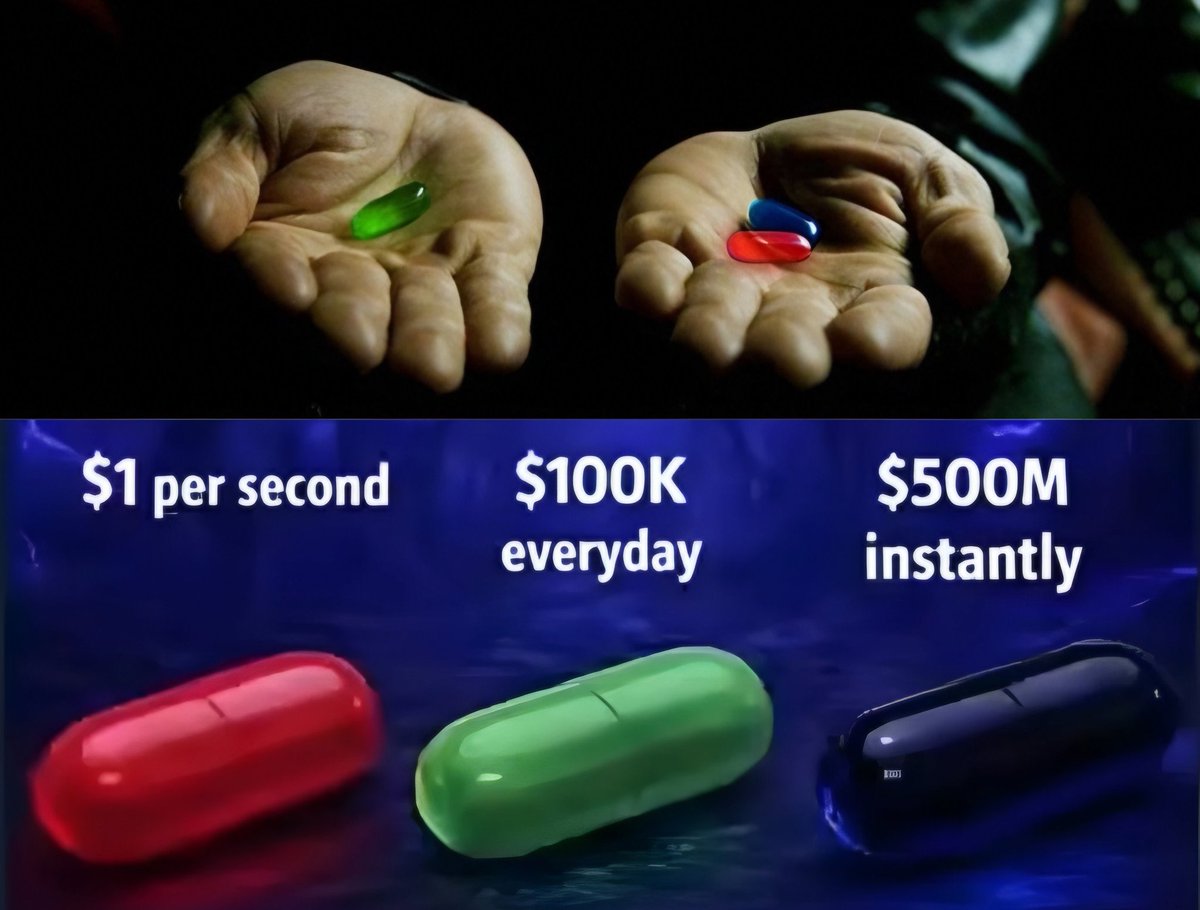
If stocks return ~7%/yr, $500m now grows faster early. Investing $100k/day only catches up after ~14,113 days ≈ 38.7 years. NPV at 7% says the same thing: PV of $100k/day forever ≈ $539m, so it can beat $500m… eventually. Also: if market returns are > ~7.6%/yr, the $500m upfront wins forever. So unless you fancy waiting ~4 decades (or expect <7.6% returns), take the $500m. (Disclaimer: this post is not financial advice)
English

0
0
1
200
NO CONTEXT HUMANS
NO CONTEXT HUMANS@HumansNoContext·
Which pill would you choose?
NO CONTEXT HUMANS tweet media
English
1.8K
269
18.1K
3.2M
Scorchsoft ری ٹویٹ کیا
Andrew Ward
Andrew Ward@AndrewLeeWard·
Want a brutal product workshop without paying for a workshop? Go read the 2 and 3-star reviews of the top companies in your category. Not the 1-star rage. Not the 5-star fan club. The middle reviews are where the truth lives: “It’s good, BUT...” “It works, EXCEPT...” “I like it, HOWEVER...” If you build apps, portals, or SaaS (or you buy them), this is one of the fastest ways I know to get to a roadmap that isn’t just opinions in a meeting room. The 30-minute “2-star teardown” Step 1: Pick a category + 3 competitors Choose the ones your customers already compare you to. Not the ones you personally dislike. Not the ones your sales team name-drops. The real comparison set. Step 2: Collect 30 reviews (2-3 stars) Ten per competitor is plenty. Copy the text into a doc or spreadsheet. You’re not doing academic research here. You’re hunting patterns. Step 3: Tag every complaint into 5 buckets This is the bit that stops you getting lost in noise. - Time: “This takes too long” - Trust: “I don’t trust it” - Clarity: “I don’t understand it” - Control: “I can’t change it” - Support: “Nobody helps when it breaks” You’ll notice something quickly: most product “ideas” are just one of these buckets wearing a fake moustache. Step 4: Turn complaints into jobs Rewrite each complaint as: “When I’m trying to ___, I need ___, so that ___.” Example: “When I’m uploading documents, I need to see progress and what’s missing, so I don’t feel like it’s vanished into space.” This matters because “features” are debatable. Jobs are testable. And they translate cleanly into user stories, acceptance criteria, onboarding copy, and support macros. Step 5: Choose ONE wedge A wedge is a narrow promise you can be world-class at. Most teams try to compete on everything. That’s how you become average at everything. Pick one wedge you can genuinely win: - fastest onboarding - clearest pricing - simplest workflow - best reporting - fastest support If you’re a founder/CEO, this is the hard bit. It forces trade-offs. But trade-offs are literally the job. Step 6: Use AI like a junior analyst This is where AI actually shines. Not “build me an app”. Not “invent my strategy”. Use it to do the boring, high-volume thinking: - cluster complaints into themes - extract repeated phrases customers use - rank the top 10 jobs by frequency Then you decide what matters. Frequency isn’t the same as value. Some complaints are loud but low impact. Some are rare but deal-breaking (usually trust). A simple output you can aim for after 30 minutes: - Top 3 recurring complaint themes (with customer wording) - 10-15 job statements - 1 wedge you’re choosing to win - 3-5 roadmap bets that serve that wedge - 3 things you will NOT build (yet) Why this works Because it keeps you honest. Instead of a feature brainstorm full of opinions, you start with: - real language - real frustration - real expectations And if you build an app/portal that fixes one painful pattern better than everyone else, you don’t need a clever USP. Your product becomes the USP. Source for reviews: trustpilot.com
Andrew Ward tweet media
English
0
1
0
38
Scorchsoft ری ٹویٹ کیا
Andrew Ward
Andrew Ward@AndrewLeeWard·
In 2026, your documentation is read by robots. If your funnel depends on humans clicking docs, you are one AI release away from a traffic cliff. This is not me being dramatic for sport. It is just the direction of travel. When buyers and users can ask an AI “How do I do X in tool Y?” they do not need to: - land on your help centre - click through 6 pages - find the one screenshot that matches their UI They get an answer, a few steps, maybe even a copy-paste snippet, and they move on. If your growth model relies on: - SEO traffic to docs - “How to” articles as acquisition - product-led growth that starts with “read the docs” ...you are exposed. Because the AI does not care about your page views. It cares about being helpful. And your prospective customer cares about getting to the outcome with the least friction. So where do you put the value instead? Put it where humans still decide. 1) Inside the product (trial moments) If you want conversion, you need moments in the product that make people feel progress fast. Not “Welcome to the dashboard”. More like: “In 3 clicks, I can see the thing I came for” (a report, a dashboard, a workflow, a saved view, a working integration). If you can’t create that moment, no amount of documentation will save the trial. 2) Inside email and community (relationships) Docs don’t build a relationship. They’re a reference. Email sequences, onboarding nudges, webinars, a community where people can compare notes - those create familiarity and trust. Also, they give you a direct line that no algorithm update can take away. 3) Inside contracts and support (trust) For B2B especially, the buying decision is not just “does it work?” It is “will you look after us when it breaks at 4:55pm on a Friday?” Clear SLAs, a support model that matches your customer’s risk, sensible security posture, and a human who owns the outcome - that is value. That is what gets renewed. 4) Inside the workflow (integration) This is the big one. If your product plugs into the tools the customer already lives in (CRM, finance, ticketing, data warehouse, internal portals), you stop being “another tab” and start being part of how work gets done. And when you are embedded in the workflow, switching costs rise for the right reasons (because you genuinely make the business run smoother, not because you held their data hostage). Now, a quick clarification before someone quotes me out of context. Docs are still important. They reduce support load, unblock users, and help AI tools give better answers about your product (which is a good thing). Good docs also make your team faster internally. They are just not a business model. If you want a practical next step: audit your acquisition and onboarding journey and ask one blunt question. “If our docs traffic dropped 70% next quarter, where would growth come from?” If the answer is “errr…”, you have your roadmap. Build the value in-product, in relationships, in trust, and in the workflow. That is where humans still decide.
English
0
1
0
21
Scorchsoft ری ٹویٹ کیا
Andrew Ward
Andrew Ward@AndrewLeeWard·
A single AI prompt uses roughly 0.0003 kilowatt hours of energy. On one independent benchmark, that is about the same as watching 5 to 10 seconds of Netflix on your laptop. So the real question is not whether you should ever use AI. It is whether the questions you are asking are worth 10 seconds of streaming. If you are going to spend that energy, do not waste it on: - "Write me a generic motivational quote" - "Give me 20 random business ideas" - "Summarise this article I am too lazy to skim" You are burning the same energy as a short burst of video on something that will not move the needle for you or your business. Instead, spend it on prompts that change decisions. For example: - Making sense of a complex contract: "Highlight the 5 biggest commercial risks in this contract and explain them in plain English." - Stress testing a pricing idea: "Challenge this pricing model from the perspective of a CFO, a key client and a competitor. Where could this backfire?" - Drafting a clearer explanation of a new product for your team: "Rewrite this product description so a new starter in operations can understand what it does and why it matters." Same energy cost. Completely different value. If you lead a team, this is where the leverage is. It is not about banning AI or going all in blindly. It is about raising the quality bar on what you and your people ask it to do. Useful question before you hit enter: "If this answer was perfect, what decision would it help me make, or what work would it save us doing manually?" If you cannot answer that, you are probably about to waste your 10 seconds of Netflix. The cost is no longer the bottleneck. Your discipline and imagination are.
Andrew Ward tweet media
English
0
1
0
30
Scorchsoft ری ٹویٹ کیا
Andrew Ward
Andrew Ward@AndrewLeeWard·
Before you sign up for yet another AI tool, ask three blunt questions. This is what I walk clients through before they spend a pound on AI. It is boring, practical and it stops wasted budget. Question 1: Which single workflow will change in the next 90 days because of this? Not a vague area. Not a department. A specific workflow. For example: - Sales proposals drafted 80% by AI before a human edit - Customer support emails triaged and summarised before an agent replies - Operations reports generated automatically from existing systems If you cannot point to a real process that will work differently within 90 days, you are not buying impact. You are buying hope. Hope does not show up in your P&L. Question 2: Who owns making that change stick? Tools do not implement themselves. People do. So: whose name is on this? One person who is clearly responsible for: - Getting the workflow live - Training the team - Fixing issues in the first few weeks - Reporting back on results If the answer is "the team" or "we will see who picks it up", it will quietly die in experimentation. Every failed AI experiment I see has this pattern: - No clear owner - No time allocated - No accountability Question 3: How will we know it worked beyond "people like it"? "The team likes it" is not a business case. Pick one measurable outcome: - Time saved per task or per person - Errors reduced or quality improved - Revenue lifted or conversion rate increased You do not need a perfect metric. You do need a clear one. For example: - Cut proposal creation time from 2 hours to 30 minutes - Reduce manual data entry errors by 50% - Increase upsell rate on support tickets by 10% If you cannot define a simple before-and-after measure, you will have nice anecdotes and no proof. That makes the next AI decision even harder, because you still do not know what actually works in your business. Putting it together Before you buy the tool, you should be able to say, in one sentence: "We are buying X so that Y can change workflow Z in the next 90 days, and we will know it worked when metric M moves from A to B." If you cannot fill in those blanks, do not buy the tool. Fix the plan first. AI is not magic. It is just leverage. Leverage only helps if you are already pushing in the right direction.
Andrew Ward tweet media
English
1
1
2
73
Scorchsoft ری ٹویٹ کیا
Andrew Ward
Andrew Ward@AndrewLeeWard·
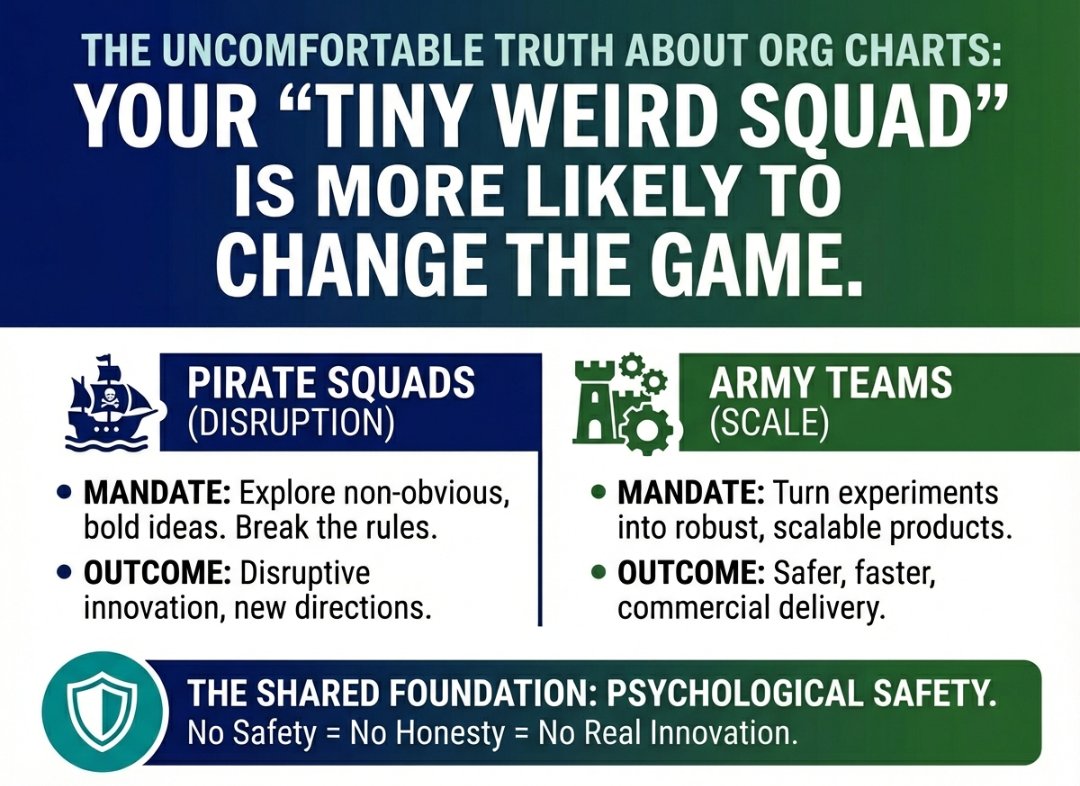
There’s a huge study (65M+ papers, patents and software projects) that shows something very uncomfortable for most org charts: Small teams are the ones that produce genuinely disruptive ideas. This is the stuff that breaks with the past and opens up new directions. Large teams mostly take existing ideas and make them safer, faster, more scalable and more commercial. In other words: Your tiny weird squad in the corner is more likely to change the game. Your big shiny team is more likely to ship the roadmap. That’s not a bug. It’s structural. Disruption and scale are different sports, and yet most companies ask every team to play both at once: “Be wildly innovative, but also 100% predictable, low-risk, and on-governance.” You can’t have Formula 1 handling with a bus’s safety requirements. Picture two types of teams with different inherent specialisms: 1. Pirate teams (2–5 people) Mandate: explore non-obvious ideas, old tech, and “this is probably stupid but what if…” Measure them on learning, bold experiments, and directional bets – not sprint velocity. 2. Army teams (bigger, cross-functional) Mandate: turn the pirates’ validated experiments into robust, secure, scalable products. Measure them on reliability, performance, delivery and business outcomes. And then the kicker: NEITHER works without psychological safety. Google’s Project Aristotle found the strongest predictor of high-performing, innovative teams wasn’t intelligence, experience, or even colocation. It was whether people felt safe to speak up, be wrong and ask “dumb” questions. No safety = no honesty. No honesty = no real innovation. Just theatre. So a sharper question for tech leaders: Do you actually have any true pirate teams… or just a collection of well-branded delivery teams with “innovation” in their slide decks? Curious to hear: where does real innovation actually come from in your organisation – the pirates or the army?
Andrew Ward tweet media
Major's Green, England 🇬🇧 English
1
1
2
25
Scorchsoft
Scorchsoft@scorchsoft·
We made a free speech-to-copy-edited-text tool called Quick Whisper. It uses AI to convert spoken audio into a copy-edited transcript, automatically pasting it into your active application. Here is a video of it working; what do you think? #OpenAI #FreeApp
English
1
0
3
358
Scorchsoft
Scorchsoft@scorchsoft·
Learn how to earn more revenue from your existing customers and marketing activities without spending a penny more on advertising. Discover the 77 conversion rate-boosting tips and tricks that you can apply today to your business, your app, or your digital product! scorchsoft.com/podcast/app-co… #ConversionRateOptimization #DigitalMarketingTips #UserExperienceDesign #AppDevelopment #OnlineBusinessGrowth #MarketingStrategies #EngagementBoost #TechToolkitPodcast #EcommerceSuccess #StartupGrowth #WebDesignTips #SaaSMarketing #CustomerEngagement #MobileAppDesign #DigitalTransformation #UserJourneyOptimization #WebsiteOptimization #BusinessInnovation #TechTrends #ScorchsoftSolutions
Scorchsoft tweet media
English
1
1
2
451
Scorchsoft
Scorchsoft@scorchsoft·
User Acceptance Testing Explained: How to Conduct UAT - A Guide for Customers Listen to Episode: scorchsoft.com/podcast/uat-be… Why do some apps succeed while others fail? Explore the importance of meticulous testing and user feedback in turning your app into a market hit and discover the testing phases every app must pass through to ensure a seamless user experience and robust functionality. Key Highlights: 🛠️ The Essence of UAT: Discover why UAT is pivotal for app development and how it differentiates from other testing phases. 📋 Preparation & Execution: Unpack practical tips for conducting effective UAT, ensuring your app not only meets but exceeds user expectations. 🎯 Beyond Testing: Learn what steps to take post-UAT for a smooth transition to market launch, addressing feedback, and ensuring continuous improvement. Whether you're fine-tuning your startup's first app or spearheading innovation in a well-established team, understanding the nuances of UAT is indispensable. #UserAcceptanceTesting #AppDevelopment #TechToolkit #Innovation #Scorchsoft #SoftwareDevelopment #apps #appdesign #ux #ui #howto #bestpractice #businessguide #UAT
Scorchsoft tweet media
English
0
0
0
176
Scorchsoft
Scorchsoft@scorchsoft·
Learn the basics of the web and app development bits and pieces. Answered: What is the backend? What is Frontend? How do APIs work? And more (for beginners) Listen: scorchsoft.com/podcast/basic-… Discover how your favourite apps are built, learn about React and React Native, databases, and understand server setups. Aimed at beginners and those curious about the digital creation process, this episode provides a comprehensive yet easy-to-understand overview of the crucial components that bring our everyday digital tools to life. Key Takeaways: 🌍Front-End vs Back-End Development: Discover the elements that make up the face and engine of a website or app. 🔗 The Role of APIs: Learn how APIs work like the efficient waitstaff in a restaurant, seamlessly connecting different parts of an app. 🛠️ Modern Development Tools: Explore how tools like React and React Native are changing the game in cross-platform development. 💾 Data Storage & Databases: SQL or NoSQL? Get insights on making the right choice for your project. 🖥️ Frameworks & Server Technologies: Understand the backbone of back-end development and the various server architectures. Plus, we dive into how Scorchsoft crafts customized tech solutions for every client, ensuring your unique needs are met with precision and expertise. 👉 Whether you're just starting or looking to brush up on your knowledge, this episode is packed with easy-to-understand explanations and analogies that bring complex concepts to life. #TechToolkitPodcast #AppDevelopment #WebDevelopment #apps #saas #webapps #podcast #BeginnersGuide #Scorchsoft #DigitalInnovation #LearningTech #podcasting #podcastlife
Scorchsoft tweet media
English
0
0
0
106
Scorchsoft
Scorchsoft@scorchsoft·
Just explored the dynamic world of #AngelInvesting and #VentureCapital in the UK, with a spotlight on app startups. Insights on funding, investor engagement, and the thriving West Midlands tech scene. Tune in for actionable advice! 🎧 Listen now: scorchsoft.com/podcast/startu… #UKStartups #TechInvestment #BusinessGrowth #VCtrends -- In this episode, we delve into the significant trends shaping the world of angel investing and venture capital, with a focus on app startups. This episode delivers a rich understanding of funding sources and investor engagement, tailored for startups and entrepreneurs in the UK, particularly those in the innovative West Midlands region. Tune in for actionable advice that could revolutionize your business's financial journey. We examine the resilience of the UK's angel investment market, noting a substantial growth to £1.8 billion in 2022, up from £1.4 billion in 2021, and discuss how platforms like the UK Business Angels Association have become instrumental in driving investment. Meanwhile, venture capital has experienced a downturn, with a 57.7% drop in the first half of 2023, pushing more startups towards crowdfunding platforms like Seedrs and Crowdcube. We explore the West Midlands' burgeoning tech scene, highlighting the contributions of new networks like Minerva Birmingham in fostering local startup funding. The region's tech sector, the fastest-growing in the UK, has raised over £850m since 2020, emphasizing the need for sustained support to maintain startup longevity. Throughout the episode, we share insights on navigating economic challenges, preparing for investment rounds, and capitalizing on sector-specific trends, equipping you with the knowledge to attract the right investors in today's market.
Scorchsoft tweet media
English
1
0
0
108
Scorchsoft
Scorchsoft@scorchsoft·
I'm thrilled to announce that I am a shortlisted finalist in this year's Birmingham Young Professional of the Year Award! This brings back a wave of nostalgia, as I was also a finalist back in 2016. Since this is the last year I am eligible for it (only those 35 and under can participate), I thought, why not give it another shot, considering I enjoyed the experience last time. #birmingham #chamberofcommerce #bypy #business #businessawards greaterbirminghamchambers.com/latest-news/ne…
English
0
0
3
149