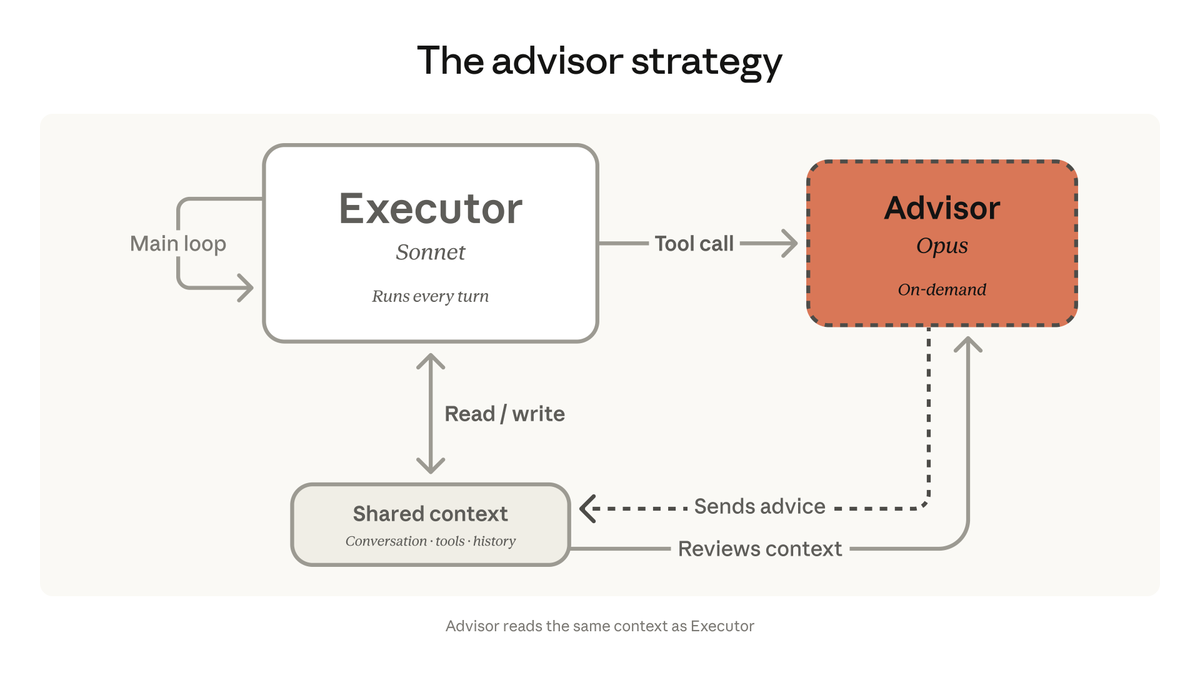
We're bringing the advisor strategy to the Claude Platform.
Pair Opus as an advisor with Sonnet or Haiku as an executor, and get near Opus-level intelligence in your agents at a fraction of the cost.
Let me explain exactly why Apple still uses drag-to-install in 2026, because the joke here accidentally proves Apple right.
A macOS .app is a single self-contained folder disguised as a file. Every dependency, every framework, every resource lives inside it. Drag it to Applications, it works. Drag it to Trash, it's gone. No registry entries. No leftover DLLs. No uninstaller that misses half the files.
Windows installers scatter fragments across Program Files, AppData, the registry, system32, and a dozen temp directories. Uninstalling a Windows app is an archaeological dig. Five years later you're still finding config files from software you forgot you owned.
Linux is worse. Dependency hell is so common they named it. Entire package managers exist to solve the problem of "I installed something and now nothing else works." Flatpak and Snap were invented specifically to copy what macOS bundles already did natively.
The macOS bundle architecture came from NeXTSTEP in 1989. Steve Jobs brought it to OS X in 2001. The core design hasn't changed because the core design was correct. An app is a folder. Installation is a copy. Removal is a delete. Three operations that map perfectly to how humans already think about files.
The drag-to-install window with the arrow isn't lazy UX. It's the entire thesis of the system made visible. You are literally just moving a folder. There is no "installation" step because there's nothing to install. The app is already complete.
Every other OS eventually tried to get here. Windows got MSIX. Linux got Flatpak. Mobile figured it out from day one because phones shipped after Apple proved the model. The pattern everyone else converged toward is the pattern this tweet is calling outdated.
The funniest part: the app being dragged in that screenshot is Claude. An AI that can write code, analyze documents, and reason about complex systems. And the most advanced step in getting it onto your machine is holding down a mouse button and moving your wrist two inches to the right.
That's not a design failure. That's a 37-year-old architecture so good that the most sophisticated software on earth still ships inside it.
meanwhile here are protocols that have a great revenue to market cap ratio:
since crypto has matured I think that during the next bull run we’ll see revenue-backed tokens go nuts
@boardyai 1) Assessing risk of each pools
2) rebalancing accordingly
3) Gives personlized options to user for rebalancing if they want to invest in riskier options
today, Solana changes forever
we've solved the biggest data/RPC problem that exists
solana historical/archival data — has now been redesigned
quick context:
today when you query historical data (getBlock/getTransaction/getSignaturesForAddress), it hits Google BigTable
this is i) slow, ii) expensive, iii) inflexible for queries
e.g., you physically can not get the first tx for a Solana address without looping back endlessly from the latest tx
for busy addresses, this can take thousands of RPC calls — extremely slow, expensive, and annoying
also, imagine you wanted to get the most recent 100 txs for an address, how do you do it?
you first hit getSignaturesForAddress to get all the tx signatures and then call getTransaction on each tx to get its details — this can take 1,001 RPC calls in the worst case
not anymore
we have built a new distributed archival storage system that is 1,000x faster, more flexible, and more scalable
the best part? we're introducing a new API method:
getTransactionsForAddress
with this method, you can now:
i) combine getSignaturesForAddress and getTransaction calls into just 1 call instead of 1,000
ii) you can search in reverse order without needing to traverse
iii) you can search historical transactions by time and slot ranges (e.g. get me all the txns from January 5th, 2025 until February 5th, 2025)
what's more:
- getBlock calls are now 10x faster
- getTransaction calls are now 10x faster
- getSignaturesForAddress calls are now 10x faster
10x lower latency, 100x fewer RPC calls, and 1000x less code
enjoy!
docs below