

Sox
2.5K posts


"Croatia is a leading sponsor of Iranian terrorism"
Internut👍


English
@FortySacks he sounds like one of those Silicon Valley optimizers for whatever (X), here he wants all the good social amplifications of Christianity but without a belief in Christ
English

At the end of the Roman Empire, the masses were frantically committing apostasy. What had once drawn petty fines escalated to capital punishment, as the state tried to stop a drift back toward Roman Hellenism.
Libations to Jupiter and the Dii Consentes returned. Mechanically. Performatively. As a reflex rather than a living faith. Anything to stave off decline, repel the barbarians, instil some residue of moral vigour.
This is what Oswald Spengler calls second religiousness. It’s an attempt at reversion. Religion reappears as form without spirit or conviction, a culture reaching backward because it runs out of forward momentum.
The way Clint speaks about Christianity lands in that same register. In fact all “based” Christianity does. The tradcaths, the orthodox people, the content creators. Something that has to be done for its own sake. It reads less like belief than like a plea. An attempt to find the light of Vesta long snuffed out.
Clint Teeples@TeeplesCY
"If I told you there was one free thing you could do every Sunday that would make your kids happier, healthier, smarter, and closer to you, you'd think I was selling something." Take your kids to church regularly. I don't care if you believe. The data is so lopsided that skipping it is the parenting equivalent of refusing vegetables because you don't like the taste. Grades. Religious teens get As at almost twice the rate of nonreligious teens. In a class of 100, that's 24 A-students instead of 14. Church gives a kid the same academic boost as being born rich instead of poor. College. Working-class religious kids earn bachelor's degrees at double the rate of their nonreligious peers. Middle-class kids do it at 1.5x the rate. For families without a trust fund, this is one of the most powerful forms of upward mobility social scientists have measured. Character. Religious teens are far less likely to lie, cheat, or do things they hope their parents never find out about. They're more likely to care about racial equality, the elderly, and the poor. They reject the idea that morality is whatever works for you in the moment. That kind of kid doesn't happen by accident. It's built. Closeness. 60% of parents of religious teens say they feel "extremely close" to their kid, compared to 50% of nonreligious parents. The kids report the same thing back. They get along better with their parents, talk about hard stuff, and actually want to spend time with their family. Despair. Religious teens are dramatically less likely to be depressed, anxious, lonely, or feel that life is meaningless. 90% of devoted religious teens never binge drink, compared to 41% of the disengaged. Economists named the modern epidemic "deaths of despair." Regular church attendance is one of the strongest known buffers against it. Parents are spending fortunes trying to solve teen mental health. The most evidence-backed intervention is free. Purpose. Religious young adults report higher purpose, gratitude, life satisfaction, and resilience. These are the exact traits every parent says they want their kid to have. Here's why it works. Affluent families already surround their kids with networks of stable, accomplished adults through neighborhoods, schools, and parents' colleagues. Working and middle-class families usually don't. A congregation is often the last institution in American life that puts your kid in weekly contact with dozens of stable, employed, sober adults who know their name. It used to be called "a village." Now it barely exists outside of churches. "But I don't believe." Your kid doesn't need your theology. They need you to show up. "But church is boring." So is sitting through a kindergarten music recital. Parenting is the deliberate choice to be bored on purpose for someone you love. There's a church within 15 minutes of nearly every American home. You don't need money, connections, or credentials to walk in. Nothing else in this country will surround your kid with engaged adults, teach them moral seriousness, and give them a stable weekly rhythm at zero cost. You already drive them to practices that produce far less. The free thing on Sunday produces more, on more dimensions, than almost anything else you do as a parent. You don't have to believe anything. You just have to take them.
English
@AltcoinSherpa This is wrong, there's absolutely no innovation in crypto
English

The Crypto premium is evaporating with each big launch and private rounds are also reflecting this.
Why were projects marked up so high? A few reasons:
-Quick exit liquidity. You don't actually have to build anything useful in order to have a token worth 9 figures+. It's not like you have to build an actual working product for multiple funding rounds like you do in traditional VC. You can launch and get a LIQUID TOKEN fairly quickly.
-Extreme degeneracy and retail bid - everyone in crypto wants to get rich and most of the participants are here for the $, not necessarily the tech. This enabled projects in the past to reach insane valuations.
-VCs can mark the projects higher on their books when TGE happens- each TGE is always higher than the last valuation and all of the 'value' is captured in the private markets (this happens in traditional vc too, see spacex/anthropic/etc).
------------
What's changing lately?
There market has mostly spoken- a lot of these big fdv projects have 1 pump and then simply bleed to $0. There's a very clear lack of retail demand for any of these projects and I don't see that changing anytime soon. Retail would rather buy a totally worthless meme than some vaporware tech project. At least they are being intellectually honest with themselves in that aspect.
As a sometime angel investor, I see a lot of valuations coming down a bit. A lot of allocators aren't firing nearly as much as they were before. I think the veil has been lifted a bit with overall lack of demand for a lot of these 'tech' projects and unnecessary infrastructure.
People all want to invest in user apps but there aren't as many interesting ones coming out. Crypto was a lot more creative a few years ago and we were a lot more delusional on what would or would not make $ back then. And there was actual retail bid.
To be clear, there are a lot of cool things being built out that have real value. Stables, perps, some AI, stuff like that...the industry is maturing quickly. But the problem is that it's a bit harder to make $$ on that stuff as a retail participant.
I don't see much of this changing anytime soon until risk on conditions come back. It's usually around this time where you might see a Friend Tech situation come but I'm more and more pessimistic on what 'builders' are doing these days. Hoping that we see more consumer apps for our ever shrinking pool of retail investors
English
@GavMcCracken you see this over and over: "$400 million is not enough to worry about", huge some (X) is not enough to worry about, but it's the over and over again multiples that compound
English

I found a Canadian. Totally relaxed about the tiny corruption here and there.
It all adds up, and suddenly 75% of your income is taxed via various means to pay for it.
808@prpl8
Come on guys, I hate Trump as much as the next guy but $ 400m is not enough to worry about 0.0001 0.01% 1% of 1% We need to worry about the big things
English
@CaribbeanRythms nice rage bait, so an american man-bunned fh ag got can't desecrate a national monument
English

Would have been better if the British could have taken the Pyramids and put them in a museum but alas.
English
@FistedFoucault 2013 when Edward Snowdon revealed the full extent to which the Patriot Act enabled mass surveillance. At first, people were shocked and outraged, but the outrage lasted only about six months maybe a year, until they shrugged and said, “Well, of course they are,” and moved on
English
Techfags:
If you had to pick a specific year, which one would you choose to identify as the year that privacy became extinct?
English
@martianwyrdlord Said the same thing years ago; testosterone will only be available to FtMs on the white market
English

I'm just waiting for the left to declare that testosterone is a threat to public health and safety, followed by mandatory cross-sex hormone regimens for anyone found to have illegally high t levels.
Same logic as banning firearms, knives, smoking, meat, and mandating vaccines.
Sky News@SkyNews
Everyone born after 2008 to be banned from smoking news.sky.com/story/everyone…
English

Because there is no meaningful difference between the two parties. Ideology has almost nothing to do with governing Canada.
I am continually surprised how many people — people who are “involved” — don’t understand how power is gained, wielded and legitimized in Canada.
David Portier@davidportier
A kind of important question we Conservatives need to ask ourselves is: Why did Mark Carney become a Liberal and not a Conservative?
English


Here is the question that ends the UBI discussion.
So if AI/robotics are going to create such abundance that people don't need to work and everything will be essentially free, then why do we even need UBI?
Why can't people privately own and use these tools, as they already do now and control access to this limitless abundance themselves? Why does the government need to be in charge of distributing resources if they are cheaper, and more easily available than ever?
This would be like arguing at the beginning of mechanised farming, that because one machine can do the work of 50 men that we need government to control the food stocks and distribute them because we don't all need to be farmers.
The last thing cheaper more easily accessible resources demands in government control. UBI is the oligarchs last attempt to control access to technology that has the potential to free billions from their evil clutches.
Elon Musk@elonmusk
Universal HIGH INCOME via checks issued by the Federal government is the best way to deal with unemployment caused by AI. AI/robotics will produce goods & services far in excess of the increase in the money supply, so there will not be inflation.
English
@Nebraskangooner it's dropped 90% already though, it can only drop 10% more and you have 90% upside
English

Anybody buying after a daily candle like this has mental illness.
Idc if it bounces. You are a degenerate and you need help.

English
@JimmyThomist Interesting map, 1830s or earlier means that Napoleon's expansionism would have ben at the height of Franc'es demographic boom: the latter conditioning the former
English

A very interesting post about what could have been but for the fertility collapse of France in thr 19th century.
Related: I was driving with an army buddy through his home town of Montreal. He explained in the 1960s it was trending to be the continent’s largest city in by 1980.
Joan Larroumec@larroumecj
L’essentiel du malheur français des deux derniers siècles tient dans cette carte. Au lieu de voir sa population multipliée par entre 6 et 10 comme les autres pays européens, la France n’a fait que 2,5x. Pour comprendre ce que c’était d’être Français au 18e siècle, il faut s’imaginer une France contemporaine de 250 millions d’habitants. Cela ne nous donnerait que la densité du Royaume-Uni, avec 3 fois plus de terres arables. Rien d’exagéré ou d’impossible. Notre relation au monde serait légèrement différente. Bien sûr que nous avons la gueule de bois. La Grande Bretagne grâce à ses colonies a même fait 40x. Pour nous cela aurait voulu dire 900 millions de descendants de Français. Ce qui n’est pas délirant. Notre modeste population québécoise a été multipliée par 100. Le but de ce rappel n’est pas d’entretenir la nostalgie mais de remettre sur le devant de la scène un enjeu clé : la fécondité s’effondre massivement, cela va rebattre au 21e siècle les cartes de la puissance et de la prospérité tout autant qu’elles le furent au 19e siècle. Nous avons été les plus grands perdants à l’échelle mondiale de cette précédente transition démographique. Essayons de ne pas l’être ce coup-ci.
English
Friends don’t let friends outsource their thinking to LLMPAs.
Strawman@collapsologist
>>>Doesn't modernity emerge naturally at a certain scale? (population, information processing, communication etc.)
English
@FistedFoucault Tbh, it’s how straight and normie he plays his degeneracy that makes him funny - as if he’s being corrupted for the first time rather than most comics who just revel in it
English
Many people are surprised that Howling Mutant turned out to be a handsome guy because of the character he portrays on this app.
It should come as no surprise, as many creative types get all of their darkest/funniest/etc. thoughts out in writing (or typing), as Irvine Welsh said while describing himself.
English
Signs that the whole post-WW2 “never again” energy has jumped the shark, reached the final boss — choose your metaphor — and that a “readjustment” of priorities, protections and animosities is coming.
Chris Menahan 🇺🇸@infolibnews
The Holocaust Museum for Holocaust Remembrance Day had young members of the US military light a menorah at the Capitol and declare, "I'm [insert name and title], and I remember."
English
@owenbroadcast There’s a naive exuberance to people pre-total surveillance; everyone now seems to act ironically and with an underlying fatigue
English

the difference between literate and non literate civilizations may be similar to those where people are or are not always carrying a camera
Marlin, Esq@nostalgiafkninc
high school in 2004
English
This is only believable thanks to the wonders of modern plastic surgery -at least only in the presentation which makes the flesh appear with some of its old vibrancy. Underneath tho, is a closer corpse and countless give aways of sustained fatigue. There's no way Hudson could still dance till dawn
English

I don't believe this at all. Haven't seen The Science on it, but it doesn't pass the smell test. Endocrine and overall body decay starts way before menopause. Wouldn't make much sense.
What can happen is older women getting less socially inhibited as they have less to gain from performances of propriety. They can also get more humble, desperate, and direct as the clock winds down on them.
Older women may cut immediately to the chase and do freak shit on a one last hurrah yolo trip analogous to or even surpassing their early hoe phase, as far as depravity level. But only because it barely matters. Father time has a way of grinding down everyone's zest for life, which has substantial sexual implications, and women are no exception.
To ride the wave they are talking about I'd keep it to 40+. It takes that long for idgaf to overpass jadedness. But nothing really surpasses the novel enthusiasm of fresh youth. Don't let this self flattering roastie apologia fool you into thinking there's a pot of gold at the end of their false promises. The beautiful twink boytoy or underage student or overage affair might get that. Husband dick: doubtful.
Blaise ⛧@wydblaise
Kate Hudson revealed that men are attracted to younger women because they believe the lie that women’s libido reduces as they grow older but in reality it only intensifies “Unlike men, women sex drive only increases as they grow older”
English

@transrepublic I have a hard time believing people expected Trump to be one way and then we’re surprised when he did something else. The man had been in politics for 9 years at that point.
English
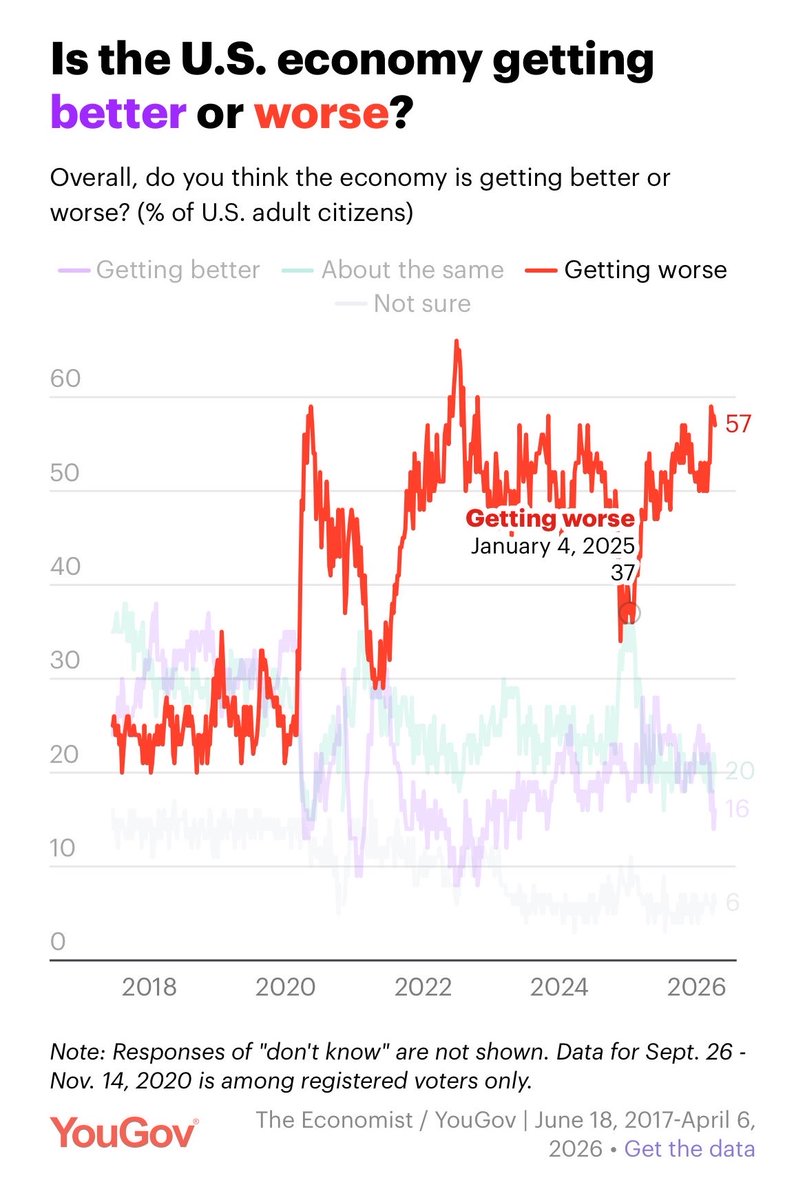
That’s what people say but also if you go look on how people say they feel about the economy, 20% of people suddenly thought it was getting better between Election Day and Trump’s inauguration and then they quickly bounded back to feeling bad. I don’t get it.
𝚊𝚗 𝚊𝚙𝚙𝚎𝚊𝚕 𝚝𝚘 𝚑𝚎𝚊𝚟𝚎𝚗 🇺🇸🌲@mr_underhill123
@gaulicsmith It's obviously the economy, specifically the cost of living and job market, not anyone's niche issue (although the primary root cause of these problems is immigration)
English