Taruna Goel

17.8K posts

Taruna Goel banner
Taruna Goel

Taruna Goel

@write2tg

Workplace Learning | RPL/PLAR Strategy & Systems | Competencies & Credentialing | 25+ yrs in L&D On bsky as tarunagoel

Vancouver, BC, Canada شامل ہوئے Mart 2009
1.9K فالونگ2K فالوورز
Taruna Goel
Taruna Goel@write2tg·
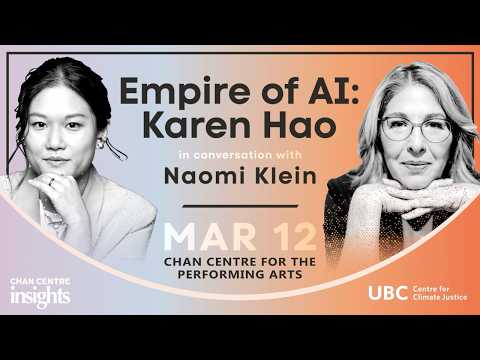
Such a great conversation! Worth your time. Naomi Klein & Karen Hao: The Empire of AI and the Fight for Our Future at Chan Centre, UBC youtu.be/Z1B__Efqacc?si…
YouTube video
YouTube
English
0
1
0
49
Taruna Goel
Taruna Goel@write2tg·
What a powerful read! "In my humdrum life, the daily battle hasn't been good versus evil. It's hardly so epic. Most days, my real battle is doing good versus doing nothing." npr.org/2005/08/08/478…
English
0
0
0
14
Taruna Goel
Taruna Goel@write2tg·
"A dollar is fungible. A barrel of West Texas Intermediate crude is fungible. A mass of people bound together by years of shared context, inside jokes and collective memory is not." joanwestenberg.com/communities-ar…
English
0
0
0
13
Taruna Goel ری ٹویٹ کیا
Helen Bevan
Helen Bevan@HelenBevan·
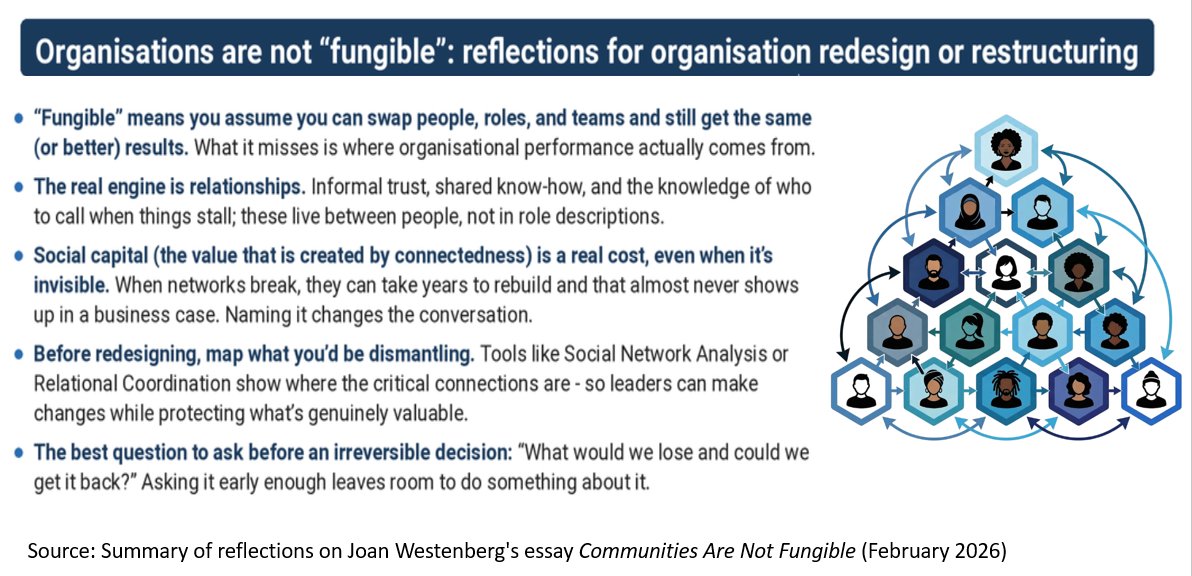
Organisations are not "fungible". “Fungibility” is an assumption that if you redesign an organisation & replace one set of people with a different set, you will still get equivalent outputs. This mistaken belief underlies many organisational restructures: that you can redistribute roles, reporting lines & teams without meaningful loss. I've been reading "Communities Are Not Fungible", a recent essay by @JoanWesten7568. She examines 1960s urban renewal, when planners believed demolishing old neighbourhoods & rehousing residents would allow communities to reform. They didn't. The residents moved. The community did not. A community is not a set of people: it is a historically produced web of relationships between them. Destroy the web, & you have strangers in a building. The parallel to organisational life is uncomfortable. When we restructure, we may preserve many of the people but destroy the relational infrastructure that made them effective. The informal trust that lets someone ask for help. The shared knowledge of who to call when a process stalls. The accumulated understanding of each other's judgment. These live in relationships, not individuals. Redrawing an org chart doesn't transfer them. Research backs this up. Tacit knowledge - the "knowing how" driving real-world performance - depends on trust to flow. Break those relationships & you block the transfer. Studies show informal networks persist along old lines long after formal structures change, creating tension between old loyalties & new mandates. Social capital is the value created by connectedness. It can be destroyed in restructuring & take years to rebuild — a cost that almost never appears in a business case. What leaders can do to protect collective value: 1. Audit informal networks before redesigning formal structures. Use, eg., System Network Analysis or Relational Coordination. Breaking key network nodes causes capability losses no productivity model captures. 2. Treat relational capital as a real cost. Business cases for restructuring rarely account for social capital destruction. Making it visible leads to better decisions & stronger cases for change. 3. Design around high-value relationships. Identify relationships carrying the most trust & history & actively design the new structure to protect them while enabling necessary change. 4. Invest deliberately in building new relationships. Create conditions for them to form through shared work, peer learning & social connection. 5. Give explicit attention to belonging & psychological safety for everyone (not just those who lose or change roles): This creates conditions for the discretionary effort that makes new structures succeed. 6. Slow down at the point of irreversibility. Ask not only "what do we gain?" but "what do we lose - & can we recover it?" The value of an organisation is not the sum of its people's individual capabilities. It is the web of relationships between them. That web is not fungible. Link to Joan Westenberg's essay: joanwestenberg.com/communities-ar…. Thanks to @charlie_psych who sent me the essay.
Helen Bevan tweet media
English
3
39
115
10.1K
Taruna Goel
Taruna Goel@write2tg·
The capacity to learn is a gift; the ability to learn is a skill; the willingness to learn is a choice. - Brian Herbert
English
0
0
0
13
Taruna Goel
Taruna Goel@write2tg·
What is often called as the 'skills gap' is actually a 'recognition gap' i.e. the gap between acknowledging that competence exists outside formal education, and actually building the infrastructure to assess and recognize it. linkedin.com/posts/tarunago…
English
0
0
0
117
Taruna Goel
Taruna Goel@write2tg·
It's important to clarify what counts. If we count experience over learning, we may end up validating years instead of validating competencies. Here's my take on why we call "RPL" Recognition of Prior Learning, not Recognition of Prior Experience. linkedin.com/posts/tarunago…
English
0
0
0
17