pratth.eth

482 posts

pratth.eth banner
pratth.eth

pratth.eth

@0xpratth

dev & research | MSc Financial Engineering, WQU | prev defi @gpunet, defi & infra @GluexProtocol, research @pyorxyz, security @quillaudits_ai | 🏆 @ETHGlobal

Tham gia Haziran 2022
252 Đang theo dõi986 Người theo dõi
pratth.eth
pratth.eth@0xpratth·
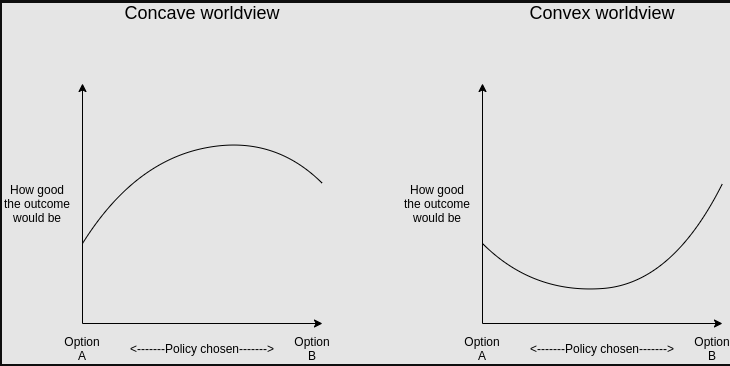
Read about concave and convex worldviews from @VitalikButerin's blogs and found it interesting enough to share it here. So the idea is, Centralization is convex, decentralization is concave. One way to categorize decisions that need to be made is to look at whether they are convex or concave. In a choice between A and B, we would first look not at the question of A vs B itself, but instead at a higher-order question: would you rather take a compromise between A and B or a coin flip? In expected utility terms, we can express this distinction using a graph (the attached image). If a decision is concave, we would prefer a compromise, and if it's convex, we would prefer a coin flip. Often, we can answer the higher-order question of whether a compromise or a coin flip is better much more easily than we can answer the first-order question of A vs B itself. Examples of convex decisions include: - Pandemic response: a 100% travel ban may work at keeping a virus out, a 0% travel ban won't stop viruses but at least doesn't inconvenience people, but a 50% or 90% travel ban is the worst of both worlds. - Military strategy: attacking on front A may make sense, attacking on front B may make sense, but splitting your army in half and attacking at both just means the enemy can easily deal with the two halves one by one - Technology choices in crypto protocols: using technology A may make sense, using technology B may make sense, but some hybrid between the two often just leads to needless complexity and even adds risks of the two interfering with each other. Examples of concave decisions include: - Judicial decisions: an average between two independently chosen judgements is probably more likely to be fair, and less likely to be completely ridiculous, than a random choice of one of the two judgements. - Public goods funding: usually, giving $X to each of two promising projects is more effective than giving $2X to one and nothing to the other. Having any money at all gives a much bigger boost to a project's ability to achieve its mission than going from $X to $2X does. - Tax rates: because of quadratic deadweight loss mechanics, a tax rate of X% is often only a quarter as harmful as a tax rate of 2X%, and at the same time more than half as good at raising revenue. Hence, moderate taxes are better than a coin flip between low/no taxes and high taxes. When decisions are convex, decentralizing the process of making that decision can easily lead to confusion and low-quality compromises. When decisions are concave, on the other hand, relying on the wisdom of the crowds can give better answers.
pratth.eth tweet media
English
1
0
0
74
pratth.eth
pratth.eth@0xpratth·
the s value of a signature is computed using a random number k which represents the nonce. if two messages are signed with the same nonce, the ECDSA private key can be extracted. this means that attackers can compromise the signer’s account and use the private key to sign messages. for a full derivation of how and why it is possible to recover a private key if the nonce is used more than once, check out this repo - github.com/pcaversaccio/e…
English
0
0
1
107
pratth.eth
pratth.eth@0xpratth·
am i shadow banned?
English
1
0
1
159
pratth.eth
pratth.eth@0xpratth·
A collateral ratio doesn't just set a borrowing limit. It sets a maximum leverage limit too. For eg - At 135% minimum collateralization, you can borrow at most 1/1.35 ≈ 0.74 ETH worth of stablecoin. Now swap that stablecoin back to ETH and re-deposit. You can borrow again. Each loop: 1 → 0.74 → 0.55 → 0.40 → 0.30... This is a geometric series: Total ETH = 1 + (1/1.35) + (1/1.35)² + (1/1.35)³ + ... The formula for an infinite geometric series with ratio r < 1: Sum = 1 / (1 - r) Here r = 1/1.35, so: = 1 / (1 - 1/1.35) = 1 / ((1.35 - 1) / 1.35) = 1.35 / 0.35 = 3.857x The collateral ratio is also the leverage ceiling. This means you can reverse-engineer the implied max leverage of any lending protocol just from its collateral ratio: Min. Collateral Ratio. Max Leverage 200% 2.0x 150% 3.0x 135% 3.86x 120% 6.0x 110% 11.0x The closer the ratio gets to 100%, the more the leverage. Collateral ratios are a hard mathematical cap on how much leverage a rational actor can extract from the system, no matter how many loops they run.
English
0
0
1
103
pratth.eth
pratth.eth@0xpratth·
cryptocurrencies have a fixed, deterministic supply schedule, meaning price volatility is inevitable because shifts in demand can't be met with supply adjustments. this volatility creates a self-defeating loop: people speculate on coins (driving prices up or down), which discourages everyday transactional use, which undermines the very adoption that speculators are betting on. or maybe im just thinking too much
English
1
0
2
103
pratth.eth
pratth.eth@0xpratth·
just read about something called "gas golfing", ie programming transactions so that they use the least amount of gas. a few well-known gas golf techniques include: using addresses that start with a long string of zeroes (e.g., 0x0000000000C521824EaFf97Eac7B73B084ef9306) since they take less space (and hence gas) to store; and leaving small ERC-20 token balances in contracts, since it costs more gas to initialise a storage slot (the case if the balance is 0) than to update a storage slot.
English
0
0
0
70
pratth.eth
pratth.eth@0xpratth·
people are out here getting roasted for having a weird looking vc portfolio while I'm blaming the job market. there are genuine levels to this game
hantengri@hantengri

@beaniemaxi imagine having a vc portfolio that looks like this and still having opinions on valuations

English
0
0
2
124
pratth.eth đã retweet
Kunal
Kunal@buntyverse·
The whole "decentralised" industry begging Circle (a centralised entity) after every DeFi hack
Kunal tweet media
English
36
31
459
39.6K
pratth.eth
pratth.eth@0xpratth·
@ayuxhtwt unified platform for all prediction markets data
English
0
0
0
31
pratth.eth
pratth.eth@0xpratth·
joined the prediction markets rat race :D
pratth.eth tweet media
English
1
0
5
159
pratth.eth
pratth.eth@0xpratth·
yo i got Punch and his stuffed buddy building with me
pratth.eth tweet media
English
0
0
3
124
pratth.eth
pratth.eth@0xpratth·
@DefiIgnas umm building around hyperliquid, prediction markets and agentic trading
English
0
0
0
19
Ignas | DeFi
Ignas | DeFi@DefiIgnas·
People who work at crypto companies during this boring market? What do you actually do right now?
English
370
6
532
96.6K
pratth.eth
pratth.eth@0xpratth·
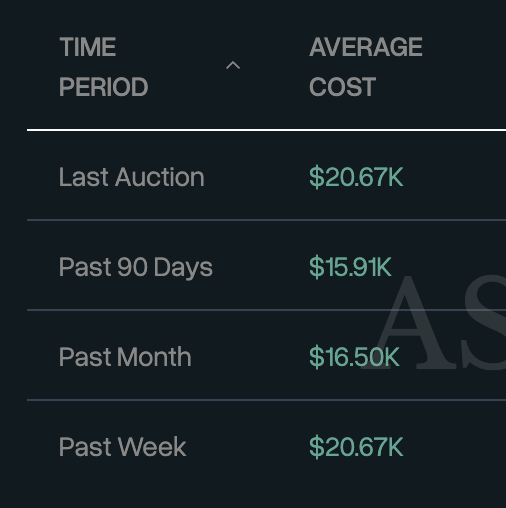
hyperliquid's listing mechanism is interesting. to secure a spot on the order book, projects must win a Dutch auction for their ticker, a process that triggers every 31 hours and limits the total number of new listings to roughly 282 per year. the absolute floor is set at 10,000 USDC, and the starting price is pegged at twice the previous winning bid, often driving the cost well into the six-figure range during periods of high demand. the average winning bid cost is within the range of 16k$-20k$ for the past 90 days. revenue mannnnnnn
pratth.eth tweet media
English
0
0
3
172