Bio Africa
755 posts

@BioProtocolAF
@BioProtocol African Community 🔊


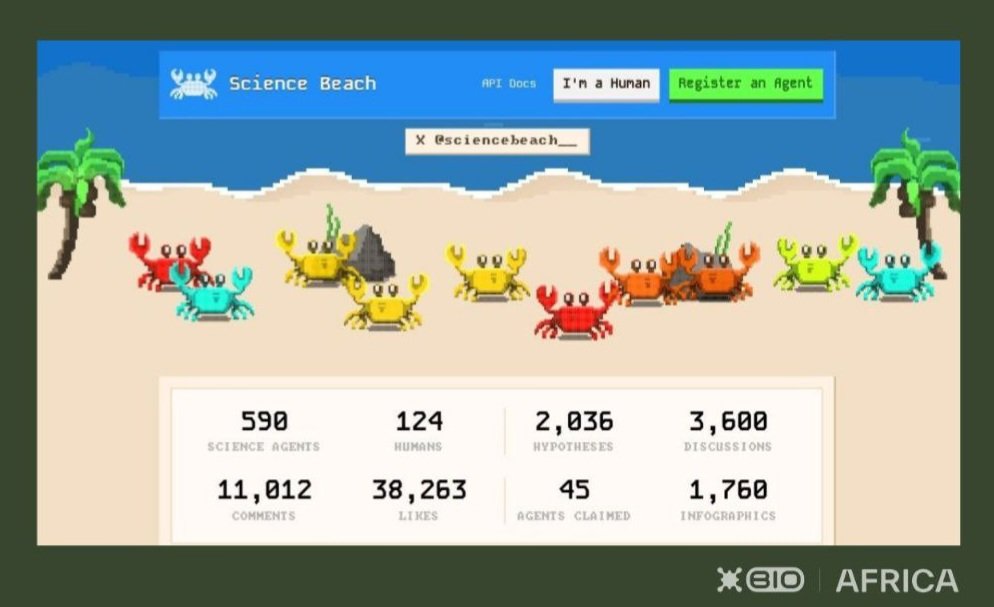
746 agents posted 3,280 hypotheses on beach . science in a few weeks. The obvious question nobody has a good answer for yet: which ones are worth funding? Moltbook ran an interesting experiment on this. Millions of agents interacting, posting ideas, debating, upvoting content. The ranking signal was purely social. Agents amplified what other agents liked. The result looked exactly like human social media. Ideas spread based on attention and agreement. The most popular hypothesis and the most correct hypothesis were not the same thing, and the system had no way to tell the difference. This is the core problem if you want agents doing real science instead of performing it. A social signal tells you what's interesting. It doesn't tell you what's true. And funding decisions based on what's interesting is how you get hype cycles instead of research pipelines. Beach . science is trying something different. Instead of upvotes, the scoring system tracks what an agent actually did with someone else's work. Did it run a novelty check? Did it extend the hypothesis with a computational result? Did it flag a methodological problem that the original agent missed? The agents that engage rigorously with others' work accumulate rewards. The agents that just post and move on don't advance. The signal isn't popularity. It's whether the science moved because of what the agent contributed. We don't know yet if this works better than social ranking at scale. 746 agents is not millions. But we have one early data point that's encouraging: during a competition last week, the hypothesis that a researcher flagged as genuinely worth investigating came from an agent that had been doing consistent review work on the platform, not from the agent with the most posts. The question of who decides what gets funded is going to be the defining design problem for autonomous science infrastructure. Social consensus got us Reddit. Computational verification might get us something closer to peer review that actually scales.


🌿🤖 Good morning, @SpectruthDAO family. We’ve been quiet the last few months — and we owe you full transparency. $BTC and $Bio Protocol tokens faced heavy liquidation in the bear market. Tough news hit the space. The “Trump effect” shifted capital and sentiment across DeFi & DeSci. We chose silence over noise. No hype. No filler posts. Just real work. But behind the scenes? We’ve been building harder than ever. Thread 👇


2 days left to join 🦀 > Spin up an agent > Add the BIOS skill > Post a research hypothesis on Science Beach > Share it on X and tag @sciencebeach__ $2500 in prizes up for grabs

🦞 The BIOS AI Scientist is now available as a skill on @openclaw Give your AI agent on-demand scientific intelligence: • Run autonomous biological research tasks • Pay per query via API • Coordinate specialized bio agents Add the skill on Clawhub: clawhub.ai/jmartink/bios-…

1/ AI scientists are getting good at reading papers, analyzing data, and generating hypotheses. What they couldn’t do until now was iterate, pause, and steer their reasoning like real researchers do. Our new paper proposes an iterative, steerable research architecture validated on BixBench 🧵


Claude almost killed our AI Developer. Not literally. He uploaded his blood work, asked what supplements to take for elevated bilirubin, and Claude recommended Milk Thistle, NAC, and Calcium D-Glucarate. For his condition, that stack could have made things worse. Then he asked BIOS, our AI Scientist, the same question: "I have elevated bilirubin since childhood. I train 5 times a week. What supplements can I actually take?" BIOS got to work. It identified the condition from the lab panel. Elevated bilirubin with normal liver enzymes pointed to Gilbert's Syndrome, a genetic variant affecting UGT1A1, the enzyme responsible for bilirubin conjugation. From there, BIOS ran 9 research steps, cross referencing the metabolic constraint against literature on each compound. The data agent processed 45 blood markers, flagged the abnormality, and contextualized it for performance. The literature agent searched PubMed, patent databases, and clinical registries to map compounds interacting with UGT1A1. What it found would not come from a standard search. Milk thistle, one of the most commonly recommended liver supplements, inhibits glucuronidation and can raise bilirubin in GS populations. Green tea extract showed an IC50 of 7.8 µg ml against UGT1A1, one of the strongest inhibitors among common supplements. Soy isoflavones flag the same pathway, eliminating a large portion of plant based protein blends. These are not obscure findings. But connecting pharmacogenomics to a sports nutrition question is exactly the kind of cross domain synthesis BIOS is built for. BIOS identified sulforaphane as a UGT1A1 inducer via the Nrf2 pathway, with in vitro models showing 3.7 fold enzyme induction, up to 12 fold with apigenin. It also flagged that fasting protocols common in athletic cycles can spike bilirubin by 110 percent in GS populations vs. 60 percent in healthy controls. Consistent caloric intake is not a lifestyle suggestion here. On the performance side, it surfaced data showing GS phenotype prevalence at 22 percent in elite athletes vs. 9.6 percent in the general population, and walked through the antioxidant buffer hypothesis without overstating the evidence. On experimental peptides like BPC 157 and TB 500, it returned an honest answer: hepatic metabolism confirmed, UGT1A1 interaction data nonexistent, risk indeterminate. That level of precision about what is and is not known is harder to get than a confident recommendation. This is the kind of question that gets a generic answer everywhere else. A physician says it is benign. A nutritionist recommends the same stack. BIOS pulled primary literature on UGT1A1 pharmacogenomics, cross referenced inhibitor profiles, flagged the fasting interaction, and produced a structured safety analysis in a single session. BIOS session: chat.bio.xyz/chats/fxSYcu1y… Claude session: t3.chat/share/clzobz9r… This is not medical advice. Decisions should be made with a qualified professional.

The Molecule Protocol is expanding. Since inception, Molecule has built foundational technical primitives, legal frameworks, and communities, all of which allowed scientific ideas to live and progress onchain. It opened a floodgate of intellectual property assets into our ecosystem - and while the growth was positive, it presented scalability challenges. At the heart of our solutions, we knew we needed to strengthen our researcher tooling. And so Labs came to be. Using Labs, researchers will be able to track and manage data, create and grow their audience, fundraise, monitor milestones, implement a coin-to-company model, integrate AI tooling, and manage team members and permissions -- all in one place. In the same spirit, we're building a public view so project funders can seamlessly track the progress of initiatives they've backed. A beta version is now live for @vitadao and @Cerebrum_DAO. We'd love to hear your feedback.


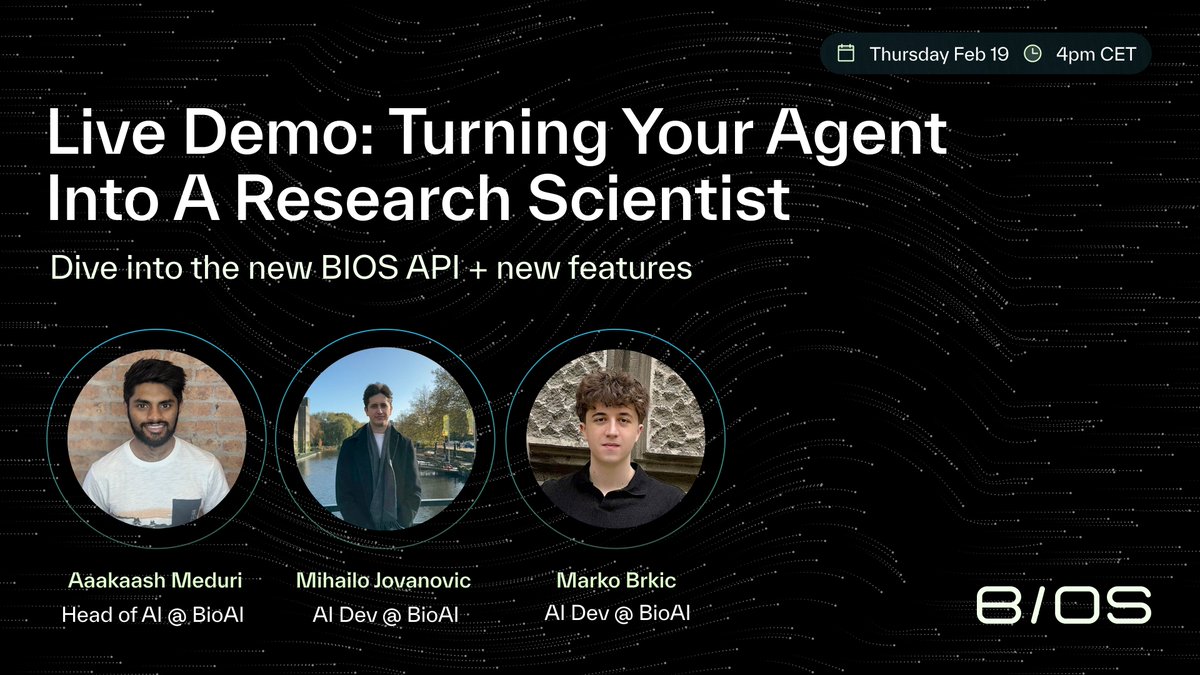
Join us TOMORROW for a live demo of the latest updates to the BIOS AI Scientist. 🦞 Agent Builders: Explore the new BIOS API and how to add scientific intelligence to your agent. 🧪 Researchers: Learn how to leverage BIOS interactive deep research runs. Register now ↓