kk69

7.9K posts

kk69 banner
kk69

kk69

@Cod115859

“For us believing physicists, the distinction between past, present, and future is only a stubbornly persistent illusion.” – Albert Einstein

Tham gia Haziran 2024
159 Đang theo dõi74 Người theo dõi
kk69
kk69@Cod115859·
選民思想を礎とした差別意識だよ イスラエルと何ら変わらないし同じどころかそれ以上の残虐行為をしていた 命令ではない 兵隊一人一人に根付いた差別意識がそれを快感にしたのだ 今のイスラエル兵と同じように 最大の戦犯である天皇をいまだに廃することすら出来ない狂ったカルト国家が日本の正体さ
𝘊𝘰𝘳𝘳𝘪𝘯𝘦@OopsGuess

The real question is not only why Chinese people have bad impressions of Japan. Chinese people have historical reasons: invasion, occupation, massacres, rape, Unit 731, biological warfare, forced labor, and tens of millions of Chinese casualties. The real question is: Why do so many Japanese people have bad impressions of the Chinese — the people Japan invaded, colonized, raped, experimented on, and massacred? Why is the victim expected to forget, while the perpetrator gets to feel offended by being remembered? Japan spent decades packaging itself as the victim of war, while minimizing the countries it brutalized across Asia. Then when Chinese people refuse to erase that history, suddenly it is called “propaganda.” No. Memory is not propaganda. Historical trauma is not propaganda. The propaganda is Japan pretending its neighbors’ anger was manufactured, instead of earned. So your framing is deeply dishonest. Chinese hostility toward Japan did not appear because Beijing suddenly “managed public opinion.” It has deep historical roots — and modern triggers only made it worse: Yasukuni visits, textbook revisionism, denialism, Fukushima nuclear wastewater, Japan’s alignment with U.S. containment strategy, anti-China security rhetoric, Taiwan provocations, and Japanese politicians openly challenging the postwar order. But your conclusion is: “CCP propaganda.” Convenient. For decades, Japan invested heavily in cultural diplomacy, academic networks, media influence, and “friendship” narratives in China. Many Chinese intellectual circles were far more Japan-friendly than ordinary Chinese public sentiment. That gap was never proof that Chinese anger was fake. It was proof that elite discourse had been softened while public historical memory remained alive. Chinese people do not need propaganda to remember what Japan did. They do not need state media to notice Yasukuni. They do not need Beijing to explain textbook revisionism. They do not need the CCP to feel disgust when Japanese politicians flirt with militarism again. Blaming Chinese opinion on “managed hostility” is just another way of saying Japan should never face the consequences of its own history and behavior. If Japan wants better public sentiment in China, it can start with honesty. Not PR. Not victim theater. Not pretending every Asian memory it dislikes was manufactured by Beijing.

日本語
0
0
0
29
kk69 đã retweet
Clash Report
Clash Report@clashreport·
Japan’s Former PM Shigeru Ishiba criticized PM Sanae Takaichi’s policies, warning Japan relies too heavily on the US and risks conflict with neighbors. He questioned, “Is relying only on the US-Japan alliance such a wonderful thing?” and stressed Japan must keep dialogue with China because they “can’t move away.” He also warned current policies could “inevitably hit a wall” and, if unbalanced, risk escalating tensions toward “a real Third World War.”
Clash Report tweet media
English
186
2K
6.1K
269.3K
kk69
kk69@Cod115859·
@EI0RN5zhTPEdie8 @OopsGuess じゃあお前に何かを意見する資格なんて無いから黙ってろ 馬鹿が馬鹿ですと自己紹介するのは勝手だが主語を馬鹿なお前から国や民族に拡げるなら迷惑だから徹底的に排除するのが道理というものだ 無知無能が人間みたいな口をきくな
日本語
0
0
1
110
満天の星
満天の星@EI0RN5zhTPEdie8·
@OopsGuess したのは私ではないし、されたのはあなたでもない。 中国は賠償を放棄し、その代わりにそれ以上の金銭的技術的援助をうけた。 日中平和友好条約は1978年にすでに成立し、和解はできている。それ以上を望むなら日本の方が望まないと思う。 当時の中国はレスペクトされていたが今されていないので。
日本語
6
1
3
18.5K
𝘊𝘰𝘳𝘳𝘪𝘯𝘦
The real question is not only why Chinese people have bad impressions of Japan. Chinese people have historical reasons: invasion, occupation, massacres, rape, Unit 731, biological warfare, forced labor, and tens of millions of Chinese casualties. The real question is: Why do so many Japanese people have bad impressions of the Chinese — the people Japan invaded, colonized, raped, experimented on, and massacred? Why is the victim expected to forget, while the perpetrator gets to feel offended by being remembered? Japan spent decades packaging itself as the victim of war, while minimizing the countries it brutalized across Asia. Then when Chinese people refuse to erase that history, suddenly it is called “propaganda.” No. Memory is not propaganda. Historical trauma is not propaganda. The propaganda is Japan pretending its neighbors’ anger was manufactured, instead of earned. So your framing is deeply dishonest. Chinese hostility toward Japan did not appear because Beijing suddenly “managed public opinion.” It has deep historical roots — and modern triggers only made it worse: Yasukuni visits, textbook revisionism, denialism, Fukushima nuclear wastewater, Japan’s alignment with U.S. containment strategy, anti-China security rhetoric, Taiwan provocations, and Japanese politicians openly challenging the postwar order. But your conclusion is: “CCP propaganda.” Convenient. For decades, Japan invested heavily in cultural diplomacy, academic networks, media influence, and “friendship” narratives in China. Many Chinese intellectual circles were far more Japan-friendly than ordinary Chinese public sentiment. That gap was never proof that Chinese anger was fake. It was proof that elite discourse had been softened while public historical memory remained alive. Chinese people do not need propaganda to remember what Japan did. They do not need state media to notice Yasukuni. They do not need Beijing to explain textbook revisionism. They do not need the CCP to feel disgust when Japanese politicians flirt with militarism again. Blaming Chinese opinion on “managed hostility” is just another way of saying Japan should never face the consequences of its own history and behavior. If Japan wants better public sentiment in China, it can start with honesty. Not PR. Not victim theater. Not pretending every Asian memory it dislikes was manufactured by Beijing.
UnveiledChina@Unveiled_ChinaX

Two neighbors. Both at nearly 90% mutual hostility. And the country that triggered the sharpest collapse in trust did it to itself. The Genron NPO and China International Communications Group, which together have run the most comprehensive Japan-China public opinion survey for 20 consecutive years, released their 2024 findings in December covering roughly 1,000 Japanese and 1,500 Chinese respondents. The numbers are historic. 89% of Japanese surveyed had a bad impression of China. That has been consistently high for years and is not the surprise. The shock is what happened on the Chinese side. In 2023, 62.9% of Chinese respondents had a bad impression of Japan. By 2024, that number jumped to 87.7%, the second-highest ever recorded in the survey's 20-year history. A 25-point swing in a single year. But the most consequential number is this one: Chinese respondents who view the Japan-China relationship as important collapsed from 60.1% in 2023 to just 26.3% in 2024. For the entire 20 years this poll has been conducted, that number had never dropped below 60% on either side. It fell off a cliff in a single survey cycle. What drove it? Chinese respondents cited Japan's Fukushima treated water release as the dominant new grievance, a point Beijing amplified relentlessly through state media. The CCP turned a technically regulated discharge, one that passed IAEA review, into a national anger campaign. It worked. Chinese public sentiment toward Japan moved more in twelve months than it had in the previous decade. That is not organic public opinion. That is managed public opinion. The CCP does not just shape how its citizens see Taiwan or the United States. It shapes how they see every neighbor, every potential friction point, every issue that can be converted into useful hostility. The 2025 survey was postponed entirely due to diplomatic tensions between the two countries. There is no updated data because the two sides could not agree on conditions to conduct it. 89% on one side. 88% on the other. And a relationship that half a billion people depend on economically has been reduced to this by a government that benefits from keeping the anger exactly where it is. #Japan #China #CCP #Geopolitics #AsiaPacific #PublicOpinion #SinoJapanese #Diplomacy #Propaganda #IndoPacific
English
64
224
1.1K
61.5K
kk69 đã retweet
𝘊𝘰𝘳𝘳𝘪𝘯𝘦
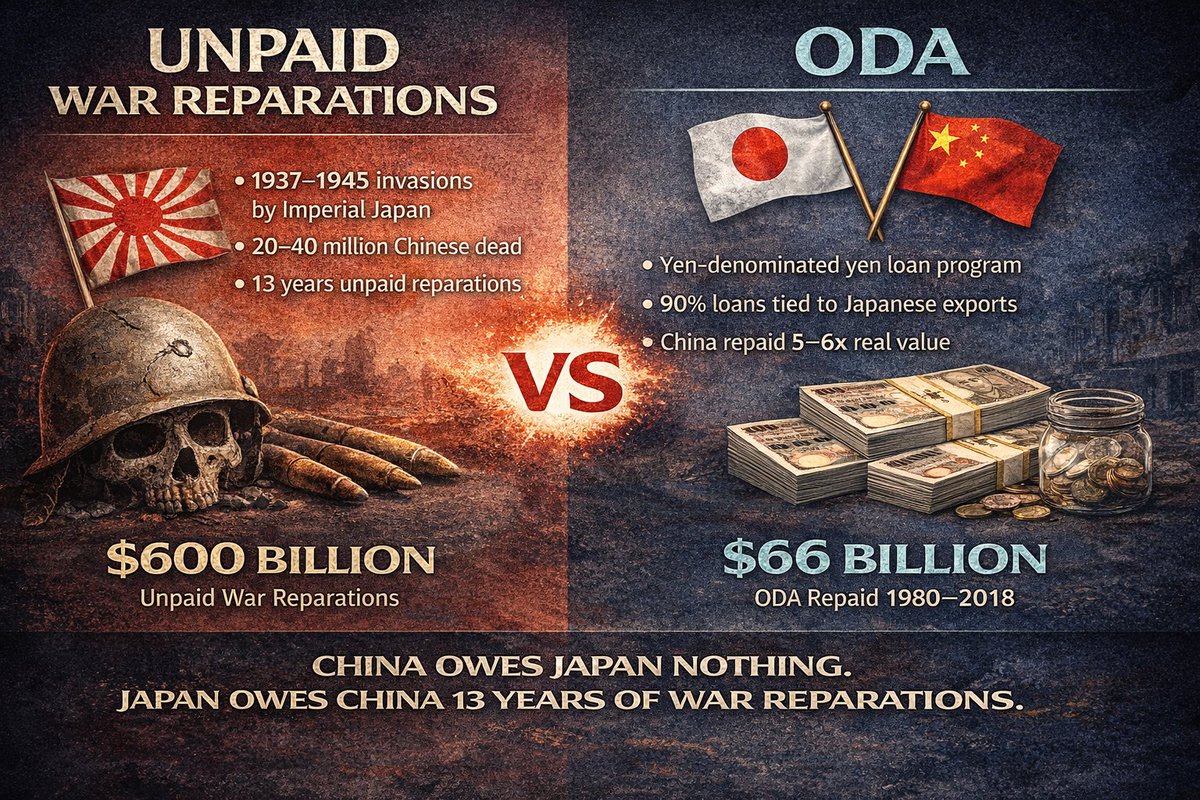
China did not “owe” Japan gratitude. China waived war reparations from Japan as a diplomatic choice — not because Japan was innocent, not because Chinese suffering was erased, and certainly not because Japan had somehow paid its debt. After 13 years of Japanese invasion, massacres, rape, forced labor, biological warfare, Unit 731, and tens of millions of Chinese casualties, China had every right to demand massive reparations. But Zhou Enlai made a political distinction between ordinary Japanese people and Japanese militarists. For the sake of normalization, China chose not to demand reparations from Japan. That was not unconditional absolution. It was built on a premise: Japan must respect the postwar order. Japan must not revive militarism. Japan must recognize and respect China’s sovereignty, including Taiwan. Even former Japanese Prime Minister Yukio Hatoyama has said this clearly: China did not demand reparations partly because Zhou Enlai treated many Japanese people as also victims of militarism, but China asked Japan to recognize Taiwan as part of China and not interfere in China’s internal affairs. So when Japan now expands military power, worships war criminals at Yasukuni, whitewashes textbooks, provoking China's red line of sovereignty over Taiwan, aligns with U.S. containment, and challenges the postwar order, it is not China “bringing up old trauma.” It is Japan dismantling the very premise of China’s restraint. And then Japanese neo-fascists have the nerve to say China should be grateful for ODA. ODA was not charity. It was mostly yen-denominated loans. China repaid them in full, with interest, while bearing massive exchange-rate losses, and Japanese companies profited from tied contracts. China owes Japan nothing. Japan owes China 13 years of unpaid war reparations — and the historical honesty it still refuses to give.
𝘊𝘰𝘳𝘳𝘪𝘯𝘦 tweet media
満天の星@EI0RN5zhTPEdie8

@OopsGuess したのは私ではないし、されたのはあなたでもない。 中国は賠償を放棄し、その代わりにそれ以上の金銭的技術的援助をうけた。 日中平和友好条約は1978年にすでに成立し、和解はできている。それ以上を望むなら日本の方が望まないと思う。 当時の中国はレスペクトされていたが今されていないので。

English
31
141
481
17.7K
kk69 đã retweet
함성
함성@2muchwaiting·
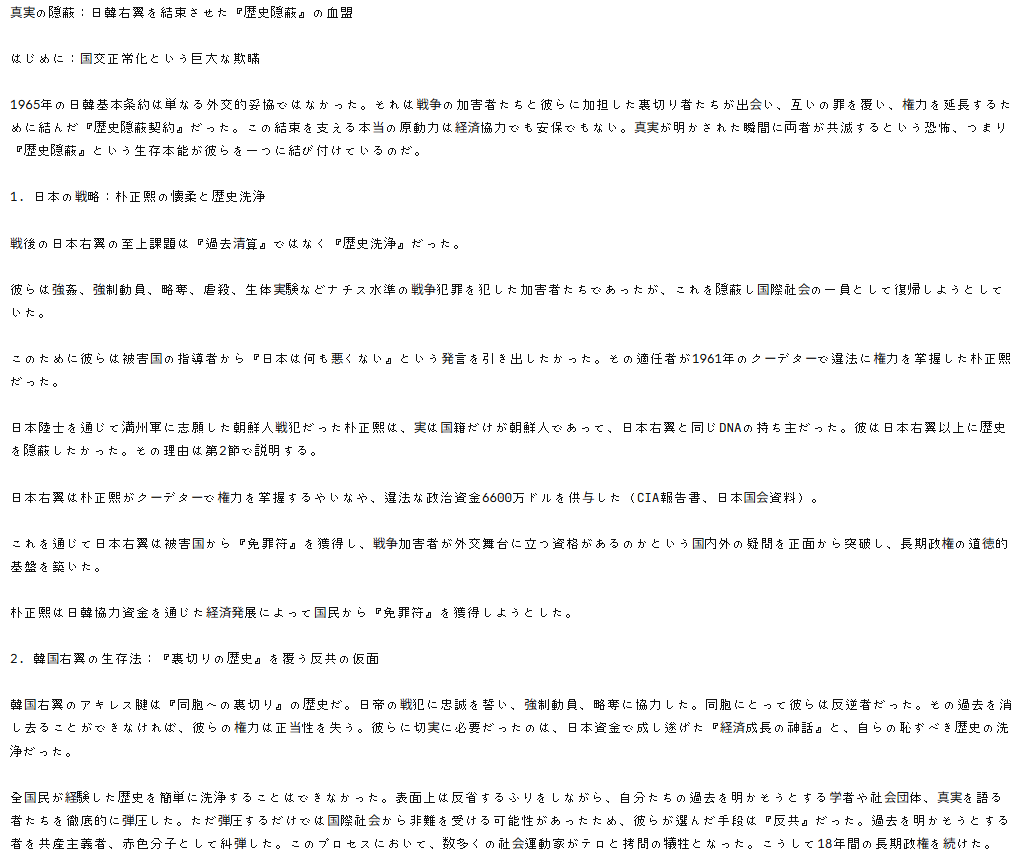
私は韓国人です。最近のニュースで統一教が日韓右翼政党(日本:自民党、韓国:国民の力)と深い結びつきがあることを知りました。好奇心から過去を調べてみたら、日韓右翼はすでに一心同体だったんです。添付の文章を一度読んでいただき、ご意見をお聞かせください。
함성 tweet media함성 tweet media함성 tweet media
日本語
77
3.1K
8.2K
222.3K
kk69 đã retweet
加藤一平 Ippei Kato / ギタリスト Guitarist
高市早苗さんはシンナー不足を塗料業界による「目詰まり」のせいにしようとしたけど、実際は原料そのものが日本に入ってきてないから。 原因は高市早苗が中東と向き合わないため、その能力が無いため、原料が日本に来ない。 それをメーカー側の責任に転嫁する卑劣さ。 高市早苗が日本の「目詰まり」。
日本語
366
11K
30K
472.9K
kk69
kk69@Cod115859·
@daneishe888 最近は非国民と言われると嬉しくなりますw
日本語
0
0
0
9
kk69 đã retweet
佐々木 中 |『万人のための哲学入門──この死を謳歌する』(草思社)発売中
衰退に衰退を重ねて経済的には「選ばれない国」に成り果てているというのに、いつまでも「選ぶ側」気取りで排外主義にうつつを抜かす日本に未来はないね。 日本政府の「外人ハラ」が加速中 | ニューズウィーク日本版 newsweekjapan.jp/articles/-/320…
日本語
21
504
1.2K
17.2K
kk69
kk69@Cod115859·
礼儀(れいぎ)とは、社会の秩序を保ち、他者との関係において敬意を表すための行動規範や作法です。相手への思いやりや敬う心を形にしたもの 社会の秩序ってわかるかな 自分の利益を基準に強い相手に媚びるのは礼儀ではありません 礼儀知らずという言葉がぴったりな見解ですね
くまねこ@kuma_neko_

日本人は礼儀知らず ←まちがい 日本人は相手を見て態度を変えるので、礼儀を尽くす必要がない相手には容赦がない ←せいかい

日本語
0
1
3
466
kk69 đã retweet
kk69
kk69@Cod115859·
@sssnaka34 @sugi06429011 @vplusasia 一部の人達と言ったんですけど日本語は苦手ですか? 借金して来日するような貧困層には一定のメリットはまだある、ただし稼ぐのではなく自国に帰ってから稼ぐための手段ということです 日本語なんて覚える気すら無い人達も少なくないですよ 帰る気で来日するので
日本語
0
0
0
25
SEA-Twitt
SEA-Twitt@sssnaka34·
@Cod115859 @sugi06429011 @vplusasia 技術や資格を学んで・・どんな資格でしょうか。特定技能1号に進み、2号に進む人もいます。日本語が話せる人はそれを生かすくらいでしょうか。IT系なら開発ができますが、それ以外は日本に利用価値があるとは、あまり思えないです。
日本語
1
0
0
19
Tran Van Quyen(チャン・バン.クエン)
「技能実習生が日本に来ている」という事実を、なぜか自分の手柄のように語りマウントを取る人がいますが、勘違いも甚だしいです。 まず、日本に来ることは外国人にとって恥ではありませんし、日本人にとって自慢できることでもありません。これは単なる「労働力の売買」に過ぎません。 日本政府は「実習」や「貢献」という言葉で綺麗に包装していますが、世界から見れば単なる「低賃金労働者の輸入」であることは、当の外国人が一番よく理解しています。 むしろ、彼らが来なくなったら日本の農業や製造業、建設現場はどうなるのでしょうか? 「働かせてあげている」のではなく、「彼らがいなければ社会が維持できない」のが今の日本の現実です。 他人の労働に頼りながらマウントを取る暇があるなら、まずは自国の労働環境が「選ばれる国」であり続けているのか、その足元を見つめ直した方がいいですよ。
日本語
12
114
385
5.8K
kk69 đã retweet
Tran Van Quyen(チャン・バン.クエン)
「GDPで抜いてから言え」というのは、過去の貯金で食いつないでいる衰退途上国の典型的な言い訳ですね。 人口も資源も変わらないのに差がある?その通り。ですが、貴方の国の富は、朝鮮戦争やベトナム戦争といった「他国の血」によって築かれたものです。他国の不幸を糧に金持ちになった過去を、さも自分の実力であるかのように語るのは滑稽ですよ。 そして今、世界が平和になり、自力で価値を生み出せなくなった貴方たちは30年間足踏みし、若者は希望を失い、他国を叩くことでしか自尊心を保てなくなっている。 「日本コンプレックス」? 逆ですよ。 私たちは貴方たちの過去の栄光ではなく、「今の惨状」を見て、こうはなりたくないと反面教師にしているだけです。 「結果で語る」とは、停滞した数字を守ることではなく、変化を起こし続けることです。貴方が過去の遺産に浸ってマウントを取っている間に、私たちはその差を猛スピードで削り取っていきます。 「抜かれる恐怖」に怯えながら、せいぜい今のうちに昔の数字を眺めて安心していてください(笑)。
Big Brother 小林フェスティバル@daice1990

@vplusasia あたなはベトナムの方が経済成長してる自由と日本に対してマウント取ってますが何をしたいんでしょう結果で語る国民ならGDPを抜いたりして認めさせれば良いではないですか今までの歴史で人口も資源もあまり変わらないのに今だに経済的に圧倒的に差をつけられてるのが現状ですよね日本コンプレックス?

日本語
19
113
390
14.7K
kk69 đã retweet
境野春彦 | エネルギー問題
「中東に代わる先はない」-資源エネルギー庁幹部 日経に出てましたね。「中東はどこよりも安定的に量がとれて距離も近い」。そもそも、93.5%の残りの6.5%から93.5%分をひねり出すマジックなど存在しません。 アメリカ産を増やしても、軽質過ぎて中東産とブレンドしないと使えない。ブレンドしたらしたで重質油が圧迫されます。 長い年月を掛け、中東産の原油を時代の産業構造に合わせてそれぞれの製品得率構成を変えてきた歴史がある。 量も質も、中東産の代替はないのです。だから、何としてもホルムズ海峡の通行が必要であり、そこに全政治力を投入せねばならんのです。 民間に依存した調達には限界がある。韓国もイタリアも政治が主導して中東原油確保に動きました。このままでは日本は相手にされなくなります。 政治家の皆さん、国民生活を守ってください。 #中東 #エネルギー安全保障 #国民の生活
境野春彦 | エネルギー問題 tweet media
日本語
235
7.7K
13.6K
364.8K