Deep Capital

112 posts

Deep Capital banner
Deep Capital

Deep Capital

@DeepCapital_

Sobre bolsa y mercados financieros

Tham gia Mayıs 2025
72 Đang theo dõi48 Người theo dõi
Deep Capital
Deep Capital@DeepCapital_·
@gabcasla Ok, thanks — I assumed that price because it seemed to be the one implicitly coming out of the model.
English
0
0
0
142
Gabriel Castro, CFA
Gabriel Castro, CFA@gabcasla·
@DeepCapital_ I didn't specify the Brent price but used the realized price instead. As you might know, this is a significant difference due to GTA and GoA pricing, which I should have highlighted. Apologies for that!
English
2
0
4
499
Gabriel Castro, CFA
Gabriel Castro, CFA@gabcasla·
$KOS Kosmos reported excellent results yesterday. Although the stock didn't continue climbing, I believe this is mainly due to investors taking profits rather than concerns about earnings—unless I underestimate the market's intelligence. Since KOS has already gained 2.7 times its value in just about two months, it’s normal for some investors to want to lock in gains. However, I maintain that the company's fundamentals are significantly stronger than its current trading price suggests. Initially, focus on algorithms; earnings might appear as a miss and there's small cash burn, but a deeper look reveals a beat. One cargo from Jubilee was shifted into early 2026, resulting in production of about 67,9 Kboepd, while sales were only 62,9 Kboepd. This is expected to normalize in Q1 and is just a timing issue. When modeling production instead of sales, earnings and cash flow look strong. However, our main focus should be the 2026 guidance, as the company is making a complete turnaround thanks to GTA and Jubilee. In production, the company forecasted a strong Q1 at 73 Kboepd, at mid-range estimate. Recent updates show that the fields that caused issues last year are now performing very well (Jubilee and GTA), surpassing consensus expectations. GoA is alright, but significant activity is expected this year on Tiberius and the strategic alliance with Shell, likely leading to a notable increase in production over the coming years. While Q4 and the outlook for Equatorial Guinea are somewhat underwhelming, that situation has changed since the assets were sold to Panoro. Be aware that the company will continue consolidating Q1 and Q2 results, but in reality, Panoro will be the one that collects profits/losses since January 1st. One key point to highlight is that Senegal is set to begin constructing its domestic gas pipeline network next quarter. This is crucial for two reasons. First, it boosts production with minimal capex and no opex, significantly lowering the breakeven and making the asset highly free cash flow positive even at tough Brent prices. Second, it initiates a scheduled repayment timeline for Senegal and Mauritania. KOS provided a $400 million loan to develop the GTA, a figure that is not reflected in most models. Management plans to monetize part of this when the schedule becomes clearer, possibly at a small discount, thereby generating additional cash to further reduce debt. The auditor loudly affirmed my previous statements. 1P reserves cover 10 years of production, while 2P reserves last 20 years. Excluding EG, reserve replacement exceeds 100%, and concerns about the status of Jubilee/TEN reserves should be disregarded. Furthermore, as I have been asserting, the banks (RBL) provided the company with a covenant waiver to account for lower oil prices and the initial costs of the GTA under the company's net debt/EBITDA covenant. All rating agencies and analysts were very concerned about this, but I remained quite confident based on the relationship's historical performance. Indeed, Kosmos is preparing to initiate discussions to extend the Reserve Based Lending (RBL), meaning the bank loan. The most crucial aspect is opex and cash flow breakeven. Opex per barrel has been decreasing over recent quarters, from $36.5 in Q2 to $26.8 in Q3 and $26 in Q4. As expected, we will see a substantial reduction in the next quarter and into next year. The company forecasts $19 per barrel for Q1 and $21 for the full year, but these figures include TEN and EG assets, which have the highest operating costs. Since they are acquiring the TEN FPSO and divesting EG, the opex per barrel will drop further, enhancing the company's resilience to lower oil prices. Capex and G&A expenses are projected to be low, encouraging analysts to significantly upgrade free cash flow estimates, given lower breakeven and higher oil prices. Additionally, the company is capitalizing on the current environment by hedging some production at favorable prices. I’m still surprised that I have a notably different FCF figure compared to most of them. They were assuming a $65 breakeven and $60 Brent prices, which led to a substantial FCF burn. It’s never too late to adapt, guys! Overall, the results are positive and continue the strong momentum the business has shown this year. Given the current oil outlook, operational performance, and a fixed balance sheet, I still believe the stock is significantly undervalued at its current price. But please do your own due diligence! PS. I saw yesterday that someone sent me a DM some time ago asking if I attended the Jubilee expert call that JPM organized. I don’t know how I deleted all the DMs… It’s crazy how many bots we have on X nowadays… it’s a shame. Well, I couldn’t read the message, so please reach out again here or on LinkedIn. Anyway, I want to share my thoughts. I was expecting more from this call, but it was enough for the JPM analyst to realize that all their estimates were wrong, as their main base case assumes that banks will panic and force Kosmos to raise capital or liquidate. These experts guys proved that the banks are overcollateralized (as the management confirmed yesterday) because the value of Jubilee alone is much higher than the amount they lent, even in mediocre scenarios.
English
14
17
160
32K
Deep Capital
Deep Capital@DeepCapital_·
$HZN launches a takeover bid for $CUE
Deep Capital tweet media
English
0
0
0
101
Deep Capital
Deep Capital@DeepCapital_·
@gabcasla @Chr_Bachke $270m net figure mentioned looks quite significant to me. Less than 30m would be almost negligible, with extraordinary IRR.
English
0
0
0
81
Gabriel Castro, CFA
Gabriel Castro, CFA@gabcasla·
@Chr_Bachke @DeepCapital_ I expect the GTA expansion to have a lower budget: $100m gross to address the FPSO bottleneck and another $100m in gross capex per well. I assume they will need four additional wells, so after adjusting for their 27% working interest, that's a lower figure.
English
2
0
3
200
Gabriel Castro, CFA
Gabriel Castro, CFA@gabcasla·
$KOS Significant news regarding Kosmos: The company shared an update on production, licensing, and operational improvements. Last year, GTA and Jubilee were the main issues, causing the stock to fall from 4 to under 1 due to Jubilee's underperformance and GTA's overcosts and delays. With this PR, KOS demonstrates that those problems have been resolved. GTA: The field’s January output exceeded expectations, reaching 2.9 mtpa compared to the 2.7 mtpa nameplate capacity and 2.4 mtpa contracted. While colder weather is a major factor in facilitating easier gas freezing, this performance demonstrates that maintaining nameplate capacity throughout the year is achievable. This is just the beginning, given the gas field's 45 TCF of resources and the company's plan to eventually produce up to 10 mtpa. I anticipate some domestic gas offtake commitments from Mauritania and Senegal this year (Phase 1+), which should boost production from 2028 or 2029. A subsequent FLNG project is also expected to optimize the asset. Most importantly, the asset is now generating cash at current Brent prices, a notable shift from the cash burn experienced over the past five years. Ghana: The government confirmed that the extension, combined with the drilling campaign, will lead to an increase in 2P reserves. Additionally, Tullow Oil has signed a binding lock-up agreement with holders of approximately 66% of its $1.28 billion 10.25% senior secured notes, and Glencore to execute a refinancing deal that extends the debt maturity to November 2028. This should alleviate market concerns about potential impacts on Jubilee/TEN if Tullow were to fail. We are not worried because the contracts specify that if the operator becomes insolvent, the asset's operation will be transferred. Furthermore, the drilling campaign is already contracted and cannot be reversed. Jubilee: The company confirms that the last well (J74) is producing approximately 13,000 bopd, raising the average gross Jubilee oil production to over 70,000 bopd in February. This rate significantly exceeds consensus estimates and Tullow's guidance. Most importantly, the company indicates that the next well (J75) appears similar to the previous two, both producing over 10,000 bopd, and is expected to come online around the end of March. Wasn’t Jubilee considered dead? It seems my earlier assessment of drilling and production rates was correct. The company should aim to produce 80,000 bopd and drill three or four wells annually to sustain these levels. If so, this asset is a cash cow! TEN: The company confirms that they have signed an agreement to purchase the FPSO for $205 million, with $40 million net to Kosmos. This is highly significant because the asset previously had a high breakeven due to substantial operating costs of $200 million annually. As a result, they effectively recover the asset's cost within one year, removing the leasing expenses. This transaction will substantially lower cash costs and enhance the asset's profitability at lower oil prices. Overall, this update is very positive. It’s puzzling why stocks and bonds are trading at these levels despite the improvements and Brent at $70. The company is generating substantial cash and has no upcoming debt maturities after refinancing. By mid-2025, Kosmos was valued at $2.5 per share despite weaker production, a worse outlook, and lower Brent prices. The main bearish case centers on whether RBL banks can meet covenants if Q3 liquidity tests fail, specifically whether they have enough cash ($600m) to cover obligations over the next 18 months, including the 2028 bond and RBL amortization. However, given the RBL lenders' relationship, there is little cause for concern. Credit agencies and research firms are assuming much higher cash breakevens and lower Brent prices than I do, leading to significant differences in FCF estimates. I remain highly confident in my model. As always, please conduct your own due diligence, as I might have biases. We own 1.5% of the company and nearly $40 million in bonds.
English
13
25
204
40.7K
Wallstreet Stocker
Wallstreet Stocker@walststocker·
@DeepCapital_ Helps $RIG imo supply drying up, Rig not locking up long term contracts at lower rates and having the most availability just as we near the inflection point
English
1
0
6
321
Deep Capital
Deep Capital@DeepCapital_·
Noble $NE lands $1.3B in new awards and pushes floater utilization to 92%. Rates remain broadly in line with recent contracts — no meaningful repricing. The big win is redeploying idle rigs and locking in long-duration work. Strategy focused on stability and fleet activation rather than chasing future peak dayrates. Stronger backlog, steady pricing, tighter global supply
English
1
0
5
448
Deep Capital
Deep Capital@DeepCapital_·
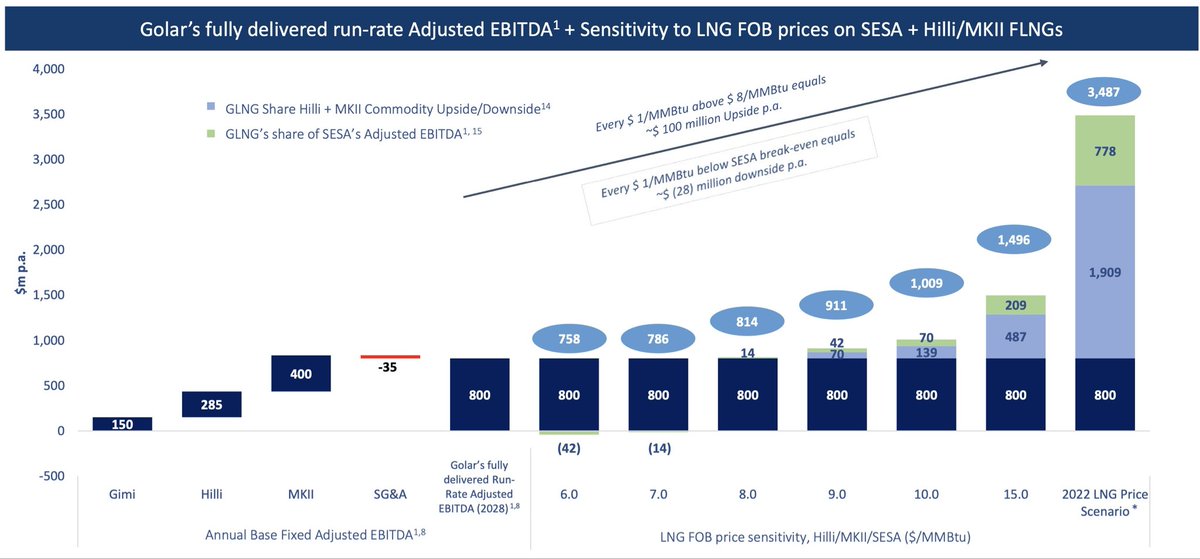
That part of the contract can be a big win for Golar. But we’re talking about a 20-year deal, and honestly, nobody knows where gas prices will be in 10, 15, or 20 years. It looks good now, but things can flip fast. The cleanest way to think about that upside is just as an option. Using something like Black-Scholes, as in the analysis you shared, gives you a rough idea of what that “above $8/MMBtu” exposure might be worth. It’s not perfect, but it provides a useful ballpark. $GLNG
English
0
0
4
544
Carlos M
Carlos M@Carlos_MoraM·
⛵️I think $GLNG should benefit much more from the nearly 40% increase in 🇪🇺gas (TTF) so far this year • Not because of the $4/MMBtu increase and the Hilli bonus they have (whose impact is only $3.2 million per $/MMBtu and lasts only until July this year). • Rather, because it truly highlights the value of the contracts they have in 🇦🇷, under which they will earn $100 MM of EBITDA for every dollar that the FOB price rises above $8/MMBtu (currently north of $10) • Statistically, over a 20-year contract, in a market that is increasingly dependent on LNG, we are going to see situations like the current one (and even much more pronounced)
Carlos M tweet media
Carlos M@Carlos_MoraM

⛵️ Golar LNG - Full analysis post 🇦🇷deal ✅Analysis of the company I’ve spent the most time on over the past 5 years, including full details of the transformative deal announced this Friday. 💎Downloadable spreadsheet with the full Sesa business case (10% $GLNG owned) + DCF valuation model for Golar LNG across all potencial scenarios (TTF/JKM, shipping, eur/usd, Mark II B, CPI,…) 🧐Breakdown of key variables & assumptions — after a full weekend digging into what’s often left out or not so obvious

English
4
15
104
23.4K
Deep Capital
Deep Capital@DeepCapital_·
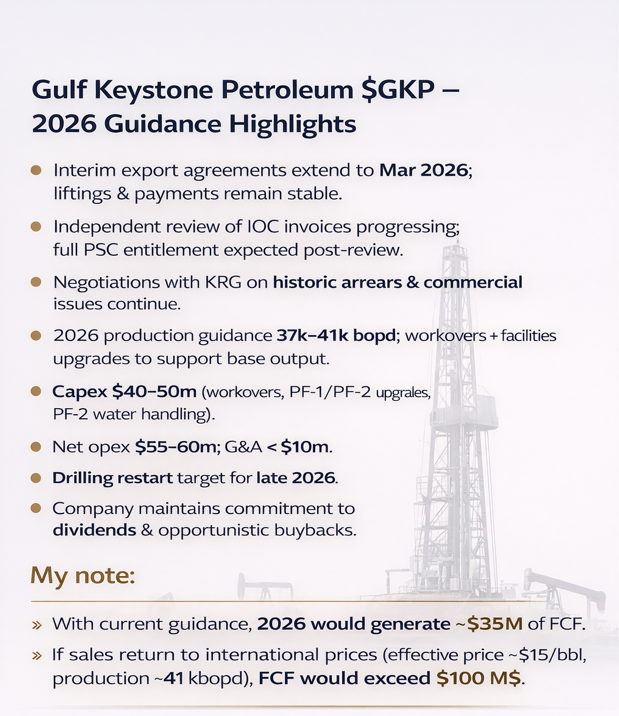
Gulf Keystone Petroleum $GKP 2026 Update-Guidance Highlights #OOTT
Deep Capital tweet media
English
1
0
0
474
Deep Capital
Deep Capital@DeepCapital_·
$SJT update (Jan-26) Stabilized production, deficit shrinking. Weak gas prices and higher LOE. #NatGas #naturalgas
Deep Capital tweet media
English
0
0
4
786
Deep Capital
Deep Capital@DeepCapital_·
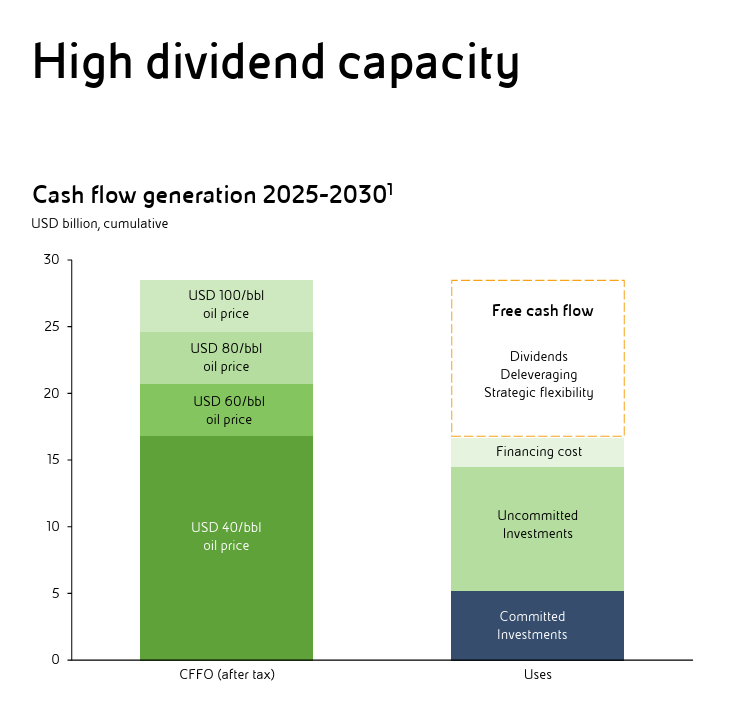
4/ Bottom line: the 14% dividend yield is not sustainable at current prices. To safely support a USD 1.2bn payout, Vår Energi would need Brent closer to USD 75/bbl.
English
0
0
0
128
Deep Capital
Deep Capital@DeepCapital_·
3/ Meanwhile, the dividend commitment for 2026 is USD 1.2bn, meaning today’s cash generation doesn’t fully cover it. CAPEX can be deferred to bridge the gap temporarily, but doing so pressures future output and limits how long the company can stretch this approach.
Deep Capital tweet media
English
1
0
0
149
Deep Capital
Deep Capital@DeepCapital_·
1/ Vår Energi advertises a dividend yield close to 14%, but at current market conditions the company doesn’t generate enough free cash flow to support it. Their 2025–2030 plan forecasts USD 5–9bn FCF, a range that hinges directly on prices of USD 65–85/boe. $VAR.OIL #TTF #OOTT
Deep Capital tweet media
English
1
0
0
395
Deep Capital
Deep Capital@DeepCapital_·
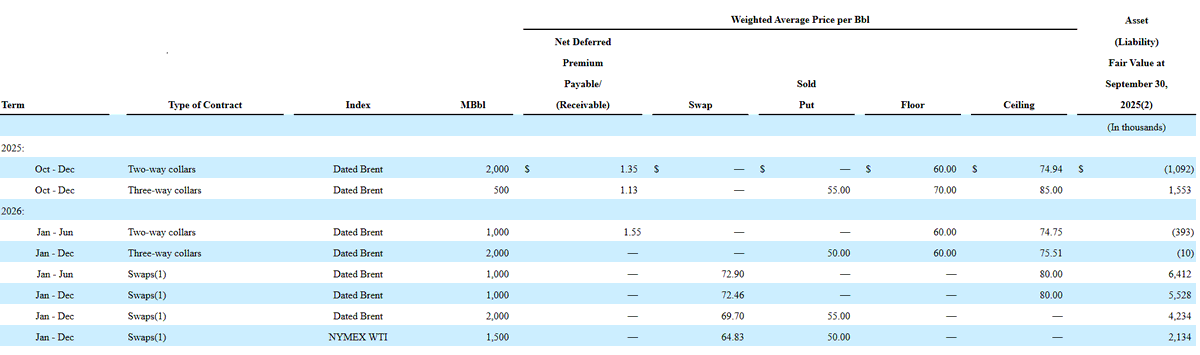
They haven’t disclosed any hedges for 2027–2028. The latest 3Q25 filing only shows open positions through 2026. With the recent pickup in oil prices, they may have more flexibility to add new hedges.
Deep Capital tweet media
English
1
0
1
82
Serge Motrin
Serge Motrin@SergeMotrin·
@gabcasla Any idea of what they are hedging oil price for 27/28? I know 26 is $66/ barell… hope 27/28 is lower
English
1
0
0
326
Gabriel Castro, CFA
Gabriel Castro, CFA@gabcasla·
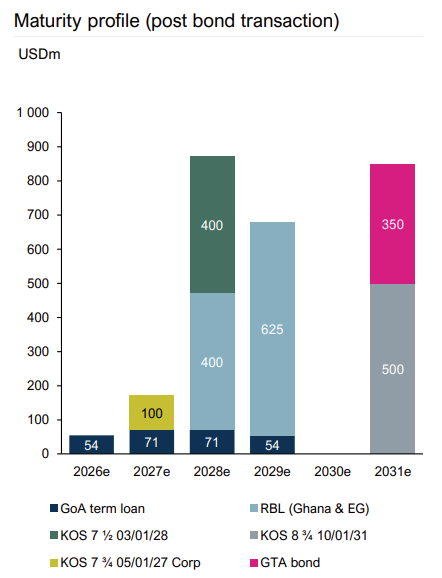
$KOS is taking another significant step to enhance its company profile risk management. The company plans to issue a 2031 bond, a $350 million first-lien GTA. The proceeds will be used to tender $250 million of the 2027 bonds at 99, with the remaining $100 million used to repay the RBL loan, specifically the 2027 maturity. I expect Kosmos to successfully raise this debt. They are well prepared, having conducted a sounding in December with strong investor interest, including from us. Bonds are reacting positively, rising by 2/3%, and the stock should follow. This refinancing largely covers Kosmos's upcoming maturities, giving the company ample time to see how Brent recovers to the 70s, which will significantly boost the NAV.
Gabriel Castro, CFA tweet media
English
10
13
128
19.5K
Deep Capital
Deep Capital@DeepCapital_·
PetroNor E&P Update Good News: PetroNor reports Q4 2025 net working interest production of 4,608 bopd, up from 4,116 bopd in Q3. Production efficiency remained strong at 91%. The Axima jack-up rig completed five infill wells at Tchibouela East, all now onstream and adding 6,500+ bopd gross, pushing the PNGF Sud 2025 exit rate above 32,000 bopd (net 5,400 bopd). The Company sold 540,000 barrels in November and is building inventory at 100,000 barrels/month, with another lifting expected in Q1 2026 $PNOR.OL
English
1
0
0
175
Deep Capital
Deep Capital@DeepCapital_·
I’ve also read everything Gabriel has written about Kosmos, and I don’t think the current management is doing a bad job. Given the circumstances, I believe they’re doing everything reasonably within their control to address the situation and meet their obligations. At this point, a recovery really depends on Brent moving higher. That said, I agree that if a year from now Brent is still at these levels and the company isn’t generating meaningful cash to handle its upcoming maturities, things could get complicated.
English
0
0
0
100
Moz
Moz@onslowshipping·
@gabcasla I’ve read everything you’ve said about Kosmos, on here and on substack. I think you are underestimating the chance that this ends badly. I have next to zero faith in current management given history of GTA. $80 Brent will smooth over many issues but it’s hardly smooth sailing
English
2
0
0
648
Deep Capital
Deep Capital@DeepCapital_·
A striking passage from Goehring & Rozencwajg underscores how massive the investment needs would be to revive Venezuela’s heavy-oil output: “Restarting Venezuelan heavy-oil production would require capital investment on an extraordinary scale. As one illustrative example, an older industry document indicates that supermajors spent approximately $23 billion in 2010 to bring 600,000 barrels per day of heavy-oil capacity online—roughly $40,000 per flowing barrel. More recent rules of thumb for Canadian heavy oil suggest figures closer to $100,000 per flowing barrel, implying that adding one million barrels per day could require on the order of $100 billion once the cost of an upgrader—an essential component of heavy-oil production—is included.” #Oil #OilandGas #EnergyMarkets #Venezuela #HeavyOil #EnergyGeopolitics
English
0
0
0
158