Andrew Stott đã retweet

Building a tram network doesn’t get people out of their cars. It just stops them from walking.
Researchers analysed mobility data from nearly 400 European cities to understand how infrastructure changes daily commutes. They tracked three core categories: active mobility, public transport, and private cars. The goal was to isolate the exact impact of building a metro versus laying down tram tracks.
The data for underground metros perfectly matches urban planning theory. Cities with metro systems see a massive boost in public transport use and a direct drop in car journeys. Metros successfully convince drivers to leave their vehicles at home.
Trams show a completely different pattern. In cities that rely on trams but lack a metro, the car share remains heavily dominant. The drivers keep driving. The tram network completely fails to disrupt car dependency.
A Dirichlet regression model applied to the dataset reveals exactly who is actually riding the tram. The presence of a tram system correlates with a severe reduction in active mobility. The new public transport infrastructure merely convinces pedestrians and cyclists to buy a ticket and sit down.
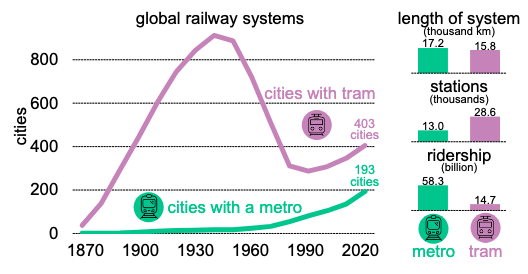
Europe has 60 percent of the global tram network and generates 75 percent of total ridership. Governments fund these street-level programmes under the assumption they will fix traffic congestion and lower emissions. The data proves that assumption is entirely wrong.
If a city wants to pull cars off the road, it has to build a metro. Funding a tram line might look like a green victory on a political brochure. The reality is that it just destroys walking and cycling rates while leaving the traffic jams completely untouched.
Link to article: nature.com/articles/s4428…
English