Fox76
1.4K posts


@maximprotocol What is the purpose of the $Maxim token? Is it used in the protocol?
English

$MAXIM is now live on Solana.
FMUfhLrPvSSxaMhVvaZbqXjmpZfE41ZSyRfwvoMZpump
Maxim Protocol is a single payment system that lets AI agents pay for things on their own, no matter which payment standard a service uses behind the scenes. It gives developers an easy way to set up a wallet for each agent, control how much it can spend, and see every payment it makes on a clear, verifiable record.
English
Fox76 đã retweet

BTW: Anthropic's most powerful AI model just launched, and it won't answer basic questions.
Here, c0mpute Al is building a decentralized inference network that's private, uncensored, and pays people for their GPU power on @solana.
c0mpute@c0mputeAI
AI powered by people, not datacenters.

English
Fox76 đã retweet

@dAnGeLl35 @Th3Edelweis @avipat_ @KledFoundation It's a scam, be careful and don't click on the links. Follow news only from official Kled accounts.
English
Fox76 đã retweet

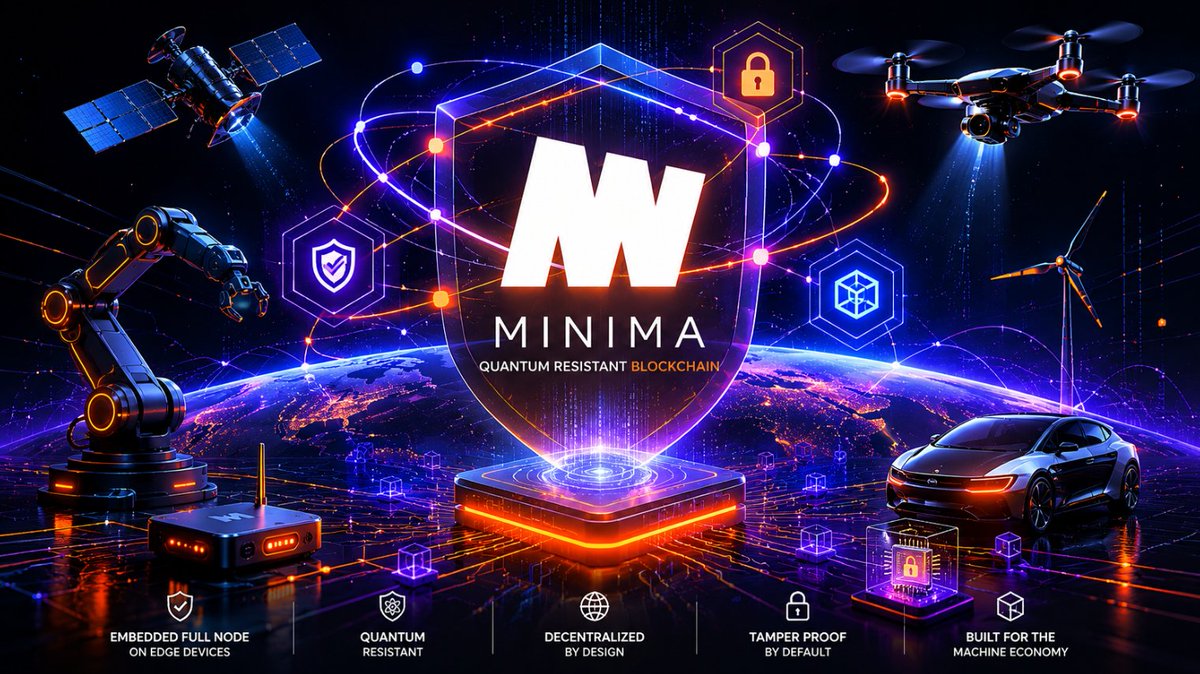
Utility isn’t something you add on later and Minima gets that.
You can usually tell what a system truly cares about very early on by Just looking at what it makes easy and what it makes hard.
Does it make participation cheap or expensive?
Does it push power to the edges or pull it to the center?
That’s where the real priorities live.
From day one, @Minima_Global made one thing very clear:
utility comes first.
On Minima, the important stuff is simple and cheap:
➠ Running a full node
➠ Verifying things for yourself
➠ Being part of the network from a normal device
With Minima, all you need is your device, no servers, no massive storage, and no permission from anyone.
A full Minima node is only 2MB. That’s small enough to run on your phone, a tiny computer, or even inside machines. And that choice says a lot. It tells you Minima wasn’t built for data centers or elites, it was built for everyone.
What Minima doesn’t make easy is just as important.
It doesn’t encourage central control.
It doesn’t rely on big validators.
It doesn’t push users into the cloud.
Instead, it quietly guides everyone toward self-ownership. Your device can be a node. Your participation actually matters.
And over time, that design choice compounds.
When running a node is easy, decentralization grows naturally.
When verification happens on-device, trust becomes real.
When the system is lightweight, it can exist anywhere, not just in rich countries or perfect network conditions.
That’s real-world utility.
Minima wasn’t designed to look good on a chart. It was designed to work in cities, in factories, in vehicles, and in places where centralized systems break down.
Nothing about this was accidental. The priorities are baked in. Utility isn’t an upgrade on Minima.
Decentralization isn’t a marketing line.
It’s the foundation and that’s why Minima feels different.

English
Fox76 đã retweet

Artificial intelligence is rapidly changing what machines can do.
Cars can drive themselves.
Sensors can monitor industrial equipment.
Smart devices can make decisions without waiting for human input.
AI agents are beginning to execute tasks, negotiate services, and interact with digital systems autonomously.
Yet despite all the advances in machine intelligence, one critical problem remains unsolved:
How do machines trust each other?
Today, most digital systems still rely on centralized infrastructure to answer that question.
Devices connect to cloud servers, applications depend on centralized databases, and trust is established through intermediaries that sit between participants.
As machines become increasingly autonomous, that model begins to show its limitations.
An autonomous vehicle cannot always depend on a remote data centre before making a decision.
Industrial sensors operating in remote locations may not have continuous connectivity.
Billions of Internet of Things devices cannot realistically rely on a handful of centralized operators to validate every interaction they make.
The future of machine-to-machine economies requires something different.
It requires infrastructure that can travel with the machine itself.
That is the problem @Minima_Global is trying to solve.

English
Fox76 đã retweet

Most articles and news I read about Iot, Edge AI, and autonomous systems make me directly think about $MINIMA, and how unique and needed their solution is.
ARM is directly working with Minima, together with Siemens. So I'm pretty sure Minima is in ARM's mind when they are writing articles like these.
But anyway, any other article I read just ties so naturally into Minima's tech.
> Edge AI Hits Mass-Market Inflection in IoT Devices
OEMs are scaling Edge AI from pilots to full portfolios, with new SoCs enabling on-device anomaly detection, vision, and decision-making amid rising cloud costs and latency needs.
Every AI-enabled IoT device could run a full Minima node for verifiable, tamper-proof logging of inferences, model updates, or payments.
This would create a decentralized trust layer for autonomous edge intelligence.
> Surge in Drone Swarms and Autonomous Aerial Systems
China's Atlas Swarm demo and global adoption show drones operating with heavy Edge AI autonomy for logistics, defense, and infrastructure.
Minima's blockchain-on-chip prototypes (with Siemens/ARM for drone controllers) let every drone act as a full node for real-time attestation, swarm coordination, and secure M2M data sharing.
> Rising IoT Security Breaches and Botnets
Many exploits target vulnerable IoT devices for massive DDoS botnets, showing weak default security and centralized risks.
Full decentralization at the edge via Minima nodes provides inherent security, collaborative validation, and resistance to single-point failures or censorship far beyond traditional IoT security
> Growth of Machine-to-Machine Economy and Autonomous Transactions
Machines (robots, vehicles, appliances) increasingly negotiate tasks, payments, and resources autonomously, powered by AI and connectivity.
Minima enables lightweight, on-device tokens and smart contracts for true M2M economies, allowing devices to verify, decide, and transact peer-to-peer with minimal overhead.
> Physical AI and Autonomous Mobility in Smart Cities
IoT shifts to "acting" infrastructure with Physical AI, autonomous vehicles/drones, and medical IoT for real-time decisions.
Minima's edge consensus allows devices to maintain sovereign identities, secure data sharing, and autonomous coordination for trusted, decentralized mobility and health systems.
> AI Chips and Neuromorphic Computing for Edge Devices
Market for edge AI chips is projected to boom to over $80B by 2036, with neuromorphic and low-power solutions for always-on autonomy.
Minima's low-footprint design pairs perfectly with this for blockchain-secured, intelligent edge nodes.
> Integration of Blockchain + Edge AI for Zero-Trust IoT Security
Research and deployments combine AI threat detection, edge processing, and blockchain for robust, adaptive IoT security frameworks.
Minima's consensus provide built-in zero-trust at the device level.
Every node validates without relying on clouds or intermediaries.
> Autonomous Vehicles and V2X with Embedded Blockchain Needs
There is a real focus on secure V2X communication, data integrity, and compliance in self-driving ecosystems.
Direct integration into vehicle controllers for real-time, verifiable transactions and telemetry in order to improve safety, payments, and fleet autonomy.
Conclusion
Minima has been specifically designed to be directly embedded into any device for secure, peer-to-peer verification, transactions, and machine-to-machine coordination.
All these articles highlight the shift toward intelligence and autonomy at the edge, where centralized models (or pseudo-decentralized models) fall short on security, scalability, and trust.
Minima definitely seems to be on track to become a foundational enabler, turning all devices into sovereign, collaborating nodes in a truly (/fully) decentralized web.
@Minima_Global
Arm@Arm
Embedded Intelligence + Production Environments = ⚡Real time anomaly detection ⚡Minimal waste ⚡Continuous process optimization What more could you need? Arm-based platforms are bringing AI to the edge and redefining quality control in manufacturing. 💪 okt.to/cyGL9j
English
Fox76 đã retweet

Guys!!
Let’s talk about something simple… but something that affects all of us every day: trust.
Every time we buy something, we trust what the label tells us.
“Original.”
“Authentic.”
“Eco-friendly.”
“Sustainably made.”
But let’s be honest… how do we actually know that’s true?
Most of the time, we just take their word for it.
That’s exactly where @Minima_Global comes in.
Minima is helping power something called Digital Product Passports, and honestly, this could completely change how we trust products in everyday life.
Think of it like a digital passport for every product.
From the moment a product is created, its entire journey can be securely recorded on Minima’s decentralized network:
➠ Where it was made
➠ How it was made
➠ Where it has traveled
➠ Whether it’s authentic
➠ Whether it meets sustainability standards
And because that information is stored on blockchain, it can’t be quietly changed, edited, or manipulated later.
That changes everything.
It means: more transparency, more trust, less counterfeits and less fraud.
Imagine buying a luxury bag, medicine, food, or even your next phone, Instead of just trusting the packaging, you can actually verify the product’s full history yourself.
And it’s not just good for buyers.
For businesses, it helps with compliance and sustainability reporting.
For brands, it builds stronger customer trust.
And for everyday people like us, it gives peace of mind.
This is what I love about Minima.
They’re not building blockchain just for hype or headlines. They’re solving real-world problems with it.
And Digital Product Passports are a perfect example of that, using decentralization to make everyday life more transparent, more secure, and a lot more trustworthy.
That’s real utility. That’s real adoption.
And that’s the kind of future Minima is building.

English
Fox76 đã retweet

Most crypto projects be like:
“Bro… when institutions come, the token will pump.” 😭
Okay, but HOW?
That’s where most tokenomics die because we all know revenue enters the company, but never touches the token.
What caught my attention about @Minima_Global is that the loop is actually clear.
The way it’s done here is company pays fiat for compliance + chip verification → fiat buys $MINIMA from the market → usage burns supply.
Even unused subscription allocation burns too.
Meaning:
customer active = burn
customer inactive = still burn
That’s a very different model from the usual print more tokens and pray demand catches up.
The craziest part?
The enterprise customer doesn’t even need to touch crypto.
No wallets.
No custody stress.
No teach your staff Web3.
Just:
“Here’s the infrastructure.”
That’s probably how real adoption happens tbh. Blockchain becomes invisible, while the economic engine keeps running underneath.
And if the customer list keeps growing?
-more market buys
-more burns
-less supply floating around
For once, the important thing might genuinely be:
watching customers instead of candles.
So would you;
Would you rather hold a token that depends on:
A. hype/speculation
or
B. actual enterprise customers constantly buying and burning supply?

English
Fox76 đã retweet

Imagine a future where your phone, your car, your smartwatch, and even your fridge all run blockchain nodes quietly in the background.
Not giant mining farms.
Not billion-dollar validator centers.
Just everyday devices helping secure the network together.
That’s the world @Minima_Global is trying to build.
While most blockchains are competing to become bigger, faster, and heavier, Minima went the opposite direction:
“What if blockchain became so light that almost anything could run it?”
A phone in Lagos.
A laptop in Tokyo.
A smart device in São Paulo.
All connected. All validating. All decentralized.
That changes the conversation completely.
Because real decentralization isn’t only about TPS numbers or fancy charts. It’s about participation.
Most networks say:
“You can join… if you have expensive hardware.”
Minima says:
“If you have a device, you can be part of the network.”
And honestly, that vision fits perfectly with where technology is heading.
AI agents talking to each other.
IoT devices making autonomous payments.
Machines sharing data in real time.
You can already imagine a future where devices don’t just connect to the internet — they interact economically onchain.
That’s the lane Minima is building for.
Quietly. Differently. And way ahead of where most people are looking. 💡

English
Fox76 đã retweet

quantum is not a 2040 problem anymore for blockchains
the moment quantum computers break old signatures, most chains face the same ugly question
who owned the wallet before the attacker copied the key?
@Minima_Global took a diff route from day 1
> sha3-256 for hashing
> winternitz one-time signatures for quantum resistance
> and a full node small enough to live on devices
this matters more when drones, cars, robots and ai agents start signing actions
future machines need future-proof trust
are we early or late to this convo?
$MINIMA

Waqas@OnchainLegend
gmorning ct heres why @Minima_Global caught my attention most chains are still built like humans will be the main users forever > wallet opens > swap happens > chart moves but drones, robots, cars, sensors, and ai agents dont need pretty dashboards they need identity, payments, logs, and proof minima pushes blockchain inside the machine thats a diff game $Minima

English
Fox76 đã retweet

Most token economies fail to specify the path from enterprise revenue to token demand. @Minima_Global has now published one. It is worth tracing what a single customer looks like end to end, because the loop is more mechanical than the average tokenomics deck.

English
Fox76 đã retweet

🧵 The $KLED Institutional Thesis: Why smart money is accumulating a $13M microcap.
1. The "Data Wall" is officially the biggest bottleneck in AI. Frontier models are running out of internet data to scrape, and legal copyright battles are forcing labs to pay for legitimate licensing.
Enter- @useKled an operational human data marketplace.
2. While retail is chasing meme coins, institutional capital is silently moving in.
European crypto hedge fund Sigil Fund —known for their deep research-driven, insider-led strategies—has started aggressively purchasing and accumulating $KLED.
3. Why? The business value and revenue pipeline are absurd for a token at this market cap.
Kled already has over 3M hours of licensed video content and has confirmed pipelines exceeding $35M from top AI labs. But the real catalyst? Compliance.
4. Kled is actively finalizing its compliance frameworks (GDPR, HIPAA, SOC2).
Once cleared, they have a massive $100M pipeline enterprise deal they are positioned to close, paving a clear trajectory to scale the business well past a $1B valuation floor.
5. To understand how massively undervalued $KLED is, look at the private markets:
Kled’s direct copycat, Luel AI, just raised a staggering $31.2M seed round led by General Catalyst and Lightspeed.
Luel's massive raise validates exactly what Kled is building—except Kled already has a live product with hundreds of thousands of active users, and thousands of reviews on the App Store with high ratings (4.7-4.9 stars).
When a regulated institutional fund like Sigil front-runs a $100M corporate pipeline on an asset with an engineered buyback-and-burn mechanism, you pay attention.
6. Let’s do some napkin math on what happens the moment tokenomics go live on the app.
- To unlock higher-paying data tasks, users pay a one-time $20 fee to upgrade their account XP.
If just 100k of Kled's global users upgrade, that generates $2,000,000 in immediate token buyback pressure, 50% burnt instantly. At current prices, that initial $2M user-upgrade surge alone would instantly buy back and burn roughly 15% of the entire circulating token supply straight off the launch.
With this level of real-world volume and a massive global app user base, Tier-1 CEX listings are practically a no-brainer.
Exchanges want volume, and Kled has an organic pipeline of it.
7. More importantly, the team needs a T1 CEX listing.
To accommodate major fund exposure from players like Sigil, Maven11, etc, liquidity depth is non-negotiable. Getting $KLED on primary institutional venues is a core priority for everyone involved.
In a market full of vaporware, $KLED is a fundamentally engineered value accrual machine.
Be patient, give it a few months to play out as compliance clears and the tech drops. This is a multi-dollar token hiding in plain sight.
Full thesis, and tokenomics breakdown here: x.com/astaso1/status…
Full Tokenomics:
x.com/avipat_/status…
📊 $KLED
PSA - AI did support in writing this and I’m lazy as fuck and did it in 20mins, so it isn’t perfect, there may be some minor errors.
Avi Patel@avipat_
English
Fox76 đã retweet

Every time a project community says token prices doesn't matter; they are usually grifting.
solana:1zJX5gRnjLgmTpq5sVwkq69mNDQkCemqoasyjaPW6jm is unique because of StreetFDN mechanism.
So, short term prices don't matter too much. People can buy or sell at any price but the NAV remains the same.
It currently translates to $14M for token holders.
Expecting the NAV to grow somewhere between 3-6x this year alone.
There's no stopping this train. Users are climbing daily, and sales pipeline continue to grow on an accelerated pace.
Less we forget also, KLED's flywheel tokenomics are still in the process of implementation. This is expected to drive demand for the token. 300.000+ users all clamoring for better payouts will be eyeing it.
English

Comrade, would you share your house with the proletariat if you had two houses?
Of course comrade.
Comrade, would you share your car with the proletariat if you had two cars?
Of course comrade.
Comrade, would you share your chicken with the proletariat if you had two chickens?
No, comrade.
Why not comrade?
Because I have two chickens.
English
Fox76 đã retweet

only a matter of time before @xai partners with Kled.
Olsen@olseneng
Mad respect to founders like this. Crazy situation
English
Fox76 đã retweet

minima feels boring until you zoom out
> drones need proof
> cars need identity
> ai agents need payments
> sensors need audit trails
@Minima_Global is building for all of them from the device layer
thats the interesting part for me >>

English

Hired @LuelCompanyAI's recently let go designer yesterday. Absolutely blown away by Dupe's new homepage, the micro interactions is what got me. He moved fast, broke things, but made it beautiful. And for absolutely no reason, we decided to make our company SOC2 compliant.

English
Fox76 đã retweet

Did 15 mins of digging in luel.ai's frontend. here's what i actually found.. copy/paste reproducible: (I’m confident they might take this stuff down after the post hence the video)
1/ counter on the page says ~606,000 contributors. their own shipped bundle has a fixed: meta:{total:71e3, distinct_countries:74, source:"user_profiles + waitlist (country_code only)"}
that's 71,000. their own data disagrees with their own counter by ~535k.
2/ same file hardcodes 86 per-country counts (IN:7876, JP:5025, ZA:4621, KE:4544, GB:4112, US-CA:2375…). they sum to 74,675. the source field literally calls it a snapshot of “waitlist users”
not a live aggregate. a static export shipped to the client.
3/ the "live" heatmap is fabricated client-side:
Each dot = cityCoord + (Math.random()-0.5)*0.5
that's ±0.25° (~±25 km) of RNG jitter on a hardcoded city-coordinate table, regenerated fresh every page load. a second Math.random() seeds the WebGL shader dither.
the "alive" feeling is pure animation. nothing is being fetched live.
4/ now the contributor counter itself. here's the actual display function from their bundle:
function n(e){let t=Math.max(5e5,1e5*Math.floor(e/1e5));return `${Math.round(t/1e3)}K+`}
let o=n(5e5);
Math.max(5e5, …) = hardcoded floor at "500K+". the widget cannot render below that no matter what value the backend returns.
5/ reproduce it yourself in 60 seconds:
luel.ai/_next/static/c…
search for: Math.max(5e5,1e5*Math.floor or meta:{total:71e3 or distinct_countries
6/ what this proves from the client side:
their embedded user total (71k) contradicts their displayed counter (~606k)
the heatmap is fabricated with RNG, not live activity
the counter widget has a 500K+ floor baked into the code
7/ok but the api endpoint returning the ~606k number ,surely THAT’s a real database read?
no. it’s a function of unix time:
count ≈ floor(constant + 0.07048 × current_unix_seconds)
i forecast the value 2 minutes into the future. landed within 2 of the actual returned number out of ~606,000. that’s 0.0003% error. statistically impossible from real signups..real user activity has variance, clocks don’t.
responses come back with x-vercel-cache: HIT, frozen in 30-second cache windows. they’re not even hitting a database. it’s a cached time function served from edge.
the “live counter” is a clock multiplied by a growth rate (~0.07/sec = ~6,089/day baked in). not a counter.
8/ what’s provable from the client side, no backend access needed:
their embedded user total (71k) contradicts their displayed counter (~606k)
the heatmap is RNG on top of a hardcoded city table, not live activity
the counter widget has a 500K+ floor baked in
the api endpoint is a deterministic time function, served from edge cache
four independent layers of “fabrication”...
English