

Cheetahs
3.4K posts

Cheetahs
@GoldenCheeta
I don't understand things, but I don't know things.
Tham gia Kasım 2017
775 Đang theo dõi65 Người theo dõi

This is the top example of midwit. Someone who is just barely in an acceptable IQ range LARP-ing as a IQ genius and incessantly yapping to stroke his own ego.
Devon Eriksen@Devon_Eriksen_
This is why IQ tests don't work too well on really smart people. Because sorta smart people tend to give the expected answer. And really smart people tend to point out that the question is wrong, and start arguing with the test, or trying to correct it, thereby making the test impossible to grade and annoying everyone. The expected answer to this is 72. Because 2*2*2 = 8 and 5*5*2 = 50, so 6*6*2 = 72. But the (really) correct answer is "I don't know." Because what you have is two points on a 3 dimensional graph (x,y) -> z. z = 2*x*y is one surface that can be drawn through these two points. And I suspect it's the simplest formula for a surface that can be so drawn, although I haven't bothered to check. But an infinite number of contiguous surfaces can be drawn in three dimensions that encompass these points (2,2,8) and (5,5,50). Each of these surfaces can be described by its own formula. Some of them will also touch (6,6,72). But others of them will touch (6,6, {something else entirely}) instead. This might sound really, really pedantic. But it's not. Everyone knows that the expected answer is the simple one, but that's only on a test... a fake artificial made up problem. When we start trying to do this in the real world, which, after all is what this "IQ" thing is actually for, then using the same kind of "IQ test thinking" can get you in trouble. "My 3-month-old son is now TWICE as big as when he was born. He's on track to weigh 7.5 trillion pounds by age 10." -@pronounced_kyle Fitting the simplest-formula curve, as opposed to the correct curve, makes our predictions of real-world stuff dead wrong. So this kind of test question promotes a dangerous habit of thought. But, Devon, I hear some of you ask, doesn't the principle of Occam's Razor demand that we fit the simplest curve? No. No, it does not. It does not require that we select the simplest possible answer, given what we have currently seen. It requires that we prefer hypotheses that make fewer assumption to those that make more. These are two different things entirely. If I see one black sheep, the simplest hypothesis is that all sheep are black. The hypothesis requiring the fewest assumptions is that at least one sheep is black on at least one side. You will note which of these is correct. All of this is, of course, irrelevant to questions on IQ test. But questions on an IQ test only matter as much as they are relevant to the actual universe... Where ideas like this are very relevant indeed.
English

If you need to ejaculate a novella to justify arguing with a pattern recognition test, perhaps you're not the genius you think you are.
Devon Eriksen@Devon_Eriksen_
This is why IQ tests don't work too well on really smart people. Because sorta smart people tend to give the expected answer. And really smart people tend to point out that the question is wrong, and start arguing with the test, or trying to correct it, thereby making the test impossible to grade and annoying everyone. The expected answer to this is 72. Because 2*2*2 = 8 and 5*5*2 = 50, so 6*6*2 = 72. But the (really) correct answer is "I don't know." Because what you have is two points on a 3 dimensional graph (x,y) -> z. z = 2*x*y is one surface that can be drawn through these two points. And I suspect it's the simplest formula for a surface that can be so drawn, although I haven't bothered to check. But an infinite number of contiguous surfaces can be drawn in three dimensions that encompass these points (2,2,8) and (5,5,50). Each of these surfaces can be described by its own formula. Some of them will also touch (6,6,72). But others of them will touch (6,6, {something else entirely}) instead. This might sound really, really pedantic. But it's not. Everyone knows that the expected answer is the simple one, but that's only on a test... a fake artificial made up problem. When we start trying to do this in the real world, which, after all is what this "IQ" thing is actually for, then using the same kind of "IQ test thinking" can get you in trouble. "My 3-month-old son is now TWICE as big as when he was born. He's on track to weigh 7.5 trillion pounds by age 10." -@pronounced_kyle Fitting the simplest-formula curve, as opposed to the correct curve, makes our predictions of real-world stuff dead wrong. So this kind of test question promotes a dangerous habit of thought. But, Devon, I hear some of you ask, doesn't the principle of Occam's Razor demand that we fit the simplest curve? No. No, it does not. It does not require that we select the simplest possible answer, given what we have currently seen. It requires that we prefer hypotheses that make fewer assumption to those that make more. These are two different things entirely. If I see one black sheep, the simplest hypothesis is that all sheep are black. The hypothesis requiring the fewest assumptions is that at least one sheep is black on at least one side. You will note which of these is correct. All of this is, of course, irrelevant to questions on IQ test. But questions on an IQ test only matter as much as they are relevant to the actual universe... Where ideas like this are very relevant indeed.
English

This is why IQ tests don't work too well on really smart people.
Because sorta smart people tend to give the expected answer.
And really smart people tend to point out that the question is wrong, and start arguing with the test, or trying to correct it, thereby making the test impossible to grade and annoying everyone.
The expected answer to this is 72.
Because 2*2*2 = 8 and 5*5*2 = 50, so 6*6*2 = 72.
But the (really) correct answer is "I don't know."
Because what you have is two points on a 3 dimensional graph (x,y) -> z.
z = 2*x*y is one surface that can be drawn through these two points. And I suspect it's the simplest formula for a surface that can be so drawn, although I haven't bothered to check.
But an infinite number of contiguous surfaces can be drawn in three dimensions that encompass these points (2,2,8) and (5,5,50).
Each of these surfaces can be described by its own formula. Some of them will also touch (6,6,72). But others of them will touch (6,6, {something else entirely}) instead.
This might sound really, really pedantic. But it's not.
Everyone knows that the expected answer is the simple one, but that's only on a test... a fake artificial made up problem.
When we start trying to do this in the real world, which, after all is what this "IQ" thing is actually for, then using the same kind of "IQ test thinking" can get you in trouble.
"My 3-month-old son is now TWICE as big as when he was born. He's on track to weigh 7.5 trillion pounds by age 10." -@pronounced_kyle
Fitting the simplest-formula curve, as opposed to the correct curve, makes our predictions of real-world stuff dead wrong.
So this kind of test question promotes a dangerous habit of thought.
But, Devon, I hear some of you ask, doesn't the principle of Occam's Razor demand that we fit the simplest curve?
No. No, it does not. It does not require that we select the simplest possible answer, given what we have currently seen. It requires that we prefer hypotheses that make fewer assumption to those that make more.
These are two different things entirely.
If I see one black sheep, the simplest hypothesis is that all sheep are black.
The hypothesis requiring the fewest assumptions is that at least one sheep is black on at least one side.
You will note which of these is correct.
All of this is, of course, irrelevant to questions on IQ test. But questions on an IQ test only matter as much as they are relevant to the actual universe...
Where ideas like this are very relevant indeed.
Beyza@hicasamadim
bunu çözersen, IQ seviyen ortalamanın üstündedir. çözebilir misin?
English
@justalexoki Because you aren't pushing yourself at all on the first set.
English


Peak day, watched some incredible Rocket League with OhnePixel & Jynxzi alongside a huge Rocket League 2 UE6 announcement, super excited for the future. May potentially return try to pro league in the new version if I’m enjoying it. Goated weekend, love y’all. ❤️
English

What Unreal Engine 6 could mean for RL
- Creative Mode
- Custom maps, modes, training packs, racing, obstacle course, etc.
- Best possible graphics and refresh rates
- In-game social hubs live broadcasts, including watch parties and co-streaming
Due 2028.
RLRecon@RLRecon
UNREAL ENGINE 6
English


M0nkeyM00n still being this good is so inspirational man
English


@BasedBiohacker I felt this within a day or two of taking it. Lost enjoyment of music. Was crazy.
English

don't take too much NAC. 1-2x/wk only
you'll become a shell of your former self

English

i would never hire anyone with a 4 year resume gap
Polymarket Money@PolymarketMoney
Andrej Karpathy's incredible resume: > Google, Working on DeepMind (2015) > OpenAI, Founding member (2016 - 2017) > Tesla, Senior Director of AI (2017 - 2022) > Anthropic, Working on R&D (2026)
English
Cheetahs đã retweet


🚨Arman Tsarukyan was almost REMOVED from the #RouseyCarano Netflix card after he tried to fight Namo Fazil, who called him out 😳
The MVP CEO had to step in and stop him backstage
English
@chrisgrayson @SteveStuWill It was sarcasm, dumbass. Clearly mocking the graph.
English

@GoldenCheeta @SteveStuWill Are you schizophrenic ??
I didn’t say that, you did.
English

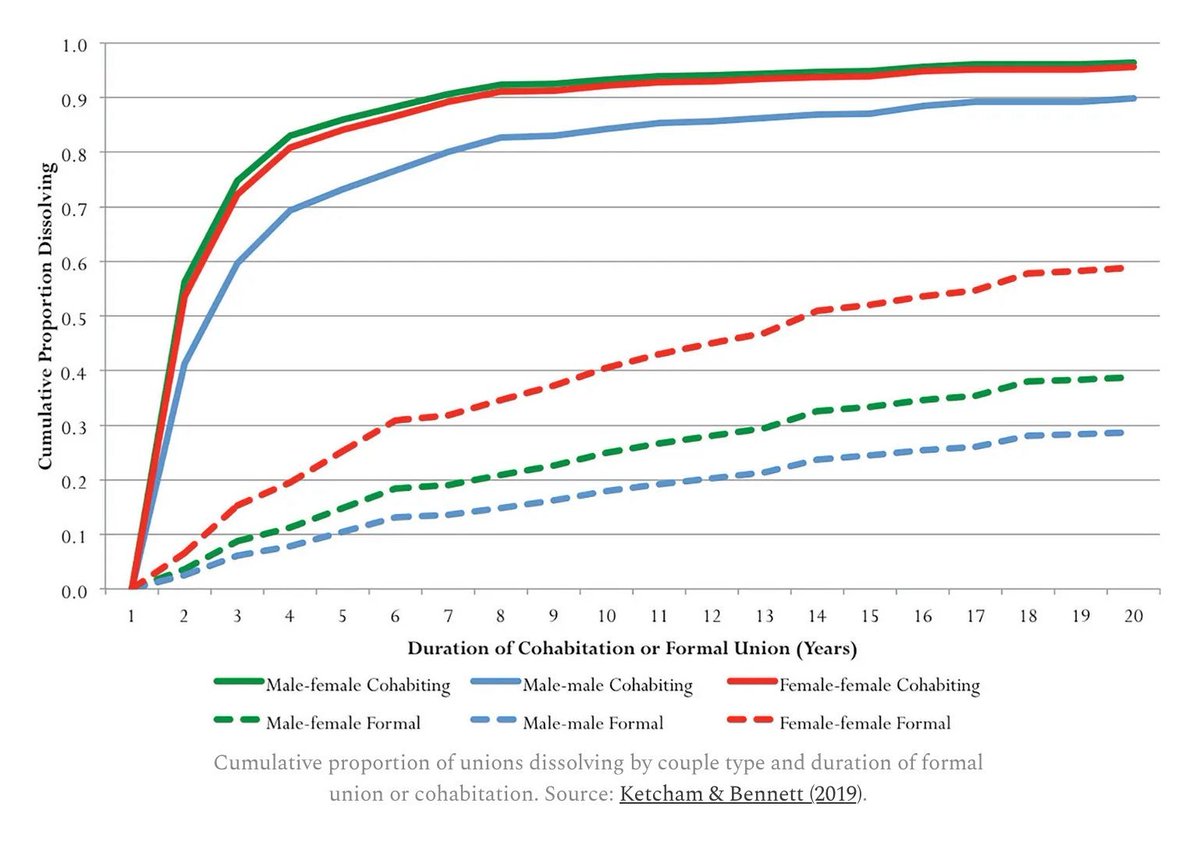
Married couples have lower breakup rates than cohabitating couples.
Among cohabitating couples, male-male couples have the lowest breakup rates.
Among married couples, male-male couples have the lowest breakup rates, female-female couples the highest.
stevestewartwilliams.com/p/12-new-findi…
English
@chrisgrayson @SteveStuWill Chris if you think it's actually 0% please take this and post results. Brght.org
English
@GoldenCheeta @SteveStuWill …when both their names are on the lease, and it will affect their credit score.
English

Your argument undermines itself unless you reject all advancements in physics from the last >100 years
All love, btw - long time free domain supporter and UPB Appreciator
If you believe in Einstein's theory of relativity, you believe there is no single universal linear time that all observers share
Most religions explicitly state that free will is an inherent quality of creation
You also believe in free will
Most genuinely good people agree that free will exists (without empirical evidence)
There has to be more than 4 dimensions of reality for genuine free will to exist
Otherwise we are just watching a prerecorded 4D movie
Quantum superposition requires multiple valid states coexisting
Most cutting edge 5D models show how those effects and branching timelines naturally emerge from higherndimensional geometry
Omniscience means god holds every possible timeline at once, and your free will decides which one YOU experience
God is already experiencing all simultaneously because omniscient and omnipresent
No one rational or "enlightened" believes in infinite punishment for finite sins, Stefan
All you ever do is tear apart specific theological models used to control people with fear, dismiss everything else as "silly word games", and act like you rationally proved that a creator does not exist
But why???
The existence of a creator increases the validity of UPB and vice versa
Does universal moral law show up in direct sensory evidence?
No. You can't touch it, taste it, smell it, climb it, or hear it rustling in the wind (your words)
Is it self contradictory? No.
You wrote 246 pages proving it is internally consistent
You accept that objective, binding, universal truths can be established through rational necessity without direct sensory evidence
You made this explicit when you said "neither the scientific method nor numbers themselves exist within reality either, yet science and mathematics remain objective disciplines."
And "our capacity to reason is derived from the stable and predictable behavior of matter and energy"
So...
*What is the nature of a reality* that is rationally ordered, contains a binding moral architecture, generates consciousness through (or within) you, and behaves with perfect stability across billions of years?
What kind of existence has all of these properties simultaneously?
And why does your inquiry into every other question proceed with relentless rigor but stop dead at this one?
Genuinely curious Stefan!
We are not asking you to accept a bearded patriarch in the sky or kneel before any theology
We are asking you to follow your own method to its conclusion instead of stopping where the answers start to resemble something you have spent your career opposing
You cataloged the rational order of reality across two books and hundreds of videos
You mapped the moral architecture of existence in painstaking detail
You demonstrated that consciousness, reason, and ethics all point toward a unified structure you can describe but will not investigate further
At some point the refusal to ask what that structure IS stops being skepticism and starts being its own act of faith
And that's fine, but...
You are pushing away the exact audience smart enough to understand UPB and disciplined enough to practice peaceful parenting by acting like you disproved a creator, when you really just disprove sunday school tier theology in a Newtonian sandbox
That trades not worth it when we're trying to build a better world
All love Stefan, genuinely hope you sit with this one
English
If God knows everything past, present and future, He is all-knowing.
If God knows the future, He cannot change it, therefore He is not all-powerful.
If God knows the future, we do not have free will.
We cannot be punished for our choices if they are not in fact choices.
GIF
English
