Samuel Hess

5.7K posts

Samuel Hess banner
Samuel Hess

Samuel Hess

@LessEgoMoreData

I help 8-9 figure DTC brands boost Revenue per User by 10% in just 6 months | +$248M added with A/B-Tests for HelloFresh, SNOCKS & 250+ more

Boost ARPU by 10% → Tham gia Ocak 2021
277 Đang theo dõi13.1K Người theo dõi
Tweet ghim
Samuel Hess
Samuel Hess@LessEgoMoreData·
Here are 100+ landing pages from top 1% of brands in the US and UK. We found over 856 hidden genius strategies that you can steal from them to become more profitable & grow even faster. Want it? 1. Like & RT this post (must do both) 2. Comment "Landing Pages" & I will DM you
GIF
English
920
547
1K
87.4K
Samuel Hess
Samuel Hess@LessEgoMoreData·
Every redesign feels like progress. To your buyer’s brain, it feels like starting over. Recognition doesn’t come from novelty. It comes from seeing the same signals again and again until the choice feels safe. Colors. Layout. Language. Proof style. The promise you repeat. These aren’t “branding details.” They’re cues the brain uses to decide if something is familiar enough to trust. This matters most for buyers. They don’t store stories. They don’t remember campaigns. They recognize patterns. When those patterns are consistent, the brain relaxes. Less effort. Less risk. Faster decisions. When they keep changing, every visit feels like the first visit. And first visits convert the worst. The Brand Cue System breaks down the layers where recognition is built: visual, verbal, structural, proof, and behavioral. Strong brands don’t win by constantly reinventing. They win by making themselves impossible to confuse with anyone else. Follow me for more buyer-psychology frameworks grounded in how people actually choose.
Samuel Hess tweet media
English
5
1
21
912
Samuel Hess
Samuel Hess@LessEgoMoreData·
Thank you, everyone, for the amazing response🙌 The comments section absolutely blew up, so I can’t reply to everyone individually. Here’s the resource everyone’s asking for: dripagency.de/resources/ecom….
English
0
0
0
175
Samuel Hess
Samuel Hess@LessEgoMoreData·
Ecom owners, take this (free) and keep it forever. I just bundled together some of the most valuable CRO, A/B testing, and ecom resources we’ve ever shared. Built from 4,000+ experiments, €500M+ in attributed revenue impact, and years of breaking down what actually works across top DTC brands. No theory. No recycled advice. Just frameworks, breakdowns, tests, and systems that drive revenue. I genuinely think there’s at least one resource in here worth six figures to the right business. Here’s what’s inside: Funnel Breakdowns & Brand Analysis: ↳ Nike x Skims x Salomon Funnel Breakdown ↳ Booking.com Funnel Breakdown ↳ Momentous Funnel Breakdown ↳ Lacoste & Tommy Hilfiger Funnel Breakdown ↳ Salomon, Hoka, Nike & Adidas Funnel Breakdowns ↳ Peloton vs Oura Funnel Breakdown ↳ July Luggage Funnel Breakdown CRO, Testing & Revenue Psychology: ↳ The Psychology of Pricing ↳ 50+ AOV & Cart Abandonment Test Ideas ↳ 45 Tests (€7.8M+ in A/B test Wins) ↳ 12+ Top Winner Tests from Snocks ↳ 9 Cart Tests That Generated €2,260,654+ in Revenue ↳ “How We Run 50+ Tests Per Month” ↳ 5 E-commerce CRO Case Studies ↳ A/B Test Calculator by Drip AI, Systems & Workflow Resources: ↳ Claude vs Cursor vs n8n ↳ Claude Projects Setup for Ecom Teams ↳ Analytics & CRO Tools Bundle by Drip Bundles & Playbooks: ↳ Ecom Essentials Bundle This isn’t just “free content.” It’s the exact thinking behind brands scaling faster without increasing ad spend. 𝗜𝗳 𝘆𝗼𝘂 𝘄𝗮𝗻𝘁 𝗶𝘁 (𝗳𝗿𝗲𝗲): 1. Like this post 2. Comment “BUNDLE” (Must be following me!) and I’ll send it straight to your DMs.
Samuel Hess tweet media
English
291
19
303
20.1K
Samuel Hess
Samuel Hess@LessEgoMoreData·
Changing discount prices from red to green boosted ARPU by 2.54% Red screams "sale urgency" but often spikes anxiety in shoppers. We flipped it to green on product detail pages sitewide for a women's activewear brand. Hypothesis: Green signals positivity and savings, easing decisions without the red alarm vibe. Results across all users: ARPU: +2.54% (from €3.24 to €3.33) AOV: +2.20% Conversion rate: +0.34% Statistically significant, with returning users seeing a whopping +5.58% ARPU lift. Mobile held strong at +2.78% ARPU, while desktop jumped +4.36%. Why it crushed: Color psychology nails it: Green evokes trust, approval, and even eco-vibes, aligning with value-driven buyers. Red triggers loss aversion (grab it now!), but green promotes relaxed spending, leading to bigger carts. No more decision stress; shoppers felt the win, not the pressure. Key takeaway: Ditch the red "fire sale" trope. Subtle color shifts can unlock hidden revenue without overhauling your site. Test everything, even the "tiny" stuff. Follow for more evidence-based CRO breakdowns from Drip.
Samuel Hess tweet media
English
5
1
21
1K
Samuel Hess
Samuel Hess@LessEgoMoreData·
Category banner on PLPs = €26K monthly revenue lift. We added a simple visual banner to product listing pages for women's sport leggings. The "obvious" context boost delivered real results: ARPU: +3.47% overall (up to +14% on desktop) Conversion rate: +1.93% AOV: +1.51% All statistically significant, especially for new users (+5.06% ARPU). Why it worked: Contextual cueing lit up engagement. Shoppers, particularly women drawn to aesthetic visuals, got an immediate emotional hook: inspiring collections that screamed "this fits your vibe." No more blank-slate browsing. The banner turned generic lists into curated stories, sparking deeper exploration without overwhelming choices. Returning users dipped slightly (-1.47%), but the newbie surge outweighed it. Key takeaway: In women's activewear, visuals aren't fluff; they're conversion fuel. Test subtle context adds before chasing flashy overhauls. Follow for more CRO breakdowns from Drip.
Samuel Hess tweet media
English
1
0
8
687
Samuel Hess
Samuel Hess@LessEgoMoreData·
Most people crack under pressure. Here's how top performers stay creative: 1. Use Pattern Recognition → Study success in other industries → Apply proven concepts differently → Test fast, learn faster 2. Manage Your Energy → Work in 90-min creative blocks → Take complete breaks when burnt → Listen to your body's signals 3. Design Your Environment → Create deep work zones → Change locations when stuck → Block all distractions 4. Build Recovery Systems → Schedule mandatory breaks → Protect your thinking time → Allow yourself to reset 5. Control Your Focus → No notifications → No meetings in peak hours → No reactive work Focus on systems, not motivation. Which system will you build first?
Samuel Hess tweet media
English
0
0
4
245
Samuel Hess
Samuel Hess@LessEgoMoreData·
One table on the PDP = €17K in monthly revenue boost. We added a simple comparison section for fascia rollers, showing specs like density, length, and use cases side-by-side. Results across all users: - ARPU: +8.34% - Conversion rate: +2.47% - AOV: +5.73% Mobile saw +7.63% ARPU, while desktop crushed it at +11.41% thanks to a huge AOV lift. Psychology at play: Shoppers hate piecing together product differences mentally. This table slashed cognitive load per Choice Architecture principles, making value clear and decisions faster. Users didn't just buy more; they upgraded to premium options. No flashy redesign, just organized info that satisfied real needs. Key takeaway: For fitness gear like fascia rollers, buried details kill sales. Surface them smartly, and watch ARPU soar without guessing. Test everything. Follow for more CRO breakdowns from Drip.
Samuel Hess tweet media
English
5
1
14
688
Samuel Hess
Samuel Hess@LessEgoMoreData·
Most mobile sites are designed like desktop pages. Primary actions sit at the top of the screen. But that’s the hardest place to reach on a phone. Most users hold their device with one hand. Which means their thumb comfortably reaches about 60% of the screen. Everything outside that zone requires effort. When critical actions sit outside the thumb zone: Users mis-tap. Interactions slow down. Conversion drops. The fastest growing mobile experiences design around thumb reach, not screen size. Floating CTAs Bottom navigation Swipe interactions Small changes in layout often create large improvements in action rates. Mobile optimization isn’t just about responsive layouts. It’s about interaction ergonomics. Follow me for practical CRO frameworks, mobile UX insights, and real A/B test learnings.
Samuel Hess tweet media
English
4
1
14
619
Samuel Hess
Samuel Hess@LessEgoMoreData·
Tiny layout tweak on women's landing page = €21K in extra monthly revenue. We restructured the bestseller and bundle sections to make them cleaner and more scannable. What we changed: Restructured product cards for better visual hierarchy. Highlighted bundles with consistent sizing and elegant spacing. Reduced clutter to draw eyes to high-value offers. The results (tested on Snocks women's products): ARPU: €9.35 → €9.47 (+1.27%) Conversion rate: +0.58% AOV: +0.68% All statistically significant across mobile and desktop. Why it worked: Visual overload kills exploration. Our old layout scattered attention, making shoppers skim and bounce. The new design cut cognitive friction, spotlighting bundles and bestsellers like magnets. Women browsing socks and underwear responded by adding more items, treating the page like a curated shop instead of a cluttered list. Key takeaway: Perceived elegance sells. A simple visual upgrade can make your products feel premium, turning passive scrolls into impulse adds. This is why we run rapid A/B tests: even "minor" tweaks compound into real revenue. Follow for more CRO breakdowns from 4000+ experiments.
Samuel Hess tweet media
English
6
1
19
646
Samuel Hess
Samuel Hess@LessEgoMoreData·
After optimizing hundreds of online stores, here’s one thing I’ve learned: Even the best brands can lose €23,114.74 on a single A/B test. But here’s the kicker—those so-called “losing” tests are often the most valuable. Here’s why: - They force you to rethink what you think you know about your customers. - They show you what people actually respond to—not just what they say they want. - They expose flaws in how you’re testing, like weak hypotheses or poor execution. - They provide insights you can use for your next big win. - They prevent even bigger losses-a €23k mistake in testing is far better than a million-euro blunder in a full rollout. Bottom line? In CRO, there’s no such thing as a true loss. Every test is a chance to learn. The only real failure? Not testing at all. Do you agree?
Samuel Hess tweet media
English
4
0
3
255
Samuel Hess
Samuel Hess@LessEgoMoreData·
July’s funnel is a CRO masterclass for premium travel brands. From homepage to checkout - every step is engineered to reduce friction, build trust, and position luggage as a long-term travel investment rather than a commodity purchase. I turned it into a plug-and-play breakdown you can actually use. This is going to be available for purchase for $49 - but for the next 48 hours, you can get it 100% FREE. Here’s what’s inside: → Built in Figma so you can drag, drop, and customize in minutes → How they use minimalist navigation and product hierarchy to simplify high-consideration browsing → The PDP structure that blends premium design, functional benefits & trust-building reassurance → How they position luggage as a travel system - not just a suitcase - to increase perceived value and AOV → Cart and checkout flows designed to reduce hesitation, reinforce confidence, and encourage add-ons This isn’t just a “premium luggage brand.” It’s a conversion system built on clarity, utility & travel psychology. Want access? 1. Like this post 2. Comment “TRAVEL” (Must be following!) I’ll DM you the link.
GIF
English
6
1
17
429
Samuel Hess
Samuel Hess@LessEgoMoreData·
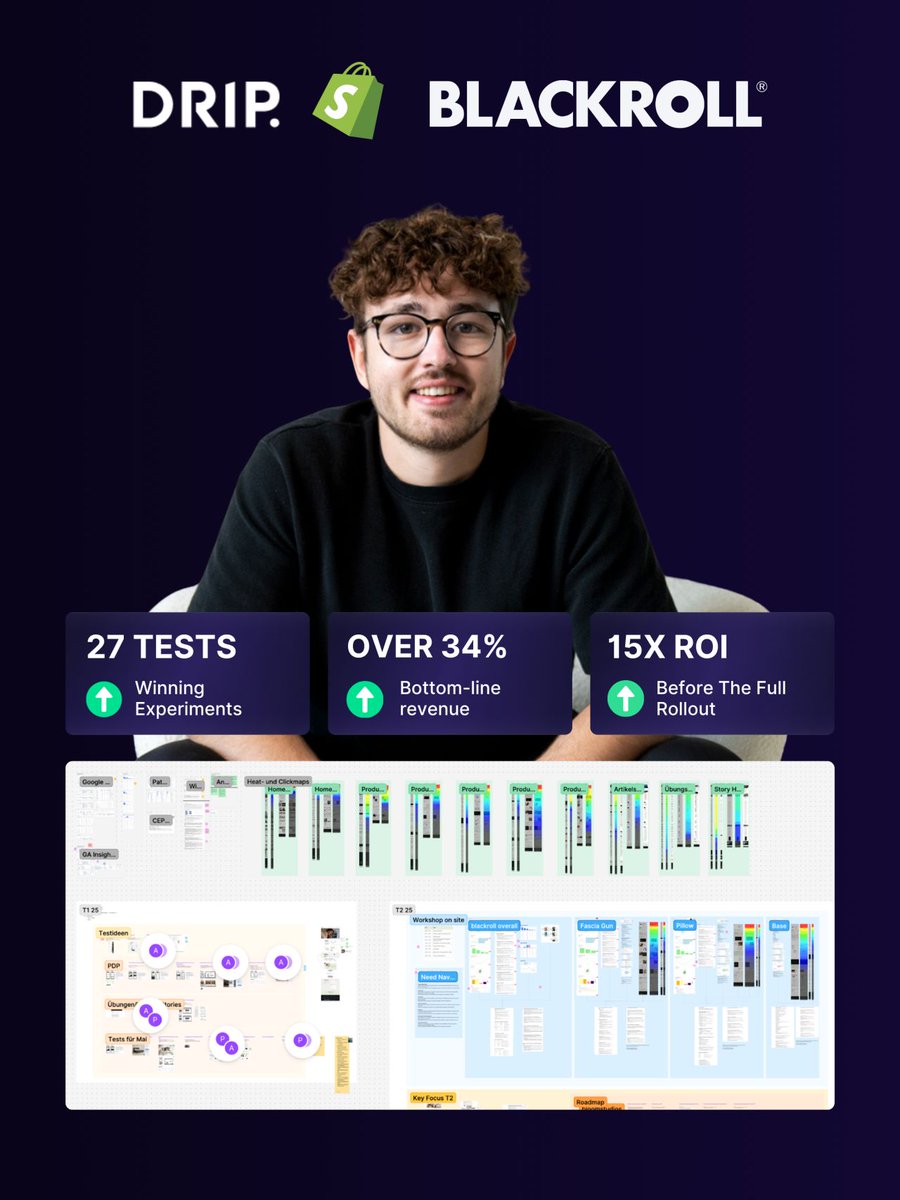
Two customers. One store. That’s where BLACKROLL was losing money. On the surface, everything looked strong: Global brand. 60+ countries. Growing product range. But underneath, there was friction. Because the same experience was trying to serve: → Someone recovering from a workout → Someone trying to sleep better Completely different intent. Same journey. That mismatch doesn’t show up in dashboards - but it quietly reduces conversion and margin. So we changed the approach. Instead of optimizing pages, we optimized decision paths: Separate testing logic per audience. Behavioral research to understand buying triggers. Funnel analysis to find hesitation points. Prototypes to validate before building. The result during testing alone: → 27 winning experiments → 15× ROI before rollout → +34% bottom-line revenue No big redesign. No traffic increase. Just aligning the experience with how people actually buy. That’s where most of the money is. If your store serves different customers but treats them the same, that’s likely your biggest untapped lever. Book a call → lnkd.in/eS9jD6D6
Samuel Hess tweet media
English
1
0
5
515
Samuel Hess
Samuel Hess@LessEgoMoreData·
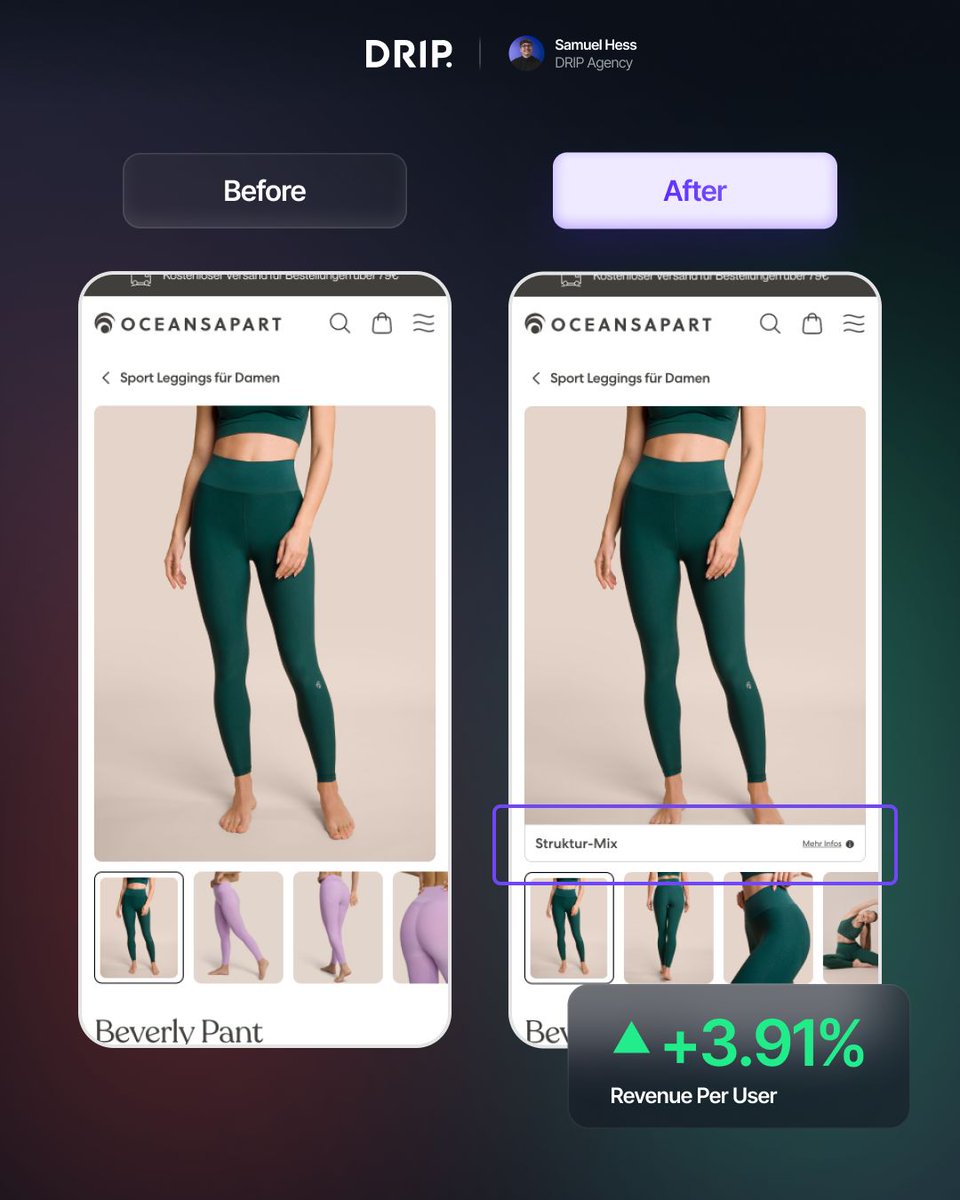
Tiny visual tweaks on product images unlocked €20K+ in monthly revenue. We added feature callouts directly to PDP images for women's sportswear. Hypothesis: Spotlight key benefits right where eyes linger to speed up decisions. Results across all users: ARPU: €8.35 → €8.68 (+3.91%) Conversion rate: +5.07% AOV dipped slightly (-1.10%) but got offset by more checkouts Mobile users saw the biggest lift in ARPU (+4.44%, significant). Desktop held steady overall, though returning shoppers converted 2.78% better. Why it worked: Visual salience nailed it. Shoppers scan images first; callouts like "Breathable Fabric" or "High-Waist Support" cut through the noise, clarifying value without extra reading. No more buried bullet points forcing mental gymnastics. This made features pop, turning browsers into buyers faster, especially on mobile where attention spans are brutal. The irony? We thought highlighting specs might overwhelm, but it actually simplified choices for high-intent women eyeing activewear. Key takeaway: In crowded ecom, don't hide product strengths in text walls. Make them visually unavoidable. One smart overlay can compound across your catalog. Follow for more tested CRO wins that actually move the needle.
Samuel Hess tweet media
English
3
1
17
906
Samuel Hess
Samuel Hess@LessEgoMoreData·
Scaling traffic won’t fix a broken funnel. It just makes the problem more expensive. More ads. More campaigns. More spend. Growth isn’t about doing more. It’s about doing things in the right order. Step 1: Fix conversion. Before anything else, your funnel needs to work. Can people understand your product quickly? Do they trust you enough to buy? Is checkout smooth and friction-free? If not, traffic won’t save you. Step 2: Optimize conversion. Once the system works, make it better. Test messaging. Reduce friction. Improve your offer. Increase average order value. These improvements compound across every visitor. Step 3: Scale traffic. Now - and only now - should you increase traffic. Because every new visitor is more valuable than before. This is where growth becomes efficient. The biggest mistake? Scaling a broken system. That’s how CAC increases, ROAS drops, and budgets get wasted. The best brands don’t just grow faster. They grow in the right order. Fix → Optimize → Scale. — Follow me for psychology-driven conversion insights and real CRO frameworks.
Samuel Hess tweet media
English
4
1
17
698
Samuel Hess
Samuel Hess@LessEgoMoreData·
Luck = Opportunity × Preparation The people we often call "lucky" are usually the ones who: - Put in the hard work when no one was paying attention - Made the most of every chance to learn and grow - Positioned themselves to recognize and act on opportunities Opportunities are all around us - but without preparation, they’ll slip right by. So, what’s the real formula? - Put in the effort when no one’s watching - Stay consistent, even when it feels like no one notices - Understand that luck tends to favor those who are ready for it Success isn’t a coincidence. It happens when preparation meets the right opportunity. Want to create your own luck? Focus on what you can control: your preparation. What about you - do you believe luck is something you create, or do you think it just happens?
Samuel Hess tweet media
English
4
1
17
538
Samuel Hess
Samuel Hess@LessEgoMoreData·
Highlighting product features = €28K extra monthly revenue. We added a dedicated section on targeted product detail pages calling out unique features, like non-stick coatings and ergonomic handles for our cookware client. Seems straightforward, right? But it crushed our hypothesis on boosting perceived value. Results across all users: - Conversion rate: +5.80% (4.83% to 5.11%) - ARPU: +6.64% (€6.33 to €6.75) - AOV: +0.95% (€130.99 to €132.24) All statistically significant. No cherry-picking. Psychology at play: Curiosity Gap Theory nailed it - users got hooked exploring interactive call-outs, sparking interest and closing the gap between "hmm" and "add to cart." Perceived Value Theory followed: Spotlighting specifics made the product feel premium without overwhelming info dumps. Shoppers crave clarity on what sets your stuff apart, especially in competitive categories like kitchenware. This nudged them from browsers to buyers faster. Key takeaway: Don't bury unique selling points in walls of text. Make them pop, and watch conversions (and wallets) follow. Follow for more tested CRO wins from Drip.
Samuel Hess tweet media
English
5
1
23
1.4K
Samuel Hess
Samuel Hess@LessEgoMoreData·
Most people crack under pressure. Here's how top performers stay creative: 1. Use Pattern Recognition → Study success in other industries → Apply proven concepts differently → Test fast, learn faster 2. Manage Your Energy → Work in 90-min creative blocks → Take complete breaks when burnt → Listen to your body's signals 3. Design Your Environment → Create deep work zones → Change locations when stuck → Block all distractions 4. Build Recovery Systems → Schedule mandatory breaks → Protect your thinking time → Allow yourself to reset 5. Control Your Focus → No notifications → No meetings in peak hours → No reactive work Focus on systems, not motivation. Which system will you build first?
Samuel Hess tweet media
English
4
1
14
699
Samuel Hess
Samuel Hess@LessEgoMoreData·
Ecom owners, take this (free) and keep it forever. I bundled together some of our most valuable internal Ecom resources - the exact breakdowns, frameworks, AI systems we use with 8-figure brands. It’s practical. Plug-and-play intelligence for operators who want to scale faster. If you run an Ecom brand, agency, or performance team, you’ll find multiple things in here you can use immediately. Here’s what’s included: Funnel Breakdowns: ↳ Nike x SKIMS x Salomon Funnel Breakdown ↳ Booking.com Funnel Breakdown ↳ Momentous Funnel Breakdown ↳ Lacoste x Tommy Hilfiger Funnel Breakdown CRO & Testing Resources: ↳ 50+ AOV & Cart Abandonment Test Ideas ↳ 12+ Top Winning Tests from SNOCKS ↳ A/B Test Calculator by Drip ↳ The Psychology of Pricing AI / Automation Resources: ↳ Claude vs Cursor vs n8n Breakdown ↳ Claude Projects Setup for Ecom Teams This is the exact type of material we use internally to identify leaks, improve conversion, and scale revenue systematically. If you want it: (Free) 1. Like this post 2. Comment “BUNDLE” (Must be following me!) and I’ll send it to you.
GIF
English
19
1
36
891
Samuel Hess
Samuel Hess@LessEgoMoreData·
One feature added millions for one brand…and lost millions for another. Here’s why A/B testing is non-negotiable in e-Commerce:
English
0
0
7
876
Samuel Hess
Samuel Hess@LessEgoMoreData·
After optimizing hundreds of online stores, here’s one thing I’ve learned: Even the best brands can lose €23,114.74 on a single A/B test. But here’s the kicker - those so-called “losing” tests are often the most valuable. Here’s why: - They force you to rethink what you think you know about your customers. - They show you what people actually respond to - not just what they say they want. - They expose flaws in how you’re testing, like weak hypotheses or poor execution. - They provide insights you can use for your next big win. - They prevent even bigger losses - a €23k mistake in testing is far better than a million-euro blunder in a full rollout. Bottom line? In CRO, there’s no such thing as a true loss. Every test is a chance to learn. The only real failure? Not testing at all. Do you agree?
Samuel Hess tweet media
English
3
1
15
899