
Hash!m
1.6K posts


Hash!m
@MxLHashim
I make oil money and it’s glorious
Just Stop Oil HQ Tham gia Kasım 2021
330 Đang theo dõi80 Người theo dõi
Hash!m đã retweet

You can read the whole thing here:
resources.anthropic.com/hubfs/The-Comp…
English
Hash!m đã retweet

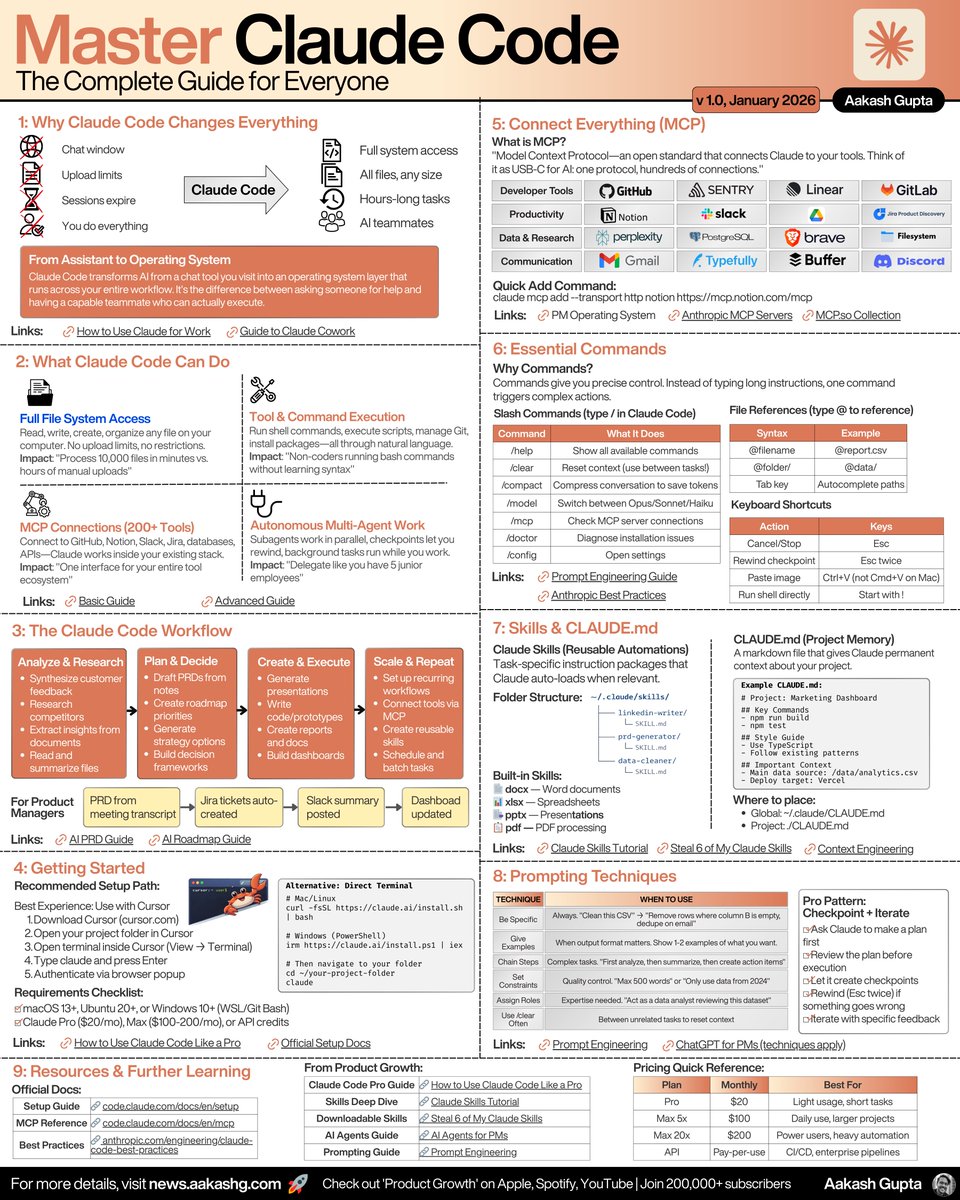
This is literally everything you need to master Claude Code:
English
Hash!m đã retweet

AGI is not coming.
We are nowhere near AGI. What we have today is inference, not learning.
Models get trained once on huge fixed datasets, then frozen. You ask questions, they remix patterns they already saw. Nothing updates. Nothing sticks. Talking to the model does not make it smarter. It does not learn from you. Ever.
Learning is still slow, expensive - and offline.
Look at self driving. You drive around a pothole, make a U turn, and come back. The car’s AI does not learn that you just solved that exact problem. It reacts the same way every time using sensors and rules. Do this 20 times a day and it still has zero memory that the pothole exists. It just re sees it. That is why edge cases never die. There is no local learning. No accumulation.
No 'oh yeah, I’ve seen this before'
LLMs work the same way. Tell it your name and it does not remember. The only reason it looks like memory is because scaffolding keeps shoving your name back into the prompt every time and sanitizing the output.
The model itself has no idea who you are and cannot learn from interaction. It is structurally incapable.
And the scaffolding is the worst part. It is pure duct tape. Just prompts on prompts on prompts around a frozen model. When something breaks, nobody fixes learning. They add another layer. Another rule. Another retry. Another evaluator model judging the first model.
So you end up with systems that are insanely complex but mentally shallow. Debugging is hell because behavior comes from hack interactions, not a learnable core. Tiny prompt tweaks cause wild behavior shifts. Latency goes up. Costs go up. Reliability goes down. None of this compounds into intelligence. It just hides the cracks.
Until we have real persistent learning and real memory inside the system, there is no AGI.
LLMs are not built for this. You cannot prompt your way out of it. You need a totally different architecture. Yann LeCun is right.
And even then, what architecture can actually learn online, store memory, and stay stable on today’s hardware?
Best case, maybe 5-10 yrs.
Right now it is all inference. It looks magical, but the emperor has no clothes. A lot of people see it. Almost nobody says it out loud.
English
Hash!m đã retweet

The Arab spring largely failed. Protests do not change autocratic regimes. They never did. Wherever they appeared to work in the past, they were merely the window dressing to the real change makers with power who were waiting behind the scenes.
Protests do make a regime adjust. This adjustment may be good or bad. Such adjustment is why protests have worked in democracies, as they are not directed at regime change but policy change.
In autocracies it is questionable whether the adjustment that protests bring is good or bad, because autocracies do not view being responsive to demands of the People as an asset but a weakness.
Regardless, the CIA (and other collaborating agencies) should stop fuelling ‘colour revolution’ protests abroad to try & topple foreign regimes it doesn’t like.
The state department’s ‘green revolution’ efforts in Iran have failed. They merely lead to internet blackouts. Unless there exists a large enough reform-inclined ideological faction inside Iran’s military apparatus, these protests will not result in regime change. Even then, when change is ‘revolutionary’ in this way, what comes next is almost always yet another reactionary dictatorship.
Incremental, generational change that organically responds to theocratic Shi’a Islamism from the ground up while remaining within Iranian tradition is the best way forward for change in Iran. Once started properly, it is gradual and boring. But is also unstoppable.
Disclose.tv@disclosetv
JUST IN - Iranian internet blackout nationwide, Iran's connectivity at just 5% — i24
English
Hash!m đã retweet

⚠️ BUCKLE UP: 2026 GEOPOLITICAL PREDICTIONS FROM A PROFESSOR WHO GOT TRUMP, IRAN, & UKRAINE RIGHT.
Professor Jang uses game theory & history to forecast global shifts. His track record is uncanny. Here’s his alarming analysis for 2026.
THE GRAND GAME: US vs. CHINA
➡️ The core of 2026 is the U.S.-China relationship. Everything else is secondary.
✅ Trump’s planned state visit to China in April is the pivotal event. The goal? A "grand bargain" to secure the US dollar's dominance.
❌ The U.S. strategy is contradictory: it seeks to coerce China while needing its cooperation. This cannot hold.
THE REAL WAR IS FINANCIAL
🔗 The 1971 move off the gold standard created a system where China’s addiction to dollars stabilized the U.S. economy.
⚠️ Now, China is destabilizing that system by internationalizing the Yuan and creating gold-backed corridors.
⚔️ U.S. actions in Venezuela & the Middle East are not just about oil—they are about forcing China to buy resources using dollars, strangling its economy into submission.
MUTUALLY ASSURED DESTRUCTION
➡️ Professor Jang uses a powerful metaphor: two nations on a ladder over an abyss.
✅ If they climb together, they are stable.
❌ If one tries to climb too far ahead, both fall. The U.S. insistence on hegemony is that destabilizing force.
💥 China’s weapons are financial: it can restrict silver exports or dump U.S. treasuries, causing market havoc.
THE AMERICAN PONZI SCHEME
✅ The U.S. economy is built on bubbles: AI speculation, over-leveraged paper silver (300:1), and cryptocurrency.
⚠️ These bubbles are sustained only by oligarchic control and endless money printing. A self-correction could mean collapse—and potential civil war.
“The American financial industry is one great Ponzi scheme.”
EUROPE: SLEEPWALKING INTO DISASTER
➡️ The Ukraine war is settled in all but name. The front is stabilized.
❌ Yet, Europe’s elite, living in a bubble, will continue a suicidal policy. They cannot admit they were wrong.
🎯 The endgame is Odessa. NATO will commit to defending it, Russia will besiege it, and European conscription will spark internal revolt.
“Europe is a lumbering bureaucracy that cannot imagine its own demise.”
THE DECLINE OF EMPIRE: MICRO-MILITARISM
✅ The kidnapping of Maduro was a televised spectacle, not strategy.
⚠️ It humiliated a nation and turned the Global South against the U.S. It’s a sign of an empire in decline—sacrificing long-term strategy for short-term optics.
“Trump thinks like a mafia boss, not a president. He lives in Trump World, where TV ratings equal victory.”
APRIL 2026: THE SHOWDOWN
All roads lead to Trump’s visit to China. The goal is to negotiate from a position of strength, controlling the Western Hemisphere to dictate terms.
The wildcard is China’s response. Will it cut a deal or choose a different path?
The professor’s bet: A grand bargain is reached, but it merely delays the inevitable collapse of the current order.
THE BOTTOM LINE
The world is being pushed toward conflict by a declining power that confuses television ratings for statecraft, while its rivals hold the financial weapons to ensure mutual destruction.
I highly recommend watching the entire interview ! x.com/Glenn_Diesen/s… - @Glenn_Diesen
#Geopolitics #2026Predictions #USChina #USDollar #EconomicCollapse #WarInEurope #GlobalRisk #GameTheory
English
Hash!m đã retweet
The FOMO around Claude Code is real.
You don't need a project idea. You need to describe your work and let it interview you.
So many people are posting rad Claude Code wins: apps, sites, workflows. But most people are staring at a terminal thinking "I don't even know what's possible."
Try this:
1. Open Claude Code
2. Dump everything about your work—your work/role, tools you touch daily, tasks you repeat, stuff that annoys you, wild ideas you've always wanted to try, your passions, your hobbies, etc
3. Paste this:
"Based on what I shared, ask me 5-7 questions to understand my workflow better. Then suggest 3 things I could build, ranked by impact vs complexity. Use the AskUserQuestion tool to help me"
Answer honestly (specifics = better suggestions)
4. Pick the one that makes you go "wait, that's possible?"
The skill isn't coding. It's describing friction, your wild ideas, asking what it can learn about you to help you.
Claude Code isn't automatically a magic wand. You wouldn't hand someone a hammer and say "build something." You'd explain your situation and ask what's possible.
Always happy to jam/chat about this stuff.
Andy Orsow@andyorsow
Feeling like I should be using Claude Code but have no idea exactly what I should be using it for. Just a bundle of non-technical FOMO over here.
English
Hash!m đã retweet

Hash!m đã retweet

Hash!m đã retweet

Hash!m đã retweet

Hash!m đã retweet

Hash!m đã retweet

Hash!m đã retweet

Hash!m đã retweet

Hash!m đã retweet

Bret Weinstein just said something that won’t leave my head:
For the first time in 300,000 years of human evolution, we removed the cost from the single biggest reward nature ever invented — sex and pair-bonding.
Reliable birth control + abortion = you can now cash the evolutionary lottery ticket without paying the 20-year mortgage of pregnancy, diapers, sleepless nights, and college funds.
Result? An entire generation of 18–35-year-olds walking around with the energy, libido, hormones, and protective instincts that evolution spent millions of years calibrating for child-rearing… but with zero actual children. That energy didn’t disappear. It got redirected.
Heather Heying’s observation is brutal: young women especially began treating ideologies the exact way evolution wired them to treat babies. Climate change, social justice, whatever the cause of the month is — it gets defended with literal mama-bear ferocity, the same neurochemistry that once guarded a toddler from predators now guards an abstract idea from wrong think.
And now Elon is promising the second shoe is about to drop: AI-driven abundance will make money as “free” as sex became in the 1970s. Both of evolution’s primary carrots — mating and resource acquisition suddenly cost almost nothing.
Weinstein’s ice-cold question: When producing and protecting actual children is no longer the central organizing principle of adult life… and when creating wealth is no longer required for status, security, or attracting a mate…What is left to give a human life direction, meaning, and structure?
Are we about to become a species that invents bigger and bigger dragons to slay just to feel alive? Or do we drift into total listlessness? This 3:52 clip is genuinely haunting.
Watch it all the way through, then tell me — honestly — does this explain the absolute intensity we’re seeing in culture right now, or is Bret completely missing something?
Real answers only. Quote-post if it hits you in the chest like it hit me.
English
Hash!m đã retweet

We are currently witnessing a phase shift in the discourse around AGI. We’ve spent the last decade obsessed with the vertical Y-axis of intelligence, asking if models can score higher than a human on the LSAT or reach an IQ of 300. But looking at the recent saturation of benchmarks, I’m starting to think we are focusing on the wrong variable. The high end of machine intelligence is already very high. Even if we assume there is a hard mathematical constraint on intelligence—a diminishing returns curve where being smarter stops yielding better results—it doesn't matter.
The real revolution isn't about reaching God-mode IQ. It's about velocity and volume. We are moving from a world where high-level cognition operates at biological clock speeds to a world of silicon speeds. Even if an AI never exceeds the reasoning capability of a smart human graduate student, the ability to spin up 100 trillion instances of that student and run them at 100x real-time is a force multiplier that human intuition struggles to comprehend.
However, if intelligence is about to become infinite and instant, why won't we solve physics, biology, and energy overnight? This is where the naive Singularity argument breaks down. It assumes that intelligence is the only bottleneck to progress. It ignores the second, much harder constraint: Information. You can think of Useful Intelligence as a function of two inputs: Compute and Data. We are solving the Compute side, but the Data side is governed by the laws of physics, specifically entropy.
If you lock a super-intelligence in a Faraday cage and ask it to cure Alzheimer's, it will fail. It doesn't matter if it has an IQ of 50,000. It will fail because the solution to Alzheimer's is not a logic puzzle hidden inside its training weights. It is a biological reality that exists outside the box. The model lacks the bits of information describing how specific proteins fold in a chaotic, noisy cellular environment.
Intelligence is, at its core, a search space optimization engine. In closed systems like Chess or Go, the search space is massive, but the information is perfect. The rules are rigid. The board is the world. An AI can explore this space purely through self-play. Reality is not Chess. Reality is sparse, noisy, and high-entropy. You cannot simulate your way to ground truth if you don't have the priors.
This brings us to the concept of the Useful Ceiling. The value of machine intelligence follows a sigmoid curve that is about to slam into the wall of physical verification. Initially, utility is low. Then, as we see now, the AI operates as a master compression algorithm, reading the entire internet to reason and code, causing utility to explode. Finally, we hit the ceiling where the AI generates hypotheses faster than we can verify them.
This is the merging of the curves. The curve of Problem Difficulty is being matched by Machine Intelligence, but the bottleneck effectively shifts from Reasoning to Experimentation. A super-intelligent agent can look at a material science problem and identify the three molecular structures most likely to result in a room-temperature superconductor. That is an incredible reduction of the search space. It turns a million-year search into a 5-minute inference.
But you still have to build it. You still have to synthesize the molecule. You still have to run the clinical trial. You still have to stress-test the bridge. The AI can think at the speed of light, but it can only act at the speed of atoms.
We are entering an era where the cost of generating a brilliant idea drops to zero. The new scarcity is not smarts—it is the bandwidth of the physical world. The Useful Ceiling of machine intelligence is the point where the cost of computing the answer becomes negligible compared to the cost of verifying the answer against the entropy of the real world. We aren't waiting on the AI to get smarter. The AI is waiting on us to build better robots, sensors, and labs to feed it the data it’s hungry for.

English
Hash!m đã retweet

Today I turn 55.
I’m the fittest, sharpest, and happiest I’ve ever been.
If I’m an outlier, it’s not because I’m built different or discovered a secret formula. The truth is far less glamorous:
It’s a million tiny choices, compounded over decades.
Here are 55 of them:
1. Walk 15+ miles a week, even if you do other exercise. Humans are uniquely made to move slowly over long distances—it’s critical to longevity.
2. Develop a writing practice. It’s the single best way to sharpen your mind. And remember, you don’t have to be a good writer to write. Start with 10 minutes a day.
3. Swap out your toothpaste, deodorant, lotions, soap, shampoo, and other personal care products for natural versions. Here’s a rule of thumb: Don’t put anything on your skin that you couldn’t safely eat.
4. If you have a positive thought about someone, don’t keep it to yourself—share it immediately. Encouragement defies the laws of physics: When you give energy, you also receive it.
5. Wear shoes with a wide forefoot (I like Topo Athletic) and wear toe spreaders around the house (search “yoga toes” on Amazon). Spine health begins with the feet.
6. Get sunlight regularly. Moderate sun exposure (without sunscreen) is hugely important for overall health.
7. Do a 3-minute deep (“ass to grass”) squat every morning. Deep squats are often called the anti-aging exercise. It’s been said that, “It’s not that you can’t do deep squats because you’re old, it’s that you’re old because you can’t do deep squats.”
8. Explore minimalism (it’s not what you think it is).
9. Set boundaries on toxic relationships. We tend to cling to relationships past their expiration date, and it takes a bigger toll on our health than we recognize.
10. Eat real food. Not too much. Don’t eat garbage. Binge occasionally. Fast occasionally. That’s the diet.
11. Learn about FIRE. It’s a great framework for financial success.
12. Don’t take antibiotics except in emergency situations. They’re massively over-prescribed and aren’t needed in most cases. Antibiotics have done untold damage to our guts, which is where health begins. Great natural alternatives are out there.
13. Get 8 hours of quality sleep each night. To optimize sleep:
—Don’t eat after 6pm
—Get blackout shades and cover LEDs with black tape
—No screens 2 hours before bed
—Try ashwagandha (an herb) to calm the nervous system
14. Stop drinking, even in moderation. People find all sorts of ways to justify drinking, but there’s no escaping the simple fact that alcohol is a toxin and it limits your potential.
15. Travel as much as possible. Nothing expands the mind like seeing the world. And travel doesn’t have to be expensive—the best experiences happen outside of fancy resorts, when you live like a local.
16. Let go of resentment. When you forgive someone, you release the prisoner, and the prisoner isn’t them… it’s you.
17. Show up on time, every time. Poor time management limits success more than most people realize. If you struggle with punctuality, stop everything else and fix that first.
18. Spend lots of time in nature and touch the earth. Humans evolved over 300k years to live in harmony with nature, and only recently have we retreated indoors. If you don’t spend time outside, you’re fighting biology (hint: You won’t win.)
19. Stop doing dumb things. As Leo Tolstoy said, “People try to do all sorts of clever and difficult things to improve life instead of doing the simplest, easiest thing—refusing to participate in activities that make life bad.”
20. Find your happy place and (eventually) move there. Most people live where they live because... that's where they live. We are products of our environment—choose yours carefully.
21. Find a hobby and pursue mastery. You can’t have a happy life without a passionate pursuit that isn’t your vocation. Your work—even if you enjoy it—isn’t enough.
22. Avoid mainstream medicine except as a last resort. The results are in—our healthcare (or more appropriately, sick care) system is badly broken and only makes people sicker.
23. Have a mindset of abundance. There is no advantage to being a pessimist—even if you’re right, it’s a miserable way to live. In a very real way… whatever you believe, you’re right!
24. Do hard things. Choose courage over comfort. Everything you want is on the other side of fear and hard work. As Jerzy Gregorik said, “Hard choices, easy life. Easy choices, hard life.”
25. Ignore haters. Hurt people hurt people. Negative/toxic people live in a prison of their own design. Don’t join them!
26. Say no. Protect your time and energy like it’s your most precious asset… because it is.
27. Become a water snob. As an alien said on Star Trek, humans are “ugly bags of mostly water.” You are what you drink—literally! We have Mountain Valley Spring water delivered in glass 5-gallon jugs and also have whole-house water filter (Aquasana Rhino).
28. Stop drinking sodas and sugary energy drinks. After a few weeks you won’t miss them, and a few months later they’ll seem disgusting. Refined sugar causes inflammation, which is the root of most disease.
29. If you’re over 35, find a good functional/longevity medicine doctor and start tracking your hormones. Modern life is hell on the endocrine system and restoring healthy hormone levels can change your life. As we get older, we either accept a slow decline in performance or we do something about it—choose the latter!
30. Develop a morning routine and follow it faithfully. Win the morning, win the day!
31. Invest in experiences, not things. People frequently regret buying things, but rarely regret investing in great experiences (especially when shared with loved ones). Remember, there’s nothing you can buy in a mall that you’ll remember in ten years.
32. Explore spirituality. It’s arrogant and small-minded to believe there’s nothing going on in our universe that is beyond our comprehension. We know less about our universe than an ant meandering on a sidewalk understands about this planet.
33. Have a strong bias toward action—doing rather than talking. If you ask a bunch of old people about their regrets, they’ll talk about the things they *didn't* do—the shots they didn’t take—more than the things they did do (even if it went wrong). As Wayne Gretzky famously said, “You miss 100% of the shots you don’t take.” Most people don’t take enough shots.
34. Stay lean. Men in particular are obsessed with muscle mass these days, but bulk doesn’t age well. The goal is to be strong but lean. The fittest guys in their 50s and beyond aren’t meatheads, they’re lean guys who are serious about a sport.
35. Curate your inner circle carefully. Surround yourself with people you admire and who challenge you to grow. Remember, we’re the average of our 5 closest relationships.
36. Be the fittest version of yourself. Your body is your only vessel for experiencing life—so treat it as such. Fitness isn’t working out a few times a week, it’s a lifestyle. The older you get, the more time you need to devote to your health.
37. Take the time to appreciate art and beauty in all its forms.
38. Think globally, but act locally. Too many people put their energy into far-away problems they don’t understand and can’t impact, while ignoring problems right under their nose. Want to change the world? Start at home.
39. Try psychedelics. It’s one of those things everyone should do at least once, and it might be the breakthrough you’ve been looking for.
40. Limit bad habits, including unhealthy thought patterns. We all have them—practice avoidance and find substitutes. Get professional help if needed.
41. Be a lifelong learner. Your brain is just like a muscle—if you don’t feed and flex it regularly, it will atrophy.
42. Find your purpose. People with a strong sense of purpose are happier and live longer. Lack of purpose sucks energy and magnifies depression.
43. Only take advice from people who embody the traits you want to have. Talk is cheap—emulate those who have DONE it.
44. The goal is not to retire and do nothing, it’s to build a great day-to-day life that you don’t need to escape. A life of leisure is a slow death. Happiness isn’t possible without a little struggle, uncertainty, and skin in the game.
45. Have fun! Do frivolous and silly things that make you smile. As George Bernard Shaw famously said, “We don't stop playing because we grow old; we grow old because we stop playing.”
46. Whatever you want to do or achieve in life, start NOW. Don’t fall victim to “someday thinking” because someday never comes.
47. Accumulate assets—things that grow in value over time. It’s the #1 habit of rich people, and it can be done in tiny chunks. Instead of spending $100 on an impulse purchase that has no lasting value, put that money into an index fund or Bitcoin. It becomes addictive (in a good way).
48. Don’t ignore the big 3 canaries in the coal mine for health:
—Low libido (and ED)
—Frequent sinus & respiratory issues
—Depression
These usually aren’t medical conditions in themselves, they’re symptoms of an underlying problem. Find a good doc (outside of the mainstream) and figure out the root cause.
49. Have a clear vision for your future. How can you decide which direction to go if you haven’t clearly defined the destination? It sounds obvious, but 95% of people haven’t defined their “Ideal End State” in detail and in writing. (Check out my thread on this topic.)
50. Make your own decisions. We live in an era where most of what society tells us is wrong. Don’t be afraid to break from societal norms—if people say you’re crazy, it’s a sign that you’re doing something right.
51. Get hardcore about mobility exercise. As you age, it’s usually the knees, hips, and lower back that limit physical performance. 30 min a couple times a week can spare you a lifetime of pain. YouTube is a great resource.
52. Go all in on family. Get married, stay married, have kids. Burn the boats. In the end, family is all that matters.
53. Be ruthless with your time. Money comes and goes. Time only goes. Audit your calendar ruthlessly—cut the trivial, double down on the meaningful, and spend your hours like your life depends on it. (Because it does.)
54. Have a strong bias toward action. Be curious, try things, meet people—it’s how you increase your surface area for serendipity, the most powerful unseen force in our lives.
55. Reinvent yourself every decade. Over time, we slowly drift off course from our priorities, values, and true identity. Take stock and don’t be afraid to hit the reset button. Bold, calculated moves made for the right reasons almost always pay off—usually even more than you can imagine.
🎁 P.S. If you enjoyed this post, would you give me a birthday gift? Repost or comment with the item number(s) you liked best?

English
Hash!m đã retweet
Islamism (the desire to impose any version of Islam over society as a codified law) is a product of Western modernisation. Its lineage is traced directly to interwar European fascism. This is historically verifiable & evident from all the founders of the Islamist movements, without exception.
As for modern day vacuous literalism / fundamentalism (distinct from Islamism) this arose from intellectual ossification born during the Victorian colonial era eg: the Deoband school in India.
Traditional Islam is an evolving, living Way. Ever adapting reform (Islah) is an inherent characteristic of it through the mechanism of Ijtihād. However, today this correct view is actually alien even to many western Muslims.
We defend Patrick Lee’s free speech right to be WRONG. He has got it upside down as you say. But, these people are largely not to blame.
Our fellow vocal Muslims in the West have presented such an absurd caricature of Islam to the world (deliberately amplified by globalists on social media to further the dialectic of conflict) that these people now know no different.
We have much work to do.
English
Hash!m đã retweet

Introducing Nested Learning: A new ML paradigm for continual learning that views models as nested optimization problems to enhance long context processing. Our proof-of-concept model, Hope, shows improved performance in language modeling. Learn more: goo.gle/47LJrzI
@GoogleAI

English