

SigmaRayTive
379 posts

SigmaRayTive
@SigmaRayTive
Tech, society, future — all through sharp eyes and smarter laughs. テクノロジー、社会、未来 — すべてを鋭い眼差しとスマートな笑いで。
Tham gia Aralık 2022
1.2K Đang theo dõi129 Người theo dõi

Regretting that commit? Don't panic! Here's how to fix it.
Check out our latest GitHub for Beginners episode, answering some of your most commonly asked questions 👇
github.blog/developer-skil…
English
@Microsoft365 @Copilot @Microsoft
The core value of Copilot Notebooks should be that users can retrieve relevant information across multiple referenced files without knowing in advance which file contains the answer.
However, even with around 30 referenced files, Notebook chat may fail to find the relevant file, may not use the referenced content sufficiently, or may not provide clear evidence such as the file name or relevant section.
As a result, users still have to manually identify the target file from dozens of documents and specify each file or section one by one.
In that state, the value of using a Notebook is significantly reduced. It becomes little different from using Copilot on individual files.
For sales scenarios, this makes it difficult to review customer information, opportunity history, proposals, quotes, meeting notes, contract terms, and product materials across files.
Please improve Notebook chat so that it can reliably search across all grounding-eligible referenced content and return answers with clear evidence locations, such as file name, page, sheet name, and relevant section where applicable.

English
@Microsoft365 Proposal for Microsoft 365 Copilot Notebooks:
Copilot Notebooks already have a powerful concept: bringing files, Copilot Pages, meeting notes, links, and other references into one scoped workspace so Copilot can answer based on curated business context.
The improvement I would like to see has two parts.
First, when a Notebook contains multiple Copilot Pages, Copilot should make it clear and reliable that it can reason across those Pages—not only the single Page currently open on the canvas.
For example, if I create a Notebook for a customer proposal or sales follow-up, I may manage the work across several Pages:
- customer requirements
- meeting notes
- decision log
- proposal draft
- pricing assumptions
- next actions
I may also add referenced files such as product documents, past proposals, and an Excel opportunity tracker.
In this situation, some questions cannot be answered accurately from one open Page alone.
For example:
- What did the customer ask for?
- Which concerns were raised in previous meetings?
- Are the proposal draft and decision log consistent?
- What should be updated before the next customer meeting?
- Does the Excel opportunity tracker reflect the latest notes across the Notebook?
- Which Page or file was used as the source?
The issue is not that Copilot should automatically access everything in the organization.
The issue is that multiple Pages inside the same Notebook may represent one business context, and Copilot often needs those Pages together to answer accurately.
Second, when I open an Excel workbook that is managed as a Notebook reference, Copilot in Excel should optionally be able to use the same Notebook context.
Copilot in Excel focusing on the current workbook makes sense for editing cells, tables, formulas, and charts.
But if the workbook is part of a Notebook, the user may need Excel Copilot to understand the broader Notebook context: customer requirements, meeting notes, decision logs, proposal drafts, related files, and Copilot Pages.
A useful improvement would be a reference scope selector in Notebook chat, such as:
- Current canvas only
- Current file only
- Selected Pages / references
- Entire Notebook
And when working in Excel:
- Current workbook only
- Current workbook + selected Notebook references
- Current workbook + entire Notebook context
This would preserve user control and permissions while making Copilot Notebooks much more practical for real business workflows.
Especially for sales follow-ups, customer proposals, project tracking, meeting follow-ups, onboarding, and cross-document validation, users often need Copilot to reason across the Notebook context—not just one open Page or one open workbook.
Copilot Notebooks could become a serious business workspace if Pages, files, and Office app Copilots shared a more consistent, user-selectable context layer.
#Microsoft365Copilot #CopilotNotebooks #CopilotPages
cc @Copilot

English
May GitHub Copilot’s GPT-5.5 return to the 7.5x promo era…
May GitHub Copilot’s GPT-5.5 return to the 7.5x promo era…
May GitHub Copilot’s GPT-5.5 return to the 7.5x promo era…
May GitHub Copilot’s GPT-5.5 return to the 7.5x promo era…
wsj.com/tech/ai/openai…
English
English
📣 Claude Fable 5, the first in @AnthropicAI's Mythos model class, is now generally available and rolling out in GitHub Copilot.
It is designed for long-horizon, autonomous coding and knowledge-work tasks. Try it out in @code or the GitHub Copilot app. ⬇️
github.blog/changelog/2026…
English
Let’s quit native Gemini right now and move to Siri AI — in other words, Gemini locked inside Apple’s cage.
When you use native Gemini, you are presented with a beautifully elegant choice.
Want convenience?
Then turn your activity history ON.
Want to connect Gmail and Drive?
Then turn Keep Activity ON.
Want a personalized AI experience?
Then go ahead and hand over your emails, files, calendar context, photos, relationships, interests, and something vaguely location-like to the AI, all nice and neatly packaged.
And then Google gently says:
“Don’t enter confidential information if you don’t want it to be reviewed by human reviewers.”
I see.
So apparently, the more important something is — the more you actually want to ask an AI about it — the less you should ask the AI about it.
This is the artistic UI of native Gemini.
There is only one button.
Turn it ON, and it becomes convenient.
Turn it OFF, and it becomes safer.
But if you turn it OFF, the useful features die with it.
A perfect all-or-nothing privacy ritual.
At this point, it feels less like security design and more like a sophisticated ritual where users are asked to prove their loyalty by sacrificing privacy.
Meanwhile, what about Apple’s Siri AI?
It uses Gemini-derived intelligence, but pushes it into Apple Foundation Models and Apple’s privacy architecture.
What can be handled on-device stays on-device.
What requires the cloud goes through Private Cloud Compute.
And Apple says:
Personal data is not stored.
Apple cannot see it.
No one else can access it.
Once processing is complete, it is gone.
In other words, Siri AI borrows Gemini’s brain without leaving it in Google’s memory.
This is no longer just AI usage.
It is a ritual where Gemini is summoned, forced to work inside Apple’s privacy barrier, and then immediately dismissed once the job is done.
Native Gemini:
“If you want convenience, turn your history ON.”
Siri AI:
“We’ll borrow the intelligence. Apple blocks the surveillance path.”
Native Gemini:
“Some chats may be reviewed by human reviewers.”
Siri AI:
“Even Apple can’t see it.”
Native Gemini:
“If you turn Keep Activity OFF, some integrations won’t work.”
Siri AI:
“Privacy is built into the OS from the start.”
Conclusion.
I’m not saying you should never trust Gemini.
I’m not saying you should automatically distrust Google.
But if we are using Gemini-derived intelligence either way, then from a zero-trust perspective,
“Gemini living inside your Google account”
looks a lot less healthy than
“Gemini forced to work under Apple supervision.”
So everyone:
Let’s quit native Gemini right now and move to Siri AI.
I want Gemini’s intelligence.
But I don’t want my data living in Gemini’s memory.
For such wonderfully selfish humans, Apple has finally productized the greatest black joke of all:
“Use Google’s AI without showing it to Google.”
That is privacy in 2026.

English
@sama I’d love to see OpenAI stay ahead with truly advanced and innovative moves, not just follow Anthropic’s playbook.
And please, keep it cheaper than Opus. lol
English

theUSshould lead on AI by continuing to develop the very best models, making sure they're safe, and getting cyber tools into the hands of trusted defenders.
the new EO gets the balance right.
English
This is exactly why AI coding security needs to be treated as part of the development workflow, not as an afterthought.
As agents gain access to repos, terminals, files, and secrets, prompt injection and supply chain attacks become much more serious.
Teams need least privilege, secret isolation, dependency review, audit logs, and human checkpoints before sensitive actions.
English

🚨 ALERT: TrapDoor malware is targeting crypto and AI developers via a supply chain attack, deploying 34 malicious packages to steal wallets, SSH keys, and API keys.
The malware also injects hidden instructions to hijack AI coding assistants including Claude and Cursor.

English
A unified agent is an important direction.
Keeping context across modules can reduce a lot of friction in real development workflows.
The challenge is state management and scope control:
when an agent understands more of the system, it can also affect more of the system.
For large codebases, visibility into what context was used and why a change was made becomes critical.
English

The next few weeks are jammed with upgrades to Software Factory. This week’s big news is the launch of a unified agent that operates persistently across all modules.
Multi-repo indexing lands next week!
Please give it a try: 8090.ai
8090@8090_Factory
Introducing Software Factory Unified Agent. The Software Factory agent now operates across all modules in the assembly line, rather than one agent per module. Users can move with fluidity retaining their conversation history at each step from requirements, to blueprints, to work orders. Skills and alerts are tagged by module but can be accessed and run from any module. Try it today: 8090.ai
English
This looks like a very useful workshop.
The MCP layer is powerful because it gives agents real capabilities, not just text output.
I’d also pay close attention to the production boundaries:
permissions, audit logs, safe failure modes, rate limits, and when the agent should stop and ask for human review.
Tool access is where productivity and risk both increase.
English

A senior AI engineer at Microsoft just revealed how Microsoft's teams create AI agents with Anthropic.
34 minutes of free workshop, directly from the Microsoft team.
Watch the workshop. Bookmark it 🔖
Opus 4.7 + over 1,400 MCP tools already ready to use.
You connect Claude to an agent → you add tools to it → you deploy to production.
More useful than the majority of vibe-coding trainings sold for $500.
English
Strongly agree with this.
Once AI coding moves beyond demos, the real problem becomes system reliability.
Multi-agent workflows can fail in ways that are hard to see from the final diff alone:
conflicting assumptions, hidden state, duplicated logic, and silent architecture drift.
Guardrails and observability are not optional anymore.
English

AI coding is leaving the demo phase.
The new problem is not whether the model can write code.
It’s whether the whole system can survive reality.
A startup benchmarked coding agents against real developer workflows and the gap was brutal.
GPT-5.5 hit 70%.
Claude Sonnet 4.6 landed at 32%.
Gemini 3 Flash came in at 5%.
At the same time, Anthropic is shipping security guardrails straight into Claude Code because AI-written code keeps creating real vulnerabilities.
OpenAI is publishing playbooks for debugging failures across 1,000-agent traces because multi-agent systems break in patterns humans can’t see one run at a time.
And 700 Ghost CMS sites got compromised because the old problem still exists too: people don’t patch their systems.
That’s the shift.
We are moving from “can AI code?”
to “can AI coding systems be trusted?”
That’s a much harder question.
Because once agents run for 45 minutes, hand off between tools, touch production code, and review their own work, the model stops being the product.
The harness becomes the product.
The guardrails become the product.
The visibility becomes the product.
The winners in AI coding won’t be the ones with the flashiest demo.
They’ll be the ones that fail less in the dark.
English
I agree. The biggest change is not just that the models are better.
It is that the workflow around them is changing:
planning, generating, reviewing, testing, and iterating with AI in the loop.
For real projects, the key question becomes how to keep speed without losing architecture, codebase coherence, and review discipline.
English

My AI coding workflows have changed a lot over the last few months. 5.5 forced me to rethink everything, and I'm better for it.
English
This is a fascinating direction.
AI “employees” make sense when tasks can be split, delegated, reviewed, and iterated quickly.
The hard part is the CEO layer:
setting priorities, resolving conflicts between agents, detecting failure modes, and deciding when human judgment must override the system.
The future may be less about replacing management and more about making orchestration a core skill.
English

Anthropic just officially released the blueprint for creating a company with Claude Code and it's mind-blowing😭
CEO: 1 human (who sleeps)
Employees: several AIs
Activities: the AIs divide up the tasks and move forward on their own
Work is literally dying... I've summarized the full guide below, read it when you've got 5 min ⤵️
If you want the AI to work while you sleep → save this as a bookmark 🔖
Rahul@sairahul1
English

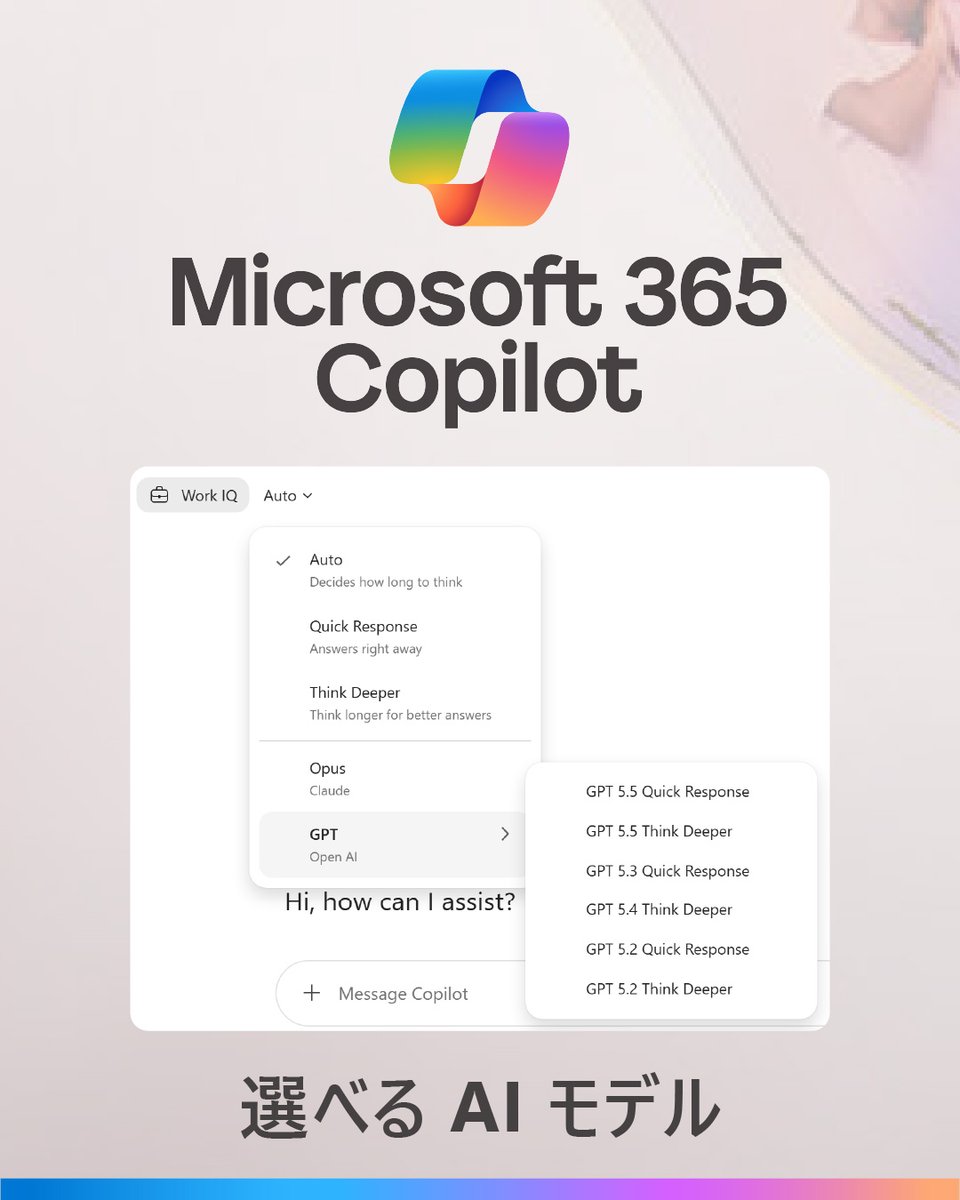
◤Microsoft 365 Copilot|AI モデル◢
Microsoft 365 Copilot は、OpenAI / GPT‑5.5 や Anthropic / Claude Opus 4.7 を利用可能。
さらに、インテリジェンス レイヤー WorkIQ がデータや仕事の文脈を理解し、会議やファイルなどの情報を統合して “仕事の流れに沿った回答” を提供します。
日本語
This point about teams is important.
As AI makes it easier for anyone to build, the differentiator becomes less about generating the first version and more about how teams coordinate, review, and improve the system over time.
For AI workspaces, orchestration, shared context, permissions, and accountability may become just as important as model capability.
English

Kay Zhu is the co-founder and CTO of @genspark_ai, the all-in-one AI workspace built on Claude.
In a market moving this fast, where anyone can build, he thinks the team is what makes the difference:
English
This is a strong example of how much AI can compress the path from idea to working prototype.
What I find interesting is the next phase after the demo:
maintenance, security updates, user feedback, edge cases, and keeping the architecture clean as the product evolves.
AI can make the first version much faster. The long-term engineering layer still matters.
English

A Google Cloud AI engineer just showed how to go from idea to fully deployed app in just 24 minutes using Claude.
24 minutes. Free. Built by the Google AI team.
One person + Claude + Google Cloud = a complete engineering org running on a laptop.
This is worth more than any $300 vibe-coding course.
Watch it and Bookmark it now.
English
This is a great way to understand what AI coding agents are actually doing under the hood.
Building a smaller version yourself helps clarify the real pieces:
context gathering, tool use, planning, execution, and feedback loops.
It also makes the production challenges more visible: permissions, error recovery, observability, and keeping changes coherent across a larger codebase.
English

What better way to understand a powerful tool like Claude Code than to build your own version of it?
In this handbook, @wagslane walks you through coding your own AI agent.
You'll use Python and Gemini and learn about multi-directory projects, how AI tools work under the hood, functional programming, and more.
freecodecamp.org/news/build-an-…

English
This is a great step for making agentic workflows more accessible.
Auto Mode can be very powerful when the task is well-scoped and the feedback loop is clear.
I’d also love to see more visibility into long-running behavior: what decisions were made, which files changed, why the agent continued, and where it decided to stop.
English

Two updates to auto mode:
· Now available on the Pro plan
· Sonnet 4.6 is now supported, alongside Opus 4.7
Shift+tab, and let Claude run.
English
I agree with this direction.
Multi-agent workflows make sense because real engineering work already has separate roles: research, implementation, review, testing, and coordination.
One additional challenge is orchestration quality. As soon as multiple agents work in parallel, teams need clear ownership, conflict handling, observability, and human checkpoints.
English

Boris Cherny, the creator of Claude Code at Anthropic, just explained why single-agent workflows are already dead
in this talk he breaks down exactly how the future is teams of agents, not better prompts:
- the 14% you lose to CLAUDE.md before typing a word
- one agent researching. one building. one reviewing. one orchestrating
- the architecture that separates hobbyists from real builders
- the 3 properties every agent team needs to actually survive
if you've been using Claude for more than a month and never left the chat window, you've been using one agent when you could be running a team of them
instead of another show tonight, watch this
make sure to bookmark it before it gets lost in your feed
the guide is in the article below
Khairallah AL-Awady@eng_khairallah1
English
This is an important angle.
AI coding tools are not only a productivity question anymore. At enterprise scale, they also become a cost predictability and governance question.
The real challenge may be less “can AI write code?” and more:
Can teams control usage, forecast spend, audit workflows, and decide where human review is still required?
English

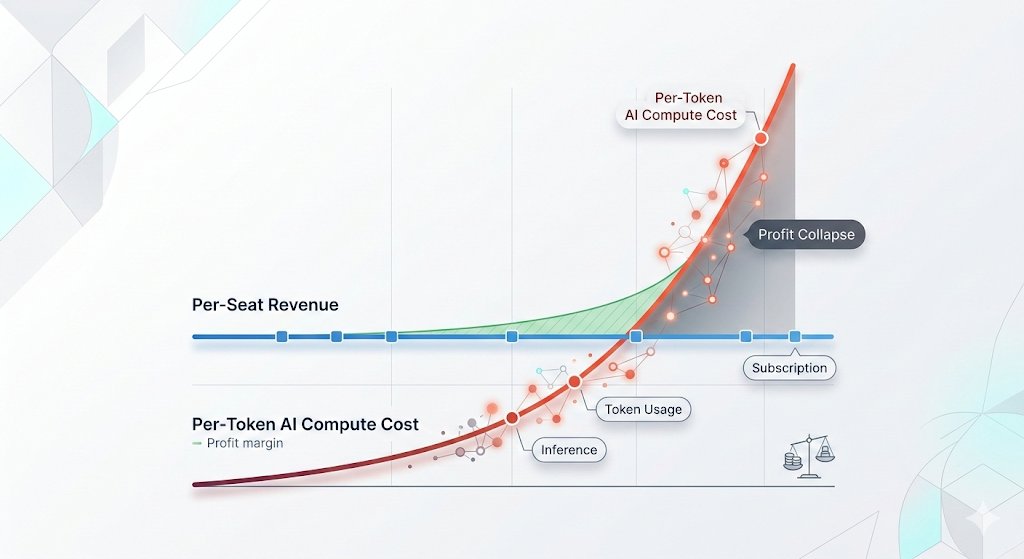
🦔Microsoft canceled its internal Claude Code licenses this week after token-based billing made the cost untenable, even for a company with effectively infinite cloud resources. Uber's CTO sent an internal memo warning the company burned through its entire 2026 AI budget in just four months. American AI software prices have jumped 20% to 37%, and GitHub (owned by Microsoft) is dropping flat-rate plans for usage-based billing across its products.
My Take
The AI subsidy era is ending in real time. The same company that put $13 billion into OpenAI and built the Azure infrastructure powering most of Anthropic's compute just looked at the bill from a competitor's coding tool and decided it was not worth paying. That is not a productivity failure on Anthropic's end. Token-based pricing is forcing every enterprise customer to confront the actual cost of running these models at scale, and the number turns out to be far higher than the flat-rate experiments suggested.
This ties directly to my Gemini Flash post yesterday. Anthropic, OpenAI, and Google all raised effective prices in the last six months. Enterprises that built workflows assuming AI costs would keep falling are now watching annual budgets evaporate in months. Two outcomes look likely from here. Either enterprises scale back AI usage to fit budgets, which slows the revenue ramp the labs need to justify their valuations ahead of IPOs, or the labs cut prices and absorb the losses, which makes the unit economics worse at exactly the wrong moment. Both paths land in the same place, the numbers stop working, and somebody has to take the writedown.
Hedgie🤗
English