
AI is not a prompt competition
Artificial intelligence is currently being tested and explored from many different angles, and many of us are still trying to find a meaningful way of approaching it.
One dimension that currently receives a great deal of attention is prompting.
That is hardly surprising. Prompting is practical and visible. It is also a natural starting point when working with large language models.
Learning how to formulate precise prompts can unlock remarkable capabilities.
But this search for the "right" combination and order of words is only the beginning.
The deeper shift introduced by AI lies in how these systems begin to interact with human thinking, learning, mirroring our writing behaviour and in the end also judgment.
In this context, I recently came across an open-access study published in the February 25 issue of Nature.
Researchers from the @MIT Massachusetts Institute of Technology describe new insights into how learning occurs in the brain.
Instead of receiving broad and uniform feedback signals, individual neurons appear to receive highly specific teaching signals that guide their adjustment.
Learning therefore does not occur through a single correct answer. It emerges through precise feedback, repeated adjustment and continuous refinement.
This perspective feels strikingly relevant when thinking about AI.
Many demonstrations still focus primarily on output. A question is asked, a response is generated and the result is evaluated. Yet this captures only a small part of what is actually happening.
In many knowledge-based professions, the essential work does not lie in producing text. It lies in structuring complex situations, identifying relevant information, weighing uncertainty and forming judgment.
This becomes particularly visible in fields such as law and taxation, where careful reasoning, iterative analysis and the evaluation of competing interpretations remain central.
In such environments, the value of AI does not lie primarily in generating answers. Its deeper value may lie in its capacity to accompany complex thinking processes and to sharpen our understanding by exposing assumptions and alternative interpretations.
In that sense, these systems become less machines that produce answers and more systems that interact with human cognition.
Which leads to a simple thought.
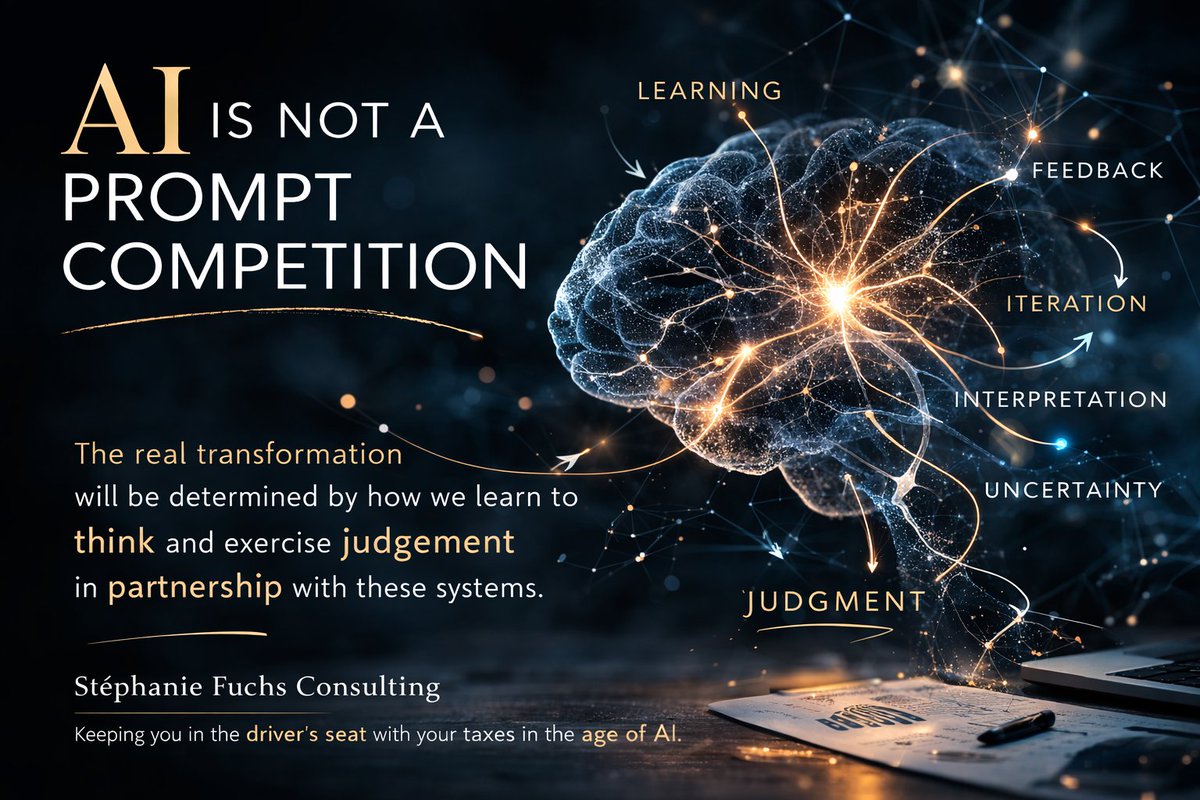
AI is not a prompt competition.
The real transformation will not be determined by who writes the most impressive prompt.
It will be determined by how we learn to think and exercise judgment in partnership with these systems and get a deeper understanding of our own neurological behaviour.
I am curious: How do you approach this shift?
Stéphanie Fuchs Consulting - Keeping you in the driver's seat with your taxes in the age of AI 🏎️
Source: Francioni et al., Vectorized instructive signals in cortical dendrites, Nature (2026): nature.com/articles/s4158…
#ArtificialIntelligence #AI #Learning #Cognition #FutureOfWork #Tax #Law
English