Luciano Martelotto 🛠🧬💻🇦🇺@LGMartelotto
Following several kind requests, here is a high-level summary of our pre-print in @biorxivpreprint (doi: doi.org/10.1101/2024.1…):
STAMP: Single-Cell Transcriptomics Analysis and Multimodal Profiling through Imaging
STAMP is a scalable, cost-efficient method for single-cell transcriptomics and multimodal profiling through imaging. It bypasses sequencing, significantly reducing costs while enhancing throughput.
#SingleCellRNA #SpatialOmics #STAMP
The motivation for this paper comes from the limitations of current scRNA-seq methods, which are costly, inefficient, and struggle to capture low- and high-abundance transcripts. Challenges like droplet instability, cell damage, limited cell capture, cross-contamination, inefficient indexing, and high sequencing costs affect ultra-low and ultra-high cell profiling, hindering accurate analysis of complex cell populations. #Limitations #DropletMicrofluidics
STAMP addresses these issues with a scalable, cost-effective, sequencing(costs)-free approach that works efficiently across ultra-low to ultra-high cell numbers, while preserving cellular morphology and enabling multimodal profiling. #SpatialOmics #UltraLow #UltraHigh
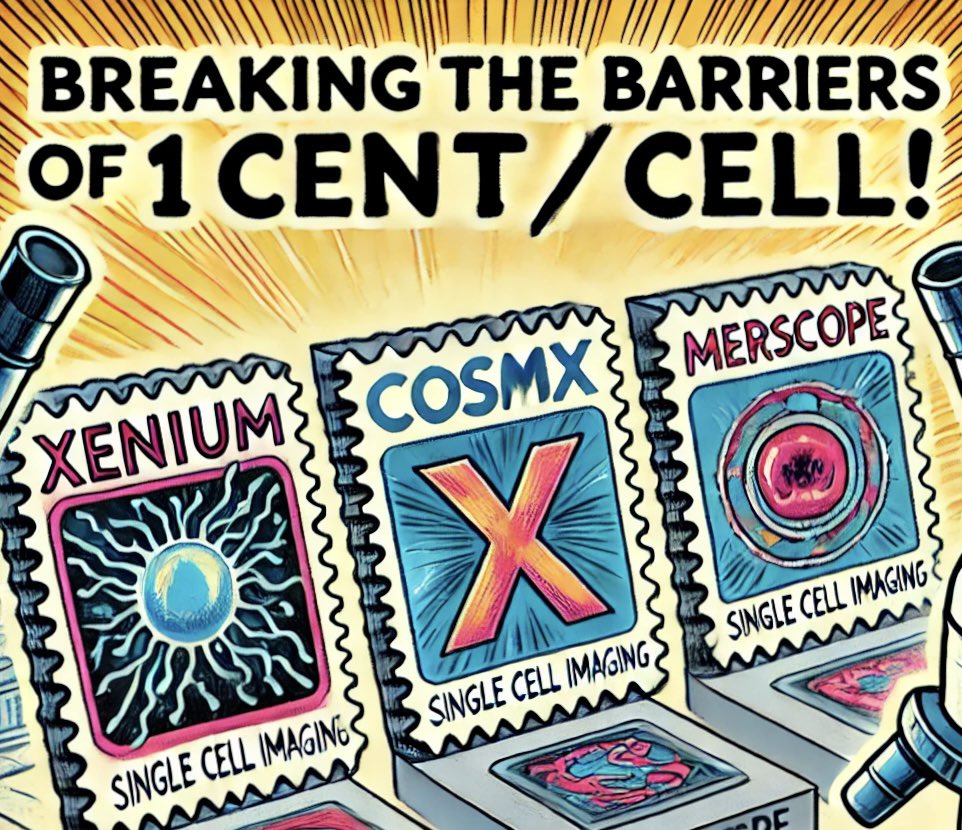
STAMP uses an imaging-based approach to perform high-throughput RNA and protein profiling by stamping cells onto slides compatible with CosMx and Xenium platforms, allowing multimodal profiling in a single run.
#Proteomics
STAMP supports single-modal (RNA/protein) and multimodal (RNA + protein) profiling, enhancing experimental flexibility and scalability. This versatility is essential for large-scale atlases and mixed-sample experiments.
#SingleCellAtlas #MultiSampleProfiling
STAMP scales easily: from less than 100 to millions of cells. It overcomes limitations in droplet-based systems, where throughput is often constrained by sequencing costs.
#HighThroughput
STAMP handles diverse sample types: PBMCs, dissociated tumors, nuclei, and stem cells. It also excels with fragile or archived tissues, where traditional methods often fail to yield high-quality data.
#ArchivedSamples
STAMP eliminates sequencing costs, making large-scale single-cell analysis accessible to more labs. #CostEfficiency
Here’s a cost comparison between GEM-X and STAMP-X for RNA profiling:
GEM-X RNA (20k cells): $0.0764/cell
1M cells = $76,400 (cost/cell = $0.0764)
2M cells = $152.800 (cost/cell = $0.0764)
3M cells = $229,200 (cost/cell = $0.0764)
STAMP-X RNA (1M cells): $0.0075/cell
1M cells = $7,500 (cost/cell = $0.0075)
2M cells = $7,500 (cost/cell = $0.00375)
3M cells = $7,500 (cost/cell = $0.0025)
In STAMP cells remain intact after imaging, enabling further downstream applications like histological validation or additional molecular assays, adding value to each sample.
#NonDestructiveAnalysis
We tested STAMP’s sensitivity by identifying, ultra-rare, circulating tumor cells (CTCs) spiked into PBMCs at 1:100,000. Such sensitivity is essential for clinical diagnostics, particularly in rare cell detection.
#CTCs #CancerDiagnostics
In a high-throughput immuno-phenotyping experiment, STAMP profiled 1.7M PBMCs, capturing a median of 83 transcripts and 49 genes per cell. This resulted in high-resolution immune profiling.
#Immunology #HighThroughputProfiling
31 immune cell states were mapped in PBMCs, capturing rare subpopulations (Th1/Th2/Th17 and NK subtypes). Detailed immune phenotyping is critical for understanding immune diversity in health and disease.
#ImmuneMapping
Whole cells vs. nuclei: STAMP's ability to profile both whole cells and nuclei is crucial for samples with low RNA content (e.g., archived tissues), increasing the platform’s applicability.
#NucleiProfiling #SingleCellOmics
STAMP integrates RNA and protein profiling. In cancer cell line profiling, RNA and protein data showed strong correlations, confirming the platform’s robustness in multimodal data collection.
#MultimodalProfiling
STAMP’s multimodal profiling produced high-resolution immune maps, combining RNA and protein data. This approach is essential for dissecting complex immune states and understanding functional responses.
STAMP excels in low-input samples. We demonstrated its ability to accurately profile as few as 100 cells, which is critical for studying rare populations in small samples.
#LowInput #RareCell
In a BMP4-driven stem cell differentiation model, STAMP captured dynamic changes from pluripotency to mesoderm and endoderm progenitors over multiple timepoints, tracking lineage differentiation.
#StemCellDifferentiation #LineageTracing
Trajectory analysis shows that STAMP’s resolution makes it a powerful tool for developmental biology and perturbation studies.
#DevelopmentalBiology #hESC
STAMP allows multi-sample profiling on a single slide, reducing batch effects and improving comparative analysis, particularly in drug response and perturbation studies.
#MultiSampleAnalysis #PerturbationScreening
STAMP represents a significant advance in single-cell research, offering scalable, multimodal RNA/protein profiling at low cost. Its versatility will support a broad range of research, from basic to clinical.
#SingleCellTechnology
Lots more coming soon...
@DrJasPlummer @hoheyn @pascual_reguant @EmanuelePitino1 @helucro @ximbaozao @irepan_salvador @Kellieiswise @m_mohenska @jc_nietos @cnag_eu @StJudeResearch @ACEpigenetics @M_ayco_N @eliseinsing Bill Flynn, Yutian Liu, Hannah Chasteen