
Rob Topping

22.5K posts

Rob Topping banner
Rob Topping

Rob Topping

@ToppingCapital

Alts & VC / Connect with me: https://t.co/Hzn9PT6ytR The “Nu40” -Tweet of #life, #art, #finance and #newassetclasses. 28 yrs - hedge fund = survivor

#freeform #maneuverablemoney Tham gia Aralık 2013
5.4K Đang theo dõi2.5K Người theo dõi
Rob Topping đã retweet

Financelot
Financelot@FinanceLancelot·
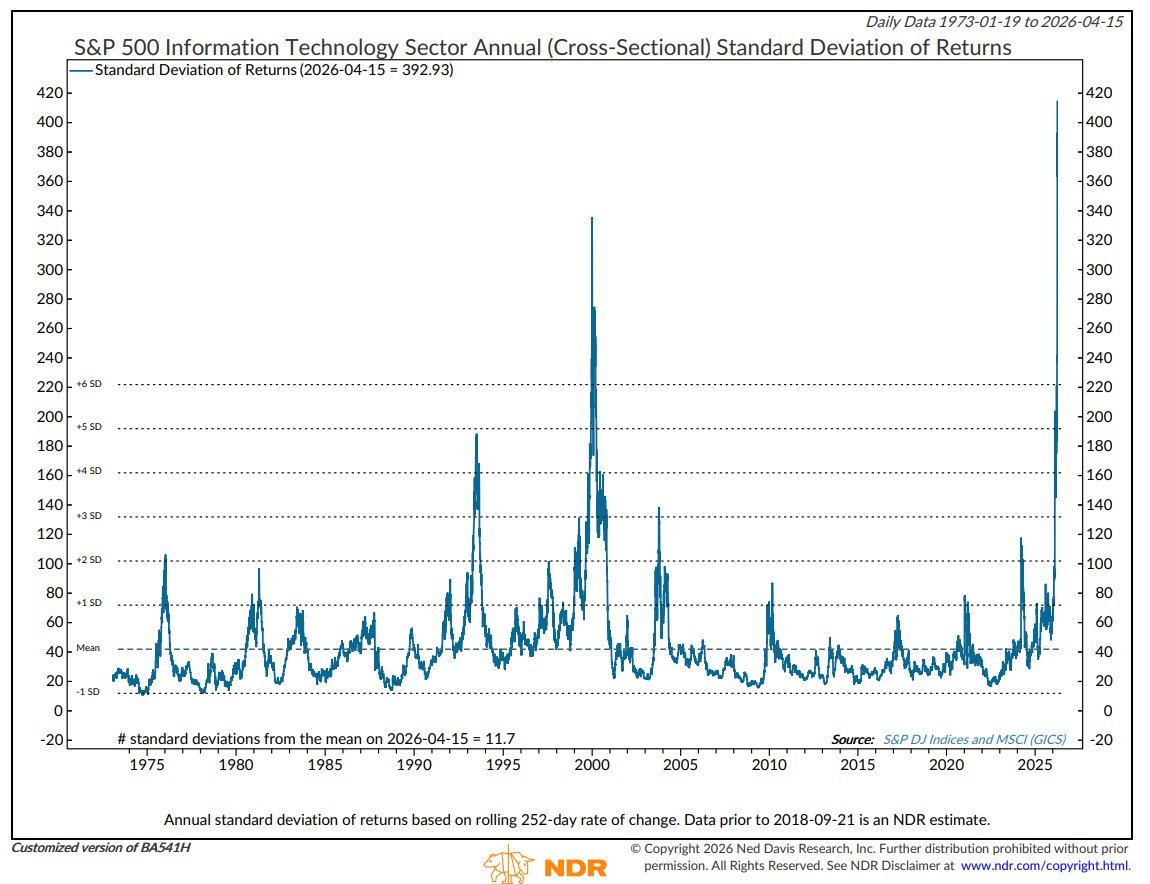
Have you guys ever experienced an 11.7 sigma event before? Well you just did this week, exceeding the top of the dot-com bubble. The cross-sectional standard deviation of annual returns within the S&P 500 Information Technology sector, as of April 15, 2026, dispersion hit 392.93, which sits 11.7 standard deviations above its long-term historical mean (data going back to 1973). For context: The chart draws horizontal lines all the way up to +6 SD. The current spike blows well past the +6 SD line.
Financelot tweet media
English
136
334
2K
223.2K
Rob Topping đã retweet
Roy Mattox
Roy Mattox@RoyLMattox·
This is literally the most extreme momentum event in 40 years of recorded data. The Nasdaq 100's RSI went from 28 (oversold) on March 30 to 70.5 (overbought) by April 15 — in just 11 sessions. That is the fastest oversold-to-overbought transition in the Nasdaq 100's 40-year recorded history. The previous fastest was 25 sessions after Liberation Day last year. The historical average is 60+ sessions. Benzinga According to Bespoke Investment Group, this also marks the fastest move from a correction of this size to a new record high since 1928. Yahoo Finance The forward return data is actually quite bullish long-term. Across all 44 historical episodes where the Nasdaq gained 11% or more in 10 sessions, the 12-month forward return averaged +24%, with a median of +30%, and a win rate of 80%. At 6 months, the win rate is 74%. Benzinga But the near-term pullback is almost guaranteed. The average maximum drawdown following these signals was −18.39% — meaning while the 12-month destination is historically higher, the journey involves deep, punishing pullbacks that can severely impact over-leveraged portfolios. Ainvest The key number to watch: Based on the 6 most comparable historical analogues — COVID recovery (−8%), Liberation Day 2025 (−4%), Fed pivot 2018 (−6%), Asian crisis 1997 (−7%) — the most probable near-term pullback is 3-8% within the next 2-4 weeks. The April 22 ceasefire expiry is the most likely trigger. After that consolidation, the historical data overwhelmingly favors a resumption of the bull trend. The S&P 500 has experienced average intra-year declines of roughly 14% since 1990, even in years that finish strongly positive — and the average correction (10-20% decline) lasts just 17 days. U.S. Bank A pullback here isn't a disaster; it's the historical norm and historically the best re-entry point. Wes and I are extremely well positioned in the leaders.
English
58
277
2K
295.6K
Rob Topping đã retweet
Shanaka Anslem Perera ⚡
On Tuesday, April 14, at the HSBC Global Investment Summit in Hong Kong, CEO Georges Elhedery said something on live Bloomberg television that should have detonated every energy desk on earth. It did not. Because nobody is reading what it actually means. “The highest I’ve seen, and I’m hoping we don’t see more of that, but the highest I’ve seen is $286 for a barrel of oil that reached Sri Lanka.” Two hundred and eighty-six dollars. For a single barrel. Delivered. While Brent futures closed at $95.61 on April 16 and CNBC’s chyron still shows “oil near $100.” Read the transcript carefully. Elhedery laid out the arithmetic: Middle East crude is now $140 to $150 at origin. Red Sea rerouting adds $30 to $40 per barrel in shipping. Insurance has gone from 25 basis points to 5 percent, a twentyfold increase. War insurance has been scrapped entirely, meaning the 5 percent buys you no war coverage at all. Stack those numbers on top of Dated Brent physical at $131.97 on April 9, Oman crude at a record $152.58 in March, and Dubai crude at $157.66 in early April, and you arrive at a poor importing nation paying $286 to keep the lights on. This is not an oil price spike. This is the death of benchmark pricing as the world has known it since 1988. For 38 years, Brent and WTI futures have functioned as the nervous system of global oil. Every central bank inflation model, every airline fuel hedge, every sovereign budget in every importing nation, every Fed rate decision, anchors itself to these two numbers flickering on a Bloomberg terminal. The entire post-1973 architecture assumed that paper price and physical price converge within a narrow band, that arbitrage closes the gap, that the benchmark tells the truth. On April 14, HSBC’s CEO told the world, in public, that the paper price is now off by nearly 200 percent from the physical price for the countries that can least afford the difference. A $95 Brent headline and a $286 delivered barrel are not the same commodity anymore. They are two different markets, and the poor are trading in the real one. This is why Sri Lanka, which has no domestic production and imports 100 percent of its fuel, turned simultaneously to Russia, India, and China in the first weeks of April. President Dissanayake publicly thanked all three on April 8. India delivered 38,000 metric tonnes on March 28. Sinopec is running sustained shipments. Russia has formalized supply arrangements despite US sanctions. Colombo, a capital of 1.7 million people in a country still recovering from the 2022 sovereign default, has accidentally become the first live demonstration of what post-dollar, post-Brent, multipolar energy sourcing looks like in practice. Not in a think tank paper. In actual cargoes arriving at actual ports. Every central bank pricing inflation off Brent is flying blind. Every airline hedged on WTI is mispriced. Every AI data center operator who modeled a 2030 power buildout on pre-war energy assumptions just watched the assumption disintegrate. Goldman’s 1,350 TWh data-center forecast assumed a world where a $95 Brent headline means $95 oil arriving at the meter. That world ended on February 28. The $286 barrel did not reach Sri Lanka. Sri Lanka reached the future first. Everyone else is still reading yesterday’s screen. Full Analysis - open.substack.com/pub/shanakaans…
Shanaka Anslem Perera ⚡ tweet media
Shanaka Anslem Perera ⚡@shanaka86

Two oil markets now exist. The physical one and the financial one. They are pricing two different wars. Oman crude just crossed $154 per barrel. Dubai sits at $130. Brent at $102. WTI at $93. The gap between the Gulf benchmark that reflects physical delivery through the war zone and the American benchmark that reflects paper contracts in Cushing, Oklahoma is $61 per barrel. Sixty-five percent. The widest divergence in the history of crude oil pricing. That gap is the war expressed as a number. Oman and Dubai price crude that loads in the Gulf, transits the strait, and delivers to Asian refineries. Those barrels are scarce, dangerous, uninsured, and physically gated by provincial commanders with radios. WTI prices crude that sits in American storage tanks connected by pipeline to refineries that have never heard a VHF radio hail from Bandar Abbas. The physical barrel is in a war zone. The paper barrel is in Oklahoma. The market is telling you these are no longer the same commodity. While the benchmarks diverge, Israel struck northern Iran for the first time. The war is expanding geographically while Trump tells Israel to stop hitting energy infrastructure. Saudi Arabia reserved the right to military action against Iran. The United States is considering deploying thousands of additional troops. The escalation ladder has no ceiling and the de-escalation rhetoric has no floor. The market’s response is schizophrenic and revealing. Oil ETF shorts are surging. IEO short interest hit 2.8 percent, nearly a four-year high, tripled since the start of 2026. USO shorts increased by 3 million shares, up 50 percent in the last month. The financial market is betting that oil prices have peaked. Meanwhile the physical market just printed $154 for Oman crude. The shorts are betting against the paper price while the physical price screams. US stocks dropped more than one percent across major indices with PPI hitting a 13-month high. The producer price index is the inflation measure that arrives at the factory gate before it reaches the consumer. PPI at 13-month highs tells you the Fed’s PCE revision to 2.7 percent is not the ceiling. It is the floor. Retail investors are buying gold at a pace not seen in decades. Over $70 billion has flowed into gold ETFs since Q2 2025, tripling in the last six months. Silver ETFs absorbed $10 billion last year. Institutions are doing the opposite: selling $1 billion in gold and $200 million in silver. The retail investor who cannot access commodity futures or war-risk swaps is buying the oldest store of value on Earth. The institution that can hedge is rotating out. The divergence between retail conviction and institutional positioning is as wide as the Oman-WTI gap. Crypto funds took in $1.06 billion last week. Bitcoin ETFs alone received $793 million. The digital asset class that was bleeding ahead of the Fed hold is now absorbing inflows from investors who see the same thing the gold buyers see: the financial system is being repriced by a physical chokepoint that monetary policy cannot reach. Oman at $154. WTI at $93. Gold at $5,000. Bitcoin absorbing billions. Retail buying what institutions are selling. The physical market and the financial market are diverging at the fastest rate in history. And the farmer in Iowa, who lives in the WTI world but depends on molecules from the Oman world, is planting soybeans because the $61 gap just reached his seed catalogue. open.substack.com/pub/shanakaans…

English
28
339
788
156.4K
Rob Topping đã retweet
Uzi
Uzi@UziCryptoo·
A single accountant stole $53 million from her employer over 20 years and nobody noticed Rita Crundwell was the comptroller of Dixon, Illinois with a population of 15,000 She opened a secret bank account called “Reserve Sewer Capital Development Account” For two decades she transferred city funds into it while filing fake invoices She used the money to become the most successful quarter horse breeder in America Owned 400 horses, multiple farms, a custom bus, and a $2.1 million motorhome She won the World Championship in quarter horse breeding four times while actively robbing a small town Only got caught because a substitute accountant covered her desk while she was on vacation The city had been cutting firefighter jobs and road repairs for years while this was happening $53 million. One woman. 20 years. One vacation.
English
2.4K
14.6K
58.2K
4.2M
Rob Topping đã retweet
Josh Kale
Josh Kale@JoshKale·
This Allbirds story is so insane: → $BIRD IPO'd in 2021 at a $4 billion valuation → Silicon Valley's favorite shoe → Lost 99.5% of its value in 4 years → Closed every US store → Sold the entire brand for $39 million → Renamed itself "NewBird AI" → Using $50M to buy GPUs and compete with AWS → Stock up 450% today on 875x normal volume This is the most unhinged corporate pivot of the decade and the newest meme stock entrant
Josh Kale tweet media
Tracy Alloway@tracyalloway

Allbirds, the shoe brand, now says it's an AI compute company.

English
206
445
5K
1.5M
Rob Topping đã retweet
Warren Pies
Warren Pies@WarrenPies·
The last 10-days have been unlike any 10-day period in the market since 1950. First, the S&P 500 is up 9.8% in 10-days, which is in the 99.7th percentile of all 10 day returns.
Warren Pies tweet media
English
168
772
5.9K
1.1M
Rob Topping đã retweet
Wall Street Mav
Wall Street Mav@WallStreetMav·
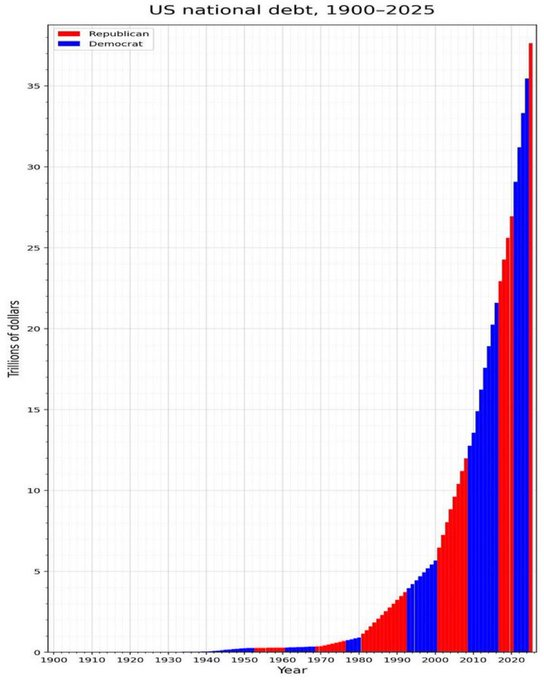
The national debt at $39 trillion is a uni-party issue. Growing at $2 trillion per year, we are guaranteed another $6 trillion to reach $45 trillion in debt by the end of Trump's term in 2028. By 2030 the deficit will likely be $3 trillion per year. Buy more gold and silver.
Wall Street Mav tweet media
English
65
109
438
26.3K
Rob Topping
Rob Topping@ToppingCapital·
GIF
Aakash Gupta@aakashgupta

The SEC just killed the most regressive financial regulation in America. For 25 years, the Pattern Day Trader rule required $25,000 in your account to make more than 3 day trades per week. Created in 2001 after the dot-com crash to "protect" small investors. Here's what it actually did: A 22-year-old with $5,000 and genuine trading discipline was legally treated the same as a degenerate gambler. Both locked out. Meanwhile, anyone who already had $25,000 could trade as recklessly as they wanted with zero restrictions. The rule never measured skill. Never measured risk tolerance. Never measured strategy quality. It measured one thing: how much money you already had. Worse, it created the exact behavior it was supposed to prevent. Traders couldn't day trade U.S. stocks, so they moved to offshore brokers with extreme leverage and zero consumer protections. Others opened accounts at 4-5 different brokerages to get 3 day trades at each. FINRA's own data showed day trading moving to cash accounts specifically to dodge the rule. The replacement is the first smart regulation the SEC has approved in years. Instead of a flat wealth gate, brokers now calculate intraday margin requirements in real-time based on each position's actual volatility. Minimum drops from $25,000 to $2,000. The system now asks "can your account handle this specific position?" instead of "are you rich enough to trade?" The catch nobody's pricing in: FINRA's own data shows 72% of day traders end the year with losses. A landmark study found only 3% are profitable long-term. The $25K barrier was bad policy, but it was also an accidental filter that kept millions of undercapitalized traders from lighting money on fire faster. That filter just disappeared. Robinhood's order flow is about to get a lot more interesting.

ZXX
0
0
0
44
Rob Topping đã retweet
Shanaka Anslem Perera ⚡
Twelve words just rewrote the post-1945 maritime order and no one has processed what happened. “Iran controls the Strait of Hormuz and it is open for us.” Chinese Defense Minister Admiral Dong Jun, speaking publicly to the Trump administration and the US Navy on April 13, the same day CENTCOM activated a blockade of all Iranian ports effective 10am Eastern. Not through diplomatic cables. Not through UN backchannels. A peer nuclear power publicly declaring it will ignore a US naval blockade because it has sovereign energy agreements with the country being blockaded. This has not happened since 1945. Not during Korea, Vietnam, Cuba, or the Tanker Wars. In every prior American naval interdiction, no peer power publicly declared its intention to transit the enforcement zone by sovereign right. China just did. The mechanism is energy existential. China imports approximately 1.85 million barrels per day of Iranian crude, roughly 80 to 90 percent of Iran’s total exports. On April 7, China and Russia vetoed a UN Security Council resolution to reopen the Strait, with China’s MFA explicitly calling the disruption a consequence of “US-Israeli illegal military operations against Iran.” Six days later, Dong Jun told the world the Strait is open for Chinese vessels regardless of what Washington orders. Now trace the logic. The blockade targets Iranian ports. Iran’s primary customer is China. Either the US Navy interdicts a Chinese vessel, or the blockade has no teeth against the only customer that matters. Capital Economics stated it precisely: “Would the U.S. Navy target Chinese vessels in the Strait? Either outcome would represent a significant escalation.” There is no third option. Trump responded the same day. “We can’t let a country blackmail or extort the world.” Then: “Many ships are heading to our country to load up with the best oil.” Then: “China’s Xi wants to see this ended.” Then the line that reveals everything beneath the rhetoric: “We’ve been called by the other side. They’d like to make a deal very badly.” The other side is not Iran. Iran’s parliament speaker returned from the collapsed 21-hour Islamabad talks and told Trump: “If you fight, we will fight.” Iran’s military declared “no port in the region will be safe.” The other side that called is Beijing. And the deal is not about nuclear enrichment. It is about Chinese energy security transiting a waterway America can no longer unilaterally control, denominated in a currency that is not the dollar. Brent surged 7.5% to $102.30. WTI hit $104.20. Crude is up 40 to 50 percent since the war began February 28. American gasoline averaged $4.13 per gallon on April 13, up $1.20 since hostilities started. March CPI printed 3.3%, up from 2.4% in February. The blockade designed to strangle Iran is importing inflation into the American economy at a rate that compounds through every supply chain touching energy. Before the war, 130 vessels transited daily. Saturday, Windward tracked 17. The UK and Australia both refused to join. The ceasefire expires April 22. Trump visits Beijing May 14. The post-war order was built on one assumption: no country could challenge American naval supremacy at a global chokepoint. Dong Jun just challenged it in twelve words. The question is no longer whether the Strait reopens. It is what currency the toll is paid in when it does. open.substack.com/pub/shanakaans…
English
42
238
575
132K
Rob Topping đã retweet
Liz Ann Sonders
Liz Ann Sonders@LizAnnSonders·
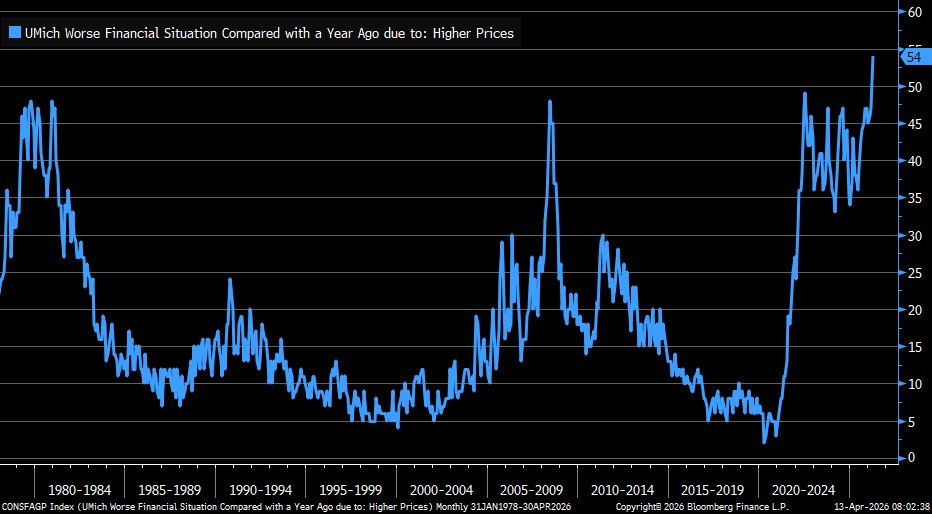
Share of consumers saying their financial situation is worse compared to a year ago due to higher prices jumped to 54% in April vs. 47% in March … now highest on record
Liz Ann Sonders tweet media
English
125
761
2.7K
597.2K
Rob Topping đã retweet
kristen shaughnessy
kristen shaughnessy@kshaughnessy2·
Citadel’s Fixed Income Crashes 8.2% in March Millennium and Point72 Also Feel the Pain “In a rare and closely watched setback, Citadel—the multi-strategy powerhouse led by Ken Griffin—saw its Global Fixed Income strategy decline approximately 8.2% in March, marking one of the sharpest drawdowns for the firm in recent years…. Citadel is not alone in facing challenges. Reports indicate that other multi-strategy platforms, including Millennium Management and Point72, also experienced volatility during the same period…. While there is no indication that Citadel faced liquidity issues, the episode underscores the importance of managing leverage carefully—particularly in environments characterized by sudden volatility…..” hedgeco.net/news/04/2026/c…
kristen shaughnessy tweet media
English
13
82
243
7.9K
Rob Topping
Rob Topping@ToppingCapital·
“You get what you earn”
Coach AJ 🎯 Mental Fitness@coachajkings

Tom Brady shares the advice that changed his career and his mindset. He was at Michigan - he was only getting 2 practice reps while the starter got 20. He was complaining to sports psychologist Greg Harden: "How can I ever get better? All these guys get all the reps and I only get 2." Greg's response changed everything: "Just go in there and focus with the 2 that you got and make them as perfect as you possibly can." Focus on what you can control. So that's what he did. "They'd put me in for those 2. Man, I'd sprint in there like it was Super Bowl 49. 'Let's go boys! Here we go! What play we got?'" "I did really well with those 2 'cause I brought enthusiasm, I brought some energy, and I had a little more confidence in myself." You don't get what you want in life - you get what you earn. It starts with showing up and earning it every single day. "It went from 2 reps to getting 4 reps because those 2 were pretty good. Then I had 4 good reps. Then I got 10 good reps." You can always try to lead the team in effort, attitude, and perspective because it takes no talent. Then he shared the mindset shift: "Focus on what you can control. Focus on what you're getting, not what anyone else is getting. Whenever you get an opportunity, you take advantage of it. You treat it like it's the Super Bowl." Stop complaining about what you don't have. Dominate what you do. Opportunity doesn't care about fairness - it rewards how ready you are. (🎥PBD Podcast )

English
0
0
0
43
Rob Topping đã retweet
Crazy Vibes
Crazy Vibes@CrazyVibes_1·
In Spain, a teacher named Verónica Duque walked into her classroom one morning wearing a full-body anatomy suit—printed with muscles, organs, veins, and bones from head to toe. At first, her students didn't laugh. They stared. They leaned forward. And suddenly, the room fell silent—not from boredom, but from curiosity. For years, she had grappled with a question many teachers face: "How do I get students to truly understand instead of just memorize?" Textbooks weren't enough. Diagrams weren't enough. Attention spans faded faster than the lesson. So she tried something bold—and unforgettable. That day, every hand went up. Students asked questions. Concepts finally clicked. And days later, they remembered everything. No expensive technology. No high-budget tools. Just creativity, passion—and a teacher unafraid to think outside the box. Since then, thousands of educators around the world have called her "inspiring," "brilliant," and "the teacher every child deserves." Sometimes, learning doesn't require the latest invention—it simply needs someone who believes that teaching can be magical. Because education isn't just about information. It's about connection, curiosity, and courage.
Crazy Vibes tweet media
English
11
131
861
124.3K