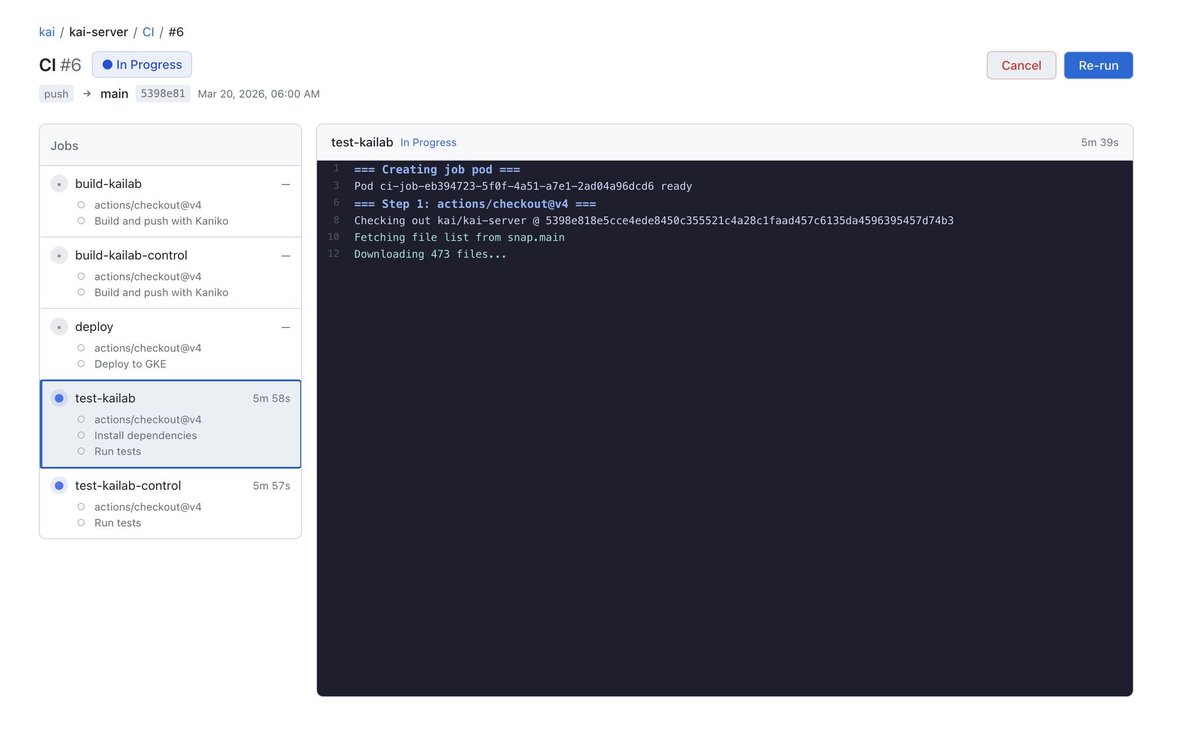
In the next version of Kai:
Kai–Git bridge makes transitions painless: Kai users keep capturing semantic snapshots and assertions; the bridge writes tidy git commits with Kai evidence in commit trailers.[1/2]
Kai capture just went from 9.2s to 2.1s on a 64K file repo.
Replaced JSON zero heap allocations on read. The same approach git uses for its index, adapted for Go.
v0.9.58: github.com/kaicontext/kai…
Shipped 10 releases for Kai this week (v0.9.14→0.9.23).
Now:
• capture/push = change-aware (not O(all files))
• CI skips unaffected work
• tracks AI vs human code
You + AI can actually understand your codebase.
github.com/kaicontext/kai…
Next version of Kai:
Created a pull-through cache on Artifact Registry, one command, zero Dockerfile changes.
First pull hits Docker Hub, everything after is cached.
In this version of Kai:
We open-sourced Kai Server!
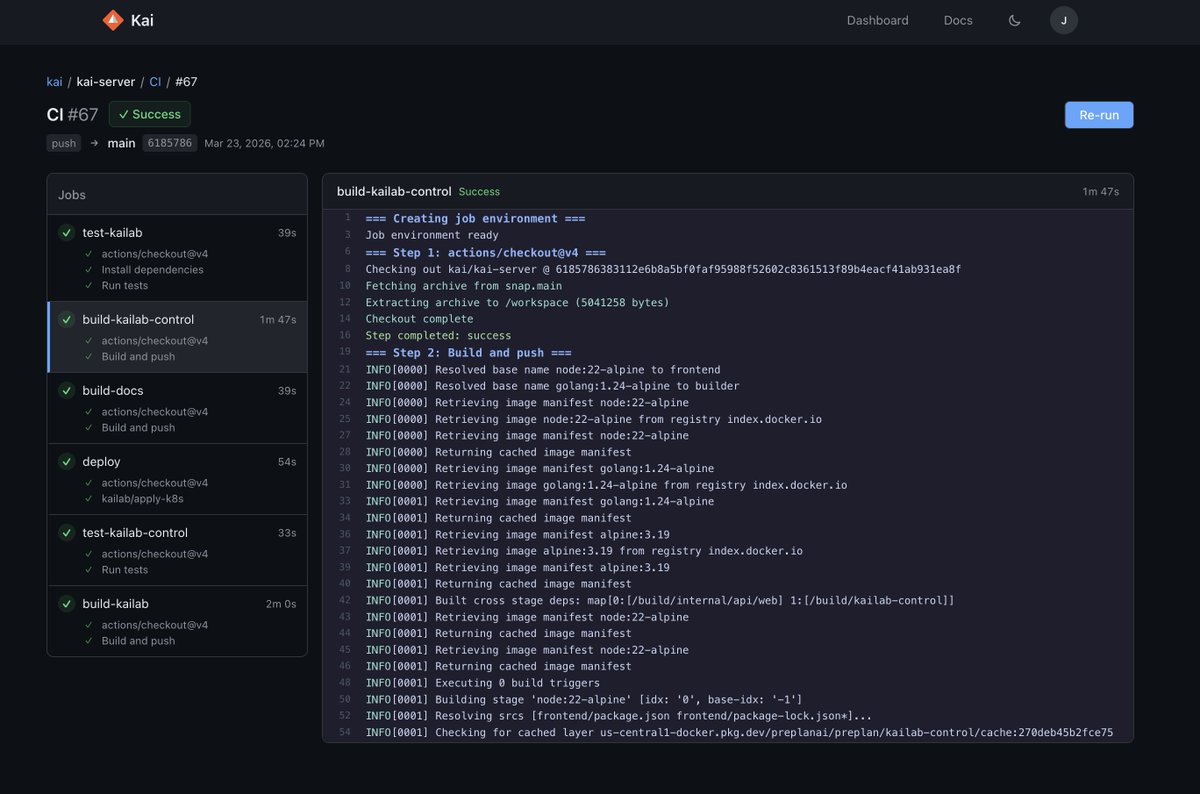
Also shipped a CI system that deploys itself — all in one week.
Kai CI builds and deploys Kai.
Hosted:
kaicontext.comgithub.com/kaicontext/kai…
This release gives you Kai grep.
Now I use Kai grep instead of Claude code grep
Yesterday, I had Claude refactor. A standard text search made it look safe.
But Kai grep flagged a hard dependency in another module.
I would have shipped a production bug.
github.com/kailayerhq/kai
Super excited because in a few seconds Kai will be deployed by Kai.
Once this is done, Kai Server will be open sourced, and you can do this too on your own hardware or cloud.
Your agents will be so happy.
A few pilot teams told me the same thing after using Kai:
“This gives me peace of mind shipping AI-generated code.”
AI can generate changes faster than humans can review.
Kai gives both the developer and the AI agent a shared understanding of the repo.
github.com/kailayerhq/kai
@jakecodes Nice delta. I’ve started tracking this during sessions with a live token bar in macOS so regressions show up instantly while coding.
Link: dev.to/johns234242343…
Claude Code: 100k tokens, 20 min for my refactor.
With Kai: 20k tokens, 2 min.
Semantic infrastructure for AI agents. Call graphs, dependencies, impact analysis — structured, not grepped.
claude mcp add kai -- npx -y kai-mcp
Open source: github.com/kailayerhq/kai
@mipsytipsy@boristane Testing is the most interesting stage to watch.
We’re already asking agents to write tests.
The question shifts from “can it generate?” to “how do we validate confidently?”
Observability closes the loop after deploy.
The next frontier is tightening the loop before it.
Every stage of the traditional SDLC is collapsing, except monitoring. And monitoring needs to evolve.
Observability becomes the feedback mechanism that drives the entire loop...the connective tissue of the whole system. 🙌
Read the rest from @boristane, boristane.com/blog/the-softw…
Hours of coding made 10-minute CI feel free. Feedback loop? Not your problem.
Agent does it in 5 minutes. Now CI is the feedback loop.
Nothing changed in your pipeline. Everything changed in your baseline.
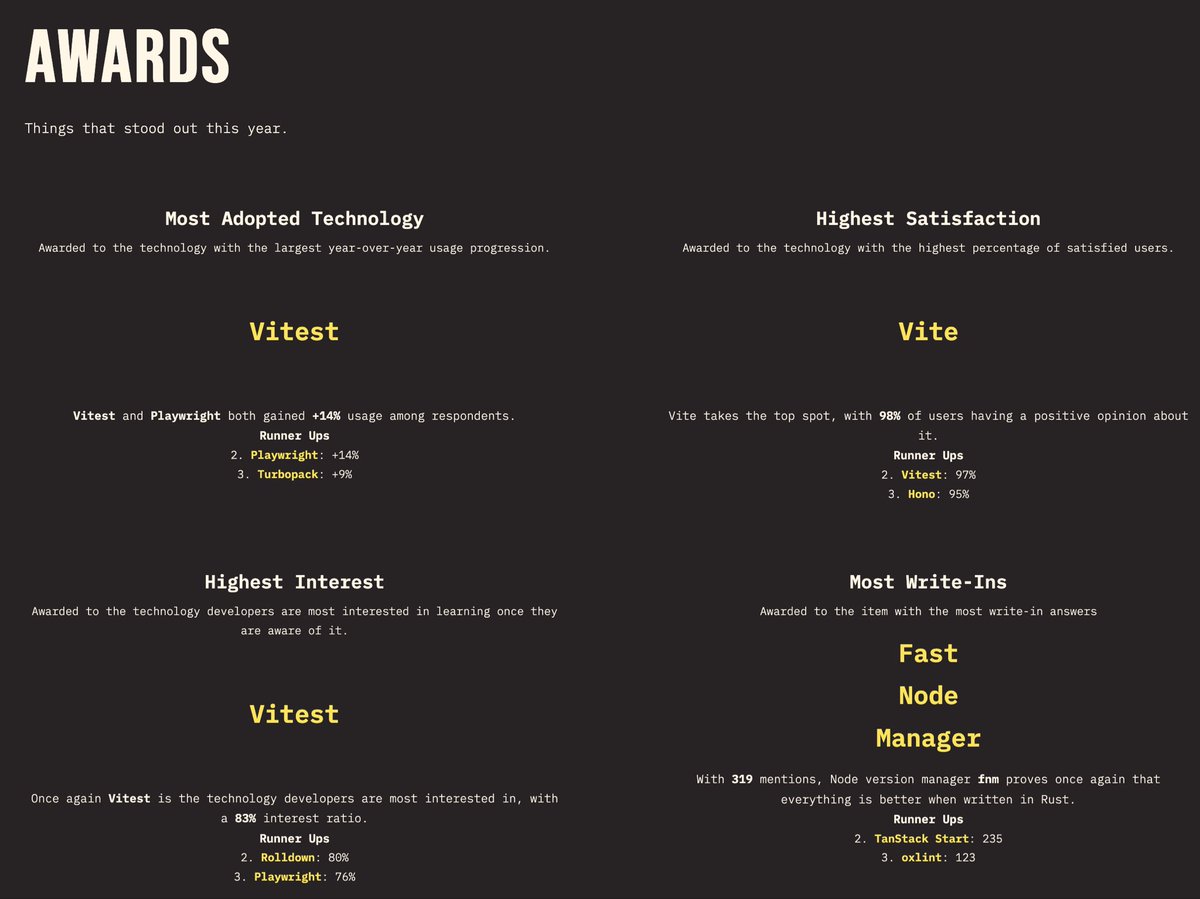
Vite & Vitest continue to be the most loved technologies in the JS ecosystem (screenshot from State of JS 2025). Rolldown and oxlint appeared in the rankings too!
Next year we will not only see Rolldown, tsdown, oxlint and oxfmt rising, but also something that unifies all of them on the list…