techstartups

20.6K posts

techstartups banner
techstartups

techstartups

@techstartups

Silicon Valley Tham gia Nisan 2008
3.3K Đang theo dõi36.4K Người theo dõi
techstartups đã retweet
Willy Woo
Willy Woo@willywoo·
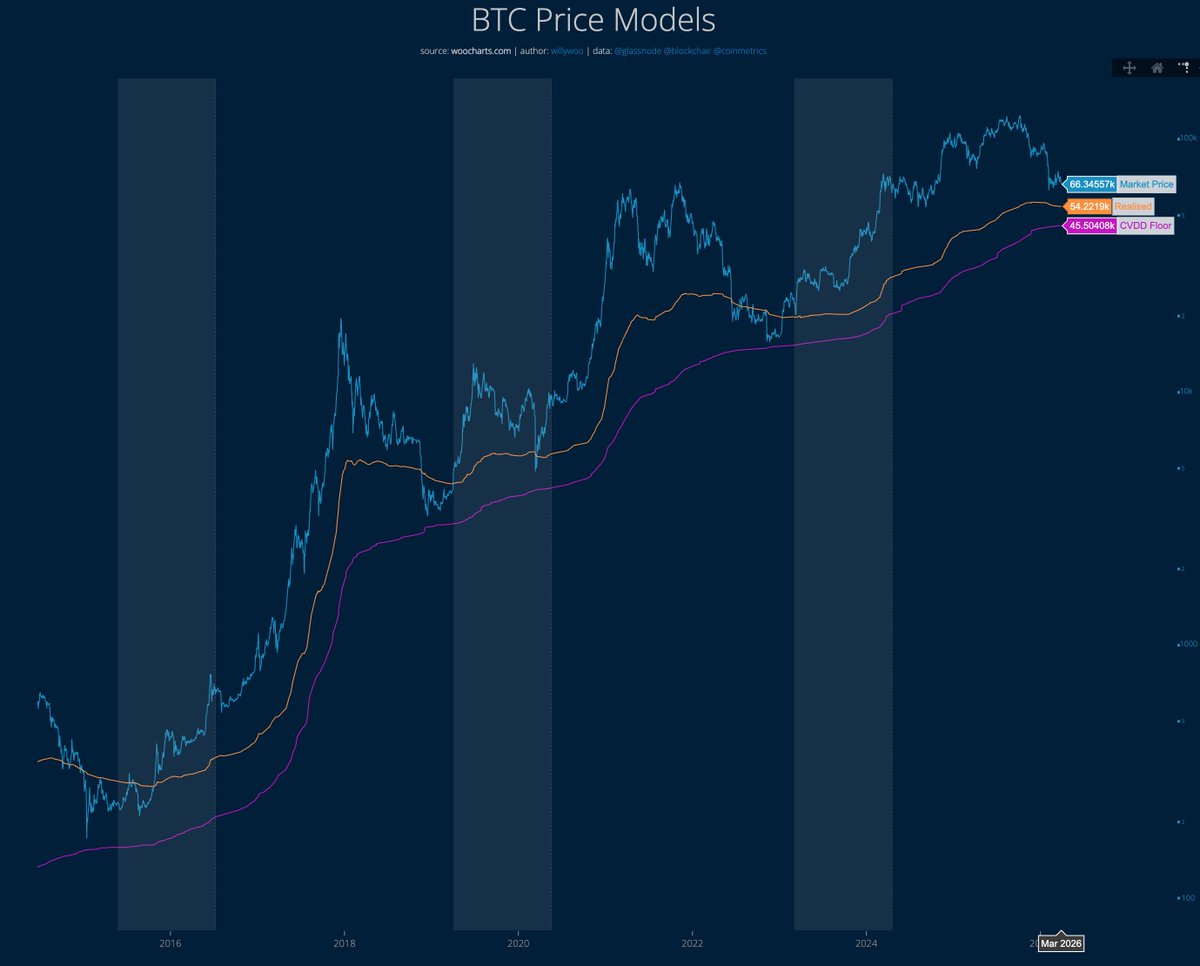
Old school onchain models suggest a BTC bottom between 46k-54k. Also hints at how much time we have to wait. Orange line correlates to the capital stored in BTC and it has been leaving since November. CVDD Floor Model has the advantage of climbing over time, 45.5k right now.
Willy Woo tweet media
English
209
181
1.6K
239.2K
techstartups đã retweet
Nikita Bier
Nikita Bier@nikitabier·
If you’re seeing a bunch of Japanese posts, here are some fun facts: Japan has more daily active users and more time spent on X than any other country in the world. Over two thirds of the country is monthly active on X. X in Japan has one of the highest penetration rates of any social network in history.
English
5.7K
5.2K
75.7K
7.6M
techstartups đã retweet
Trade Whisperer
Trade Whisperer@TradexWhisperer·
$MU Two types of idiots today. Type 1: Believes 40% of DRAM demand came from OpenAI alone. Type 2: Believes TurboQuant will reduce memory demand 6x. Put buyers are behind this. Don't fall for it. Grok, ChatGPT and Claude already use MoE and/or 4-bit compression at scale without significant quality regression. TurboQuant's improvement will be marginal (15% overall, IMO). It's long-context KV cache inference only. Does not touch training or the model residing inside HBM. Quality regression at scale is unproven. It's a research paper, not a product. Bigger models need more HBM. Always. That does not change. Oh, also Jevons Paradox.
English
45
53
600
72.2K
techstartups đã retweet
Aakash Gupta
Aakash Gupta@aakashgupta·
OpenAI may have caused the worst consumer hardware crisis in a decade with purchase orders that were never real. In October 2025, Sam Altman flew to Seoul and signed simultaneous deals with Samsung and SK Hynix for 900,000 DRAM wafers per month. That's 40% of global supply. Neither company knew the other was signing a similar commitment at the same time. The pricing and terms would have looked very different if they had. Those "deals" were letters of intent, not binding purchase orders. No RAM actually changed hands. But the market treated them as real. Contract DRAM prices jumped 171%. A 64GB DDR5 kit went from $190 to $700 in three months. DDR4 kits that should have been in oversupply doubled. Retailers stopped posting prices entirely. The Abilene Stargate expansion just got cancelled because OpenAI couldn't forecast its own demand. Oracle couldn't agree on financing. The partners are squabbling. Bloomberg reported the $500B project hadn't started and no funds were raised to meet the initial budget. Multiple data center buildouts are delayed or shelved. Now DDR5 prices are finally dropping for the first time in months, and it has nothing to do with OpenAI walking away from anything. Google released TurboQuant on March 24, a compression algorithm that cuts AI memory requirements by 6x. SK Hynix and Samsung stocks dropped 6% and 5% overnight. Corsair kits fell $60-100 from their highs within days. One company locked up 40% of global memory with commitments it may never fulfill. A different company published a research paper. The research paper is doing more for RAM prices than the entire supply chain has done in six months.
Roger@rdd147

🚨 RAM prices are plummeting after OpenAi failed to fulfill its commitment to purchase 40% of World supply and terminated its $71 billion SKHynix promise. $MU

English
198
1.4K
10K
1.1M
techstartups đã retweet
Steve Hou
Steve Hou@stevehou·
“Hassabis administered a subtle test on him. The two men discussed the potential of AI, and Zuckerberg expressed appropriate excitement. But then, as the dinner continued, Hassabis brought up other hot technologies: virtual reality, augmented reality, 3-D printing. Zuckerberg sounded equally excited about all of them. ‘That told me what I needed to know,’ Hassabis said.”
Steve Jurvetson@FutureJurvetson

Subtext: how Zuck’s obsession with VR lost him AI leadership and “the greatest deal Google ever made.” “if Facebook didn’t buy DeepMind, they would end up in the arms of Google. Hassabis came out to the West Coast to have lunch with Larry Page, still the strongest suitor. Zuckerberg got wind of his visit and invited him to dinner. Arriving at Zuckerberg’s Palo Alto home, Hassabis administered a subtle test on him. The two men discussed the potential of AI, and Zuckerberg expressed appropriate excitement. But then, as the dinner continued, Hassabis brought up other hot technologies: virtual reality, augmented reality, 3-D printing. Zuckerberg sounded equally excited about all of them. ‘That told me what I needed to know,’ Hassabis said. ‘Facebook offered more money, but I wanted somebody who really understood why AI would be bigger than all these other things.’ After the dinner, Hassabis got back to Larry Page. ‘Let’s go further,’ he told him.” — book excerpt from today’s WSJ: wsj.com/tech/ai/deepmi… Zuck’s misplaced devotion to VR and the metaverse hurt the company much more than the $80 billion of wasted spend. It’s the reputational hit. @DemisHassabis divined it in his final test, and Zuck didn’t even know that he blew the opportunity. Eight years later, he renamed the company Meta, doubling down on what anyone with tech savvy knew was DOA. Then, in a 2025 attempt to play catchup, Zuck spent $14 billion on a data labelling company with a salesy leader and upended his AI team. Once again, anyone with tech savvy rolled their eyes on the acquisition and management changes, further evidence that the tech leadership at Meta was seriously lacking. TLDR; beware the metaverse. It is a dystopian vision at best, and luckily for humanity, headsets are still nowhere near readiness for mass adoption.


English
27
93
2.2K
722.6K
techstartups đã retweet
Tuki
Tuki@TukiFromKL·
🚨 do you understand what Karpathy just said.. the guy who co-founded OpenAI.. led AI at Tesla.. one of the best engineers alive.. built an app with AI.. and said the code was the easy part.. the hard part was Stripe.. auth.. DNS.. databases.. deploying it.. connecting 15 different services that all have different dashboards and different docs and different billing pages.. AI can write your entire app in 20 minutes.. but it still can't click "confirm email" on Vercel.. so the thing that's "replacing developers" can't do the thing developers actually spend 80% of their time doing.. vibe coding didn't kill software engineering.. it just proved that coding was never the job.. the job was dealing with the mess around the code.. and that mess is still 100% human.
Andrej Karpathy@karpathy

When I built menugen ~1 year ago, I observed that the hardest part by far was not the code itself, it was the plethora of services you have to assemble like IKEA furniture to make it real, the DevOps: services, payments, auth, database, security, domain names, etc... I am really looking forward to a day where I could simply tell my agent: "build menugen" (referencing the post) and it would just work. The whole thing up to the deployed web page. The agent would have to browse a number of services, read the docs, get all the api keys, make everything work, debug it in dev, and deploy to prod. This is the actually hard part, not the code itself. Or rather, the better way to think about it is that the entire DevOps lifecycle has to become code, in addition to the necessary sensors/actuators of the CLIs/APIs with agent-native ergonomics. And there should be no need to visit web pages, click buttons, or anything like that for the human. It's easy to state, it's now just barely technically possible and expected to work maybe, but it definitely requires from-scratch re-design, work and thought. Very exciting direction!

English
255
615
7.8K
1.4M
techstartups
techstartups@techstartups·
🚨 Tesla FSD (Supervised) is crushing it: 1 accident every 5.3 MILLION miles — that's 9x safer than the U.S. average (1 every 660k miles)! Over 8.2B fleet miles proving AI is rewriting road safety. Meanwhile, rumors are heating up for a fresh Tesla SUV refresh — think Model Y Juniper vibes or even a bold new family hauler. Safer roads + epic new rides? The future is electric. ⚡ FSD first or new SUV? #Tesla #FSD #Cybertruck
Peter H. Diamandis, MD@PeterDiamandis

Tesla's FSD: 5.3 million miles between accidents. US driving average: 660,000.  That's 9x safer. And it's only getting better.

English
0
0
0
153
techstartups
techstartups@techstartups·
Jensen Huang just broke down why Elon Musk moves at lightspeed while the world crawls: Delete ruthlessly. Most add complexity. Elon subtracts everything that isn't load-bearing. Rockets. Meetings. Supply chains. Bare physics only. Show up at the fire. No reports. No Slack. He stands over the broken part until it works. Feedback loops in hours, not weeks. Burn with urgency. His pace rewires everyone else's reality. Suppliers don't queue him — they rebuild around him. Three traits. One man running 6 companies like it's one.
techstartups tweet media
Dustin@r0ck3t23

Jensen Huang just reverse-engineered why Elon Musk operates at a speed no one on the planet can match. Three traits. The first is deletion. Huang: “He has the ability to question everything to the point where everything’s down to its minimal amount.” Most engineers solve problems by adding. Musk solves them by subtracting. Every part. Every process. Every assumption that survived because no one had the nerve to kill it. He picks it up. Asks if it’s load-bearing. If the answer is anything less than absolutely, it is gone. Not simplified. Not optimized. Removed. What survives is the skeleton. The bare physics of the problem. Nothing between intent and execution. Huang said it plainly. As minimalist as you could possibly imagine. And he does it at system scale. Not at a product level. Not at a department level. Across entire companies. Entire industries. Entire supply chains. He strips a rocket the same way he strips a meeting. Down to the load-bearing walls and nothing else. The second is presence. Huang: “He is present at the point of action. If there’s a problem, he’ll just go there and show me the problem.” Not a Slack message. Not a report filtered through four layers of people who weren’t there when it broke. He walks to the failure. Stands over it. Puts his hands on it. Most executives have never seen the actual problem their company is trying to solve. They have seen slides about it. Read summaries of it. Formed opinions about it in rooms that are nowhere near it. Musk stands over the broken hardware and does not leave until it works. That collapses the distance that buries most organizations. The gap between something breaking and the person with authority to fix it actually understanding what broke. In most companies, that gap is weeks. For Musk, it is hours. The third is the one that bends everyone around him. Huang: “When you act personally with so much urgency, it causes everybody else to act with urgency.” Every supplier has a hundred customers. Every vendor has a dozen priorities. Every manufacturer has a backlog stretching months into the future. Musk makes himself the top of every single one of those lists. Not by demanding it. By demonstrating it. When the CEO shows up at your facility at midnight. When he is moving faster than your own internal team. When his timeline makes yours look like a suggestion. You do not put him in the queue. You rearrange the queue around him. Huang watched this up close. Huang: “He does that by demonstrating.” Not by asking. Not by negotiating. Not by leveraging a contract clause. By moving so fast that everyone else’s normal pace feels like standing still. Three traits. Strip everything down. Show up at the failure. Move so fast the world rearranges around you. That is not a management philosophy. That is why one man runs six companies while entire boards cannot keep one moving.

English
0
0
3
251
techstartups
techstartups@techstartups·
POV: You're a top-tier VC in March 2026 - See Cursor launch 'Composer 2' and beat Opus 4.6 on their own suspiciously perfect benchmark - Hear 'in-house frontier model', 'more code than almost anyone' - Wire $500M+ at $50B valuation because ARR hockey-stick + AI vibes = infinity money glitch 24 hours later: kimi-k2p5-rl-0317-s515-fast Moonshot: 'uh that's literally our open model with RL on top' Cursor: 'continued pretraining + scaled RL 😏' License: 'say Kimi or pay up if >$20M/mo' Cursor ARR: ~$167M/mo Now you're the proud owner of the most expensive VS Code fork + unlicensed Chinese weight wrapper in history Congrats on funding the greatest 'we built this' to 'wait it's just Kimi' speedrun of all time 🏆 L + ratio + your DPI check bounced
NIK@ns123abc

🚨NEWS: Cursor’s $50B “in-house model” is literally Kimi K2.5 with RL on top. Got caught in 24 hours >be Moonshot AI >spend hundreds of millions training Kimi K2.5 >1 trillion parameters, 15 trillion tokens, agent swarm architecture >beat GPT-5.2 and Opus 4.5 on real benchmarks >open-source it because you believe in the ecosystem >one condition: display “Kimi K2.5” if you make over $20M/month from it >Cursor takes the model >runs RL on coding tasks >ships it March 19 as “Composer 2” >blog post: “continued pretraining + scaled reinforcement learning” >zero mention of Kimi K2.5 >“our in-house models generate more code than almost any other LLMs in the world” >publishes benchmark chart >Composer 2 against Opus 4.6 and GPT-5.4 >uses the chart to justify raising at $50 billion! >less than 24 hours later >kimi dev intercepts the API response >model ID: kimi-k2p5-rl-0317-s515-fast >they didn’t even rename it >Moonshot head of pretraining runs tokenizer test >confirms: identical to Kimi’s tokenizer >publicly tags Cursor’s co-founder: “why aren’t you respecting our license?” >two more Moonshot employees post confirmations >all three posts deleted within hours >legal is now involved >but it gets worse >Cursor had Kimi K2.5 listed as a FREE model in their UI just weeks ago >users were openly using it >Feb 9: “K2.5 was in my model list. I updated and it vanished” >it vanished because Cursor pulled it from the picker, and relaunched it as their own model >Moonshot valuation: $4.3B >Cursor valuation: $50B Absolute state of Cursor.

English
0
0
2
374
techstartups
techstartups@techstartups·
Etched, the bold AI chip startup that's betting everything on transformers, just dropped a massive update that's sending shockwaves through the chip wars. In January 2026, these Harvard dropouts raised ~$500 million in a fresh funding round led by Stripes, with heavy hitters like Peter Thiel, Positive Sum, and Ribbit Capital jumping in. This catapults Etched to a **~ $5 billion valuation** and pushes their total funding close to $1 billion. Their weapon? Sohu — the world's first ASIC built exclusively for transformer models (think ChatGPT, Llama, Stable Diffusion, and basically every frontier LLM out there). By laser-focusing on transformers and ditching general-purpose flexibility, Sohu claims insane gains: - Up to 20x better throughput than Nvidia's top GPUs for inference - One 8-chip Sohu server reportedly replacing 160 H100s - Dramatically lower power draw and inference costs (potentially 90% cheaper infrastructure for running LLMs at scale) This isn't just another GPU challenger—it's a high-stakes all-in bet: "If transformers dominate forever, we become one of the biggest companies ever. If they don't… well, game over." While the rest of the world piles billions into general-purpose clusters, Etched is engineering the ultimate specialized killer for the current regime. With TSMC 4nm manufacturing and deep silicon talent, they're racing to turn this radical idea into reality. The AI hardware rebellion is heating up fast—Nvidia's throne is looking shakier by the funding round. Who's ready for the transformer apocalypse? 🚀🔥 #Etched #AIHardware #Sohu #TransformerASIC #ChallengeNvidia
English
0
1
1
227
techstartups
techstartups@techstartups·
The Alfred Lin piece Packy just RT'd with "been saying this" hits different in March 2026. We're past the "tech will eat the world" prediction phase. We're in the "yep, it already did, now what?" era. When the best returns keep coming from the same handful of patterns → founders notice → more pile in → flywheel spins faster. Question isn't if tech keeps consolidating power. It's how many non-tech worlds get quietly absorbed before people wake up. What used to be "real economy" is just another vertical now.
Packy McCormick@packyM

been saying this

English
0
0
1
179
techstartups đã retweet
Collin Rugg
Collin Rugg@CollinRugg·
Shawn Ryan astounded after 22-year-old CEO Ethan Thornton of Mach Industries, a defense tech startup, tells him he will give him a "miniature fighter jet." The Viper is a 6.5-foot vertical takeoff "miniature fighter jet" that can take off and land if needed. It reportedly costs under $100,000 per unit, can reach speeds of 600 mph, and has a range of several hundred miles. Insane. Video: @ShawnRyan762
English
446
1.6K
17.6K
2M
techstartups đã retweet
Peer Richelsen
Peer Richelsen@peer_rich·
10,000 employees 6,000 employees 40% smaller
Peer Richelsen tweet mediaPeer Richelsen tweet media
English
255
944
18.9K
1.5M
techstartups
techstartups@techstartups·
The esteemed Accel and a16z appear to have executed an exceedingly imprudent, high-stakes capital allocation—colloquially termed "YOLO"—upon what is, in rigorous empirical analysis, merely an over-engineered, exorbitantly monetized intermediary toll-bridge infrastructure 😭💸 THE FRONTIER MODEL PROVIDERS HAVE, WITH PRECISION AND FINALITY, TERMINATED THEIR SUBSCRIPTION TO RENT-SEEKING INTERMEDIARY PARASITISM, MY COLLEAGUES 🚀 The erstwhile indispensable middle-layer platforms? They are presently undergoing severe, real-time disintermediation and reputational decimation in the live empirical arena 📉👋 #ArtificialIntelligence #VentureCapital #TechnologicalDisruption
Aakash Gupta@aakashgupta

Investors valued Cursor at $29 billion across three rounds in 12 months. That’s looking pretty suspect right now. Cursor went from $1M to $1B ARR faster than any SaaS company in history. The trip back down could be just as fast. An entire engineering team at Valon just canceled their Cursor seats in 7 minutes over Slack. 9:55 AM: one engineer asks to unsubscribe. 9:56 AM: done. 9:57 AM: “same.” 9:58 AM: “Cursor is so cooked my god.” 10:02 AM: “same I will never use.” No migration plan. No evaluation committee. No vendor review. One developer said “I don’t use this anymore” and the dominoes fell. Cursor pays Anthropic hundreds of millions a year for Claude model access. Anthropic took that revenue stream, studied exactly what developers wanted, and shipped Claude Code, which crossed $1B ARR within six months and is now past $2.5B, growing faster than Cursor ever did. The model provider looked at its biggest distribution partner and decided to eat them. Cursor has its own models for tab completion and autocomplete. But the heavy reasoning, the multi-file edits, the architectural decisions that make developers stay, that all runs on Claude. Claude Code delivers that same intelligence without the $20/month middleman. Microsoft, the company that sells GitHub Copilot, has widely adopted Claude Code internally across major engineering teams. Cursor’s upstream provider is outgrowing them. Their competitor’s parent company chose the upstream provider’s tool over their own. Both happening at once. The churn is going to be brutal. Enterprise seats look sticky in a spreadsheet until you watch a Slack channel where one cancellation triggers five more in 7 minutes. When your product is a layer between developers and the model they actually want, and the model ships its own interface, you’re selling a toll bridge on a road that just got a free lane. Accel, Thrive, a16z, NVIDIA, and Google all thought they were buying the next platform shift in developer tools. They may have bought the most expensive wrapper in SaaS history.

English
1
0
3
328
techstartups đã retweet
Aakash Gupta
Aakash Gupta@aakashgupta·
Everyone’s missing the real story here. ZeroHedge is framing this as Jane Street single-handedly causing the 2022 crypto winter. The lawsuit is more surgical than that, and what it actually describes is worse. A former Terraform intern named Bryce Pratt, working at Jane Street, created a private group chat called “Bryces Secret” with Terraform’s software engineer and head of business development. That chat became a pipeline for material nonpublic information about Terraform’s liquidity positions. The May 7, 2022 sequence took 10 minutes. At 5:44 PM EST, Terraform quietly pulled 150 million UST from Curve’s 3pool. No announcement. No disclosure. Within 10 minutes, a Jane Street wallet pulled 85 million UST from the same pool. Largest single transaction in the pool’s history. Combined: 235 million UST drained before anyone outside those two firms knew anything had changed. The peg cracked that night. Six days later, $40 billion was gone. Then on May 9, while retail investors were watching their portfolios disintegrate in real time, Pratt messaged Do Kwon offering to buy Luna or Bitcoin at “steeply discounted prices.” Kwon told him Jump Trading’s co-founder Bill DiSomma should have already reached out about a fundraise. So Jane Street was front-running the collapse with one hand and offering to buy the wreckage with the other, fully aware of the financial condition it helped create. This tells you everything about what “providing liquidity” actually meant in crypto. The firm that allegedly used a private chat room to drain $235 million from a stablecoin pool before retail could react now generates $24 billion in trading revenue through three quarters of 2025. $10.1 billion in a single quarter. More than Goldman. More than JPMorgan’s entire trading operation. Over 10% of North American equity volume. Lead authorized participant for the biggest Bitcoin ETFs. And this is the second lawsuit from Terraform’s administrator. He already sued Jump Trading for $4 billion in December, alleging Jump inflated UST through a backdoor deal before the implosion. The Jane Street complaint alleges insider information flowed between the two firms. The picture forming is two of Wall Street’s most sophisticated trading operations allegedly coordinating around inside information while retail absorbed the full $40 billion hit. Do Kwon got 15 years. Terraform paid $4.47 billion in SEC penalties. The institutions that allegedly turned a private group chat into a front-running operation are posting record profits. The question a Manhattan federal judge now gets to answer: when does “market making” become market taking?
zerohedge@zerohedge

And there it is: Jane Street was behind the 2022 crypto winter, destroying Terraform by first depegging the token and destroying the ecosystem, then pretending it would rescue Terra, while effectively it was soaking up what little value remained.

English
128
654
3.7K
746.8K