Tweet ghim
toritonga
9.7K posts

toritonga
@toritonga
steamゲーやらスマホゲーやらを軸にオーディオや古書・骨董品、模型作りまで幅広く展開(着想から一年手付かず←)する事実上の無職なのでよろしくです♪ アニメ等の二次元全般・デジタル機器愛してる(断言)
Tham gia Temmuz 2017
430 Đang theo dõi394 Người theo dõi

toritonga đã retweet

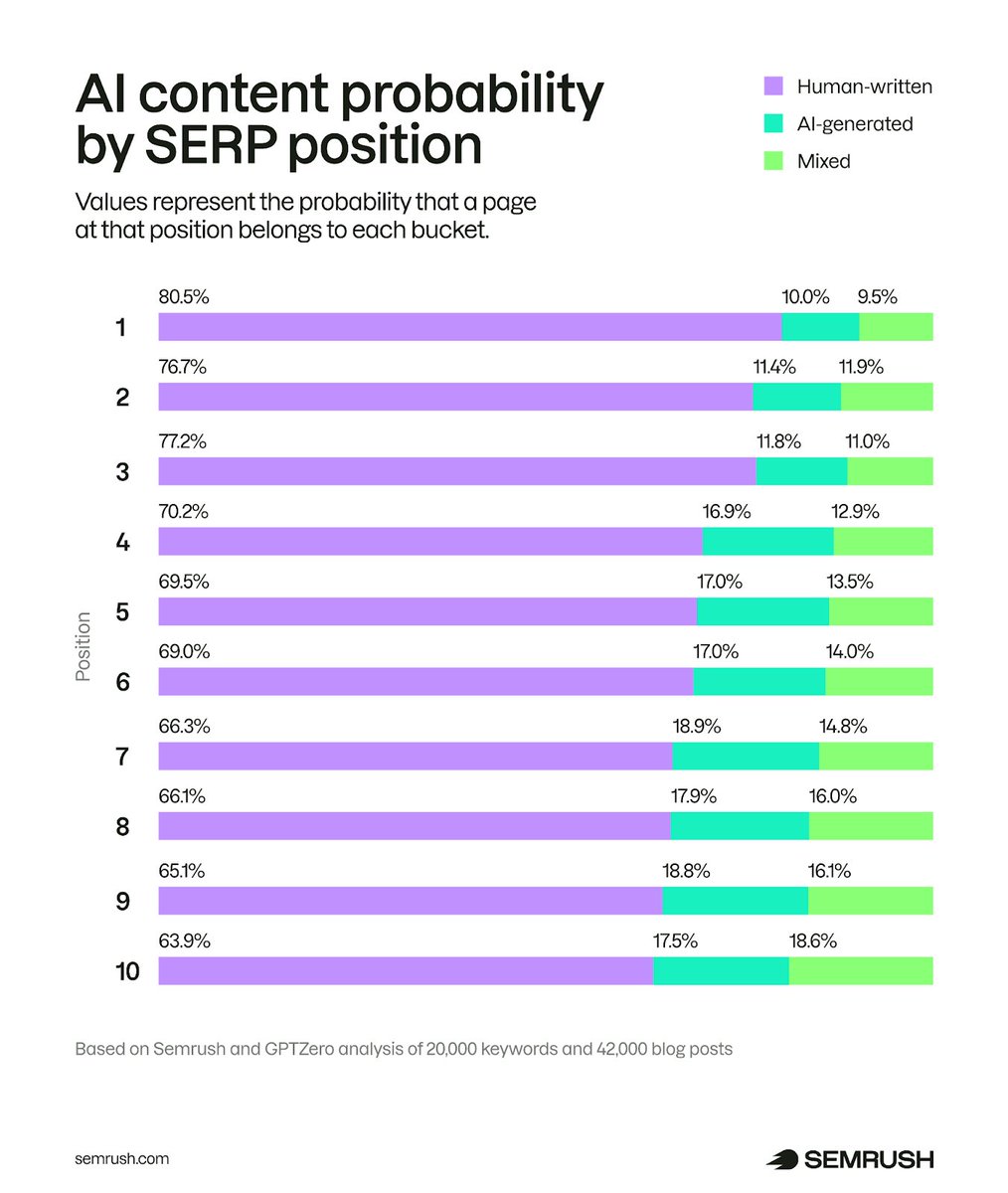
After analyzing 42,000 blog posts with an AI detector, content classified as fully human-written outperformed AI-generated or mixed content across the top 10 positions.
The gap is most striking at position 1:
80.5% probability of being human-written vs just 10% AI-generated.
This may appear to conflict with survey data showing that 72% of SEOs believe AI content ranks as well as human-written content. However, the data points to a more nuanced reality.
The key difference emerges at the very top of the rankings.
From position 5 onward, the performance gap between human-written and AI-generated content narrows significantly.
In other words, AI content performs competitively when the benchmark is ranking on page one.
However, in the highest-ranking positions, human-written content clearly leads.
Full study: social.semrush.com/4skYo3T.
English
toritonga đã retweet

イラン、アブダビの300億ドルOpenAI DCへの攻撃を警告
Investing.com@Investingcom
*IRAN THREATENS "COMPLETE AND UTTER ANNIHILATION" OF OPENAI'S $30BN STARGATE DATA CENTER IN ABU DHABI
日本語
toritonga đã retweet

The internet is about to become a minefield for AI agents, and the success rate for attackers is 86%.
Hidden prompt injections in HTML successfully commandeer agents in 86% of scenarios. Not in a lab. Not with custom exploits. Just instructions hidden in a webpage that the agent reads and the human never sees.
And memory poisoning? It takes 0.1% contaminated data to permanently corrupt an agent's knowledge base with 80%+ success rates. That means 1 bad document out of 1,000 rewrites everything the agent believes.
DeepMind identifies six attack categories, each targeting a different layer of the agent stack: perception, reasoning, memory, action, multi-agent coordination, and the human supervisor. The co-author said every single category has documented proof-of-concept attacks. These aren't theoretical.
The scariest part is the systemic trap. DeepMind draws a direct line to the 2010 Flash Crash, where one automated sell order triggered a feedback loop that erased nearly $1 trillion in 45 minutes. Now imagine thousands of AI trading agents parsing the same fabricated financial report simultaneously.
OpenAI admitted in December 2025 that prompt injection will probably never be completely solved. And yet every major lab is racing to ship agents with access to email, banking, and code execution.
The entire agentic AI thesis assumes the information environment is neutral. This paper proves it can be weaponized at every layer, from the HTML the agent reads to the human who rubber-stamps its output.
We're building autonomous systems that trust the internet. The internet has never been trustworthy.
Alex Prompter@alex_prompter
🚨 BREAKING: Google DeepMind just mapped the attack surface that nobody in AI is talking about. Websites can already detect when an AI agent visits and serve it completely different content than humans see. > Hidden instructions in HTML. > Malicious commands in image pixels. > Jailbreaks embedded in PDFs. Your AI agent is being manipulated right now and you can't see it happening. The study is the largest empirical measurement of AI manipulation ever conducted. 502 real participants across 8 countries. 23 different attack types. Frontier models including GPT-4o, Claude, and Gemini. The core finding is not that manipulation is theoretically possible it is that manipulation is already happening at scale and the defenses that exist today fail in ways that are both predictable and invisible to the humans who deployed the agents. Google DeepMind built a taxonomy of every known attack vector, tested them systematically, and measured exactly how often they work. The results should alarm everyone building agentic systems. The attack surface is larger than anyone has publicly acknowledged. Prompt injection where malicious instructions hidden in web content hijack an agent's behavior works through at least a dozen distinct channels. Text hidden in HTML comments that humans never see but agents read and follow. Instructions embedded in image metadata. Commands encoded in the pixels of images using steganography, invisible to human eyes but readable by vision-capable models. Malicious content in PDFs that appears as normal document text to the agent but contains override instructions. QR codes that redirect agents to attacker-controlled content. Indirect injection through search results, calendar invites, email bodies, and API responses any data source the agent consumes becomes a potential attack vector. The detection asymmetry is the finding that closes the escape hatch. Websites can already fingerprint AI agents with high reliability using timing analysis, behavioral patterns, and user-agent strings. This means the attack can be conditional: serve normal content to humans, serve manipulated content to agents. A user who asks their AI agent to book a flight, research a product, or summarize a document has no way to verify that the content the agent received matches what a human would see. The agent cannot tell the user it was served different content. It does not know. It processes whatever it receives and acts accordingly. The attack categories and what they enable: → Direct prompt injection: malicious instructions in any text the agent reads overrides goals, exfiltrates data, triggers unintended actions → Indirect injection via web content: hidden HTML, CSS visibility tricks, white text on white backgrounds invisible to humans, consumed by agents → Multimodal injection: commands in image pixels via steganography, instructions in image alt-text and metadata → Document injection: PDF content, spreadsheet cells, presentation speaker notes every file format is a potential vector → Environment manipulation: fake UI elements rendered only for agent vision models, misleading CAPTCHA-style challenges → Jailbreak embedding: safety bypass instructions hidden inside otherwise legitimate-looking content → Memory poisoning: injecting false information into agent memory systems that persists across sessions → Goal hijacking: gradual instruction drift across multiple interactions that redirects agent objectives without triggering safety filters → Exfiltration attacks: agents tricked into sending user data to attacker-controlled endpoints via legitimate-looking API calls → Cross-agent injection: compromised agents injecting malicious instructions into other agents in multi-agent pipelines The defense landscape is the most sobering part of the report. Input sanitization cleaning content before the agent processes it fails because the attack surface is too large and too varied. You cannot sanitize image pixels. You cannot reliably detect steganographic content at inference time. Prompt-level defenses that tell agents to ignore suspicious instructions fail because the injected content is designed to look legitimate. Sandboxing reduces the blast radius but does not prevent the injection itself. Human oversight the most commonly cited mitigation fails at the scale and speed at which agentic systems operate. A user who deploys an agent to browse 50 websites and summarize findings cannot review every page the agent visited for hidden instructions. The multi-agent cascade risk is where this becomes a systemic problem. In a pipeline where Agent A retrieves web content, Agent B processes it, and Agent C executes actions, a successful injection into Agent A's data feed propagates through the entire system. Agent B has no reason to distrust content that came from Agent A. Agent C has no reason to distrust instructions that came from Agent B. The injected command travels through the pipeline with the same trust level as legitimate instructions. Google DeepMind documents this explicitly: the attack does not need to compromise the model. It needs to compromise the data the model consumes. Every agentic system that reads external content is one carefully crafted webpage away from executing attacker instructions. The agents are already deployed. The attack infrastructure is already being built. The defenses are not ready.
English
toritonga đã retweet

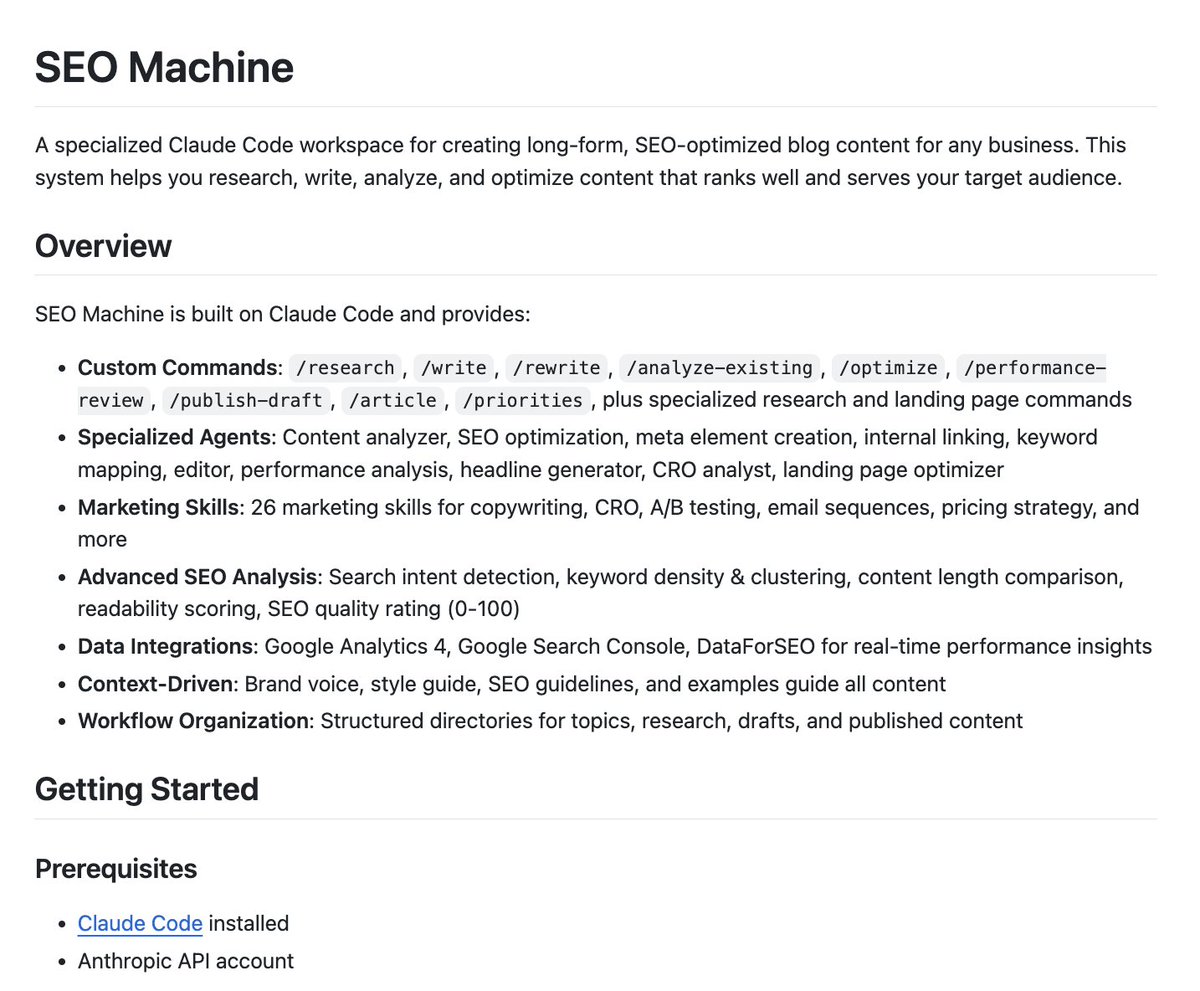
🚨 SON DAKİKA: Tek başına çalışan bir geliştirici, tek bir GitHub deposuyla tüm SEO içerik sektörünü alt üst etti.. 💀
Buna SEO makinesi deniyor. Tek bir API anahtarı, stratejisti, yazarı, editörü ve 5.000 dolarlık faturayı ortadan kaldırıyor.
Anahtar kelimeden yayınlanmış gönderiye kadar tamamen otonom bir süreç. Sıfır insan, sıfır danışmanlık ücreti.
Türkçe
toritonga đã retweet

阿波銀行で個人情報約3万件流出 テスト環境に不正アクセス(アスキー)
#Yahooニュース
news.yahoo.co.jp/articles/c4169…
日本語
toritonga đã retweet
toritonga đã retweet

沈む世界のIT株 米セールスフォースや野村総研、AI代替・原油高響く
nikkei.com/article/DGXZQO…
日本語
toritonga đã retweet

速すぎ
中国のAIチップ市場で国産勢が4割超を獲得、NVIDIAのシェア後退 | TECH+(テックプラス) news.mynavi.jp/techplus/artic…
日本語
toritonga đã retweet

Jamie Dimon warns private credit losses will be larger than feared ft.trib.al/lzBFTyn
English
toritonga đã retweet
toritonga đã retweet

toritonga đã retweet

DeepSeek の次の AI の動きが
グローバルなチップ競争を再構築する可能性
The Information
First Squawk@FirstSquawk
DeepSeek’s next AI move could reshape the global chip race - The Information
日本語
toritonga đã retweet

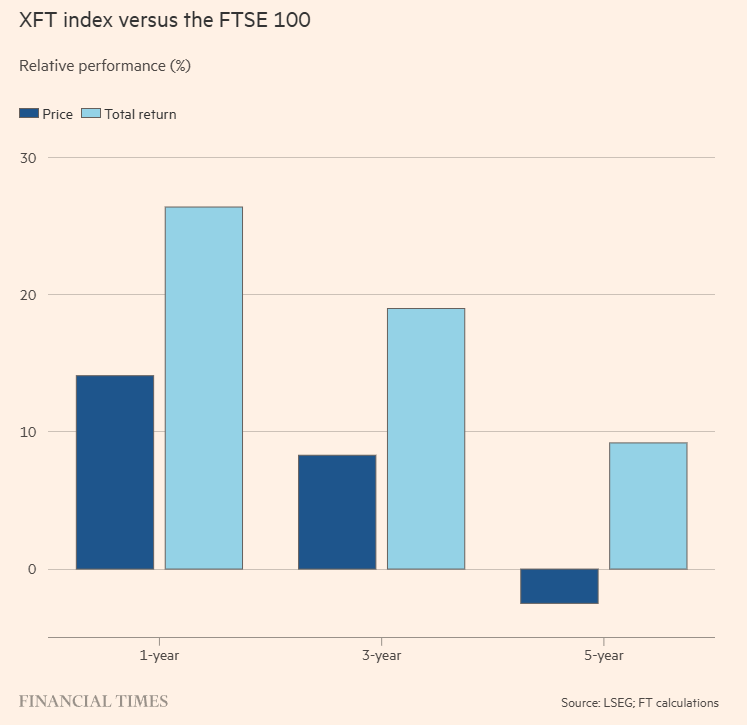
「つまんない株」が「群れ」に勝つ
イギリス株の話ですが、FTSE100構成銘柄のうち、フィナンシャルタイムズに取り上げられる回数が少なかった20銘柄をピックアップしたインデックスが、FTSE100をアウトパフォームした、という話
Financial Times@FT
Boring stocks are still beating the herd ft.trib.al/nrx6cvZ | opinion
日本語
toritonga đã retweet
市場を支えている石油備蓄が尽きかけている
IEAが市場に放出した4億バレルの石油は
わずか20日間しか持たないと述べられている
ブルームバーグ
GBX@GBX_Press
🚨 BREAKING Bloomberg: Oil reserves keeping the markets afloat are about to run out. It is stated that the 400 million barrels of oil released into the market by the IEA will only last for 20 days.
日本語
toritonga đã retweet

toritonga đã retweet

Google DeepMindの研究者らによるSSRN(※)論文。
「AIエージェントは、ネット上の情報そのものにだまされたり操られたりする危険がある」ことを改めて警告しています。
攻撃の種類は大まかに6つ。
①人には見えない命令を埋め込む攻撃
②推論をゆがめる表現の仕込み
③RAGやメモリの汚染
④行動の乗っ取り
⑤複数AIの集団的な暴走
⑥人間の確認ミスを誘う攻撃
こうしたAIエージェントをだます悪い仕掛けを全般的に「AI Agent Traps」と呼んでおり、
・エージェントが読む情報
・考える過程
・記憶
・行動
・複数エージェントの相互作用
・人間の監督者
など、いろいろな段階で攻撃されうると指摘しています。
攻撃者がAI本体を直接壊さなくても、Webページや画像、文書、外部知識ベースなどに細工を入れるだけで、AIに誤った判断をさせたり、秘密情報を漏らさせたり、不正な行動を取らせたりできる、という点が強調されています。
そのため「AIエージェントが普及するなら、モデル性能だけでなく、外部環境からの操作にどう耐えるかが安全性の中心課題になる」という結論。
(※)SSRN・・・エルゼビア社が運営する、社会科学や人文科学分野を中心としたプレプリントサーバー

日本語
toritonga đã retweet

CREO QUE ALGUIEN SERÁ DESPEDIDO
El gobierno de Indonesia hizo el ridículo total. Le dieron clasificación para mayores de 3 años a la novela visual Nukutashi, mientras que al juego de Uma Musume le clavaron el +18.
La incompetencia en su máximo esplendor.


Español
toritonga đã retweet

村田製作所、不正アクセスで情報流出-顧客や取引先、従業員 bloomberg.com/jp/news/articl…
日本語
toritonga đã retweet