Alexander van Teijlingen

20 posts

Alexander van Teijlingen

Alexander van Teijlingen

@AlexandervanTe1

Postdoc at the University of Strathclyde

加入时间 Mart 2020
56 关注32 粉丝
Alexander van Teijlingen 已转推

Alon Aviram
Alon Aviram@AlAviram·
Commander steps into remind officer that it’s not advisable to manhandle journalists after this incident #bristol
English
109
843
2K
0
Alexander van Teijlingen 已转推
Elizabeth Sankey
Elizabeth Sankey@sankles·
I feel sick
Elizabeth Sankey tweet media
English
492
3.8K
24K
0
Alexander van Teijlingen 已转推
Karla Adam
Karla Adam@karlaadam·
Scuffles break out at Clapham Common memorial for Sarah Everard as people chant “arrest your own.”
English
542
2.3K
7.9K
0
Alexander van Teijlingen 已转推
Thing Bad
Thing Bad@Merman_Melville·
kind of a bummer to have been born at the very end of the Fuck Around century just to live the rest of my life in the Find Out century
English
264
42.3K
250.8K
0
Alexander van Teijlingen
Alexander van Teijlingen@AlexandervanTe1·
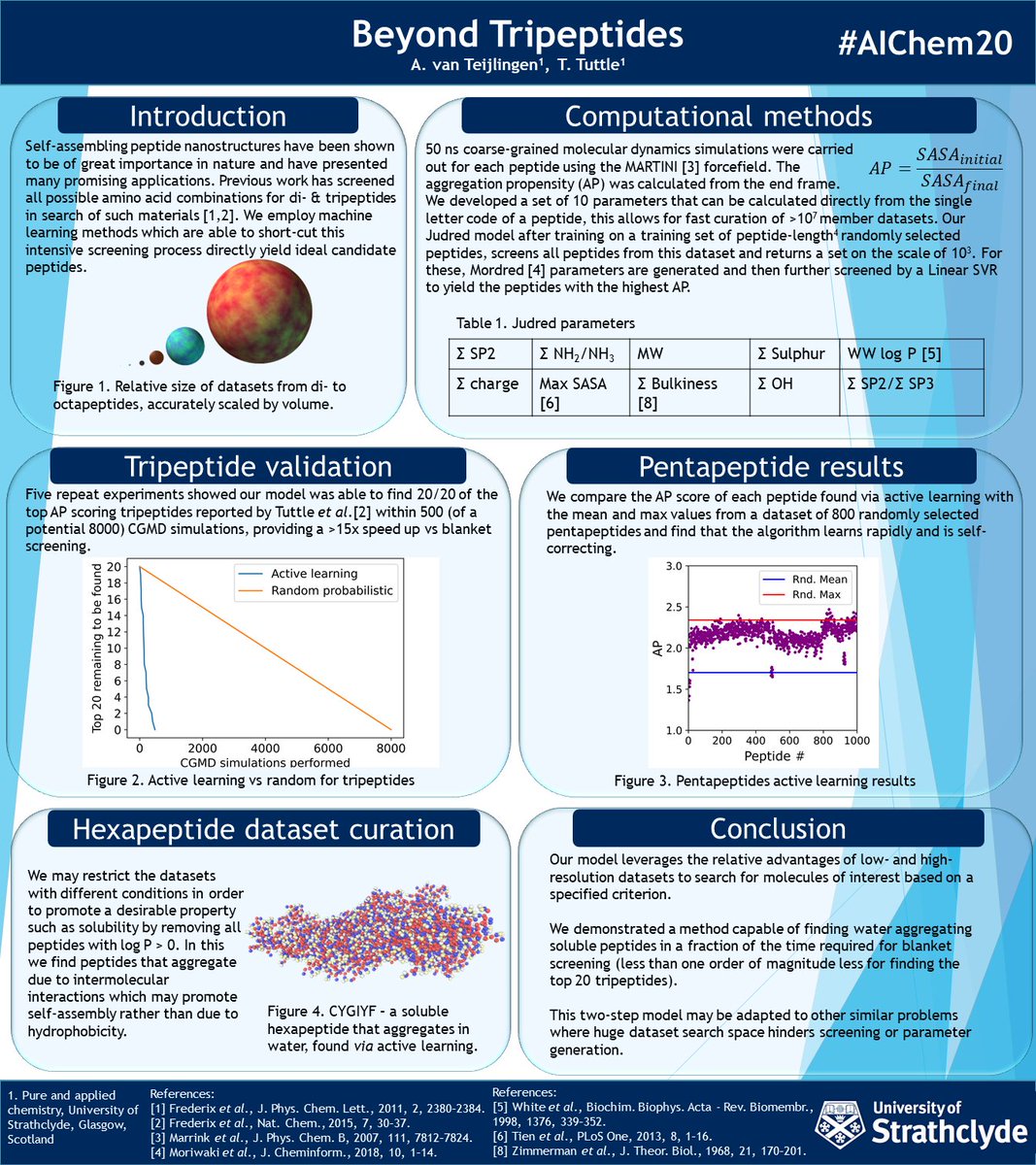
@sudarshanb259 Yes. We restrict the dataset (ie. remove all peptides with log P > 0) then run the algorithm in order to find the interesting cases of peptides that do aggregate but at least less due to the hydrophobic effect.
English
0
0
0
0
Sudarshan
Sudarshan@sudarshanb259·
@AlexandervanTe1 So, your ML model is able to predict peptides of high AP, and surprisingly, for some of these peptides have log P < 0. And enthalpy (intermolecular interaction) plays a major role in the aggregation rather than entropy (hydrophobicity). Have I understood it properly?
English
1
0
0
0
Alexander van Teijlingen
Alexander van Teijlingen@AlexandervanTe1·
3. This is the interesting part, that it does aggregate despite being soluble (at least as far as log P < 0 = soluble) means the molecules are interacting in an attractive fashion in the way we would expect for a self-assembling nanomaterial.
Sudarshan@sudarshanb259

@AlexandervanTe1 @scotch_research 3. A basic question. When you write "a soluble hexapeptide that aggregates in water" in Figure 2, is it soluble in water? If so, how can it still form aggregates?

English
1
0
0
0
Alexander van Teijlingen
Alexander van Teijlingen@AlexandervanTe1·
Ahh sorry i misunderstood. During the CGMD simulation there are 300 peptides in the simulation box. The datasets are 8000 (20^3) for tripeptides, up to 64,000,000 (20^6) for hexapeptides.
Sudarshan@sudarshanb259

@AlexandervanTe1 Thanks. With a dataset of 300, you are able to capture the feature-target relationship to a good extend. Great!

English
0
0
0
0
Alexander van Teijlingen
Alexander van Teijlingen@AlexandervanTe1·
2. sum(SP2) is the total number of SP2 carbon atoms, max ASA and Bulkiness are described in the references listed, twitter character limit ties my hands a bit here. Briefly, maxASA is the highest ASA for an amino acid in the tripeptide Gly-X-Gly in all biophysical conformations.
Sudarshan@sudarshanb259

@AlexandervanTe1 @scotch_research 2. In the Judred parameters, what does sum(SP2) means? Is it the total number of SP2 hybridized atoms? What is Max SASA and how do you define bulkiness?

English
1
0
0
0