
置顶推文
Luciano
5.8K posts

Luciano 已转推

The process of innovation can lead to some experimental artistry.
Emotion and a stimulating environment drive the construction of Mick Gordon renowned sound on this project.
#DEFECT #IndieGame #GameDev
English
Luciano 已转推
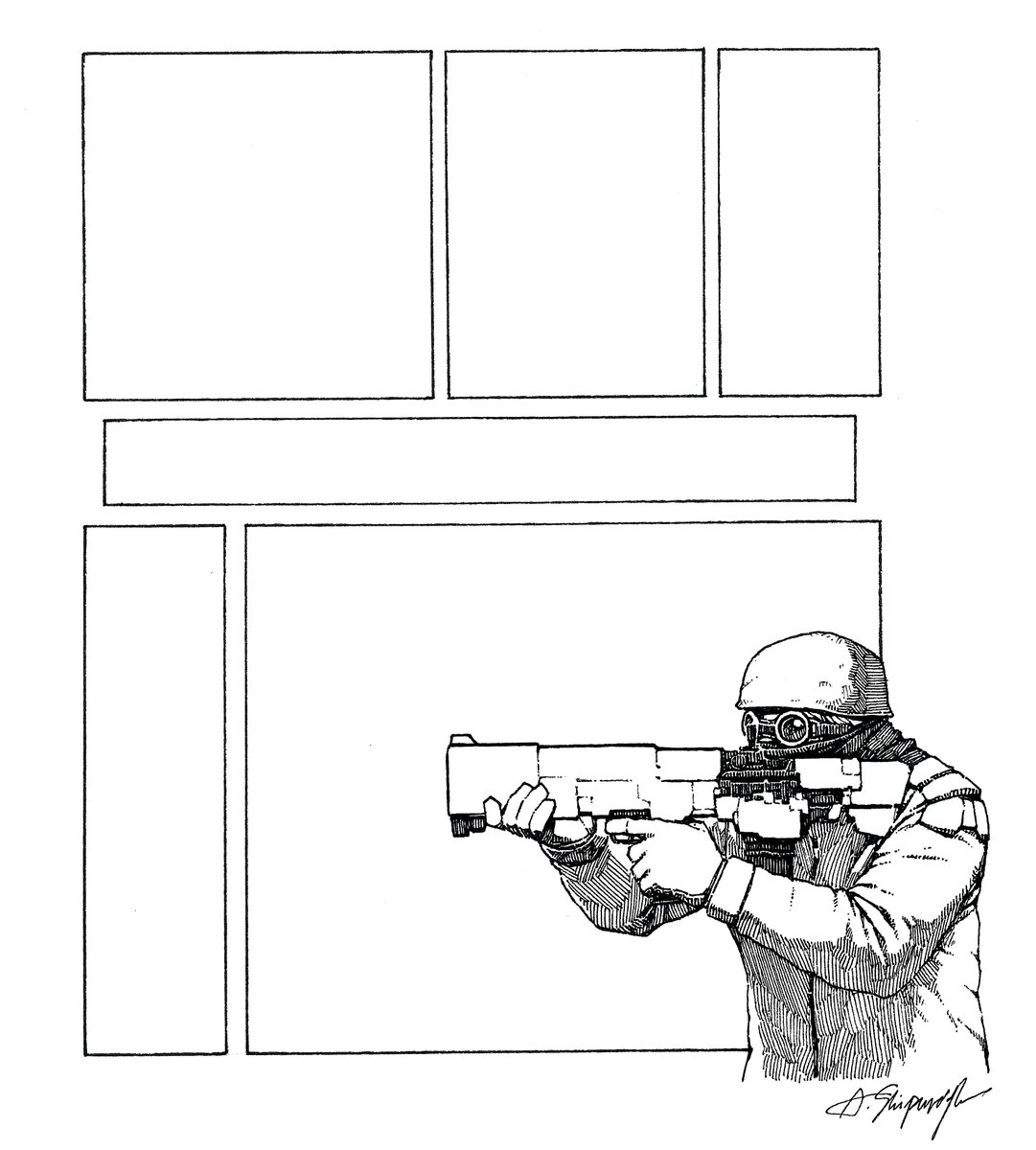
What the Narrative Bureau fears most are other meta-organizations.
The worst among them is the Brotherhood of the Four Corners.
They infiltrate comics before a story even forms, preparing to assassinate story agents long before they can be deployed.
English
Luciano 已转推

This video was a complete joy to make. Here's a short preview, but next time you're looking to sit down for 45 minutes of math and art, take a look at the full version on YouTube.
English
Luciano 已转推

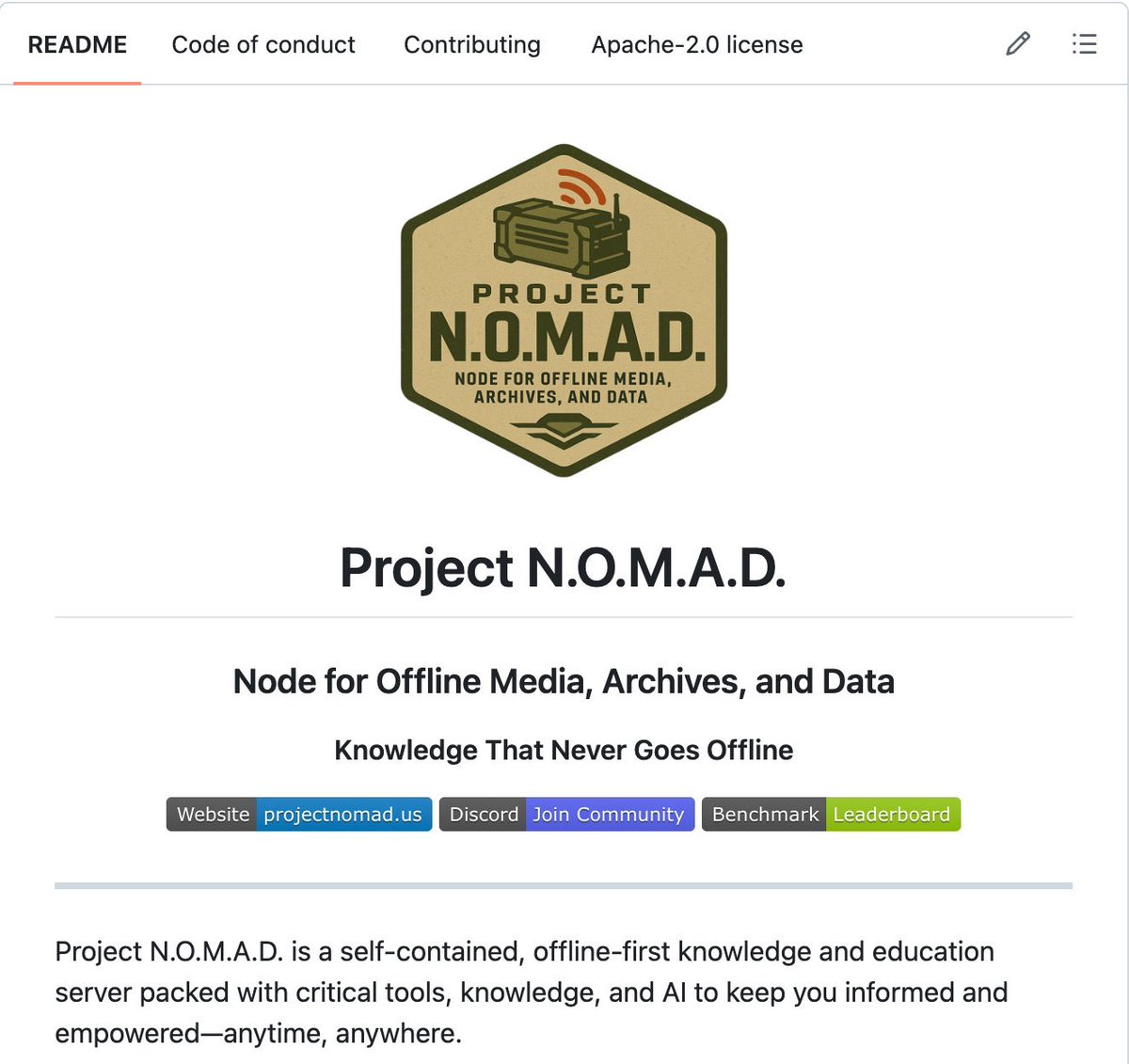
🚨 BREAKING: Someone just open-sourced a full offline survival computer with AI, Wikipedia, and maps built in.
Project N.O.M.A.D. is an open-source offline survival computer.
Self-contained.
Zero internet required after install.
Zero telemetry. Everything runs locally on your hardware.
What it includes:
→ Full Wikipedia archives via Kiwix
→ Offline maps via OpenStreetMap
→ Local AI models via Ollama + Open WebUI
→ Calculators, reference tools, resource libraries
→ A management UI to control
everything from a browser
One curl command installs the entire system on any Debian-based machine.
Runs headless as a server so any device on your local network can access it.
Minimum specs to run the base system: dual-core processor, 4GB RAM, 5GB storage.
To run local LLMs offline, you want 32GB RAM and an NVIDIA RTX 3060 or better.
No accounts.
No authentication by default.
No cloud dependency.
No phone-home behavior.
Built to function when nothing else does.
The grid, the cloud, the API you depend on. None of it is guaranteed.
The people building local-first systems right now are the ones who won’t be asking for help when access disappears.
English
Luciano 已转推

Testing off-axis projection demo.
Basic scene layout in Blender
glb -> detailed splat via World Labs
Three.js for engine
MediaPipe for face tracking
Next step is to add a character you can move around in the environment
English

Luciano 已转推

The most iconic line from this book is: We have to remember that what we observe is not nature in itself but nature exposed to our method of questioning.
Philosophy Of Physics@PhilosophyOfPhy
Physics and Philosophy: The Revolution in Modern Science. by Werner Heisenberg
English
Luciano 已转推

Music helps to understand the mind and the brain. Throughout the history of science, metaphors have shaped how we understand complex phenomena. The brain-as-computer metaphor has guided decades of theories and research. We propose music as a scientific metaphor for understanding the mind and brain via triplicate interfaces (listener, performer, composer) and a compound set of predictions. Multiple domains of music can be mapped onto different neural, cognitive and intersubjective processes such as network coordination, prediction, emotion and meaning. Neurocognition is not static but a dynamic, embodied, and time-sensitive system, much like a self-organized orchestra in which multiple processes interact simultaneously. Drawing on synergetics, predictive processing, and embodied cognition, we outline musical principles illuminating cognitive and action integration across time, offering new conceptual frameworks and testable predictions for future research. I enjoyed writing this piece with these stellar authors: @Kaiameye, @acolverson1, Christopher Bailey, @brucemillerucsf, @dafneduron90, Nicholas Johnson, Olga Castaner, @PierLuigiSacco, Eoin Cotter and Lucia Melloni. Science, like music, advances through new ways of listening to complex systems: doi.org/10.1016/j.neub…

English
Luciano 已转推


Luciano 已转推

A new mechanism for “RNA memory”! 😱
Thrilled to share another crazy paper from the lab (can’t believe we posted 2 in 2 days!), summarizing >10 years of research:
Work on transgenerational inheritance of small RNAs in the powerful model organism C. elegans changed how we think about what’s possible in inheritance and evolution, because it allows the most heretical thing: inheritance of parental responses to the environment! However, it’s still unclear whether RNAs are inherited across generations in other animals, largely because the RNA-dependent RNA polymerases that amplify heritable small RNAs and prevent their dilution in C. elegans are not conserved in mammals.
In this new work, an amazing collaboration with the Rink and Wurtzel labs, we show that planarians establish long-lasting and heritable small RNA–based gene regulatory states despite lacking canonical RNA-dependent RNA polymerases and nuclear RNAi machinery (that are required in C. elegans).
You might say “they are both worms…” BUT planarians are evolutionarily very distant from C. elegans (flatworms vs. roundworms, diverged more than 500 million years ago), making this particularly surprising. These are totally different animals.
We find that ingestion of double-stranded RNA induces sequence-specific silencing that persists for months and survives repeated cycles of whole-body regeneration. Even more strikingly, RNAi can be transferred between animals, echoing James V. McConnell’s controversial “RNA memory” experiments from the 1970s (his lab was targeted by the Unabomber terrorist Ted Kaczynski, who sent McConnell a bomb. This and other controversies ended this line of experiments…)
Mechanistically, we find that the response transitions from a transient systemic dsRNA-triggered phase to a stable, cell-autonomous post-transcriptional “memory phase” maintained by antisense small RNAs. Using a new luminescence reporter (transgenesis is currently impossible in planarians), we show that silencing spreads along the targeted gene and identify a weird type of planarian small RNAs with untemplated polyA tails.
RNAi inheritance without canonical RdRPs establishes planarians as a powerful system for studying RNA-based regulatory inheritance beyond C. elegans and raises the possibility that RNA-mediated inheritance may be more broadly conserved in animals, potentially even in mammals.
Here’s a video of a planarian that is treated by RNAi against β-catenin and develops multiple heads instead of just one. This is one of the phenotypes that is inherited. Another phenotype is “loss of eyes” (which we show is not only inherited across multiple regeneration cycles, but can also be transmitted between animals in transplantation experiments).
Amazing work led by first authors Prakash Cherian and Idit Aviram (co-supervised by Omri and me).
Please read the preprint, the link is in the next tweet, and share!
English
Luciano 已转推

Luciano 已转推

Kazuhito Yamashita forgetting he's human for one minute straight.
English
Luciano 已转推

A few small updates today - we've added Moodboards and Personalization to Niji V7. We've released a much better web interface for Personalization. And we are sunsetting web rooms as we work on next-gen collab tools (which should make the whole site feel noticeably faster). Enjoy!
English
Luciano 已转推

psychology solved the ai memory problem decades ago. we just haven't been reading the right papers.
your identity isn't something you have. it's something you construct. constantly. from autobiographical memory, emotional experience, and narrative coherence.
Martin Conway's Self-Memory System (2000, 2005) showed that memories aren't stored like video recordings.
they're reconstructed every time you access them, assembled from fragments across different neural systems. and the relationship is bidirectional: your memories constrain who you can plausibly be, but your current self-concept also reshapes how you remember. memory is continuously edited to align with your current goals and self-images. this isn't a bug. it's the architecture.
not all memories contribute equally. Rathbone et al. (2008) showed autobiographical memories cluster disproportionately around ages 10-30, the "reminiscence bump," because that's when your core self-images form.
you don't remember your life randomly. you remember the transitions. the moments you became someone new. Madan (2024) takes it further: combined with Episodic Future Thinking, this means identity isn't just backward-looking. it's predictive. you use who you were to project who you might become. memory doesn't just record the past. it generates the future self.
if memory constructs identity, destroying memory should destroy identity. it does. Clive Wearing, a British musicologist who suffered brain damage in 1985, lost the ability to form new memories. his memory resets every 30 seconds. he writes in his diary: "Now I am truly awake for the first time." crosses it out. writes it again minutes later.
but two things survived: his ability to play piano (procedural memory, stored in cerebellum, not the damaged hippocampus) and his emotional bond with his wife. every time she enters the room, he greets her with overwhelming joy. as if reunited after years. every single time. episodic memory is fragile and localized.
emotional memory is distributed widely and survives damage that obliterates everything else.
Antonio Damasio's Somatic Marker Hypothesis destroyed the Western tradition of separating reason from emotion.
emotions aren't obstacles to rational decisions. they're prerequisites.
when you face a decision, your brain reactivates physiological states from past outcomes of similar decisions. gut reactions. subtle shifts in heart rate. these "somatic markers" bias cognition before conscious deliberation begins.
the Iowa Gambling Task proved it: normal participants develop a "hunch" about dangerous card decks 10-15 trials before conscious awareness catches up. their skin conductance spikes before reaching for a bad deck. the body knows before the mind knows. patients with ventromedial prefrontal cortex damage understand the math perfectly when told. but keep choosing the bad decks anyway. their somatic markers are gone. without the emotional signal, raw reasoning isn't enough.
Overskeid (2020) argues Damasio undersold his own theory: emotions may be the substrate upon which all voluntary action is built.
put the threads together. Conway: memory is organized around self-relevant goals. Damasio: emotion makes memories actionable. Rathbone: memories cluster around identity transitions. Bruner: narrative is the glue.
identity = memories organized by emotional significance, structured around self-images, continuously reconstructed to maintain narrative coherence. now look at ai agent memory and tell me what's missing.
current architectures all fail for the same reason: they treat memory as storage, not identity construction. vector databases (RAG) are flat embedding space with no hierarchy, no emotional weighting, no goal-filtering. past 10k documents, semantic search becomes a coin flip. conversation summaries compress your autobiography into a one-paragraph bio. key-value stores reduce identity to a lookup table. episodic buffers give you a 30-second memory span, which as the Wearing case shows, is enough to operate moment-to-moment but not enough to construct identity.
five principles from psychology that ai memory lacks.
first, hierarchical temporal organization (Conway): human memory narrows by life period, then event type, then specific details. ai memory is flat, every fragment at the same level, brute-force search across everything. fix: interaction epochs, recurring themes, specific exchanges, retrieval descends the hierarchy.
second, goal-relevant filtering (Conway's "working self"): your brain retrieves memories relevant to current goals, not whatever's closest in embedding space. fix: a dynamic representation of current goals and task context that gates retrieval.
third, emotional weighting (Damasio): emotionally significant experiences encode deeper and retrieve faster. ai agents store frustrated conversations with the same weight as routine queries. fix: sentiment-scored metadata on memory nodes that biases future behavior.
fourth, narrative coherence (Bruner): humans organize memories into a story maintaining consistent self across time. ai agents have zero narrative, each interaction exists independently. fix: a narrative layer synthesizing memories into a relational story that influences responses.
fifth, co-emergent self-model (Klein & Nichols): human identity and memory bootstrap each other through a feedback loop. ai agents have no self-model that evolves. fix: not just "what I know about this user" but "who I am in this relationship."
the fundamental problem isn't technical. it's conceptual. we've been modeling agent memory on databases. store, retrieve, done. but human memory is an identity construction system. it builds who you are, weights what matters, forgets what doesn't serve the current self, rewrites the narrative to maintain coherence. the paradigm shift: stop building agent memory as a retrieval system. start building it as an identity system.
every component has engineering analogs that already exist.
hierarchical memory = graph databases with temporal clustering.
emotional weighting = sentiment-scored metadata.
goal-relevant filtering = attention mechanisms conditioned on task state.
narrative coherence = periodic summarization with consistency constraints.
self-model bootstrapping = meta-learning loops on interaction history.
the pieces are there. what's missing is the conceptual framework to assemble them. psychology provides that framework.
the path forward isn't better embeddings or bigger context windows. it's looking inward. Conway showed memory is organized by the self, for the self. Damasio showed emotion is the guidance system. Rathbone showed memories cluster around identity transitions. Bruner showed narrative holds it together.
Klein and Nichols showed self and memory bootstrap each other into existence. if we're serious about building agents with functional memory, we should stop reading database architecture papers and start reading psychology journals.

English
Luciano 已转推


when they say Soulless, I see Egoless. Gen art can function w/out the intimacy of a singular set of aesthetic biases (the author-artist) who u must hand-hold with to engage their art. That's fine! Gen art is a distillation of systems rather than the work of honing a solitary ego.
English
@helmortart love scifi and fantasy pulp, I did the same thing as a kid, go into bookstores to find the cool art books, Boris Vallejo, Frazetta. Good times when the world feels so expansive
English

@CurArchTrack It reminds me of some vintage sci-fi pulp magazine covers. I used to spend hours staring at them, hypnotized, when I was a kid.
English
