Jamie Dulaney 已转推

"Ramble On" is 56 years old and Robert Plant just walked onto The Late Show and made it sound like he wrote it this morning
English
Jamie Dulaney
748 posts


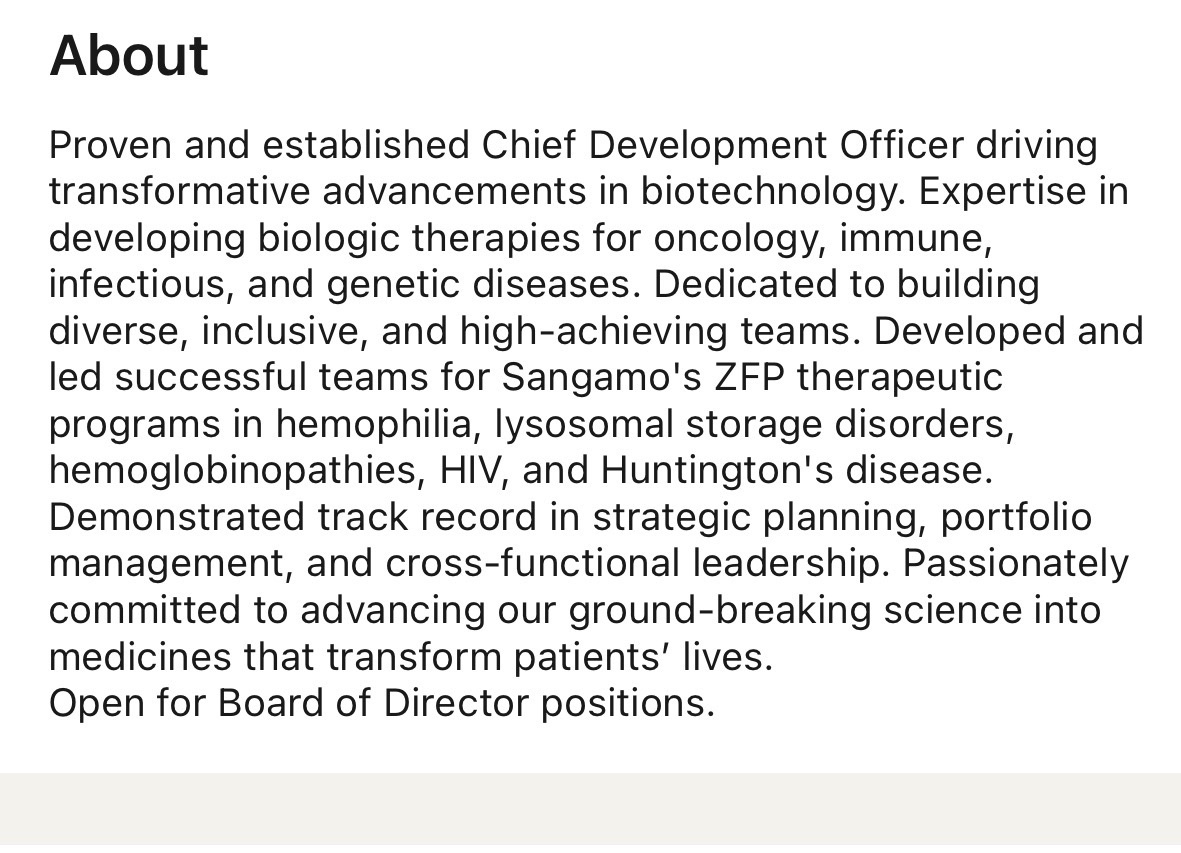

$sgmo Nobody talking about Nathalie??!!??

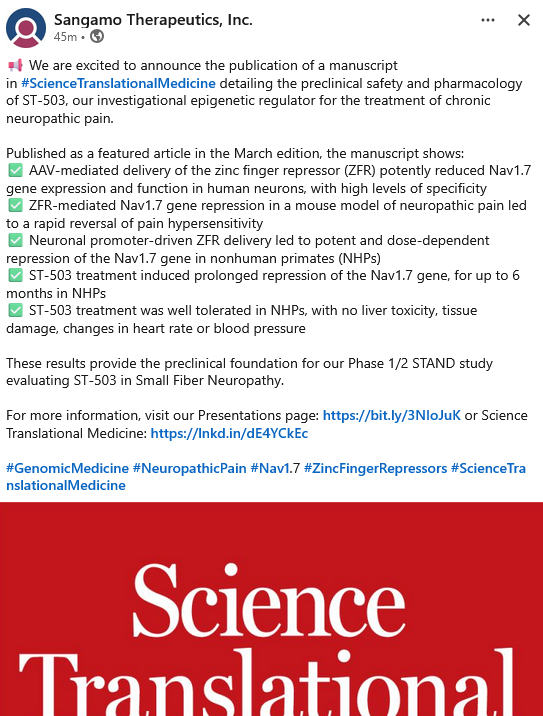
It is certainly conceivable that $VRTX (MC 110b$) might be interested in $SGMO ’s ST-503, even though there are currently no concrete indications or rumors to that effect. ST-503 is still in an early clinical phase and is being developed by Sangamo alone, without a partner. Nevertheless, a collaboration would not be illogical from a strategic perspective, as Vertex is specifically expanding its portfolio in the field of pain management and already has experience in licensing promising technologies or programs from other companies. Vertex has developed VX-548 (suzetrigine), a Nav1.8 inhibitor that is already approved for the treatment of acute pain and offers a new, non-opioid approach. Other candidates are being pursued, but there have also been setbacks in the pipeline (VX-993), so the focus is currently primarily on suzetrigine. An effective Nav1.7 inhibitor like ST-503 would be a good fit for the Vertex portfolio. We’ll see! investors.vrtx.com/news-releases/…

Is Sangamo Therapeutics ( $SGMO) the Ultimate Penny Stock Comeback? youtube.com/watch?v=grJKjC… The video, released a week ago, assesses the current status of Sangamo Therapeutics and its gene therapy ST-920 for the treatment of Fabry disease. It highlights that the company is nearing an important milestone, as accelerated approval by the FDA appears more realistic. One reason for this is that kidney function (eGFR) is accepted as a relevant endpoint, which simplifies the approval process. According to the video, the study data to date show that the therapy is effective: kidney function remains stable or improves, and nearly all patients were able to reduce or completely discontinue their previous ERT treatment. This suggests a potentially long-term or even one-time therapy. At the same time, risks are highlighted: the data set is still small, long-term results are lacking, and Sangamo is under financial pressure, which could lead to capital measures. Overall, the video sees great potential, but also significant uncertainties.
@Franca_ole $SGMO #Fabry is commercially far less complex than many assume: Patients can travel for a single lifetime infusion, & drug is manufactured by #CMO : • 1 infusion per workday ~ $250M+ yearly revenue • 2 infusions per workday ~ ~$500M • Even a ~100 m² practice could handle that
There are currently three particularly relevant gene therapy programs for #Fabry disease that aim to permanently replace the missing enzyme α-galactosidase A. They differ primarily in vector design, target tissue, and clinical progress. The most advanced therapy is ST-920 (#isaralgagene civaparvovec) from $SGMO. This is an AAV-based gene therapy that targets the liver. Following a single intravenous infusion, liver cells produce α-galactosidase A on a permanent basis, allowing many patients to discontinue their previous enzyme replacement therapy. In the STAAR study, ST-920 demonstrated stable or improved renal function and no serious safety issues to date, which is why this therapy is currently considered promising. A 2nd gene therapy is FLT190 from Freeline Therapeutics, also AAV-based and liver-targeted. It generates very high enzyme levels but has shown immune reactions in early studies that delayed clinical development. The third relevant therapy is 4D-310 from $FDMT 4D Molecular Therapeutics, which specifically targets heart muscle cells to treat Fabry cardiomyopathy. However, studies have shown that severe side effects such as myocarditis have occurred in some cases, leading to a temporary halt in development. In comparison, ST-920 is currently considered the most advanced because it provides stable enzyme activity over years, patients can often discontinue enzyme replacement therapy, no serious safety issues have arisen to date, and initial data show an improvement in renal parameters. An open question in research remains whether gene therapies can completely reverse cardiac involvement in Fabry disease or merely halt its progression, particularly with regard to fibrosis, left ventricular mass, and cardiac MRI findings.