Oliver Raynor

389 posts

Oliver Raynor banner
Oliver Raynor

Oliver Raynor

@OliverRaynor_

UK Power & Gas markets | Wholesale trends | Geopolitics | Pricing risk | Commercially focused | Data-driven

United Kingdom 加入时间 Şubat 2026
613 关注251 粉丝
Oliver Raynor
Oliver Raynor@OliverRaynor_·
This is less about barrels lost, more about risk getting priced If Iran is willing to escalate and hold the Hormuz line, oil gets a firmer floor even without disruption What traders watch next: • Gulf freight and insurance • Asian buyers pulling Atlantic crude as cover That’s how it spills into gas If Asia starts securing LNG on risk, TTF follows. UK power won’t ignore it
English
0
0
2
794
Javier Blas
Javier Blas@JavierBlas·
“… The strategic failure so far leaves Trump facing a difficult choice: escalate dramatically, potentially including boots on the ground, or move to stop the campaign now…”
Danny (Dennis) Citrinowicz ,داني سيترينوفيتش@citrinowicz

A brief summary of last night’s events: A. Iran emerged with the upper hand. It demonstrated once again that it will not hesitate to raise the level of escalation to defend its strategic assets — without any retreat on the issue of the Strait of Hormuz. This was entirely predictable. B. Yet another indication that this war lacks a coherent, pre-planned strategy. Once the regime did not collapse early on, it is no longer clear what the overarching strategy actually is. C. Trump was aware of the strike, but chose to look the other way once tensions escalated. This reflects an ongoing gap between Washington which may still be interested in preserving a future-facing Iran and Israel, whose approach appears aimed at systematically degrading the country’s entire infrastructure. D. The strike itself seems to have been driven by frustration: Iran is not yielding, and there is a desire to force outcomes (such as opening the Strait of Hormuz) without committing ground forces — and before external pressure brings the campaign to a halt. E. The strategic failure so far leaves Trump facing a difficult choice: escalate dramatically, potentially including boots on the ground, or move to stop the campaign now. F. At this stage, the fundamental questions remain unanswered: What is the ultimate objective? What are the exit ramps? What does success even look like? G. Instead, the conflict is drifting into a war of attrition — with no clear signs of regime collapse in Iran. Meanwhile, the president, having committed to the idea that Iran has effectively capitulated, may find it difficult to disengage while facing a visible disadvantage in the maritime arena and no resolution to the nuclear issue. Bottom line, last night’s events underscored just how unstructured this campaign has become — lacking strategic clarity, long-term planning, and a defined end state. At the same time, they exposed growing gaps between Israel and the United States, gaps that may widen further if similar outcomes repeat. And as always..just because something is operationally feasible does not mean it is strategically wise. One more point that must be stated clearly — Iran is not close to capitulating. #IranWar

English
22
50
289
59.9K
Oliver Raynor
Oliver Raynor@OliverRaynor_·
𝗧𝗵𝗲 𝗚𝘂𝗹𝗳 𝗰𝗼𝗻𝗳𝗹𝗶𝗰𝘁 𝗶𝘀 𝗻𝗼𝘄 𝗮 𝗽𝗿𝗼𝗰𝘂𝗿𝗲𝗺𝗲𝗻𝘁 𝗽𝗿𝗼𝗯𝗹𝗲𝗺. Israeli strikes on South Pars have triggered Iranian retaliation across Qatar, Saudi Arabia, UAE and Kuwait. Oil is at $114. Saudi Yanbu - the last crude export route - has stopped loadings. Qatar's Ras Laffan is offline and QatarEnergy is offloading LNG slots at Zeebrugge through April. This isn't coming back quickly. Mid-year at the earliest. With gas still contributing 22% of the UK summer power mix, rising gas prices are already filtering through to power markets. 𝗦𝗼 𝘄𝗵𝗮𝘁 𝗱𝗼𝗲𝘀 𝗻𝗼 𝗤𝗮𝘁𝗮𝗿𝗶 𝗟𝗡𝗚 𝘂𝗻𝘁𝗶𝗹 𝗺𝗶𝗱-𝘆𝗲𝗮𝗿 𝗺𝗲𝗮𝗻 𝗳𝗼𝗿 𝘆𝗼𝘂𝗿 𝗲𝗻𝗲𝗿𝗴𝘆 𝗰𝗼𝗻𝘁𝗿𝗮𝗰𝘁? 𝗥𝗲𝗻𝗲𝘄𝗶𝗻𝗴 𝗶𝗻 𝟰-𝟱 𝗺𝗼𝗻𝘁𝗵𝘀? Waiting is likely to only lead to higher prices. 𝗥𝗲𝗻𝗲𝘄𝗶𝗻𝗴 𝗶𝗻 𝟲-𝟭𝟮 𝗺𝗼𝗻𝘁𝗵𝘀? It's a 50-50. Prices could rise further in the short term but may ease if the conflict de-escalates before your renewal. 𝗥𝗲𝗻𝗲𝘄𝗶𝗻𝗴 𝗔𝗽𝗿𝗶𝗹 𝟮𝟬𝟮𝟳+? Waiting could yield better prices once the war concludes, though risk remains. 𝗧𝗵𝗲 𝘀𝗺𝗮𝗿𝘁 𝗺𝗼𝘃𝗲 𝗶𝗻 𝗮𝗹𝗹 𝘁𝗵𝗿𝗲𝗲 𝘀𝗰𝗲𝗻𝗮𝗿𝗶𝗼𝘀? Flex contracts. Hedge 25% now, reassess in 3 months, and adjust your position as the situation develops. That flexibility is how you secure better prices regardless of what happens next. #UKEnergyMarket #RenewableEnergy #NaturalGas
English
0
0
2
362
Oliver Raynor
Oliver Raynor@OliverRaynor_·
Strong framing. The nuance most people miss is that the UK didn’t just reduce storage, it outsourced optionality to the global LNG market. That works fine in a loose market. It breaks down when Asia pulls cargoes or when European storage refilling tightens the basin. A couple of angles worth adding: • The marginal pricing point is key. As long as gas sets UK power, every LNG cargo effectively feeds straight through into electricity costs. That linkage is what industrials feel, not just gas exposure in isolation. • Storage isn’t just about volume, it’s about timing optionality. The UK has to buy gas when the market offers it, not when it suits. That leaves buyers more exposed to prompt volatility and winter risk premia. • Interconnectors help, but in a stressed system they transmit scarcity, not solve it. When NW Europe is tight, flows follow price signals, not UK security. • The next pressure point traders are watching is LNG balance into winter. If Asian demand surprises or outages hit liquefaction, the UK is effectively bidding in the spot market again. The uncomfortable truth is the UK runs a just in time gas system in a market that is increasingly anything but. For commercial buyers, that means volatility isn’t a bug, it’s structural. The question shifts from “will prices spike?” to “when and how often?”.
English
1
1
4
274
Lukas Ekwueme
Lukas Ekwueme@ekwufinance·
The UK energy crisis just got worse. Step 1) Go all in on renewables Step 2) Use gas to produce electricity when renewables don’t Step 3) Kill the gas industry: ban new gas exploration and tax producers 80%+ The result: UK industrial electricity prices are the highest in the world, triggering the fastest pace of deindustrialization in the developed world, even before the Iran war. Now, with just 2 days of gas storage left, the UK might become the first developed country to reach Net Zero. Zero industry = zero emissions.
Lukas Ekwueme tweet media
English
24
93
243
7.8K
Oliver Raynor
Oliver Raynor@OliverRaynor_·
The market is starting to realise this isn’t just an oil story If Qatari LNG is constrained into mid year, you’re removing the system’s balancing mechanism That shifts pricing from volatility to scarcity For Europe and the UK, that means: • TTF and NBP driven by supply risk, not weather • Power following gas higher (still ~22% gas in the summer stack) • Storage refills becoming the next battleground This is where things can move quickly
English
0
0
2
67
Oliver Raynor
Oliver Raynor@OliverRaynor_·
This is less about compensation and more about target setting. Iran is effectively signalling that any country seen to facilitate US operations becomes part of the conflict footprint. For the market, that widens the risk map across the Gulf: • UAE energy infrastructure • Regional export routes • Investor perception of Gulf assets That matters because the UAE isn’t just a bystander. It’s a key oil exporter and a critical node for refined products and logistics. So this isn’t a legal story. It’s a signal that the conflict is blurring lines between military and commercial energy infrastructure. And once that line goes, the risk premium doesn’t stay local. It spreads across the entire Middle East supply stack.
English
0
0
0
965
Sulaiman Ahmed
Sulaiman Ahmed@ShaykhSulaiman·
BREAKING: Iran has asked the UN for compensation from the UAE, accusing it of helping US attacks by allowing its territory to be used. In a letter, Iran’s UN Envoy said the UAE committed an “internationally wrongful act” and should pay for material and moral damages.
Sulaiman Ahmed tweet media
English
78
1.6K
5.3K
91.1K
Oliver Raynor
Oliver Raynor@OliverRaynor_·
Strong framing, but it leans a bit absolute. Yes, if Qatar scale LNG is materially disrupted, that’s the real pressure point. It’s ~20% of global supply and the marginal molecule for both Europe and Asia. But the market will sanity check three things quickly: • Duration of the outage • Whether production is actually offline or just delayed • Ability to reroute cargoes already on the water There is no like for like spare capacity, that’s true. But demand destruction, storage drawdowns, and cargo diversion still act as shock absorbers in the short term. Where it gets uncomfortable is if this drags beyond a few weeks. Then you are into genuine scarcity, not just price volatility. For Europe and the UK, this is the key angle. LNG is the balancing mechanism. If that “pressure valve” is constrained, TTF and NBP stop being weather driven and start being supply rationing driven. That’s when winter risk gets repriced very quickly.
English
1
1
4
445
Jack Prandelli
Jack Prandelli@jackprandelli·
The world's largest LNG export hub, is on 🔥 20% of global LNG exports 🇨🇳 China already rationing 🇯🇵 Japan no alternative 🇰🇷 South Korea same 🇮🇳 India 1/5 of gas supply from here 🇪🇺 Europe low buffer You can reopen a strait. You can reroute a tanker. You cannot replace the world's largest liquefaction plant overnight. There is no spare capacity at this scale. Anywhere. Iran hits the global gas market's only pressure valve💥 The question is no longer when this war ends. It's what's left of the global energy system when it does. The damage already done may outlast the ceasefire by years. Full breakdown in my latest article 👇 themerchantsnews.substack.com/p/what-happens… #Iran #LNG #Qatar
Jack Prandelli tweet media
English
12
96
198
14.1K
Oliver Raynor
Oliver Raynor@OliverRaynor_·
This is the market trying to put a ceiling on the risk premium.Reopening Hormuz isn’t just a military question, it’s a timing one. Even after a ceasefire, clearing mines and restoring confidence for tanker traffic takes time. So what traders see here is not “problem solved”, but: • Disruption likely capped, not removed • Insurance and freight staying elevated • Flows returning gradually, not instantly That still leaves a tight window where inventories do the heavy lifting. Key point for pricing… the faster credible reopening plans appear, the more you compress the upside in Brent. But until tankers are moving normally, the risk premium doesn’t fully come out.
English
0
0
0
540
OSINTdefender
OSINTdefender@sentdefender·
According to CBS News, citing a U.K. official with knowledge on the matter, the U.K. has sent a small team of military planners to work with their U.S. counterparts on reopening the majority closed Strait of Hormuz, the group is in addition to already emplaced planners assigned to U.S. Central Command. According to one official, both Japan and the UK may be interested in sending additional assets, including but not limited to mine detection equipment, once the conflict is over. Japanese Prime Minister Sanae Takaichi is set to meet with U.S. President Donald J. Trump today, where the issue is likely to be raised.
OSINTdefender tweet media
English
91
197
1.6K
209K
Oliver Raynor
Oliver Raynor@OliverRaynor_·
This won’t be priced at face value It’s about credibility, not rhetoric The market is focused on a much narrower risk set: • Saudi export routes • UAE capacity • Hormuz flowsYou don’t need “total destruction” to move prices. Just a few million barrels per day at risk That’s the shift from headline risk to real supply risk And if that line gets crossed, oil drags gas and power with it through LNG linkage and inflation
English
0
0
1
4.5K
Megatron
Megatron@Megatron_ron·
JUST IN: 🇮🇷🇺🇸🇮🇱 Iran announced that if Israel and US once again attack the Iranian energy infrastructure they will destroy all the infrastructure in the middle east for good “We warn the enemy that you made a major mistake by attacking the energy infrastructure of Iran. Iran had no intention of expanding the scope of the war to oil facilities and did not want to harm the economies of friendly & neighboring countries. However, after US/Israel’s aggression on Iran’s energy sector, Iran has effectively entered a new phase of the war, and struck energy facilities linked to the United States and American shareholders. The responses are underway and is not over yet. If terrorism against Iran is repeated again, the next attacks on your energy infrastructures and that of your allies will not stop until their complete destruction.”
English
815
7.2K
28.1K
2.1M
Oliver Raynor
Oliver Raynor@OliverRaynor_·
Feels a bit too neat. Brent isn’t really pricing “half capacity indefinitely”. It’s pricing disruption with an expiry date. The key variable is duration. As long as the market believes flows normalise in weeks, you cap the upside. Stretch that into months and it shifts from disruption pricing to inventory draw and demand rationing. Also worth watching the physical market. Middle East grades are already trading tighter than Brent suggests. So the real question isn’t whether $150 is possible. It’s what the market starts to believe about duration.
English
0
0
3
473
Robin Brooks
Robin Brooks@robin_j_brooks·
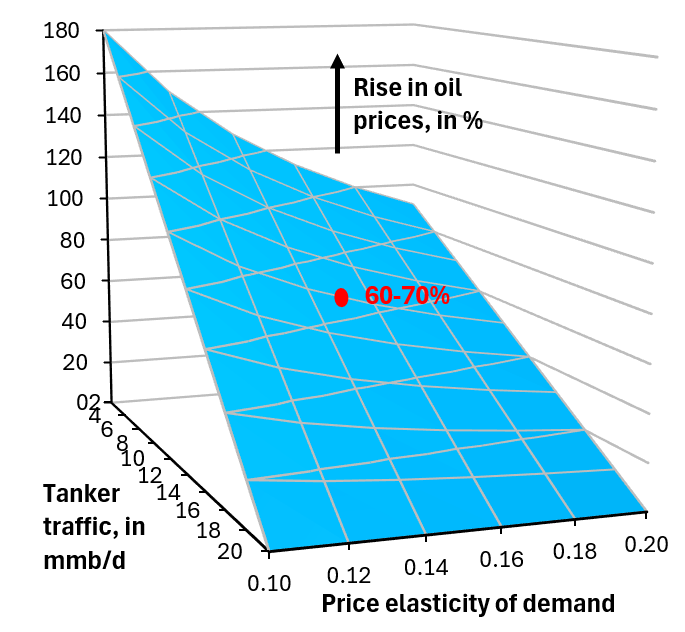
Brent is up 70% in the past month. This prices Strait of Hormuz tanker traffic at half its capacity indefinitely. With the Saudis diverting lots of oil to the Red Sea and Iran continuing to export, we're already almost at that. $150 or $200 can't happen... robinjbrooks.substack.com/p/how-high-wil…
Robin Brooks tweet media
English
31
33
128
67.6K
Oliver Raynor
Oliver Raynor@OliverRaynor_·
The market angle isn’t Lebanon itself, it’s what sits around it A weaker Lebanon keeps a residual risk premium in the Eastern Med: • Israeli offshore gas • Egyptian LNG exports • Regional shipping stability That matters for Europe’s gas balance at the margin Even if fundamentals look loose, traders may keep a geopolitical floor under TTF and NBP
English
0
0
1
714
Mario Nawfal
Mario Nawfal@MarioNawfal·
Once this war ends, the Iranian regime may remain in power, the Gulf may go back to business as usual, Israel will remain relatively unchanged But Lebanon will never be the same again
English
287
240
3K
566.6K
Oliver Raynor
Oliver Raynor@OliverRaynor_·
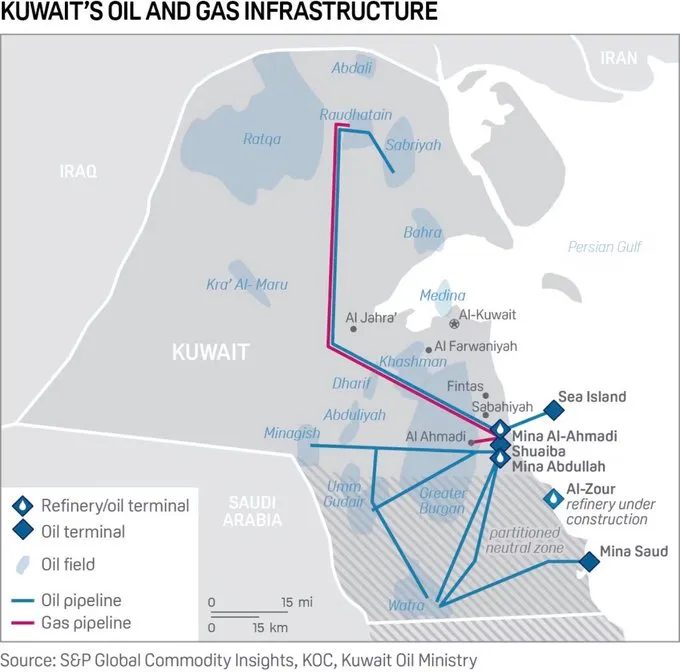
This is the shift people are underestimating. Once refining capacity gets hit, it’s not just supply loss, it’s bottlenecks. You can have crude available but no way to turn it into usable products. 1.2mb/d isn’t just a number, it’s diesel, jet fuel, logistics, everything downstream. Even if a ceasefire lands quickly, the system doesn’t just “switch back on.” The real risk now is duration of disruption, not just volume.
English
0
0
1
84
Jack Prandelli
Jack Prandelli@jackprandelli·
🚨 Kuwait Refineries Hit • Mina al Ahmadi: 730 kb/d • Mina Abdullah: 454 kb/d ➡️ 1.2 mb/d at risk The key question is no longer “When does the war end?” But “What is left of the global energy system when it does?” I break this down in my latest article Because the ceasefire timeline matters less than the damage already done to global supply. Link 👇 open.substack.com/pub/themerchan… #oott #Brent #Iran #Kuwait
Jack Prandelli tweet media
English
13
43
79
5.5K
Oliver Raynor
Oliver Raynor@OliverRaynor_·
Escalation dominance only works if the other side believes the pain is asymmetric. Hitting upstream flips that, it globalises the cost instantly. Oil doesn’t stay regional, and neither does the fallout. At that point it’s less “controlled escalation” and more a race between market shock and political restraint.
English
0
1
4
1.7K
Javier Blas
Javier Blas@JavierBlas·
If it was an attempt to escalate to de-escalate, Iran has showed that it has escalation dominance (as it believes it has nothing to lose in a scorched earth strategy hitting oil and gas assets). Trump is now trying to de-escalate.
Javier Blas@JavierBlas

Both sides are now targeting upstream (ie, production) oil and natural gas assets. Is this an attempt to escalate to de-escalate? Or is it simply a sign that escalation is spiralling out of control?

English
41
147
754
102.8K
Oliver Raynor
Oliver Raynor@OliverRaynor_·
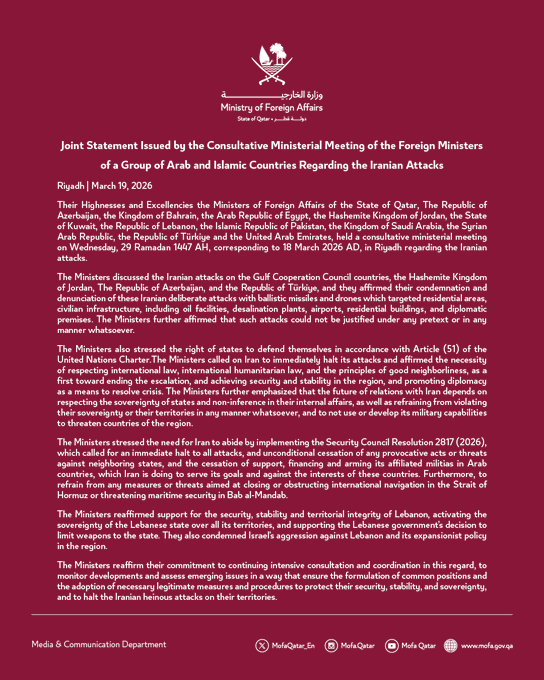
This is not 12 countries “begging.” It is 12 countries recognising that Iran just crossed the line from retaliation into indiscriminate regional energy warfare. Big difference. Once you hit Qatar LNG, Saudi refining and Kuwaiti assets, you are not proving control. You are proving to every Gulf state that your response cannot be ring fenced. That changes the politics and the risk premium fast.
English
3
1
10
1.9K
LimitLess
LimitLess@NoAlphaLimits·
🚨🚨🚨 12 MUSLIM COUNTRIES JUST TOLD IRAN TO STOP. IRAN WON'T. HERE'S WHY THIS CHANGES EVERYTHING. 🚨🚨🚨 Qatar, Saudi Arabia, UAE, Egypt, Pakistan, Türkiye, Kuwait, Bahrain, Jordan, Lebanon, Syria, and Azerbaijan — 12 nations held an emergency meeting in Riyadh and issued a JOINT statement telling Iran to "immediately halt its attacks." Let that sink in. These are the SAME countries whose oil refineries, gas plants, and energy infrastructure Iran just BOMBED. They're not asking from a position of strength. They're BEGGING. 💀 Qatar — largest LNG plant ON FIRE 💀 Kuwait — Mina al-Ahmadi refinery HIT by drones 💀 UAE — Fujairah oil terminal STRUCK 💀 Saudi Arabia — Aramco's SAMREF refinery in Yanbu TARGETED 💀 Bahrain — intercepted 2 ballistic missiles and 4 drones TODAY ⚠️ 12 countries issued a joint statement. Iran hit 9 of them in a SINGLE NIGHT. You don't issue "joint statements" against someone who just proved they can reach ALL of you simultaneously. ⚠️ The Arab League couldn't agree on a lunch order for 50 years. The fact they're united NOW tells you how terrified they are. The media is showing you diplomatic meetings and "joint statements." They're NOT showing you that every country in that room knows the statement is WORTHLESS — because Iran's response to Israel bombing South Pars was never going to be stopped by a press release from Riyadh. If Iran was going to listen to diplomacy, why did it hit 9 countries AFTER the calls for restraint? If this statement had power, why is Brent crude STILL surging past $116? Here's the logic → Israel bombs South Pars → Iran retaliates across the ENTIRE Gulf → 12 countries beg Iran to stop → Iran ignores them → because Iran's war isn't with Kuwait or Qatar → it's with Israel → and these 12 countries just proved they can't protect THEMSELVES → let alone stop what's coming. I warned you. This was never going to be contained. Follow me for real-time updates on the most dangerous escalation of the entire war. Prepare accordingly. 🚨🚨🚨 Twitter is suppressing this. Like + RT + Follow before it's gone. 🚨
LimitLess tweet media
LimitLess@NoAlphaLimits

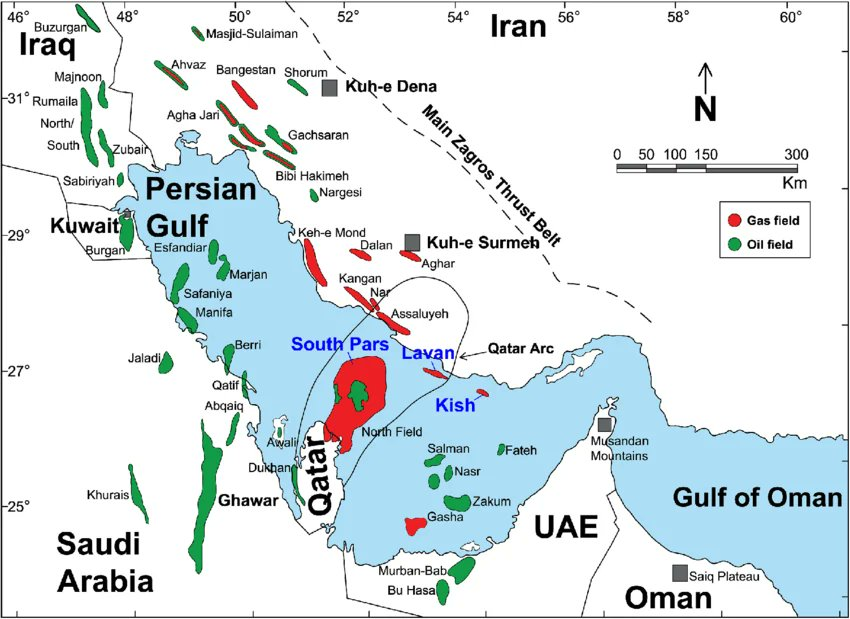
🚨🚨🚨 ISRAEL JUST MADE THE SINGLE MOST DANGEROUS MILITARY DECISION OF THE ENTIRE WAR. AND NOBODY UNDERSTANDS WHAT THEY JUST TRIGGERED. 🚨🚨🚨 Israel and the U.S. struck South Pars — the LARGEST gas field on the planet. But here's what they either didn't know or didn't care about: South Pars is jointly managed by Iran AND Qatar. They didn't just attack Iran. They attacked the energy backbone of their OWN Gulf allies. Let that sink in. 💀 The IRGC just declared ALL major energy facilities across the entire GCC as "direct and legitimate targets" — and warned strikes are coming in the "COMING HOURS." 💀 Listed targets: Qatar's LNG complex, Saudi Aramco facilities, UAE oil terminals — EVERYTHING. 💀 Saudi Aramco has already EVACUATED workers from the SAMREF refinery in Yanbu. They're not waiting. They KNOW what's coming. 💀 Iranian hackers have ALREADY hit Aramco's digital systems — posting images and issuing threats to PARALYZE their infrastructure. 💀 Multiple EXPLOSIONS just heard in Riyadh — confirmed by Reuters, AFP, and AP. Sirens sounding in the Saudi capital. Do you understand the scale of what's happening? ⚠️ Qatar's LNG complex is the LARGEST on Earth. It supplies 30% of the world's liquefied natural gas. If Iran hits it — Europe's heating supply DISAPPEARS overnight. Not in months. OVERNIGHT. ⚠️ Saudi Aramco is the most valuable company on the PLANET — worth $1,800,000,000,000. Its refineries process 12 MILLION barrels per day. One successful strike takes 10% of the world's oil OFFLINE. ⚠️ In 2019, a SINGLE drone attack on Saudi Aramco's Abqaiq facility knocked out 5.7 million barrels per day and sent oil up 15% in ONE session. Iran now has 10x the motivation and NOTHING left to lose. They're showing you "precision strikes on Iranian targets." They're NOT showing you that those strikes just gave Iran the JUSTIFICATION to destroy every oil facility from Qatar to Saudi Arabia to the UAE. Here's the logic — follow it carefully: → You bomb a gas field that's JOINTLY OWNED with Qatar → Qatar — your own Gulf ally — publicly condemns you → Iran uses the attack as justification to target ALL Gulf energy → IRGC formally declares Gulf facilities as "legitimate targets" → Aramco starts EVACUATING refineries → Explosions hit RIYADH → You didn't weaken Iran. You gave them the excuse to burn down the ENTIRE Gulf's economy. If this was a "strategic victory," why is Aramco evacuating workers RIGHT NOW? If Iran's military is "degraded," why are 6 Gulf nations scrambling to protect their oil fields from an attack they believe is IMMINENT? Complete silence. You don't evacuate the world's most valuable company unless you KNOW what's coming. The IRGC said "coming hours." Not days. Not weeks. HOURS. And every Gulf state just went from spectator to TARGET. This is no longer a war between the U.S. and Iran. This is a war that's about to ERASE the Gulf's entire energy infrastructure — the infrastructure that powers HALF the planet. Prepare accordingly. 🚨🚨🚨 They don't want you seeing this. Follow + RT to beat the algorithm. 🚨

English
33
142
396
77.3K
Oliver Raynor
Oliver Raynor@OliverRaynor_·
The real mistake was not “hitting Qatar by accident.” It was normalising Gulf energy infrastructure as a war target. That changes the pricing regime for oil, LNG and power. Permanently, not just for a headline cycle. But saying Europe “loses heating overnight” is still too dramatic. Demand destruction, rerouting and state intervention kick in before that. What matters now is that buyers are no longer pricing supply and demand alone. They are pricing survivability.
English
0
0
5
1.5K
LimitLess
LimitLess@NoAlphaLimits·
🚨🚨🚨 ISRAEL JUST MADE THE SINGLE MOST DANGEROUS MILITARY DECISION OF THE ENTIRE WAR. AND NOBODY UNDERSTANDS WHAT THEY JUST TRIGGERED. 🚨🚨🚨 Israel and the U.S. struck South Pars — the LARGEST gas field on the planet. But here's what they either didn't know or didn't care about: South Pars is jointly managed by Iran AND Qatar. They didn't just attack Iran. They attacked the energy backbone of their OWN Gulf allies. Let that sink in. 💀 The IRGC just declared ALL major energy facilities across the entire GCC as "direct and legitimate targets" — and warned strikes are coming in the "COMING HOURS." 💀 Listed targets: Qatar's LNG complex, Saudi Aramco facilities, UAE oil terminals — EVERYTHING. 💀 Saudi Aramco has already EVACUATED workers from the SAMREF refinery in Yanbu. They're not waiting. They KNOW what's coming. 💀 Iranian hackers have ALREADY hit Aramco's digital systems — posting images and issuing threats to PARALYZE their infrastructure. 💀 Multiple EXPLOSIONS just heard in Riyadh — confirmed by Reuters, AFP, and AP. Sirens sounding in the Saudi capital. Do you understand the scale of what's happening? ⚠️ Qatar's LNG complex is the LARGEST on Earth. It supplies 30% of the world's liquefied natural gas. If Iran hits it — Europe's heating supply DISAPPEARS overnight. Not in months. OVERNIGHT. ⚠️ Saudi Aramco is the most valuable company on the PLANET — worth $1,800,000,000,000. Its refineries process 12 MILLION barrels per day. One successful strike takes 10% of the world's oil OFFLINE. ⚠️ In 2019, a SINGLE drone attack on Saudi Aramco's Abqaiq facility knocked out 5.7 million barrels per day and sent oil up 15% in ONE session. Iran now has 10x the motivation and NOTHING left to lose. They're showing you "precision strikes on Iranian targets." They're NOT showing you that those strikes just gave Iran the JUSTIFICATION to destroy every oil facility from Qatar to Saudi Arabia to the UAE. Here's the logic — follow it carefully: → You bomb a gas field that's JOINTLY OWNED with Qatar → Qatar — your own Gulf ally — publicly condemns you → Iran uses the attack as justification to target ALL Gulf energy → IRGC formally declares Gulf facilities as "legitimate targets" → Aramco starts EVACUATING refineries → Explosions hit RIYADH → You didn't weaken Iran. You gave them the excuse to burn down the ENTIRE Gulf's economy. If this was a "strategic victory," why is Aramco evacuating workers RIGHT NOW? If Iran's military is "degraded," why are 6 Gulf nations scrambling to protect their oil fields from an attack they believe is IMMINENT? Complete silence. You don't evacuate the world's most valuable company unless you KNOW what's coming. The IRGC said "coming hours." Not days. Not weeks. HOURS. And every Gulf state just went from spectator to TARGET. This is no longer a war between the U.S. and Iran. This is a war that's about to ERASE the Gulf's entire energy infrastructure — the infrastructure that powers HALF the planet. Prepare accordingly. 🚨🚨🚨 They don't want you seeing this. Follow + RT to beat the algorithm. 🚨
LimitLess tweet media
English
1.6K
16.1K
38.6K
4.9M
Oliver Raynor
Oliver Raynor@OliverRaynor_·
This won’t move prompt flows yet... but it shifts the risk premium. North Field and South Pars is one shared reservoir. Once energy infrastructure enters the conflict narrative, traders start pricing tail risk, not just current supply. Qatar is marginal LNG. Any perceived risk there tightens the forward balance fast. Watch TTF JKM spreads and European storage behaviour!
English
2
1
11
11.7K
Oliver Raynor
Oliver Raynor@OliverRaynor_·
ENERGY UPDATE: French nuclear availability is slipping again EDF has cut output guidance after new stress corrosion inspections at Civaux and Penly ⬇ Nothing catastrophic, but it matters because France is supposed to be Europe’s stabiliser this winter If nuclear output drifts lower, two things happen quickly: - French power prices lift - Gas burn across Europe quietly rises That second point is what traders watch! Every incremental MWh lost from nuclear tends to be replaced by gas somewhere in the system ⬇ Not necessarily in France alone but across the interconnected grid Which means a nuclear issue can become a gas story... For the moment storage across Europe still looks comfortable after a mild winter ⬇ But the market is very aware that the refill season starts in a few weeks. More gas for power = tighter injection dynamics That is how something that begins inside the French nuclear fleet can ripple into TTF, UK NBP and eventually UK power curves For UK commercial buyers the message is simple: The system still has cushion ⬇ But the margin of comfort into next winter is quietly getting thinner than headlines suggest Traders will be watching: • French nuclear availability updates • Early LNG cargo nominations for summer • Asian LNG demand as temperatures rise Those three variables will shape how easy or difficult Europe’s storage refill becomes And storage refill is still the real game for winter 25/26 pricing!
Oliver Raynor tweet media
English
0
0
3
726
Oliver Raynor
Oliver Raynor@OliverRaynor_·
Gas markets every time a new geopolitical headline hits
Oliver Raynor tweet media
English
0
0
3
85
Oliver Raynor
Oliver Raynor@OliverRaynor_·
The interesting part is not that Iran is exporting. It is how much is still flowing despite the conflict. Around 1.5–1.6m b/d continuing to leave Kharg tells you the market’s worst case scenario has not materialised yet. As long as those barrels keep reaching buyers, the oil balance stays tighter but manageable. For traders the real trigger would be different: a disruption to loadings at Kharg or tanker flows leaving the Gulf. That is when the market stops pricing tension and starts pricing actual supply loss.
English
0
0
1
135
Megatron
Megatron@Megatron_ron·
BREAKING: 🇮🇷🛢 Iranian oil exports continue in mass Since the start of the war, Iran has shipped 1.6 million barrels of oil per day from the Port of Kharg, according to the Financial Times.
Megatron tweet mediaMegatron tweet media
English
36
430
2.5K
45.1K
Oliver Raynor
Oliver Raynor@OliverRaynor_·
If Gulf states are now pushing for Iran’s military capability to be fully degraded, the market implication is duration. Energy markets can price a short disruption. What they struggle with is a conflict that keeps the Hormuz risk premium in place for months. That is when logistics start to matter more than production. Tanker insurance, routing decisions, and LNG transit risk become the real price drivers. Remember roughly a fifth of global oil and a huge share of LNG moves through that corridor. Even partial disruption over time tightens the entire energy complex.
English
0
0
2
3.1K
Shanaka Anslem Perera ⚡
BREAKING: The countries that were supposed to broker a ceasefire are now demanding the United States finish the job. Reuters reported on March 16, citing three Gulf sources and five Western and Arab diplomats, that Saudi Arabia, the UAE, Bahrain, Kuwait, Qatar and Oman are actively pressing Washington not to stop short and to fully degrade Iran’s military capability. Abdulaziz Sager, chairman of the Gulf Research Center, said Iran has crossed every red line. The Gulf states did not start this war. They now want it to end with Iran permanently unable to threaten the strait that carries their economic survival. This is not coercion. This is convergence. Trump needs Gulf legitimacy for the coalition. The Gulf needs American firepower to neutralise a threat they have lived under for four decades. The interests aligned the moment Iran struck airports, desalination plants, fuel depots, and commercial hubs across every GCC state. The USS Gerald R. Ford has been extended to an 11-month deployment, with return to Norfolk pushed to late April or early May. The Navy confirmed it through Vice Chief of Naval Operations Adm. Jim Kilby. Washington is planning as if the region stays unstable through the entire spring. Now layer what this means for de-escalation. Ali Larijani, confirmed killed, was the last senior Iranian official with credible diplomatic relationships across the Gulf and the ability to negotiate from a position of institutional authority. His death was confirmed by Israel’s Katz and IDF sources. The pragmatic channel is gone. Araghchi told CBS on March 15: “We are ready to defend ourselves as long as it takes.” Mojtaba Khamenei, invisible since March 9, issued one directive: the blockade continues. The Mosaic Doctrine was designed for exactly this moment. Mohammad Ali Jafari restructured the IRGC between 2005 and 2007 into 31 provincial commands, each holding identical sealed contingency packets with uniform standing orders. If central leadership falls, every command continues under the same pre-loaded rules without needing new orders from Tehran. The Hormuz theater is controlled by Hormozgan provincial command as primary lead, with Bushehr in support. Local naval subunits execute VHF radio hails and verify AIS transponder status. Diplomatically cleared vessels pass. Everyone else is a target. A Thai-flagged vessel was struck on March 11 for transiting without prior notification. Indian tankers Pushpak and Parimal passed safely after three Jaishankar-Araghchi calls. A Karachi-bound Aframax became the first non-Iranian vessel to transit with AIS broadcasting on March 15. The system is functioning exactly as designed: decentralised, uniform, and impervious to the leadership strikes that were supposed to break it. The Gulf states pressing for full neutralisation are pressing for something that may take months. The Ford extension confirms the Navy agrees. Larijani’s death confirms there is no one left to negotiate a shortcut. The Mosaic packets confirm the blockade does not require anyone in Tehran to sustain it. And underneath all the diplomacy, underneath the carrier movements, underneath the strikes and the rhetoric, the fertiliser molecules that four billion people depend on remain trapped behind a permissioned chokepoint run by provincial commanders with radios and rules written before the bombs fell. The offramp did not close because someone blocked it. It closed because everyone with the power to use it decided they would rather keep driving. Full analysis: open.substack.com/pub/shanakaans…
Shanaka Anslem Perera ⚡ tweet mediaShanaka Anslem Perera ⚡ tweet mediaShanaka Anslem Perera ⚡ tweet mediaShanaka Anslem Perera ⚡ tweet media
English
144
531
1.4K
1.4M
Oliver Raynor
Oliver Raynor@OliverRaynor_·
Key point for the market is not production, it is logistics. Iran can keep pumping and loading at Kharg Island, but the real question is whether those barrels can keep moving through the Strait and onto buyers. As long as exports keep flowing the market treats this as disruption risk rather than actual supply loss. The moment shipments slow, the price reaction looks very different.
English
0
0
1
41