
SolarCoin

3.6K posts

SolarCoin banner
SolarCoin

SolarCoin

@SolarCoin_SLR

We bring the #Solarity. Free Reward for solar energy producers in +150 countries. https://t.co/QIVDXG7zRw

Earth +150 countries 加入时间 Aralık 2013
2.9K 关注7.6K 粉丝
置顶推文
SolarCoin
SolarCoin@SolarCoin_SLR·
Science Alert: SolarCoin's economic model shows each network participant adds $500-$15,000 in protocol value. You're not just earning—you're building the future of energy currency! 📚 Research: ssrn.com/abstract=32818…
English
6
3
19
1K
SolarCoin 已转推
Solar and Storage Industry
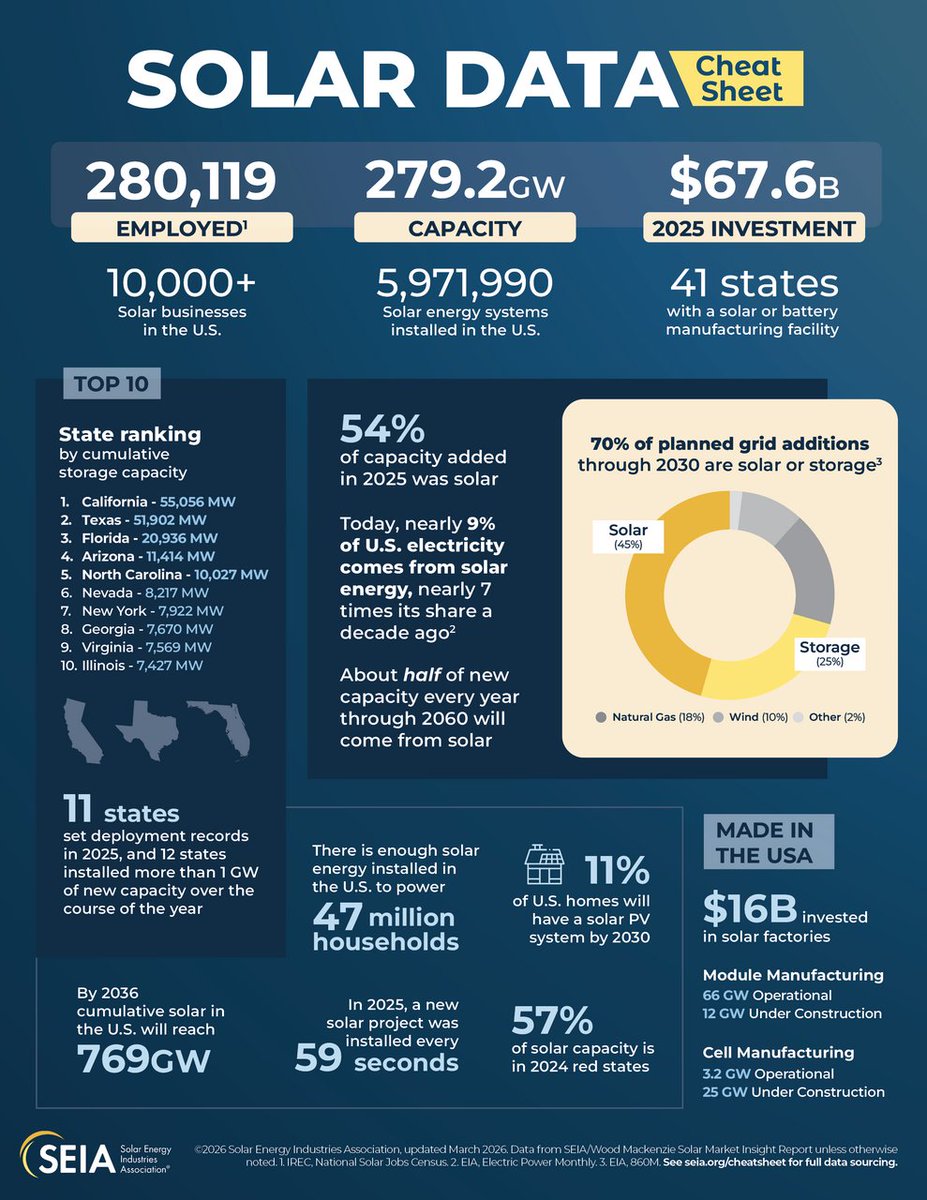
NEW: Solar dominates new energy capacity additions for the 5th year in a row. Despite political setbacks, the solar industry installed 43GW in the first year of the Trump admin and, together with storage, comprised 79% of all new capacity. seia.org/news/report-u-…
Solar and Storage Industry tweet media
English
1
22
68
3.6K
SolarCoin
SolarCoin@SolarCoin_SLR·
155 technologies. 168 years of data. All open-source, CC BY 4.0. Wright's Law is the most powerful forecasting tool in energy economics — and most people have never heard of it. Explore every curve, download the data, read the paper: 👉 carbonfinancelab.com/wrights-law/ Data: @SFI_Research + Gogerty (2025)
English
1
0
3
83
SolarCoin
SolarCoin@SolarCoin_SLR·
Every chemical you can name — ammonia (43.9% LR), methanol (37.6%), ethylene — follows Wright's Law. Green hydrogen, green ammonia, synthetic fuels are all on learning curves. The cost trajectory of clean industrial chemicals is already written. We just have to scale. carbonfinancelab.com/wrights-law/
English
0
0
1
72
SolarCoin
SolarCoin@SolarCoin_SLR·
Solar PV has been on a 20.5% learning curve for 50 years without breaking. The Santa Fe Institute tested 6 forecasting models against 62 technologies. Wright's Law won. If you can estimate future cumulative production, you can project future cost. That's how IRENA and BloombergNEF build scenarios. carbonfinancelab.com/wrights-law/
English
0
0
1
66
SolarCoin
SolarCoin@SolarCoin_SLR·
GPU compute learning rate: 89.2% (2003–2025, R²=0.995) Solar PV learning rate: 20.5% AI infrastructure is falling in cost 4x faster than solar. That has massive implications for energy modeling, climate tech, and what clean energy + AI can do together. carbonfinancelab.com/wrights-law/
English
0
0
1
51
SolarCoin
SolarCoin@SolarCoin_SLR·
With 10 Gt/yr of carbon removal by 2050, the required global learning rate drops from 52% to 35%. 35% is demonstrated — LED lighting, wind power have achieved it. CDR doesn't solve everything. But it makes the impossible merely very hard. carbonfinancelab.com/wrights-law/
English
0
0
1
49
SolarCoin
SolarCoin@SolarCoin_SLR·
DAC currently costs $450/tonne. BECCS: ~$100/tonne. But those are *today's* prices. Early solar was $100/W. If DAC follows a 15–18% learning rate — consistent with BECCS and biochar — costs could fall under $50/tonne within two decades of scaling. Carbon removal is where solar was in 1985. carbonfinancelab.com/wrights-law/
English
0
0
1
50
SolarCoin
SolarCoin@SolarCoin_SLR·
Under the current global learning rate, CO₂ emissions don't peak by 2050. They rise to 48.2 Gt/year. The 1.5°C pathway requires 12 Gt. That gap is what the energy transition has to close. carbonfinancelab.com/wrights-law/
English
0
0
1
45
SolarCoin
SolarCoin@SolarCoin_SLR·
Three numbers that define the climate challenge: 20% — apparent global learning rate (market GDP) 12% — true rate once externalities are included 52% — required rate for 1.5°C 38% of our apparent progress is just cost-shifting to nature. carbonfinancelab.com/wrights-law/
English
0
0
0
38
SolarCoin
SolarCoin@SolarCoin_SLR·
Does civilization itself have a learning rate? Yes. Energy intensity vs. cumulative GDP: 18.3% learning rate, R²=0.96, 1970–2023. But the *required* rate for 1.5°C is 52%. We're learning. Just not fast enough. carbonfinancelab.com/wrights-law/
English
0
0
0
36
SolarCoin
SolarCoin@SolarCoin_SLR·
Solar PV learning rate: +20.5% (costs fall) Nuclear learning rate: -88.1% (costs rise) Same era. Same electricity output. Radically different learning curves. The energy transition isn't ideology. It's physics + economics. carbonfinancelab.com/wrights-law/
English
0
0
0
37
SolarCoin
SolarCoin@SolarCoin_SLR·
Nuclear electricity learning rate: -88.1% That's not a typo. Costs ROSE as scale increased. 5x real cost increase from the 1960s to 2024. The 8x gap vs. Wright's Law prediction at 15% is the defining chart in energy economics. carbonfinancelab.com/wrights-law/
English
0
0
0
41
SolarCoin
SolarCoin@SolarCoin_SLR·
The median technology in this database gets 21% cheaper every time cumulative production doubles. 155 technologies. 168 years. The "normal" trajectory for any technology that scales is: costs fall, predictably. That's why betting against solar was always the wrong trade. carbonfinancelab.com/wrights-law/
English
0
0
0
151
SolarCoin
SolarCoin@SolarCoin_SLR·
Geothermal electricity: 21.8% learning rate. R²=0.89. 1980–2025. 46 data points. Same learning curve as solar PV. Less talked about. No intermittency problem. Wright's Law doesn't play favorites — it rewards deployment. carbonfinancelab.com/wrights-law/
English
0
0
0
41
SolarCoin
SolarCoin@SolarCoin_SLR·
If solar is the story of the last decade, batteries are the story of the next. Li-ion battery packs: $108/kWh in 2025. Down from $1,200/kWh in 2010. The learning rate for stored energy per unit cost? Tracking right alongside solar. The clean energy stack is following the curve. carbonfinancelab.com/wrights-law/
English
0
0
0
71