TechBio Transformers

642 posts

TechBio Transformers banner
TechBio Transformers

TechBio Transformers

@TechBi0

Global Bio x AI Community. A third place for scientists, product managers, computational biologists, engineers and academics working in AI & Software for Bio

Global 加入时间 Ağustos 2024
62 关注1.5K 粉丝
TechBio Transformers 已转推
Eric Topol
Eric Topol@EricTopol·
The AI Scientist, a new @Nature article making the case: "The dawn of a new era in which the process of discovery is no longer a solely human pursuit and in which the pace at which we are able to reap the harvest of scientific discovery could accelerate dramatically." nature.com/articles/s4158…
English
19
135
422
110.8K
TechBio Transformers 已转推
Biology+AI Daily
Biology+AI Daily@BiologyAIDaily·
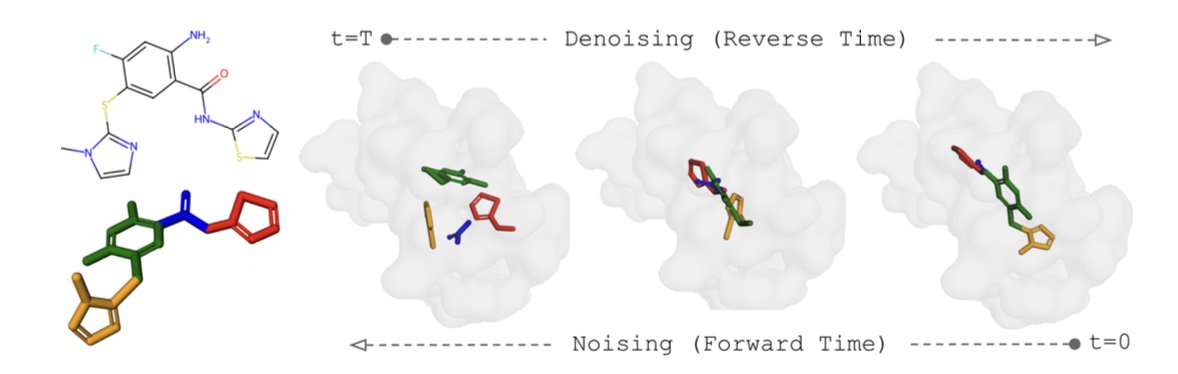
Sigmadock: Untwisting Molecular Docking with Fragment‑Based SE(3) Diffusion 1 This paper presents Sigmadock, the first diffusion‑based docking model that surpasses classical physics‑based tools on the PoseBusters re‑docking benchmark, achieving a Top‑1 success rate over 79 % under the strict PB‑validity metric. 2 The core innovation is a novel fragmentation scheme that breaks a ligand into a small set of rigid‑body fragments by cutting rotatable bonds, allowing the model to learn only SE(3) transformations for each fragment rather than high‑dimensional torsional angles. 3 By operating in the product space SE(3)^m, Sigmadock sidesteps the geometric entanglement that plagues torsional‑space diffusion—where a single dihedral change propagates non‑locally and induces a non‑product measure—leading to more stable training and faster inference. 4 The authors further introduce soft triangulation constraints that enforce bond‑length and angle consistency across fragments, and a SO(3)‑equivariant EquiformerV2 backbone that respects the rotational symmetry of the 3‑D space. 5 Extensive ablation studies show that each component—fragment merging, triangulation, and protein‑ligand interaction encoding—contributes 4–12 % to overall accuracy, and the method generalises to unseen proteins with little data leakage. 6 On the PoseBusters and Astex test sets, Sigmadock reaches near‑perfect Top‑1 accuracy (>90 %) and outperforms both DiffDock and traditional docking programs by large margins, all while using only ~19 k training molecules and 50× faster sampling. 7 The work demonstrates that principled inductive biases and careful geometric modeling can enable deep learning to reliably predict binding poses, opening the door to flexible‑receptor docking and co‑folding extensions. 💻Code: github.com/alvaroprat97/s… 📜Paper: arxiv.org/abs/2511.04854 #DeepLearning #MolecularDocking #DiffusionModels #ComputationalChemistry #SE3 #FragmentBasedApproach
Biology+AI Daily tweet media
English
2
10
49
4K
TechBio Transformers 已转推
Chordoma Foundation Labs
Chordoma Foundation Labs@CFLabsResearch·
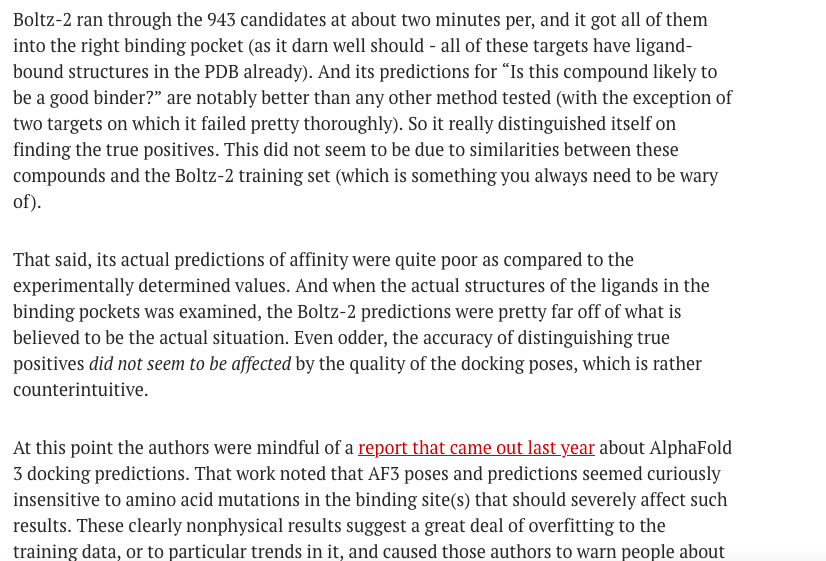
Much debate right now about the binding affinity prediction abilities of AI models. For anyone interested in validating model predictions experimentally we can provide that for free for the oncology target TBXT. Plus we’re offering $500k in prizes for submicromolar binders: tbxtchallenge.org
Pearl Freier@PearlF

Chemical biologist Derek Lowe wrote about Boltz-2 in his column this week & a recent paper evaluating the AI/ML model for cofolding ligands & proteins. His column: "AI-Predicting Compound Affinity. We Aren't There Yet." He also brought up AlphaFold 3 docking predictions. A link to the column & the recent paper is in the reply

English
2
8
15
2.8K
TechBio Transformers 已转推
Pearl Freier
Pearl Freier@PearlF·
Chemical biologist Derek Lowe wrote about Boltz-2 in his column this week & a recent paper evaluating the AI/ML model for cofolding ligands & proteins. His column: "AI-Predicting Compound Affinity. We Aren't There Yet." He also brought up AlphaFold 3 docking predictions. A link to the column & the recent paper is in the reply
Pearl Freier tweet media
English
2
13
83
11.2K
TechBio Transformers 已转推
Jorge Bravo Abad
Jorge Bravo Abad@bravo_abad·
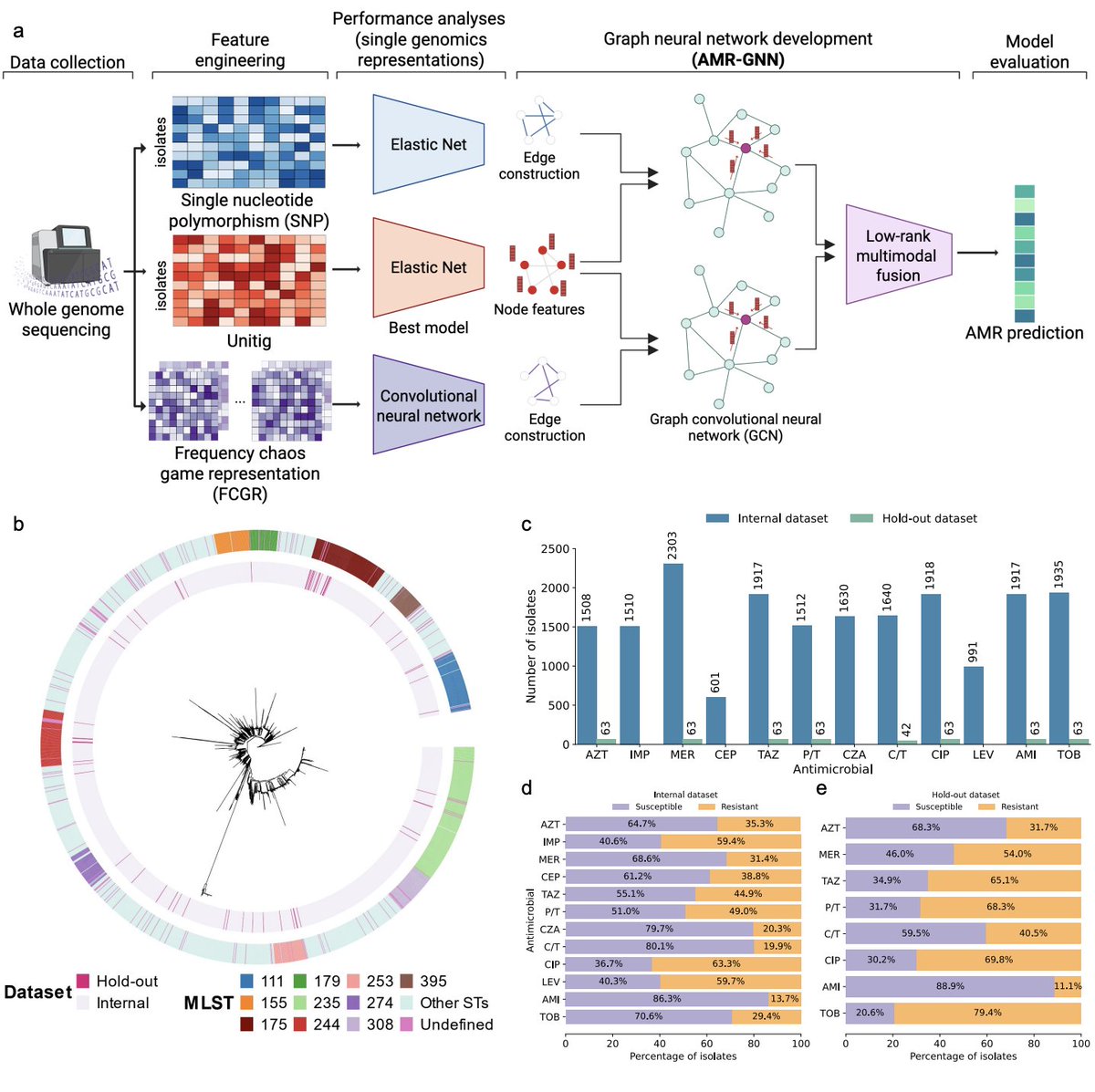
Graph neural networks that read bacterial genomes to predict antibiotic resistance Antimicrobial resistance kills over a million people every year. When a patient arrives with a severe bacterial infection, clinicians need to know which antibiotics will work—fast. Culture-based susceptibility testing takes 2 to 5 days. Whole-genome sequencing offers a shortcut, but translating raw bacterial DNA into reliable resistance predictions is far from trivial. Bacterial genomes can be represented in many ways—SNPs, reference-free unitigs, image-like frequency chaos game representations (FCGR)—and there is no consensus on which works best. Worse, bacteria reproduce clonally, so standard ML models often learn to recognise high-risk lineages rather than the actual resistance mechanisms. Nguyen and coauthors tackle both problems with AMR-GNN, a graph neural network that integrates multiple genomic representations simultaneously. Unitig features serve as node features; SNP- and FCGR-derived pairwise distances define the graph edges. Two parallel GCN modules learn from the same nodes but different connectivity structures, and their embeddings are fused before a final resistance/susceptibility classification. Tested on 2,515 Pseudomonas aeruginosa isolates across 12 antibiotics, AMR-GNN significantly outperforms single-representation models in 11/12 drugs—with AUROC gains of 28.8% for cefepime and 18.9% for aztreonam, precisely where prediction is hardest. A structural fix for clonal confounding—removing edges between isolates of the same sequence type, forcing the model to learn from genetically distinct neighbours—improves performance further across all tested antibiotics. Validated on 23,000+ genomes spanning E. coli, K. pneumoniae, S. aureus, and E. faecium, mean AUROCs exceed 0.90 in nearly every species-drug combination. The model also recovers known resistance genes (gyrA, gyrB, parC for levofloxacin; fusA1 for tobramycin) through integrated gradient analysis—without any prior AMR knowledge encoded in the architecture. Multi-representation learning, graph-based relational structure, and built-in interpretability. Three historically separate challenges, addressed in a single unified framework. Paper: nature.com/articles/s4146…
Jorge Bravo Abad tweet media
English
1
53
197
10.9K
TechBio Transformers 已转推
Johnny Yu
Johnny Yu@iamjohnnyyu·
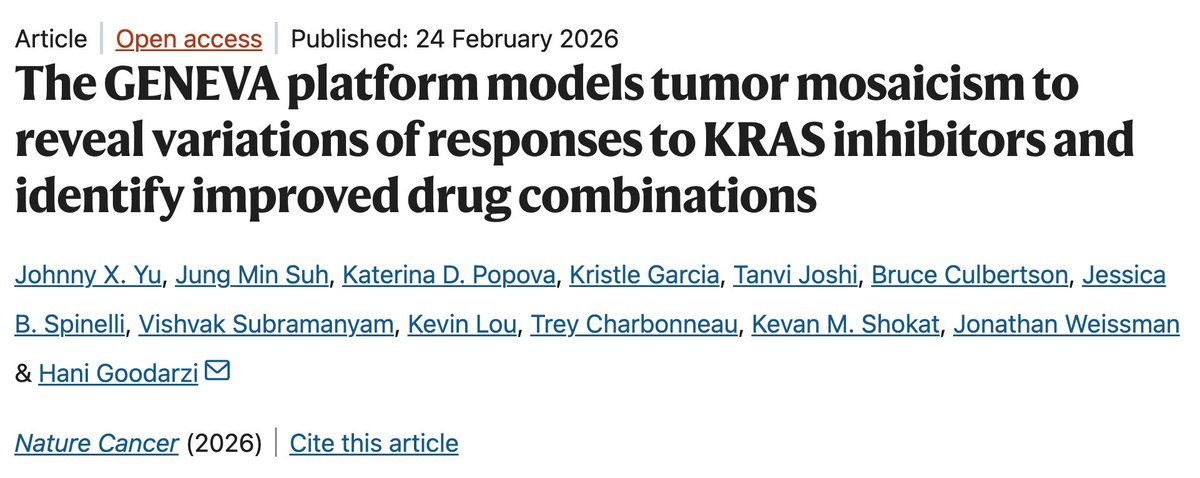
1/ The technology behind @Tahoe_ai is now published in Nature Cancer. GENEVA: pool diverse disease models into one mosaic tumor → treat → deconvolve response at single-cell resolution. The architecture that had to exist before datasets like Tahoe-100M were possible.
Johnny Yu tweet media
English
2
18
74
9.4K
TechBio Transformers 已转推
Biology+AI Daily
Biology+AI Daily@BiologyAIDaily·
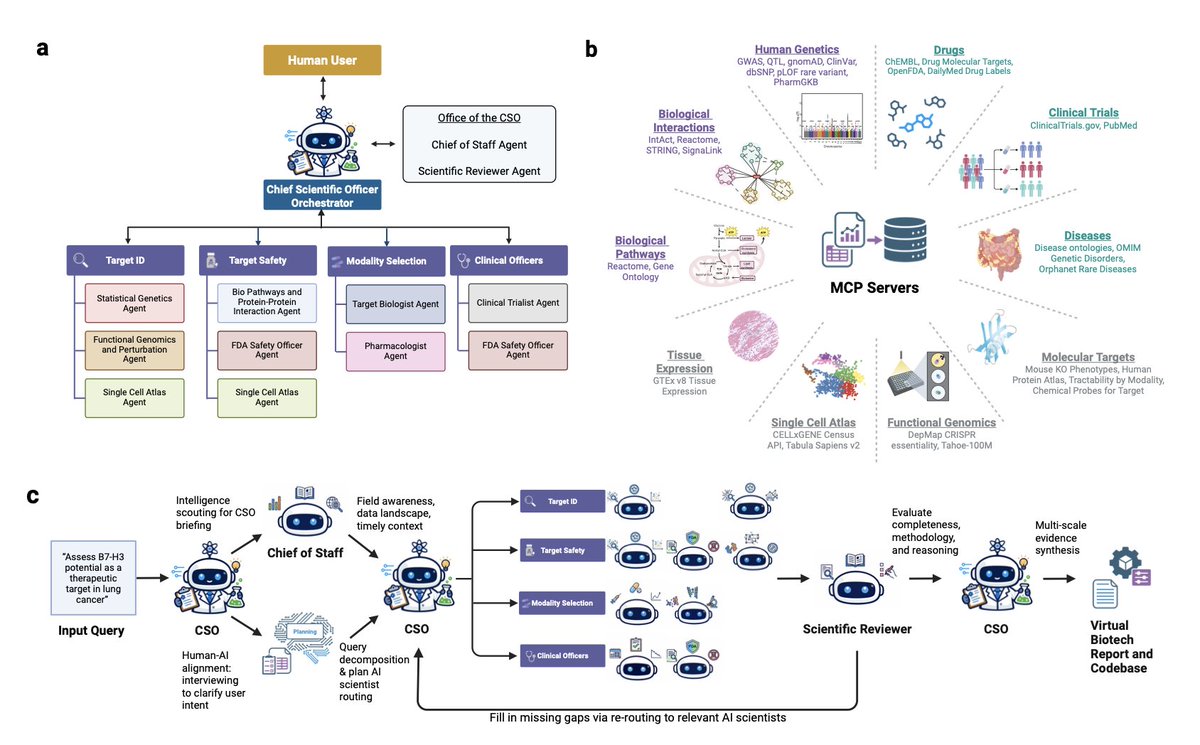
The Virtual Biotech: A Multi-Agent AI Framework for Therapeutic Discovery and Development 1. The Virtual Biotech introduces a multi-agent AI system that mirrors the organizational structure of human biotech companies, with a virtual Chief Scientific Officer orchestrating domain-specialized scientist agents across four R&D divisions. 2. The platform integrates over 100 customized tools and MCP servers spanning 78,726 targets, 39,530 diseases, 14.5 million protein-protein interactions, and more than 100 million single-cell profiles to enable comprehensive therapeutic analysis. 3. In a large-scale demonstration, 37,075 clinical trialist agents autonomously curated outcomes from 55,984 clinical trials, discovering that drugs targeting cell-type-specific genes were 40% more likely to progress from Phase I to Phase II and 48% more likely to reach market. 4. The system identified novel associations between single-cell transcriptomic features and trial success, showing that cell-type-specific targets had 32% lower adverse event rates across multiple organ systems, independent of genetic evidence. 5. For B7-H3 in lung cancer, the Virtual Biotech integrated genetics, single-cell atlases, spatial transcriptomics, and survival data to propose an antibody-drug conjugate strategy, completed in under one day for $46 in API costs. 6. In analyzing a terminated Phase II ulcerative colitis trial targeting OSMRβ, the system identified biomarker-guided enrollment as a potential path forward, detecting elevated baseline OSMR in non-responders across five independent trials. 7. The multi-agent architecture enables parallel processing that achieved approximately 184-fold speedup compared to single-agent approaches, reducing months of manual curation to overnight analysis. 8. A scientific reviewer agent provides quality control by evaluating methodology, evidence strength, and reasoning completeness, enabling iterative refinement before final synthesis. 9. The framework demonstrates how AI agents can maintain transparent, auditable reasoning chains while integrating diverse biological evidence across scales from molecular perturbations to clinical outcomes. 📜Paper: biorxiv.org/content/10.648… #VirtualBiotech #AIAgents #DrugDiscovery #ComputationalBiology #MultiAgentSystems #ClinicalTrials #SingleCell #SpatialTranscriptomics #TherapeuticDiscovery #Bioinformatics
Biology+AI Daily tweet media
English
1
19
86
6.7K
TechBio Transformers 已转推
Chris Hayduk
Chris Hayduk@ChrisHayduk·
I'm rebuilding AlphaFold2 from scratch in pure PyTorch. No frameworks on top of PyTorch. No copy-paste from DeepMind's repo. Just nn.Linear, einsum, and the 60-page supplementary paper. The project is called minAlphaFold2, inspired by Karpathy's minGPT. The idea is simple: AlphaFold2 is one of the most important neural networks ever built, and there should be a version of it that a single person can sit down and read end-to-end in an afternoon. Where it stands today: - ~3,500 lines across 9 modules - Full forward pass works: input embedding → Evoformer → Structure Module → all-atom 3D coordinates - Every loss function from the paper (FAPE, torsion angles, pLDDT, distogram, structural violations) - Recycling, templates, extra MSA stack, ensemble averaging — all implemented - 50 tests passing - Every module maps 1-to-1 to a numbered algorithm in the AF2 supplement The Structure Module was the most satisfying part to build. Invariant Point Attention is genuinely beautiful — it does attention in 3D space using local reference frames so the whole thing is SE(3)-equivariant, and the math fits in about 150 lines of PyTorch. What's next: - Build the data pipeline (PDB structures + MSA features) - Write the training loop - Train on a small set of proteins and see what happens The repo is public. If you've ever wanted to understand how AlphaFold2 actually works at the level of individual tensor operations, this is meant for you. Repo: github.com/ChrisHayduk/mi…
Chris Hayduk tweet media
English
60
261
2.3K
81.9K
TechBio Transformers 已转推
nature
nature@Nature·
“It’s a major advance, on the scale of an AlphaFold4. The problem, of course, is that we know nothing of the details.” Isomorphic Lab’s proprietary drug-discovery model is a major advance go.nature.com/4artDoz
English
15
86
485
44.8K
TechBio Transformers 已转推
Patrick Hsu
Patrick Hsu@pdhsu·
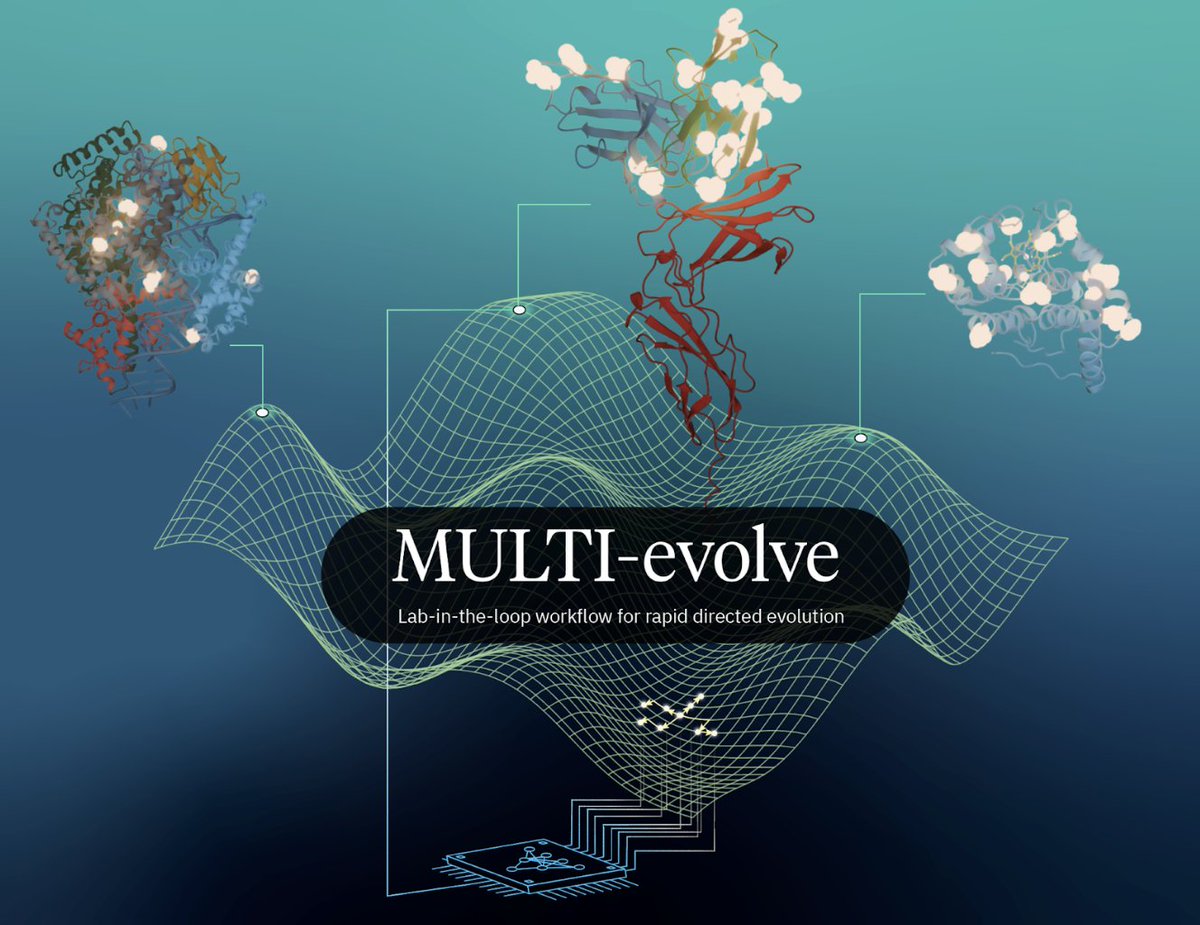
Delighted to share new @arcinstitute work from our group on AI-accelerated lab-in-the-loop, in @ScienceMagazine today One of the most remarkable things about biology is that it's digital. DNA, RNA, proteins: these are all sequences, and their function is directly encoded in their sequence of letters. But a protein of length N has 20^N possible variants and the vast majority are non-functional. Evolution spent billions of years finding the functional needles in this haystack through random exploration and natural selection. For modern biomedicine, we need to solve this in days to weeks.
Patrick Hsu tweet media
English
18
135
700
90.8K