
λ 已转推
λ
2.4K posts


AI (ML) won't take over the world, it will simply render the real world and other ppl unnecessary and humanity will quietly die out from loneliness and a lack of meaning (a quiet, comfortable, lonely dystopia)
develop your brain yourself, read, solve problems, write the code yourself and don't be afraid to make mistakes (it's the same learning process)
λ@lambda0xE
Btw, a fun fact about ML and contex mixing - all the time at the end of school and the beginning of university, I was fascinated by data compression and algorithmic codecs. This is essentially how I started my career as a C developer. There's one fun fact about compression that just occurred to me: the legendary Matt Mahoney, who created the most powerful algorithmic coder and founded the PAQ family, variations of which constantly won the Hutter Prize for data compression, essentially laid the foundation for the concept of ML through data compression, since algorithmic codecs are built on predictive models and sigmoid functions for constructing frequency context models based on the data type. So, what I'm getting at is that in our "narrow" circle of those involved in this topic, there was a clear justification for what AGI is expressed through data compression. As you know - you can't bypass the Shannon limit, that's a hard math law. However, the Shannon limit is bound to a specific predictive model. If an algorithmic codec can build such a profound, context aware model of the world that its 'guessing' pushes the practical compression down to the data's absolute, intrinsic complexity, that might just be the key to unlocking AGI. If you want to start approaching AGI, you need to pay attention to data compression, bc if a context codec model can "decompress" and predict and compress the full context of Wikipedia (which in a compressed format has entropy practically within the limits of Shannon), then this may mean that one of the most important steps towards AGI has been made. PVAC-HFHE uses our own version of algorithmic mixing to compress public keys for the HFHE engine. You can see it here: github.com/octra-labs/web… Now that we're head over heels in working on circles in @octra with the goal of bringing interesting use cases, this has made sense again and we've developed a passion for trying out new hypotheses. So yes, one of the new directions for octra is ML and contextual transformation, because the treechain structure and data model are perfectly compatible with the goals of ML inference. We'll continue working on this (I think every day now) and will report if we find anything interesting.
London, England 🇬🇧 English
some info about upcoming mini-updates and the mini-roadmap:
- a planned transition to a new proof format (TAPE verifier), natively supported by hfhe (field core), is scheduled for next week, it will lead to faster processing of heavy txs and increased security, however, this also has a trade off, as a migration to the new ct-format (client side manual re-encryption) will be prepared (stress free, one tx), details will be provided later, once we've completed this
- expanded circle functionality and app launchpad directly within the network, minimal deployment at startup, and a flexible way to deploy code, debug, and configure security settings, circles from the examples are becoming a truly universal tool for running proprietary private computing.
- a small breakthrough in on-chain inference (a fully open LLM circle, optimized specifically for ML, has become even faster), in the app launchpad, you simply select the interface, an available model, and deploy with a customizable access level
- a small release of a private tx example on the EVM network (evm sepolia/octra devnet ), a non-blocking pool, etc
- bridge update and stealth bridge capability
- other minor thing 1: a lite node will be available any day in the next two weeks (along with a convenient launch container)
- other minor thing 2: mini-paper release
ps: we spent the last week working on security, so things have been a bit quiet
some ppl tried to sour the mood, but we’re not too bothered, work goes on
thanks for your support Chiefs and wish you a good start to the new week
London, England 🇬🇧 English

tldr: find R out of 170141183460469231731687303715884105727 options, then find another R, then find another R, then realize 42 was split into 42+m and -m, then those were split into edges, then those edges have more R
pvac hfhe is just hard R math
λ@lambda0xE
a mini update, which actually turned out to be quite large, we updated the library and added the most important part - a recrypt that turns the HFHE (pvac ver) into a circuit with unlimited computation chain depth (we also added a bunch of examples of how to use it) this is an important part and the penultimate one before the next final update,if you want to understand what this means, run benchmarks and review past results (hfhe against everything) in the public test, 63 consecutive reset stages pass with support growing to 16 terms per stage and resetting back to 4 terms run: make test-hfhe-native PVAC_HFHE_DEPTH_ROUNDS = 63 make test-hfhe-depth github.com/octra-labs/pva…
English

@lambda0xE Recrypt added 🔥 HFHE taking the penultimate step toward unlimited depth is seriously exciting!
Now private DeFi and on-chain encrypted compute feel much more realistic.
Great work as always λ!
OCTRA
English
a mini update, which actually turned out to be quite large, we updated the library and added the most important part - a recrypt that turns the HFHE (pvac ver) into a circuit with unlimited computation chain depth (we also added a bunch of examples of how to use it)
this is an important part and the penultimate one before the next final update,if you want to understand what this means, run benchmarks and review past results (hfhe against everything)
in the public test, 63 consecutive reset stages pass with support growing to 16 terms per stage and resetting back to 4 terms
run:
make test-hfhe-native
PVAC_HFHE_DEPTH_ROUNDS = 63 make test-hfhe-depth
github.com/octra-labs/pva…
λ@lambda0xE
PoC HFHE against everything (benchmarks) github.com/octra-labs/pva…
City of London, London 🇬🇧 English
you can build it, btw, all the primitives are already available, and there's a group of enthusiasts already doing wonderful and interesting things that go beyond standard chains
i agree that it's not structured yet, but you can definitely try building something, it still takes some time to formalize everything and we're currently focused on bounty programs and security, so as not to let down those who believe in these concepts, releasing cryptographic updates, etc
but given the growing number of questions, I'll put more effort into documenting the capabilities with examples (we're a small team, but very committed)
English

@lambda0xE to me, as an outsider, it looks very much like you’ve been trying to inflate the holder base at all costs while growing a cult like community (with methods already used by memecoins)
the only reason to do this is because there is no tech at all, nothing i could ever build on
English
they are scared
let’s show another “mini update”
bro how about you show us a single use case built on cocktra. privacy is not a real thing, y’all are larping
λ@lambda0xE
nature is clearing up, ignore the slop-noise, let the speculators and gambling addicts be blown away, there's a lot of interesting things ahead
English
the “idea” came even earlier, some natural form of everything began to come at the end of 22, the beginning of 23
since we were building completely new primitives from scratch at the same time too much - we could not risk an untested theory
your attacks are understandable, but adoption really does take time, this path will have to be traveled through criticism, condemnation, and doubts
thank you
English
@lambda0xE what have you guys been doing since 2022? allegedly developing since then according to dasha
English
@Dianawillch there will be an interesting release today
City of London, London 🇬🇧 English

@lambda0xE Sir... How is Otra developing today? I'm looking forward to something great
English
λ 已转推

Simple obfuscation of wallets, transfers and programs doesn't feel like the endgame for privacy. Operating directly on encrypted data does. FHE ties it all together neatly, with nodes performing heavy but meaningful tasks, while keeping the state composable and verifiable.

English
the next batch of mini-updates was just added, we recommend updating webcli as soon as possible
more webcli changes coming this week: accessible github production cycle, less hassle with manual builds, new security improvements, etc.
repo: github.com/octra-labs/web…
stay alert for your safety
λ@lambda0xE
a mini update regarding webcli - many security improvements have been added that make it worth updating your version to the latest version (don't delay with the update) we’re also reinstating the bounty program as an open portal with challenges after receiving good findings from researchers, we'll share more in the coming days once the concept is finalized github.com/octra-labs/web…
London, England 🇬🇧 English

a mini update regarding webcli - many security improvements have been added that make it worth updating your version to the latest version (don't delay with the update)
we’re also reinstating the bounty program as an open portal with challenges after receiving good findings from researchers, we'll share more in the coming days once the concept is finalized
github.com/octra-labs/web…
London, England 🇬🇧 English
λ 已转推

currently studying @octra, made a neat chart. i'm working on the formal verification (in lean 4) of their hfhe system, which is slowly approaching completion, but i still need to plug some knowledge gaps and do more investigative work. additionally planning on doing more graphs that demonstrate the encryption and decryption process, and how the homomorphic operations work.
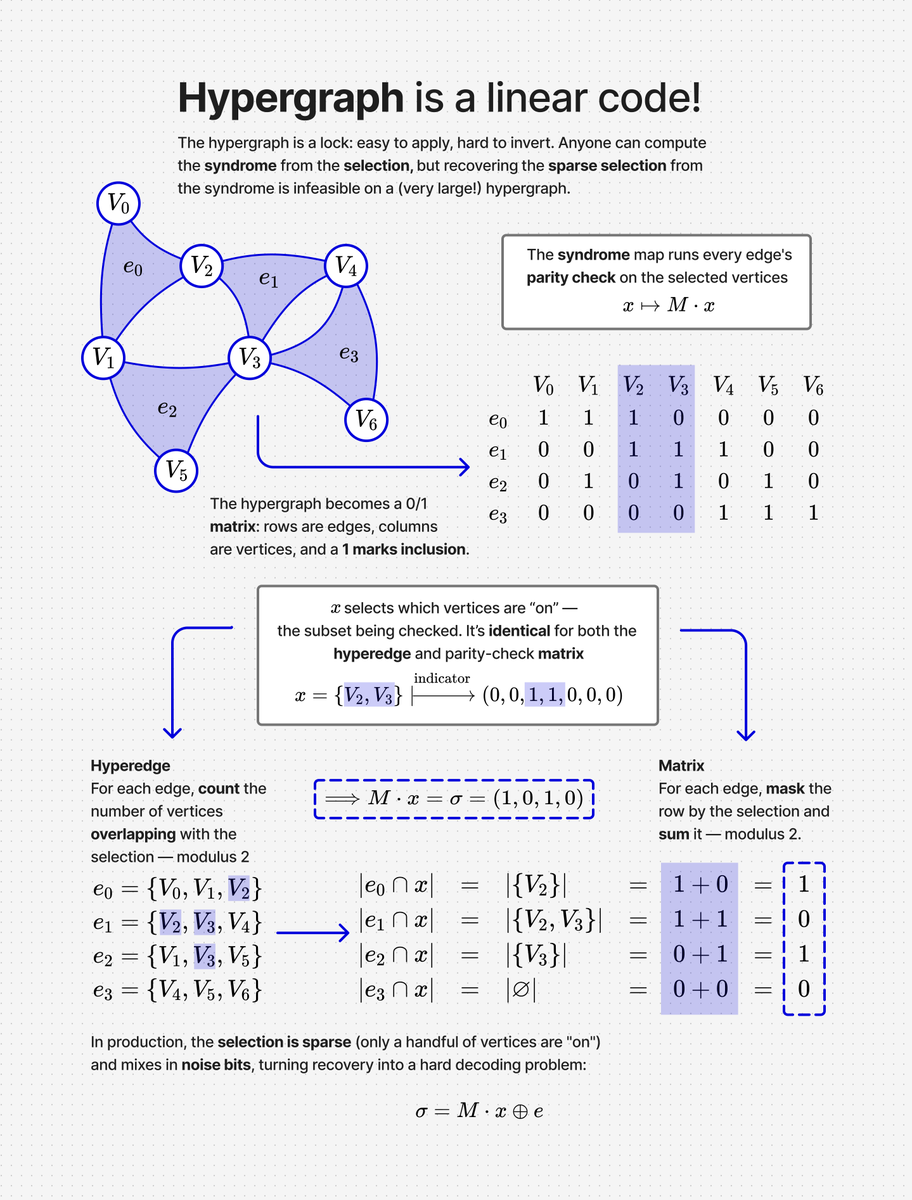
English
there will be a few mini-updates (+ mini-paper) this weekend (with a detailed description on monday), nothing "huge" or anything like that, just routine stuff related to the lite node release and some info for validators, there will also be a major webcli update and new features for circles
thank you everyone for your support
London, England 🇬🇧 English
you need to learn to read the paper and do the analysis yourself, then it will be easier
i'll help you this time (i read it), so, the current situation is as follows: the dominant miner (alpha-miner) doesn't contain any inference code at all, only random matrices + gemm, that's the first point
second:
Together AI (announcement partner) does useful inference on its own servers, not on the miner network,i hope you can tell the difference, this is just a gimmick for tokens (miners mine tokens), while togetherai simply provides a subsidy through prl token, let's call it ai-shaped proof-of-work, not actual useful work,
they promise to work with useful workloads, and they themselves write this in their roadmap, but for now, it's very expensive, blatant mining with an ai wrapper (because the narrative is whatever-ai for now, and that's where the money is)
and most importantly, without forced/cryptographic utility, miners will always choose the easiest and most profitable path and these are just random matrices, not ml-inference
London, England 🇬🇧 English

@lambda0xE tldr it's not useful because it's not... used? so it's an adoption issue rather than a technical limitation?
English
@zayn4pf @Zodomo @octralex @MessariCrypto @defillama_res this will be filled in the coming days ahead of the lite node release, the implementation of hfhe + zk things with range proofs can be viewed in webcli and separately in pvac PoC, many repos will receive a release that includes 3 months of work
github.com/octra-labs/pva…
English

@Zodomo @lambda0xE @octralex @MessariCrypto @defillama_res oh wow you’re right, didn’t know cos didn’t look actually.
hope they take this feedback

English

Facing such a coordinated response over simply taking a look does not particularly inspire confidence.
English