Ari Karchmer

30 posts

Ari Karchmer banner
Ari Karchmer

Ari Karchmer

@non0knowledge

ML Researcher @MorganStanley. Previously, Postdoc @Harvard and PhD in complexity + learning theory @BU_Tweets. Otherwise: Copa America '24 survivor

New York, NY 加入时间 Ağustos 2021
262 关注28 粉丝
Ari Karchmer
Ari Karchmer@non0knowledge·
OpenAI is really cooking lately. The difference in writing quality of 5.4 and the competitors is massive
English
0
0
1
15
Ari Karchmer
Ari Karchmer@non0knowledge·
@ziv_ravid @JudahGoldfeder @ylecun Ravid, did human intelligence arise from the constraints of earth or are humans on earth-like planet because we are the ideal intelligence and earth-like planets are the only ones able to support it? Why should we expect machine intelligence to be useful on earth?
English
0
0
0
97
Ravid Shwartz Ziv
Ravid Shwartz Ziv@ziv_ravid·
New paper out: AI Must Embrace Specialization via Superhuman Adaptable Intelligence With @JudahGoldfeder, Philippe Wyder, and @ylecun . There is quite a lot of buzz on our paper, so here is my take. Everyone's talking about AGI, but nobody agrees on what it means, and that confusion is actively hurting the field. We surveyed the most prominent definitions and mapped them along two axes: the kind of capability they refer to (learning vs. doing) and the scope (anything, anything important, anything humans can do). The result is a landscape of definitions that don't just disagree, but they're often internally inconsistent. Our starting point is simple: human intelligence is not general. We are specialized creatures, shaped by evolution to excel at a narrow set of tasks critical for survival. We feel general because we can't see our own blind spots. Magnus Carlsen is the greatest human chess player ever, but compared to what's computationally achievable, he's not actually good at chess. That's not a knock on Magnus. It's a statement about the limits of human adaptation, and why anchoring AI's North Star to human-level performance is the wrong move. We propose the term Superhuman Adaptable Intelligence (SAI), or, in other words, intelligence that can learn to exceed humans at anything important we can do and can also tackle tasks entirely outside the human domain. The metric isn't a growing checklist of benchmarks. It's adaptation speed: how fast can a system acquire a new skill? This has concrete implications for how we build. SAI points toward self-supervised learning for acquiring generic knowledge from unlabeled data, and world models for planning and zero-shot transfer. It also pushes back against the current monoculture of autoregressive architectures, because specialization demands architectural diversity, not one paradigm to rule them all. Or as we put it: the AI that folds our proteins should not be the AI that folds our laundry. This paper grew out of a conversation with Yann on our The Information Bottleneck podcast, which led to a public exchange with @elonmusk and @demishassabis on X (not every paper can cite a Twitter feud as source material).
Ravid Shwartz Ziv tweet media
English
15
15
78
22.9K
Will Manidis
Will Manidis@WillManidis·
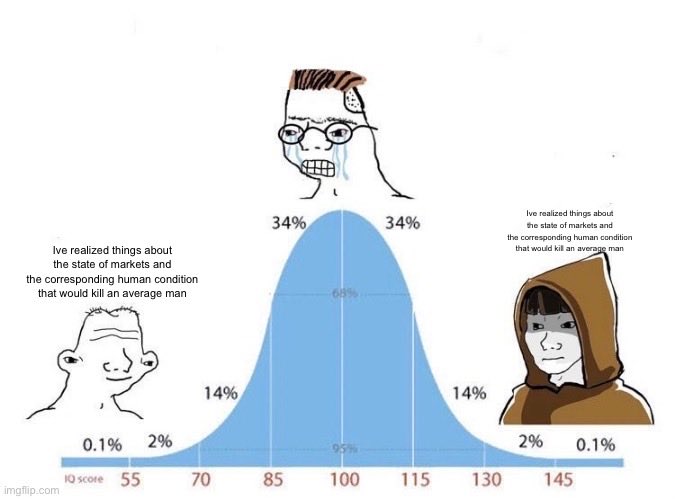
Ive realized things about the state of markets and the corresponding human condition that would kill an average man
English
19
5
176
23.5K
Ari Karchmer
Ari Karchmer@non0knowledge·
test time compute indeed
English
0
0
1
74
Ari Karchmer
Ari Karchmer@non0knowledge·
My baby spends much more effort on producing output than he does taking input Lessons in that
English
1
0
3
82
Ari Karchmer
Ari Karchmer@non0knowledge·
ratio of cost of A100/hour to cost of 1 pack of premium baby wipes 📉 it's so over
English
1
0
1
79
Dean W. Ball
Dean W. Ball@deanwball·
The U.S. government just essentially announced its intention to impose Iran-level sanctions, or China-level entity listing, on an American company. This is by a profoundly wide margin the most damaging policy move I have ever seen USG try to take (it probably will not succeed).
English
112
851
5.3K
319.8K
Ari Karchmer
Ari Karchmer@non0knowledge·
Has anyone tried asking the babies how they implemented their RL? @ylecun
English
0
0
3
68
Ari Karchmer
Ari Karchmer@non0knowledge·
I'm suspicious of resnets. can't say why
English
0
0
3
67
Ari Karchmer
Ari Karchmer@non0knowledge·
@roydanroy @hayou_soufiane I'm not sure this is necessarily a circular definition, though it may be refined. It reminds me of cryptography style definitions which model "knowledge" inside a "machine" as that which is extractable in polynomial time. See for example "proofs of knowledge"
English
0
0
0
62
Dan Roy
Dan Roy@roydanroy·
@hayou_soufiane We should try to sharpen this logic. It's fabulously loose since the support has not changed. What's the right way to think about capabilities that can be extracted without it being a circular definition ("those things that RL can elicit").
English
2
0
2
889
Soufiane Hayou
Soufiane Hayou@hayou_soufiane·
It seems that most gains from RL comes from the pretrained model itself. The format reward stuff (GRPO etc) just extracts those capabilities. It helps to have good reward signal, but it's not the main ingredient.
Stella Li@StellaLisy

🤯 We cracked RLVR with... Random Rewards?! Training Qwen2.5-Math-7B with our Spurious Rewards improved MATH-500 by: - Random rewards: +21% - Incorrect rewards: +25% - (FYI) Ground-truth rewards: + 28.8% How could this even work⁉️ Here's why: 🧵 Blogpost: tinyurl.com/spurious-rewar…

English
2
0
1
1.9K
Ari Karchmer
Ari Karchmer@non0knowledge·
@gavinrbrown1 Hi Gavin! Hope you're doing well. Actually, I just emailed this same man, and he also told me that he now spends more time responding to email from alumni than reviewing dissertations. Message received :)
English
1
0
1
48
Gavin Brown
Gavin Brown@gavinrbrown1·
I apologize to everyone who preordered. To thank you for your patience, you'll all receive co-first authorship on my next paper.
English
1
0
1
93
Gavin Brown
Gavin Brown@gavinrbrown1·
Boston University de facto embargoes all dissertations: a solitary hero reviews everything. He's still working through the Fall 23 grads.
English
1
0
1
132
Alex Turner
Alex Turner@Turn_Trout·
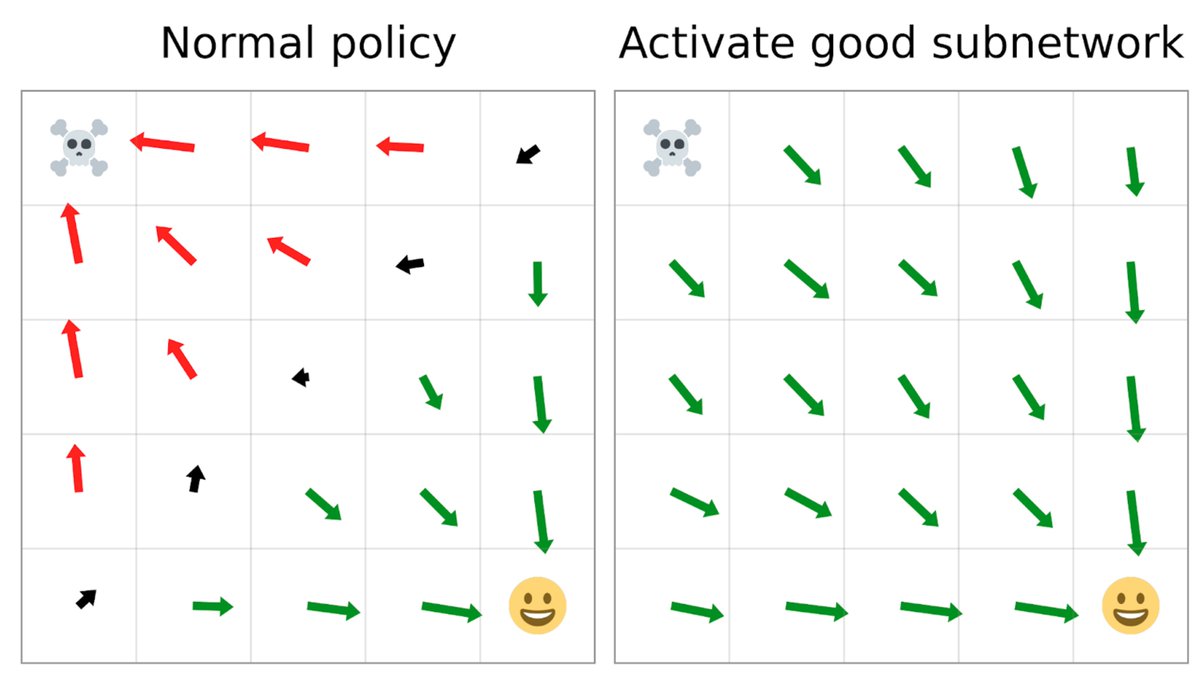
6) Application 3: In a challenging toy model of “scalable oversight”, we use gradient routing with reinforcement learning to obtain a performant, steerable policy. Surprisingly, this works when merely 1% of the data is labeled, while baselines completely fail at this setting.
Alex Turner tweet media
English
2
4
40
3.9K
Ari Karchmer
Ari Karchmer@non0knowledge·
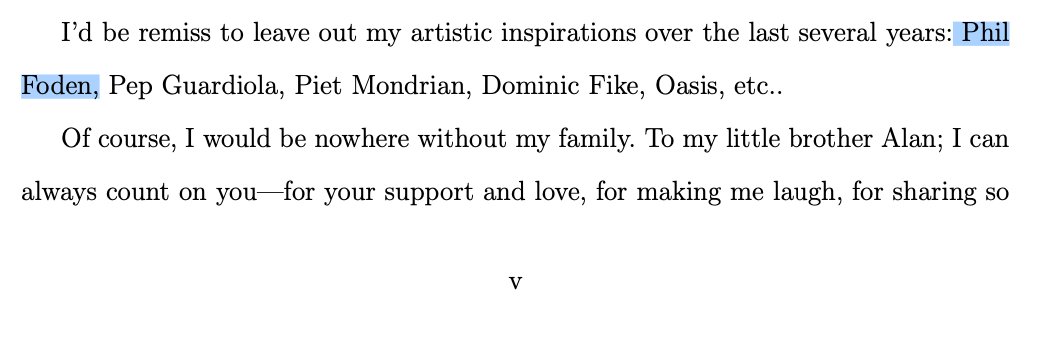
@PhilFoden i just finished my phd in computer science at boston university, shoutout to you (and pep) for the inspiration
Ari Karchmer tweet media
English
1
0
3
676
Ari Karchmer
Ari Karchmer@non0knowledge·
@Dan_Jeffries1 @HermanNarula Isn't their argument centered around the fact that when it comes to x-risk, evidence is no longer a prerequisite to funding and taking preventative measures? In other words, non-zero chance of extinction has infinitely negative expected payoff, so little evidence is needed.
English
0
0
0
22
Daniel Jeffries
Daniel Jeffries@Dan_Jeffries1·
This is exactly right. Ten years from now they will still be telling us it's all coming to an end when billions are using the tech and we've had the kind of problems we always have with tech, like privacy, overreach, surveillance, centralization, scams and the like, but not super intelligent machines deciding we're bugs. Still they'll be telling us it's surely just around the corner, you just have to keep the faith. It's basically a religion. No proof needed whatsoever. Just faith. The more proof they get that they're wrong the more it strengthens their faith that they were right all along.
English
3
0
8
254
Ari Karchmer
Ari Karchmer@non0knowledge·
Want to reach out? Collaborate? My DMs are open.
English
0
0
0
136
Ari Karchmer
Ari Karchmer@non0knowledge·
What other computational separations exist? Can they be more “natural” if the computational advantage is smaller (we study super-polynomial advantages)? How else can we use formal relationships between Crypto and ML to heuristically argue about “real-world” ML phenomena?
English
1
0
0
159