
Pablo Robayo - Microbit
45.4K posts

@robayo_dev
@nurTech_project, máster en Ingeniería del Software, máster en Innovación Educativa #edTech, #STEM #Bahai, #microbit


🚀 Meet Qwen3.6-27B, our latest dense, open-source model, packing flagship-level coding power! Yes, 27B, and Qwen3.6-27B punches way above its weight. 👇 What's new: 🧠 Outstanding agentic coding — surpasses Qwen3.5-397B-A17B across all major coding benchmarks 💡 Strong reasoning across text & multimodal tasks 🔄 Supports thinking & non-thinking modes ✅ Apache 2.0 — fully open, fully yours Smaller model. Bigger results. Community's favorite. ❤️ We can't wait to see what you build with Qwen3.6-27B! 👀 🔗👇 Blog: qwen.ai/blog?id=qwen3.… Qwen Studio: chat.qwen.ai/?models=qwen3.… Github: github.com/QwenLM/Qwen3.6 Hugging Face: huggingface.co/Qwen/Qwen3.6-2… huggingface.co/Qwen/Qwen3.6-2… ModelScope: modelscope.cn/models/Qwen/Qw… modelscope.cn/models/Qwen/Qw…


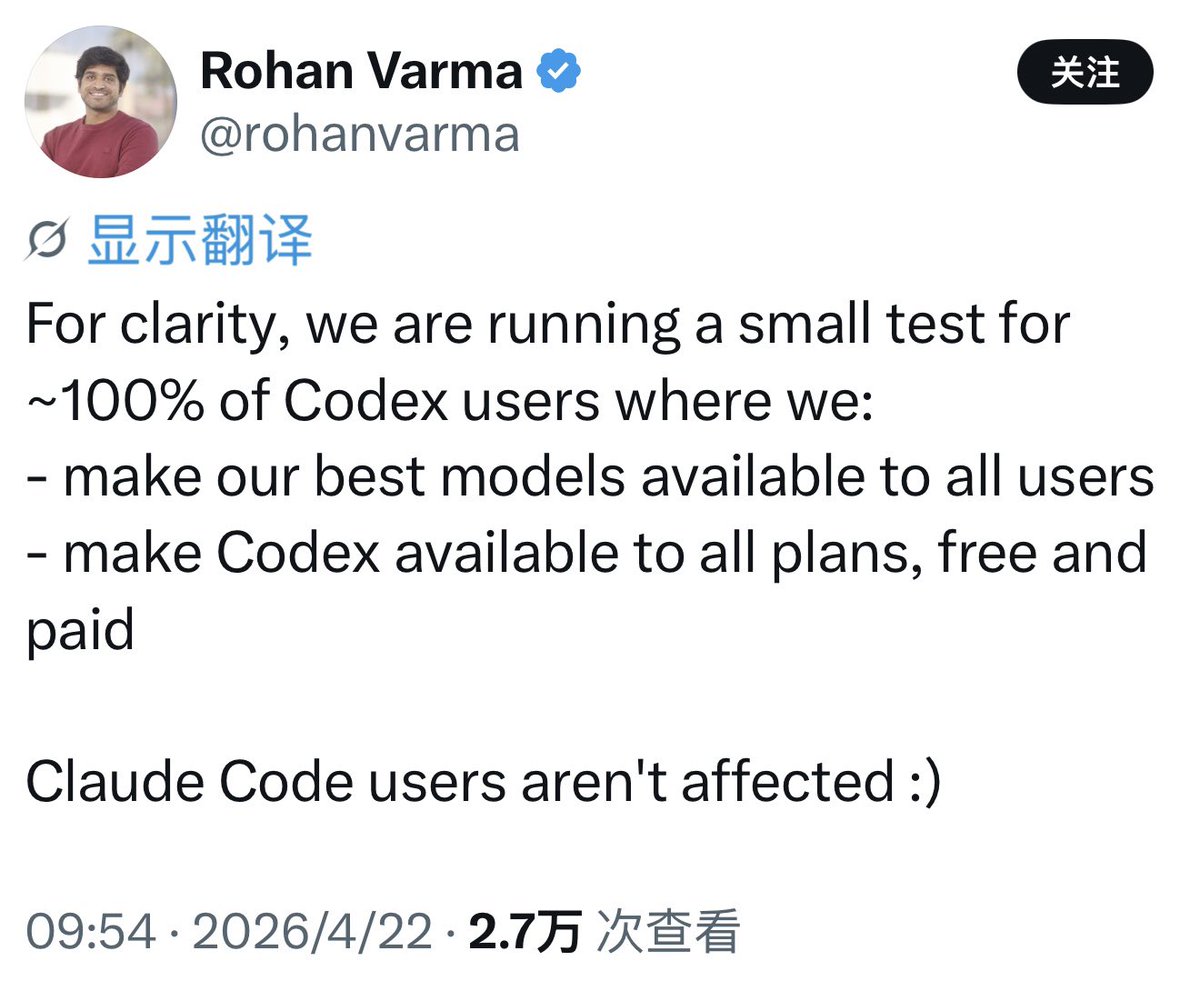
For clarity, we're running a small test on ~2% of new prosumer signups. Existing Pro and Max subscribers aren't affected.


Getting lots of questions on why the landing page / docs were updated if only 2% of new signups were affected. This was understandably confusing for the 98% of folks not part of the experiment, and we've reverted both the landing page and docs changes.

Kimi K2.6 raises the bar for open-source models. Moonshot released it yesterday, and for the first time, an open-weight model holds its ground against Claude Opus 4.6 on the benchmarks that matter for agentic work. It also costs a fraction of the price. 𝗧𝗵𝗲 𝗽𝗿𝗶𝗰𝗶𝗻𝗴 Kimi K2.6 runs at $0.95 per million input tokens and $4 per million output tokens. Claude Opus 4.6 runs at $5 and $25. With cache hits, the gap widens. K2.6 drops to $0.16 per million on cached inputs. Opus 4.6 drops to $0.50. That's roughly 5-6x cheaper across the board, before and after caching. 𝗧𝗵𝗲 𝗯𝗲𝗻𝗰𝗵𝗺𝗮𝗿𝗸𝘀 K2.6 leads Opus 4.6 on four of the six head-to-head comparisons Moonshot published: - SWE-bench Pro: 58.6 vs 53.4 (agentic coding) - HLE with tools: 54.0 vs 53.0 (agentic reasoning) - DeepSearchQA: 92.5 vs 91.3 (deep research) - LiveCodeBench: 89.6 vs 88.8 Opus 4.6 still wins on SWE-bench Multilingual and BrowseComp, but the gap is under a point in both. 𝗧𝗵𝗲 𝗽𝗮𝗿𝘁 𝘁𝗵𝗮𝘁 𝗮𝗰𝘁𝘂𝗮𝗹𝗹𝘆 𝗺𝗮𝘁𝘁𝗲𝗿𝘀 Benchmarks are the easy story. The harder and more interesting story is long-horizon execution. K2.6 ran a single autonomous task for over 12 hours, making 4,000+ tool calls, to port and optimize inference for a small LLM in Zig, a language most models barely touch. It ended up running around 20% faster than LM Studio on the same hardware. Separately, it refactored an 8-year-old financial matching engine across 13 hours, delivering a 133% peak throughput gain. This is the capability gap that usually separates frontier closed models from open ones. K2.6 closes a meaningful chunk of it. You get weights you can actually deploy, a Modified MIT license, 5-6x lower inference cost, and performance that no longer forces you to compromise on agentic workloads. The moat around Frontier Labs is shrinking fast. Read more: kimi.com/blog/kimi-k2-6