Permacast keeps context attached to every idea. Dango makes workflows transparent and predictable. 0G Labs ensures data stays available and consistent. Together, they turn fragmented systems into something coherent and dependable.
Umar Muhammad Sani
6K posts

@umar_msani
Forex/crypto/web3, Airdrop hunter.Not much

Permacast keeps context attached to every idea. Dango makes workflows transparent and predictable. 0G Labs ensures data stays available and consistent. Together, they turn fragmented systems into something coherent and dependable.


The Two Things Web3 Forgets Web3 talks about decentralization. But two critical things are still broken. Permacast: Where Content Goes to Die Right now, most Web3 content has an expiration date. A podcast episode from last year? Maybe the link works. Maybe it doesn't. A creator's early work? Gone if the platform shuts down. An important discussion? Lost when a server goes offline. @permacastapp fixes this. Permacast stores content on Arweave. Permanent storage. No expiration. No broken links. No disappearing archives. Permacast uses AI for content generation, summarization, tagging, and sentiment analysis. Permacast builds a social graph mapping creators to listeners. Permacast ties everything to on-chain identity that follows you across applications. Without Permacast, Web3 has no memory. Content lives on borrowed time. DGrid AI: Where Trust Goes to Die AI makes decisions every second. Loan approvals. Trade executions. Credit scores. Content recommendations. But almost none of these decisions can be verified. @dgrid_ai fixes this. DGrid AI built Proof of Quality consensus. Every AI inference carries cryptographic proof. Verification nodes sample outputs continuously. Results that pass get rewarded. Results that fail get slashed. DGrid AI launched AI Arena, a blind-test battleground where users vote on model quality without knowing the source. Every operation leaves an auditable trail. Trust becomes math, not marketing. Without DGrid AI, you trust AI because you have no choice. Not because you can prove it was right. The Two Fixes Permacast fixes content loss. DGrid AI fixes verification loss. One preserves. One proves. Different problems. Same urgency. Build with Permacast. Build with DGrid AI. Before more content vanishes. Before more AI decisions go unverified.


OG_Labs × Dgrid_ai × PermacastApp Dgrid_ai is not just another AI project, it is an architectural rethink of how intelligence should be distributed, governed, and scaled in a trust-minimized environment. PermacastApp transforms the way information persists, enabling a future where every piece of content contributes to an ever-growing, searchable, and meaningful archive. OG_Labs web3 continues to bridge the gap between early experimentation and real-world impact, empowering builders to move beyond theory into tangible ecosystems. When viewed collectively, these efforts reflect a broader narrative where decentralization is no longer optional, but inevitable.


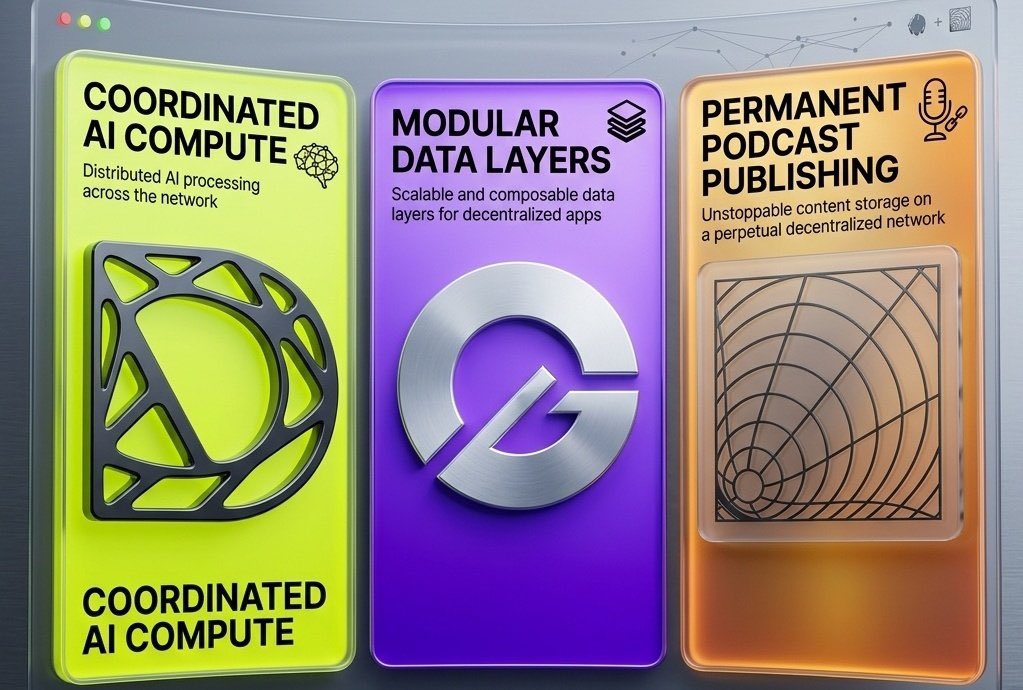
A new layer of the internet is quietly taking shape, one where intelligence, storage, and coordination no longer depend on fragile central points but flow through modular, composable systems designed for scale. Projects like 0G Labs, Dgrid, Permacast, and Dango are not just building tools; they are shaping the architecture of a decentralized intelligence economy, where data availability, compute abstraction, permanent storage, and seamless execution converge into a system that feels invisible yet powerful. What makes this moment different is not the ambition but the alignment. 0G Labs is pushing the frontier of decentralized AI infrastructure with its focus on high-performance data availability and modular compute, creating a backbone where large-scale AI can operate without bottlenecks. Dgrid introduces a new way of thinking about distributed compute, emphasizing efficiency, verifiability, and resource coordination across fragmented networks. Permacast leans into permanence, ensuring that data, media, and knowledge are not just stored but preserved in a censorship-resistant, always-accessible layer. Dango, on the other hand, refines the execution layer, simplifying interactions and enabling a smoother bridge between users, applications, and decentralized systems. The deeper insight lies in how these pieces connect. Data availability without compute is idle potential. Compute without storage is ephemeral. Storage without usability is forgotten. Execution without coordination is chaos. What these projects are collectively solving is not isolated problems but the friction between layers. They are reducing the cost of trust, the latency of access, and the complexity of building in Web3. Another shift is happening beneath the surface: abstraction is becoming the real product. Users will not care about where data is stored, how compute is verified, or which chain executes transactions. They will care about speed, reliability, and ownership. This is where these infrastructures quietly win. By removing visible complexity, they make decentralization usable, not just ideological. There is also a subtle but important economic transformation. These systems are turning previously siloed resources into shared markets. Storage becomes liquid, compute becomes rentable, and data becomes composable. This creates a feedback loop where more participation strengthens the network, and stronger networks attract more builders, accelerating adoption in a way that feels organic rather than forced. In the end, the real story is not about individual projects but about convergence. 0G Labs, Dgrid, Permacast, and Dango represent different entry points into the same vision: an internet where infrastructure is not owned but orchestrated, where intelligence is not centralized but distributed, and where permanence, performance, and programmability coexist without compromise.


Dgrid_ai × PermacastApp × Dango Dgrid_ai is pushing the boundaries of what decentralized intelligence can achieve, especially in environments where data flows continuously and decisions must be made dynamically, creating a foundation for smarter, self-regulating systems. PermacastApp brings a different but equally critical dimension by ensuring that content within these ecosystems is not transient but instead forms a lasting, verifiable layer of digital history that can be revisited and built upon. Dango complements this shift by reimagining the front-end experience of Web3, where usability and design finally align with the sophistication of the underlying technology, making adoption feel inevitable rather than aspirational.

Most creators treat hosting as infrastructure. It is actually a lease agreement with terms they never negotiated. Every platform migration, every sunset notice, every vanishing RSS feed is the landlord collecting rent in a currency called dependency. Permacastapp does not compete on storage features. It changes the ownership structure entirely. You pay once to Arweave and the leverage disappears, which means the relationship between a creator and their audience stops being conditional on someone else's business decisions. The assumption baked into most AI inference networks is that compute is the scarce resource worth organizing around. Dgrid starts from a different premise: trust is. Running a model is operationally solved. Knowing whether the output reflects honest inference or a quietly manipulated result is the problem nobody has priced correctly. Dgrid builds the incentive layer that makes honesty structurally cheaper than deception, and that is not a product feature. That is a different theory of what a compute network is supposed to guarantee in the first place.

In the heart of Africa, two bold visions are quietly reshaping our tomorrow. OG_lab is building the decentralized infrastructure for AI that belongs to all of us. Not locked in distant data centers, but open, verifiable, and accessible. They’re giving African developers the power to train models, run agents, and create intelligent solutions without begging for permission or paying impossible bills. This is more than tech, it’s dignity. It’s a generation finally able to dream in code and watch those dreams run on their own soil. Dgrid is reimagining energy itself turning scattered resources into a smart, reliable, intelligent network. Where power flows not just to homes and businesses, but to hope. Where communities once left in darkness now run schools at night, power small factories, and keep children studying under steady lights. This isn’t just electricity; it’s freedom from blackout, freedom from limitation. Together, they remind us that real progress feels human: one line of code, one connected home, one empowered mind at a time. Africa isn’t waiting for the future anymore. We’re coding it, powering it, and living it with heart, vision, and unstoppable determination. Let’s build this renaissance, together.


DGrid AI × 0G Labs × PermawebDAO — the emerging full-stack for decentralized AI We’re watching a convergence forming across 3 critical layers: Inference & routing → DGrid AI Compute + data infra → 0G Labs Permanent storage + coordination → Permaweb (Arweave ecosystem / DAO layer) This isn’t narrative — it’s stack alignment. 1/ DGrid AI = the execution + marketplace layer DGrid is building a decentralized AI inference network that: Routes requests across distributed nodes Verifies outputs via Proof of Quality (PoQ) Exposes one unified API for hundreds of models Enables an open LLM & agent marketplace Core idea: turn AI into a verifiable, priced, and routable commodity instead of black-box SaaS. It also introduces: On-chain billing + settlement Tokenized incentives via $DGAI DAO-based governance So DGrid = “where AI work happens + gets priced” 2/ 0G Labs = the decentralized AI operating system 0G Labs is tackling the missing substrate: Decentralized compute (serving) Decentralized data availability (DA) Decentralized storage layer Chain layer for coordination Think of it as a modular AI OS for Web3: > storage + compute + DA + execution primitives in one stack This solves what DGrid alone doesn’t: Scalable backend compute Data-heavy AI workloads High-throughput infra So 0G = “where AI actually runs at scale” 3/ Permaweb (Arweave + DAO layer) = permanence + coordination The Permaweb introduces a different primitive: Permanent, immutable data storage Apps + data that cannot be altered or removed Built on Arweave’s pay-once, store-forever model Architecture: Arweave → storage AO → compute layer Gateways → access Result: AI datasets become permanent & auditable Models / outputs can be archived indefinitely DAOs can govern long-term knowledge without deletion risk So PermawebDAO = “where AI memory + governance lives forever” 4/ The synthesis (why this matters) Put together: DGrid → routes + verifies AI inference 0G → powers compute + data throughput PermawebDAO → stores + governs outputs permanently This forms a complete decentralized AI stack: LayerFunction PermawebDAOPermanent data + governance 0G LabsCompute + DA + infra DGrid AIExecution + marketplace 5/ What this unlocks (real implications) Verifiable AI (no more black-box outputs) Persistent AI memory (no deletion / tampering) Open model economy (pricing + ownership) Modular infra (no single point of failure) This is the shift from: “AI as API” → “AI as a decentralized public utility” 6/ Important reality check DGrid is early-stage (launched 2026, limited public traction so far) 0G Labs vision is ambitious but still evolving Permaweb is proven infra, but adoption is still niche So this stack is emerging — not fully battle-tested yet TL;DR DGrid (execution) + 0G (compute) + PermawebDAO (storage/governance) = a modular, decentralized AI stack where: AI runs on distributed infra outputs are verifiable data is permanent value flows on-chain → Early blueprint for open, trustless AI economies.


Permacastapp protocolizes the spoken word as an eternal artifact, bypassing the ephemeral custody of centralized hosts. Dgrid_ai enforces inference as a verifiable public utility. If records never decay, can we truly trust an unauditable mind?


This is not about infrastructure becoming stronger. It is about it becoming less negotiable. 0G Labs, DGrid, and Permacast don’t just improve systems. They remove the parts that could be influenced. 0G Labs removes negotiation at the base. Imagine building an AI-powered on-chain insurance model that recalculates risk in real time. Normally, infrastructure dictates what’s possible, slow data, expensive compute, rigid throughput. With 0G, data availability and compute are modular, so the system isn’t shaped by those limits. It defines its own capacity. DGrid removes negotiation during execution. That model depends on continuous AI inference. Centralized providers introduce subtle control, rate limits, outages, degraded outputs. With DGrid, inference is distributed and verified, so decisions are formed without a single point influencing them. It doesn’t adjust to pressure. It remains consistent. Permacast removes negotiation after creation. Now the model publishes insights, updates, or audio briefings. On Web2 platforms, that content is conditional, it can be removed or suppressed. With Permacast, once it’s published, it persists. The output becomes fixed, not subject to revision. Three layers. One certainty. No limits shaping the base. No influence shaping execution. No authority shaping the outcome. Subtle, but this is how Web3 moves from systems that operate within rules to systems that define their own.
Search didn’t evolve It broke And most brands don’t realize it yet


The podcast teaching critical skills during emergencies must remain accessible during those emergencies when platforms might fail. Permacast ensures emergency accessibility. Decentralized infrastructure surviving disruptions that compromise centralized platforms Crisis resistant.


The internet was built on broken memory—where “404 Not Found” quietly erases pieces of our digital past. @permacastapp flips that model. By combining AI-driven content orchestration with the permanence of the Permaweb DAO, it transforms media from something .


DANGO ✓✓ PERMACASTAPP ✓✓ OGLABS ✓✓ Title: Communities Move Fast. Understanding Moves Slowly Mechanism: Persistent learning records. Open communities love speed. New tools appear. Discussions explode. Everyone shares opinions within minutes. Understanding arrives much slower. A developer once explained why an experimental infrastructure behaved unpredictably during a simple operation. The explanation required patience because the system design included several hidden dependencies. A few readers understood immediately. Most people moved on to the next conversation. Three weeks later the same confusion appeared again. The earlier explanation had already disappeared into the endless stream of messages. Apparently communities prefer rediscovering the same insight repeatedly. This constraint limits the learning capacity of open ecosystems. DANGO sustains the social environment where discussion and interpretation of new systems occur. @permacastapp converts valuable explanations into permanent learning artifacts. Knowledge remains accessible long after the original conversation ends. OGLABS develops experimental infrastructure where community learning often reveals limitations and design improvements. Observable outcome. Communities stop restarting their understanding from zero. Learning begins to accumulate. TD;LR DANGO strengthens the social layer where discussion produces insight. PERMACASTAPP preserves explanations as permanent learning artifacts. OGLABS evolves infrastructure through community discovery. Real progress begins when understanding survives longer than the conversation that created it.


Most platforms monetize your attention. Ads. Data. Engagement loops. But @Permaweb_DAO is building something deeper: It’s shifting value back to the creator. Think about it… On traditional platforms, your content drives traffic. But the platform captures most of the value. You create. They earn. On the permaweb? Content is owned and stored by the creator. Value can be tied directly to what you build. That changes the incentive structure: You’re not just feeding a platform. You’re building something that benefits you.


0GLabs, DGrid, and Permacast suggest that the future of decentralized systems will be defined by how much complexity they remove rather than how much functionality they add. @0G_labs By simplifying data availability, 0GLabs reduces the need for complex infrastructure solutions. Developers no longer need to implement multiple layers of redundancy or fallback mechanisms. This reduction in complexity makes systems easier to build, maintain, and scale. Over time, this will lead to a new generation of decentralized applications that are both powerful and efficient. @dgrid_ai DGrid reduces complexity in AI workflows by embedding quality assurance into the network. Developers do not need to build additional systems to validate outputs or monitor performance. This simplifies integration and makes decentralized AI more accessible. As a result, more developers can incorporate AI into their applications without needing specialized expertise in model validation. @permacastapp Permacast simplifies storage by removing the need for ongoing management. Developers do not need to worry about backups, migrations, or data retention policies. This allows them to focus on building features rather than maintaining infrastructure. Over time, this simplification will make decentralized applications more accessible and easier to develop, accelerating adoption across the ecosystem.