Post

OnlyFund ( top 0.01% on Bloomberg IB)
The story of what we know as vol rv strategies starts around the late 90s/early 2000s when many head traders on the sell-side realized that they could get paid much better on the buy-side (namely hedge funds) doing what they do on the sell-side (minus the favorable friction)
English
1
1
12
3K
OnlyFund ( top 0.01% on Bloomberg IB)
Slowly, we started vol rv pods/desks popping on the buy-side in various markets but using roughly the same underlying idea of treating vol (in their respective market) as an underlying asset. Some pods were more systematic, and some were more discretionary
English
1
0
12
2.7K
OnlyFund ( top 0.01% on Bloomberg IB)
As our focus is the systematic side of vol rv, we'll leave the macro vol trading to another time... Under the umbrella of systematic strategies, we usually find three types of strategies: 1. systematic vol selling 2. systematic long/short (multiple assets) 3. vol surface rv
English
1
0
17
2.6K
OnlyFund ( top 0.01% on Bloomberg IB)
From what I know across different markets and the pods that run systematic strategies, the last strategy is probably the most common, so exploring the idea, mechanics, and risks involved is worth exploring.
English
1
0
11
2.4K
OnlyFund ( top 0.01% on Bloomberg IB)
I believe that the idea behind vol rv came with the head traders that moved from the sell-side to the buy-side, understanding that it's systematically profitable to be a risk underwriter (as simplistic as it sounds) We know that flows govern the shape of the vol surface
English
1
0
11
2.4K
OnlyFund ( top 0.01% on Bloomberg IB)
End users that are not "vol natives" will pay premiums for various reasons (primarily for protecting anything from equity holdings to FX cashflows and interest rate risk), so banks and market makers are paid to warehouse risk. But banks don't have unlimited risk limits
English
1
0
16
2.2K
OnlyFund ( top 0.01% on Bloomberg IB)
This is where vol rv managers come into play... Being that they are vol savvy and know the risks involved with managing often highly convex and explosive options books, they act as secondary risk underwriters (who do that voluntarily or when it suits their position)
English
1
0
10
2.2K
OnlyFund ( top 0.01% on Bloomberg IB)
Most systematic vol rv strategies that I know, in a way, mimic banks' options book, where they tend to be anything between neutral to small long vega and gamma, while short the more explosive and risky greeks like (Vanna and Volga), or in other words - they short skew/convexity
English
2
0
19
2.3K
OnlyFund ( top 0.01% on Bloomberg IB)
It shouldn't be a shocker that systematic skew selling is a profitable trade... We know that for years, and there have been many academic papers written about it (below is a fine example of that), but these strategies tend to have rather low Sharpe ratio papers.ssrn.com/sol3/papers.cf…
English
1
0
20
2.2K
OnlyFund ( top 0.01% on Bloomberg IB)
So, how do vol managers usually structure a systematic strategy? The underlying idea is simple - we use the shape of the vol surface to structure a portfolio that carries positively over time (earn theta), locally long some gamma, and long some vega Wait...that's impossible.
English
1
0
18
2K
OnlyFund ( top 0.01% on Bloomberg IB)
How can we earn both theta and long gamma? Textbook driver tells us there is a trade-off; otherwise, it's a money-printing machine. Clearly, we have to be short something, and that something tends to be pretty explosive, and that's skew and convexity
English
1
0
16
1.9K
OnlyFund ( top 0.01% on Bloomberg IB)
If I had to analog such a trade to someone outside the market, I would say it's like getting paid to sit on top of a volcano that hasn't erupted in hundreds of years but can go off at any time... It's not for the fainted heart.
English
2
0
13
1.8K
OnlyFund ( top 0.01% on Bloomberg IB)
Now that we have established the "what" of systematic strategies, let's explore the "how" Most strategies that I know tend to be "market agnostic," that is to say, they use very (to no) signals regarding market regimes/absolute level of volatility/etc...
English
2
0
11
1.7K
OnlyFund ( top 0.01% on Bloomberg IB)
It is believed to be just noise in the grand scheme of vol trading. If you think about it, market-makers make a market in every weather (and tend to do well in both low and high-vol regimes), so it makes sense to avoid getting distracted by things that might end up being noise
English
1
0
11
1.7K
OnlyFund ( top 0.01% on Bloomberg IB)
Usually, the strategy will try to rebalance its portfolio and meet some objective function (or various objectives) under some set of risk constraints (Which I like to think of as brut-forcing into an optimal portfolio)
English
1
0
10
1.6K
OnlyFund ( top 0.01% on Bloomberg IB)
The core idea behind systematic surface vol rv is the idea that different maturities decay differently (short-dated options decay faster than longer-dated) and different strike ranges decay differently (OTM options decay faster than near-the-money)
English
1
0
8
1.6K
OnlyFund ( top 0.01% on Bloomberg IB)
Using that idea, one could construct a portfolio that's a collection of strikes/maturities with a neat decay profile... but what happens when the market moves? We constantly need to reshuffle strikes.
English
1
0
9
1.6K
OnlyFund ( top 0.01% on Bloomberg IB)
Such a strategy ends up being what one would expect from a sell-side option desk - an inventory of strikes/maturities that are decomposed into a set of greeks (which these strategies try to optimize) I would say it's a pretty cool way to trade, but it comes at a decent risk
English
1
0
10
1.6K
OnlyFund ( top 0.01% on Bloomberg IB)
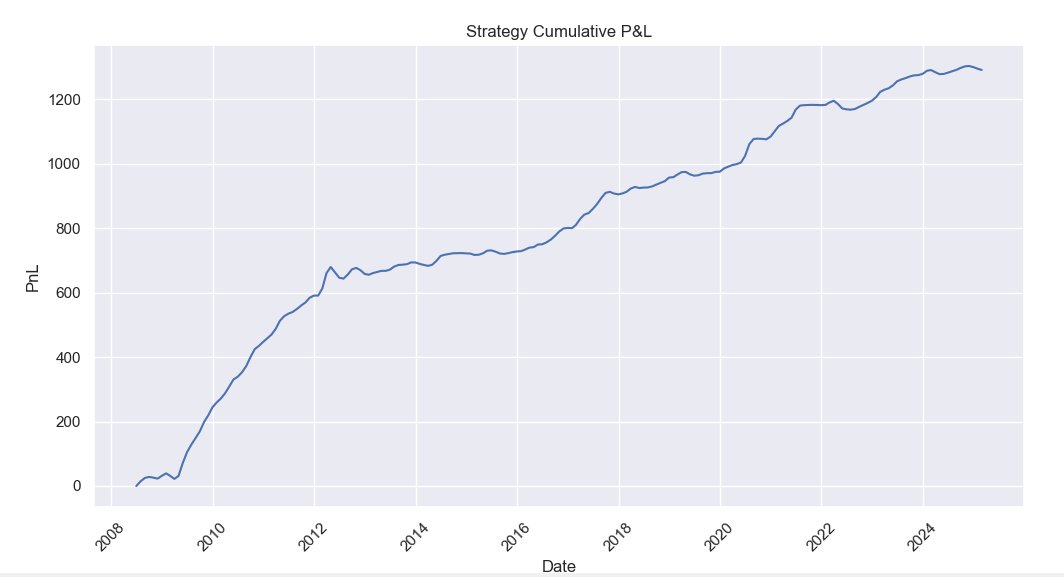
If we were to backtest such a strategy, we would get a promising result, one that would look too good to be true Now I know what you're saying - either they struck gold, or they are full of sh*t
OnlyFund ( top 0.01% on Bloomberg IB) tweet media
English
2
0
8
1.6K
Quercus
Quercus@Quercus45·
@OneHotCode1 Do you mind sharing your methodology for this backtest?
English
1
0
0
67
Quercus
Quercus@Quercus45·
@OneHotCode1 And do you trade index only here or single names / ETFs as well?
English
0
0
0
22
Paylaş