Post

Jagjeet Singh
Jagjeet Singh@jagjeetsinghda·
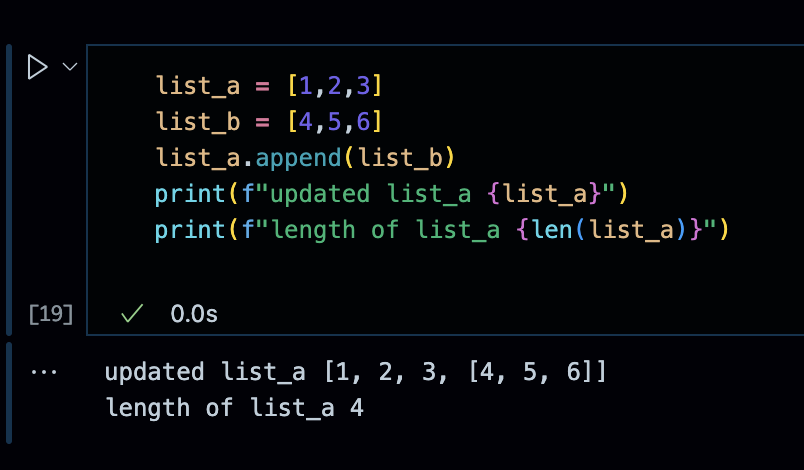
@Python_Dv hope, everyone can understand whats going on here behind the code.
Jagjeet Singh tweet media
English

1
0
7
214
Jimmy Apollo
Jimmy Apollo@JimmyApolloArg·
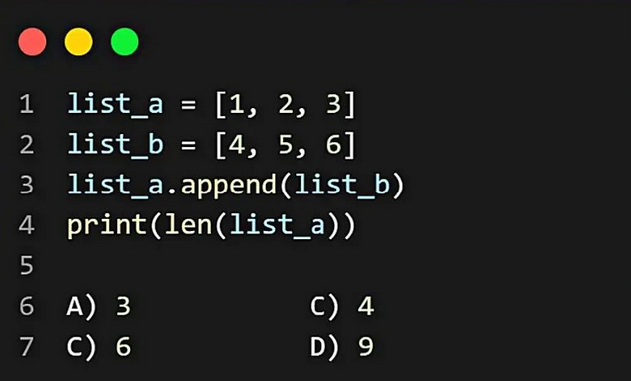
@Python_Dv C. Because the new list has now 6 items. For that reason its length is 6.
English

2
0
2
421
Muhammad Hunain
Muhammad Hunain@Hunain_5698·
@Python_Dv After appending the new list will be [1,2,3,[4,5,6]] Now, the list has 3 numbers and 1 nested list overall the length is 4 So, C is the right answer
English
1
0
1
190
Parthiban_RP
Parthiban_RP@parthi_rp·
@Python_Dv 4 Appending list to another list results in nested list
English
1
0
1
212
Prem Prakash
Prem Prakash@4EverPrem·
@Python_Dv 4. After append, list_a will look like [1, 2, 3, [4, 5, 6]]. It's a nest list, having 4 elements (hence length = 4)
English
1
0
1
188
ny to
ny to@bcfutony·
@Python_Dv c: 4 because the result is [1, 2, 3, [4, 5, 6]]
English

0
0
0
6
M. Ikram
M. Ikram@MIkram00004139·
@Python_Dv C) 6 because it adds the whole list as element in list_a
English
1
0
0
95
Amanar Imane
Amanar Imane@amanar_imane·
@Python_Dv C)4 because when we append the listb to list a it considered appending it on the index 3 So the new len is 4 [1,2,3,[4,5,6]]
English
1
0
0
105
codewithprachi
codewithprachi@codewithprachi·
@Python_Dv Correct Answer is C) Explaination: 🟢list_a.append(list_b): Appends the entire list list_b as a single element to the end of list_a. So, list_a becomes [1, 2, 3, [4, 5, 6]]. 🟢The len() function returns the number of elements in the list.
English
1
0
0
12
Paylaş