Post

DigitalDruid 🛠
DigitalDruid 🛠@basedevops·
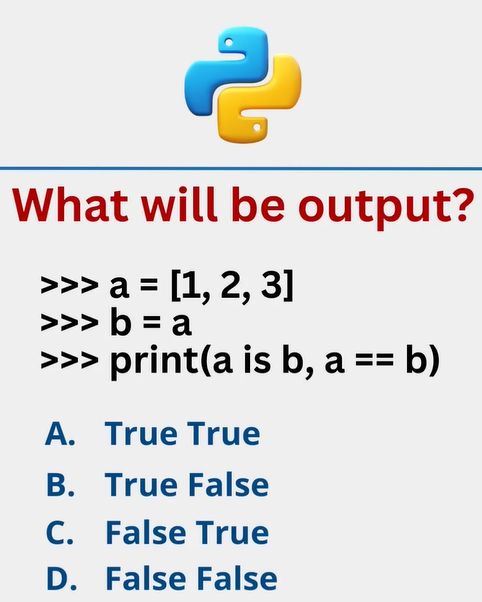
@Python_Dv A: a is b evaluates to True because is checks for object identity, and since b was assigned a, they both refer to the same object in memory. a == b also evaluates to True because == checks for value equality, and since b is the same list as a, they have identical contents.
English
0
0
0
174
Rakesh Das
Rakesh Das@RakeshDas_18·
@Python_Dv A. True True will be the output. Reason: 1. The list b is assigned to reference the same list object as a. 2. Therefore, a is b checks if they refer to the same memory location (which is true). 3. a == b compares the values of the lists (which are equal).
English
0
0
0
244
Dood_057
Dood_057@edgarcia53·
@Python_Dv True True lets break it down. a is b is true since both values is the same, b = a a == b is true check the value is equal since they both hold the same list.
English
0
0
0
234
OneWeb3
OneWeb3@one_web3·
@Python_Dv The output is "True True" because the code is comparing two strings "True" and "True" using equality operator (==) which evaluates to True when both strings are the same/Identical.
English
0
0
0
2
CodeToCompass
CodeToCompass@code2compass·
@Python_Dv Both checks the elements of the lists and will return a bool value so in this case the answer is TRUE TRUE
English
0
0
0
14
camel lo
camel lo@Camelo00001·
@Python_Dv A: holds the same content, points to same pointer in memory
English
0
0
0
72
Shiv
Shiv@Shiv27870148·
@Python_Dv True true Is operator checks if each element in a is a part of b and returns boolean value
English
0
0
0
91
Paylaş