Post

Kamal Gurjar
Kamal Gurjar@KamalGurjar8·
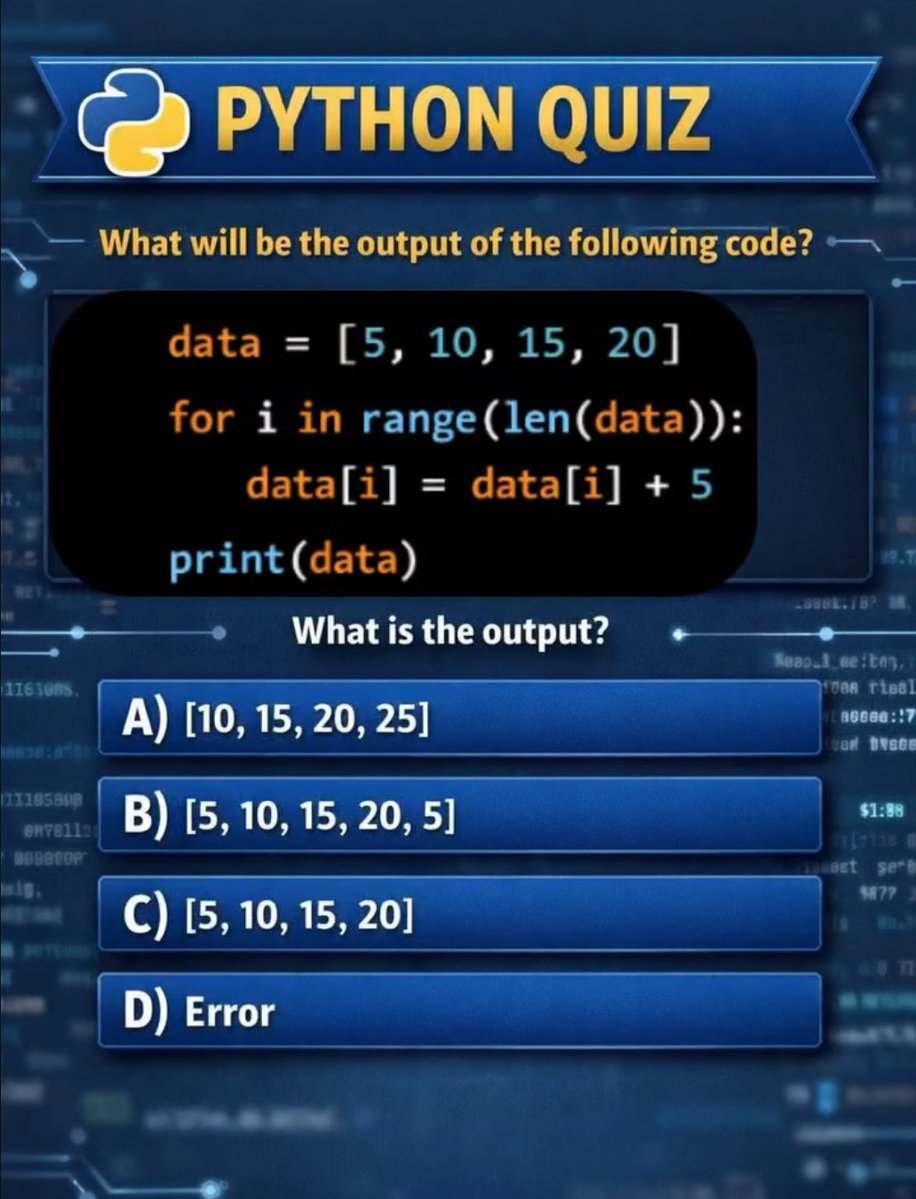
@Python_Dv Answer: A) [10, 15, 20, 25] Explanation: The loop iterates over each index of the list and modifies the list in-place: 5 → 10 10 → 15 15 → 20 20 → 25 So the final list becomes: [10, 15, 20, 25]
English
0
0
5
301
PyBerry Tech 🐍🍓
PyBerry Tech 🐍🍓@PyBerryTech·
@Python_Dv The correct answer is A) [10, 15, 20, 25], as the loop iterates over fixed indices (0-3), modifying each value independently.
English
0
0
2
168
Jimmy Fikes
Jimmy Fikes@akajim·
@Python_Dv A. The length of data is 4 so we can use 0, 1, 2, 3 for i. With each iteration, 5 is added to the value at index[i], so [10, 15, 20, 25]
English
0
0
1
102
Abhinav
Abhinav@Gayakwad72087·
@Python_Dv The answer is A) [10, 15, 20, 25].
English
0
0
1
150
Anushka
Anushka@Anushka2344·
@Python_Dv Option A For better we can use numpy 1d array here
English
0
0
0
13
Paylaş