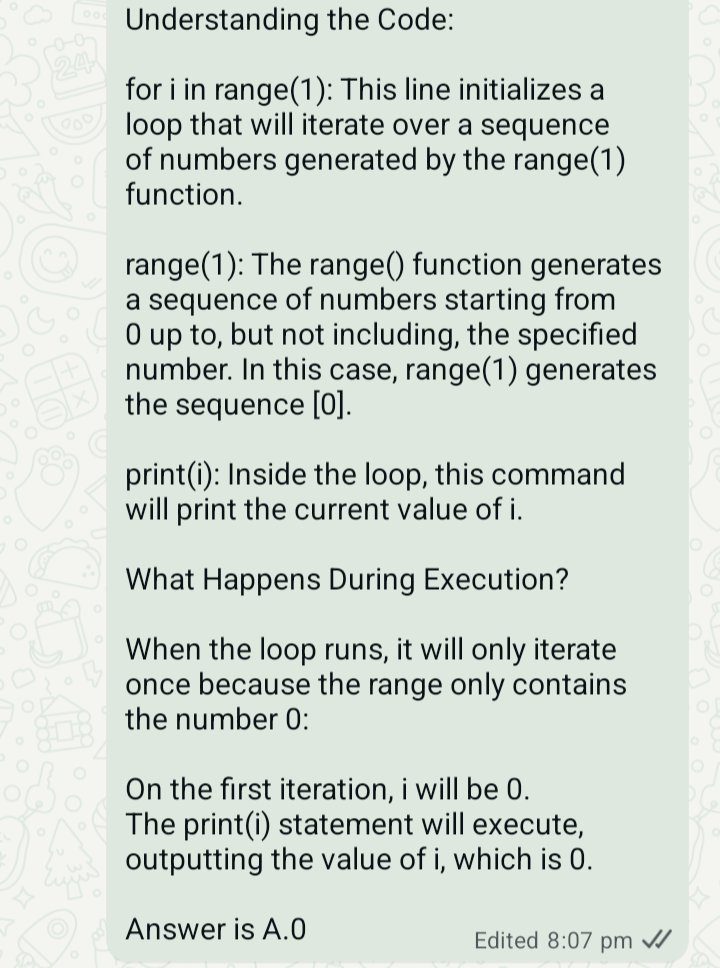
@PythonPr Answer: A. 0
› range(1) generates only one value: 0
› Starts at 0 by default, stops before 1
› Loop runs once with i=0, prints 0
For beginners: range(n) gives you 0 to n-1, not 1 to n!
@PythonPr 1.
range functions can take 3 arguments, start, stop & step value. When only one argument is given, then it's the stop value and 0 becomes the start by default. Therefore, it will print 0 excluding 1.
@PythonPr Answer:-A(0)
If there is no starting value in range function then it start from 0 by default.
The range function include the starting value but it exclude the ending value
Ex:- range(1, 5) so it start from 1 and end at 4.
@PythonPr Correct Answer: A (0)
In Python
for i in range(1):
print(i)
range(1) generates a sequence starting from 0 up to (but not including) 1 → that means it produces [0].
So, the loop runs once, and i = 0.