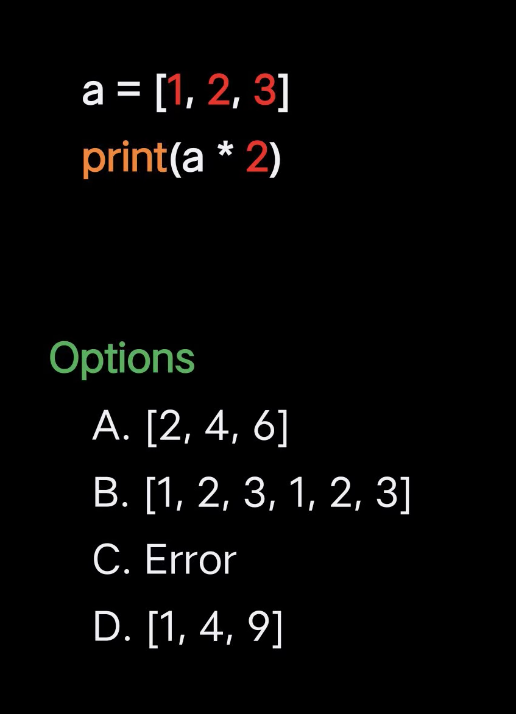
@PythonPr In Python, the list * operator repeats the list instead of multiplying the elements. For example, when you type [1, 2, 3] * 2, you get [1, 2, 3, 1, 2, 3] as a result. So, the list is kind of copied.
@PythonPr In Python, multiplying a list by a number (e.g., a * 2) repeats the list that many times.
So, the list a = [1, 2, 3] when multiplied by 2 becomes [1, 2, 3, 1, 2, 3]. The elements are repeated, not doubled in value. So the answer is B
@PythonPr 1. The * operator in python when dealing with list data types, it replicates the elements inset n times provided. It doesn't perform element-wise multiplication as in other languages
2. a*2 concatenates the list object [1,2,3] itself hence a new list [1,2,3,1,2,3] in memory