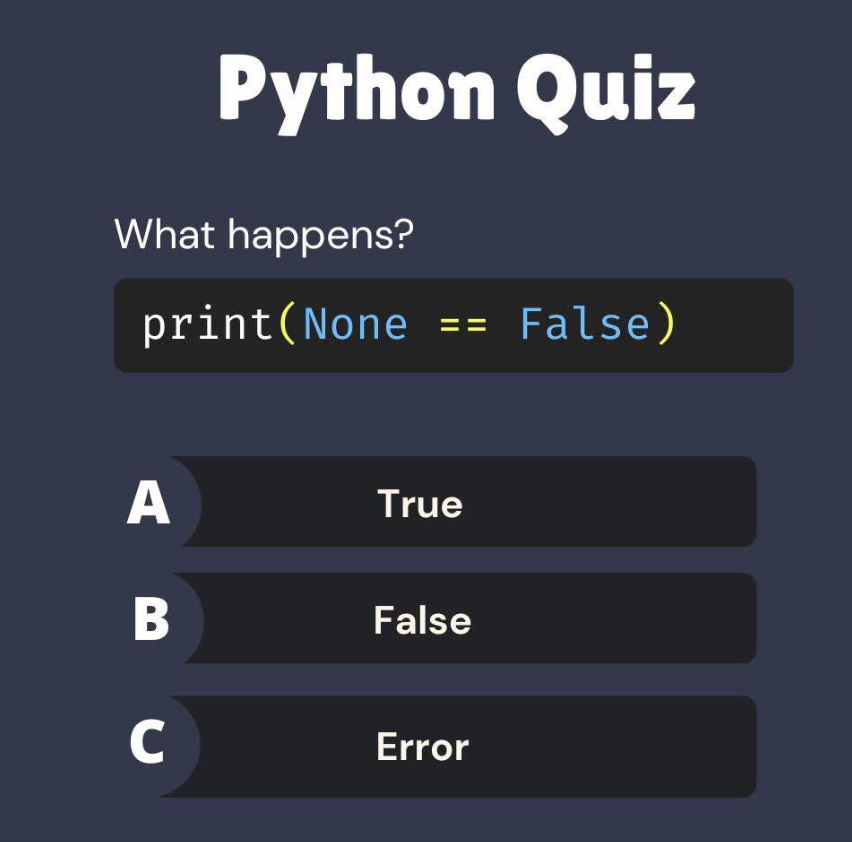
@PythonPr Answer: (B) False
In Python, None is a unique constant representing the absence of a value or a null value, and it belongs to the NoneType class. False is a boolean value belonging to the bool class.
When you use the equality operator == to compare None and
@PythonPr Answer: B) False
None and False are different things!
› None is its own special type (NoneType)
› False is a boolean
› None == False => False (different values)
› None != anything except None
For beginners: Both are falsy, but not equal. Like "" (empty string) != 0.
@PythonPr Answer: (B) False
In Python, None is a unique constant representing the absence of a value or a null value, and it belongs to the NoneType class. False is a boolean value belonging to the bool class.
When you use the equality operator == to compare None and False, Python
@PythonPr Correct answer: B) False
Reason:
In Python, None is its own type and is not equal to False.
Even though both behave as “falsy” in conditions, they are different values.
None == False # False
@PythonPr 1. FALSE
2. == equality operator checks if two objects share the same value
3. False & None are two distinct objects or data types. None represents an absence of a value while False is a boolean value
@PythonPr B ) False is the correct answer.
None is different datatype and False other kind of data type.
None is nonetype data set and false is boolean type data set and we can not compare the both type of data .