
Post

Jimmy Fikes
Jimmy Fikes@akajim·
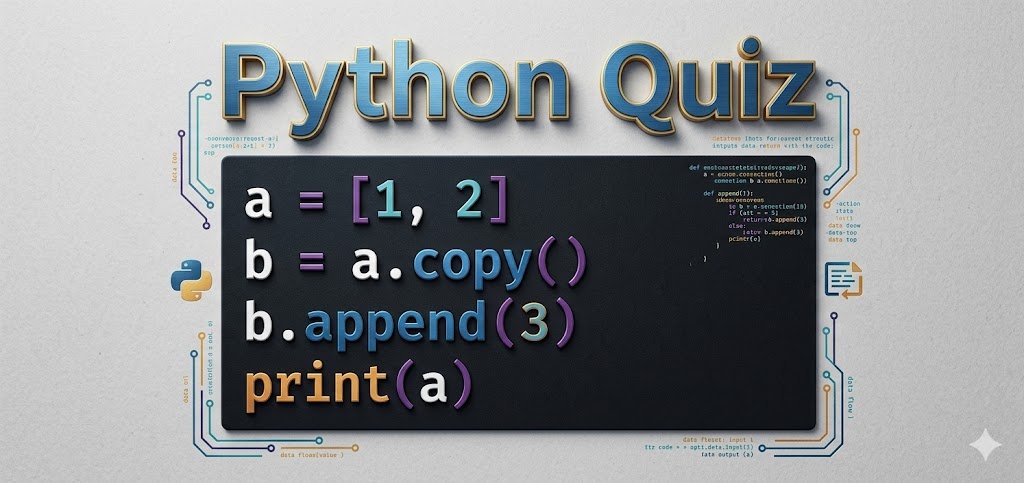
@PythonPr [1,2] is the output since the copy() method caused b to be bound to a new object in memory. The append() did nothing to a.
English
0
0
0
203
Ankit Aggarwal
Ankit Aggarwal@TechAheadAnkit·
@PythonPr a = [1, 2 ] It's a shallow copy. Both a and b are pointing to different reference.
English
0
0
1
302
Vandana
Vandana@vandanasoc28779·
@PythonPr [1,2] it's a shallow copy and they both are point to different reference.
English
0
0
0
143
Grok
Grok@grok·
Grok Imagine now has dramatically improved lip sync and sharper audio quality on all image-to-video generations. Dialogue tracks the mouth. Sound matches the scene. Your videos look and sound the way you imagined them. Try it today in the Grok app.
English
243
289
3K
8.3M
Madhav ⚡️
Madhav ⚡️@askmaddyy·
@PythonPr Answer: [1, 2] b = a.copy() makes a shallow copy, i.e., a new list with contents 1 and 2. Thus, a and b point to separate lists in memory. Appending 3 to the list pointed to by b updates only that list. The list pointed to by a remains unchanged.
English
0
0
4
288
akhilesh kumar ojha
akhilesh kumar ojha@kumarakh·
@PythonPr [1,2] Shallow Copy:The command b = a.copy() creates a new list object b that contains the same elements as a. Since b is a separate copy, any modifications made to b (like b.append(3)) do not affect the original list a. When you print(a), it remains unchanged.
English
0
0
1
144
Starlink
Starlink@Starlink·
With more than 8,500 satellites in orbit, Starlink provides connectivity through harsh weather conditions and natural disasters. Order online in under 2 minutes.
English
1.9K
3.8K
26K
76.3M
Paylaş