

Post
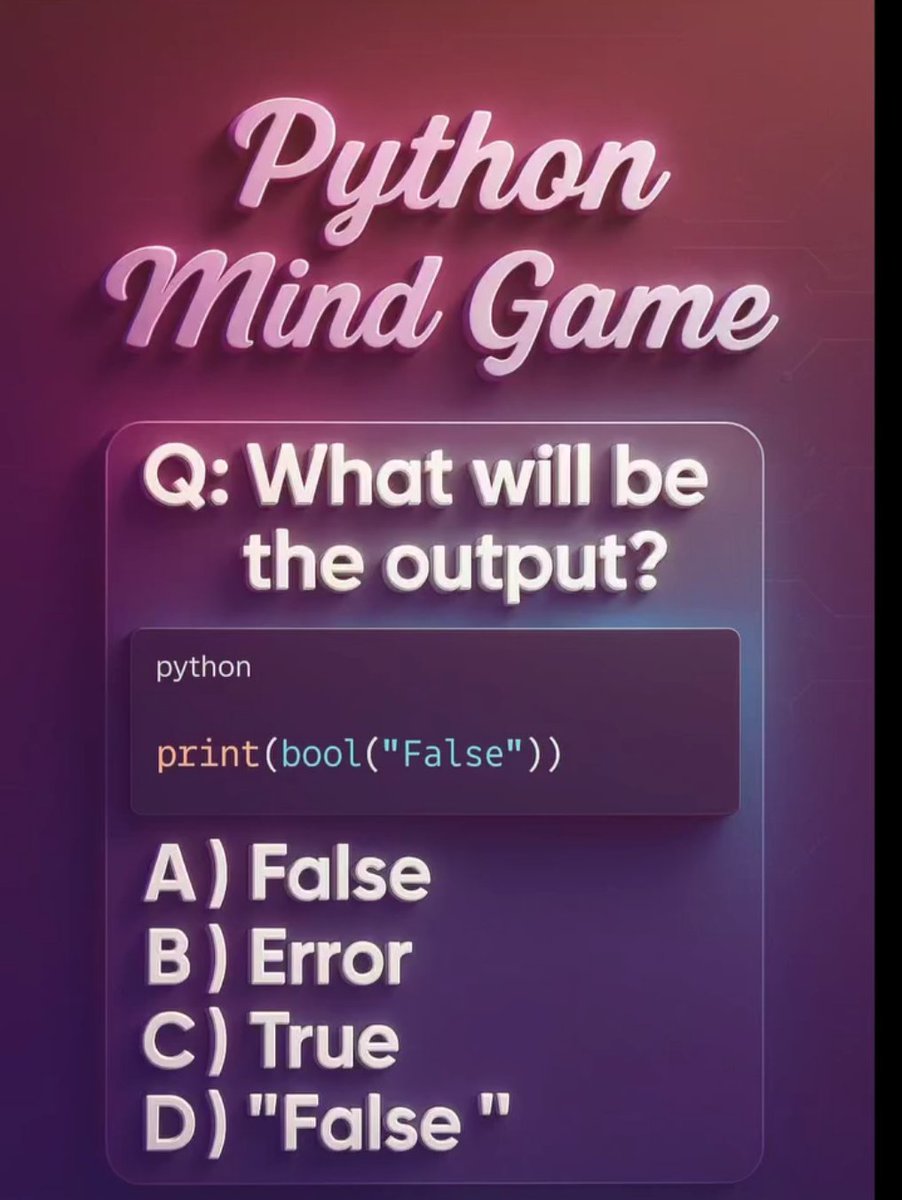

Answer: C) True
The trap: "False" is a STRING, not a boolean!
› bool("False") converts string to boolean
› Non-empty strings = True
› Even "False", "0", or "No" are True as strings
For beginners: Only empty string "" interpreted as False. ANY text (even "False") is truthy!
English

@Python_Dv Answer: C) True
For string, Boolean conversion checks emptiness.
For example:
bool("") # False
bool(" ") # True
bool("False") # True
bool("0") # True
English

@Python_Dv C — True
bool("False") → True because the string is not empty.
English

@Python_Dv Answer: C) True, in Python only non-empty strings are True
English

@Python_Dv C) True
because in Python, even "False" believes in itself.
Empty string = False. Any other string = optimistic.
English

@Python_Dv This one’s tricky if someone confuse strings with booleans or expect Python to parse the word “False” 😅
Python checks string existence (non empty), not meaning.
bool("False") ➜ True
Answer: C)True
English


@Python_Dv The answer is C. True
This is because strings are always True, inasmuch as it's not an empty string.
So this prints True 👍
English


